






About this worksheet
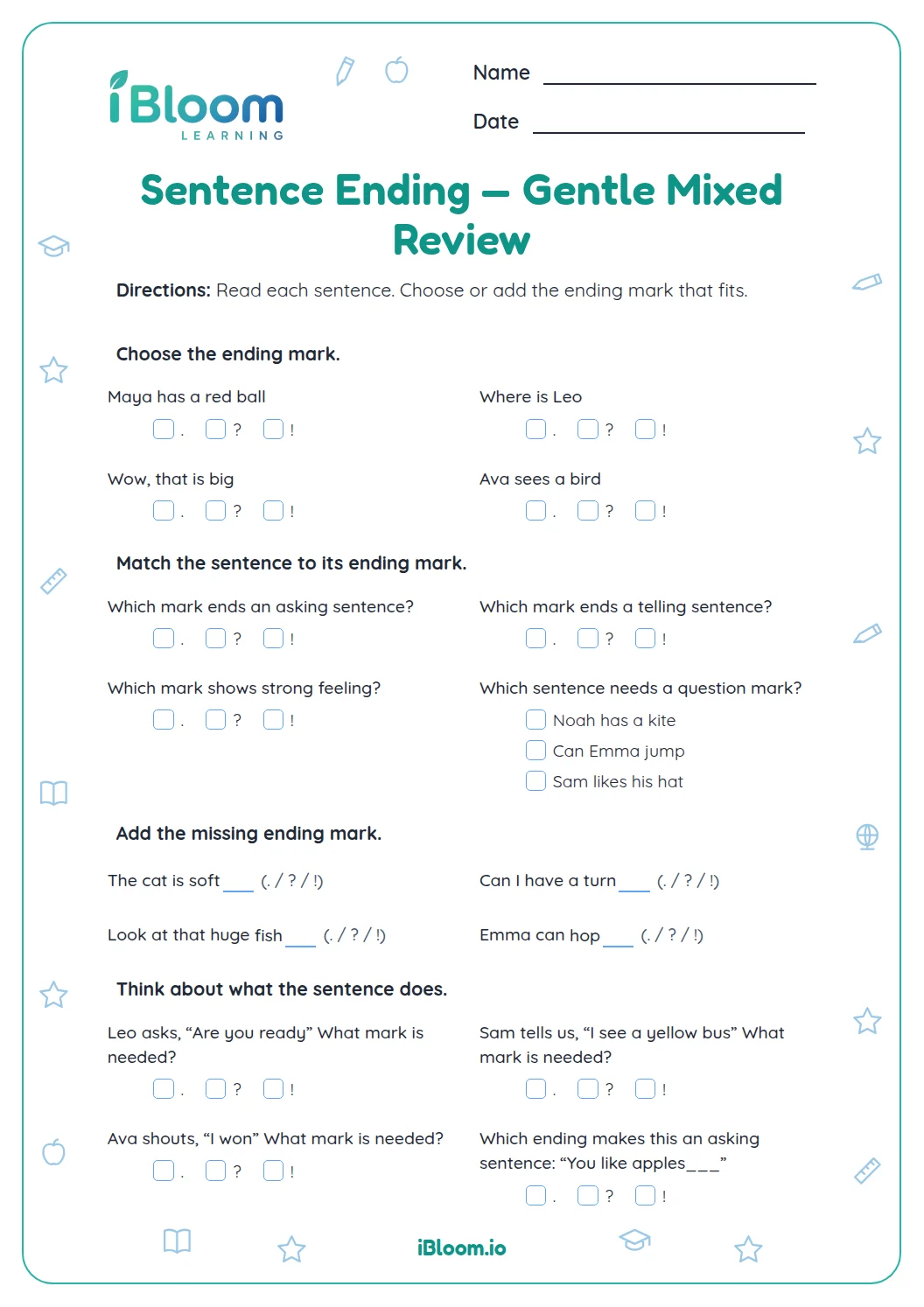
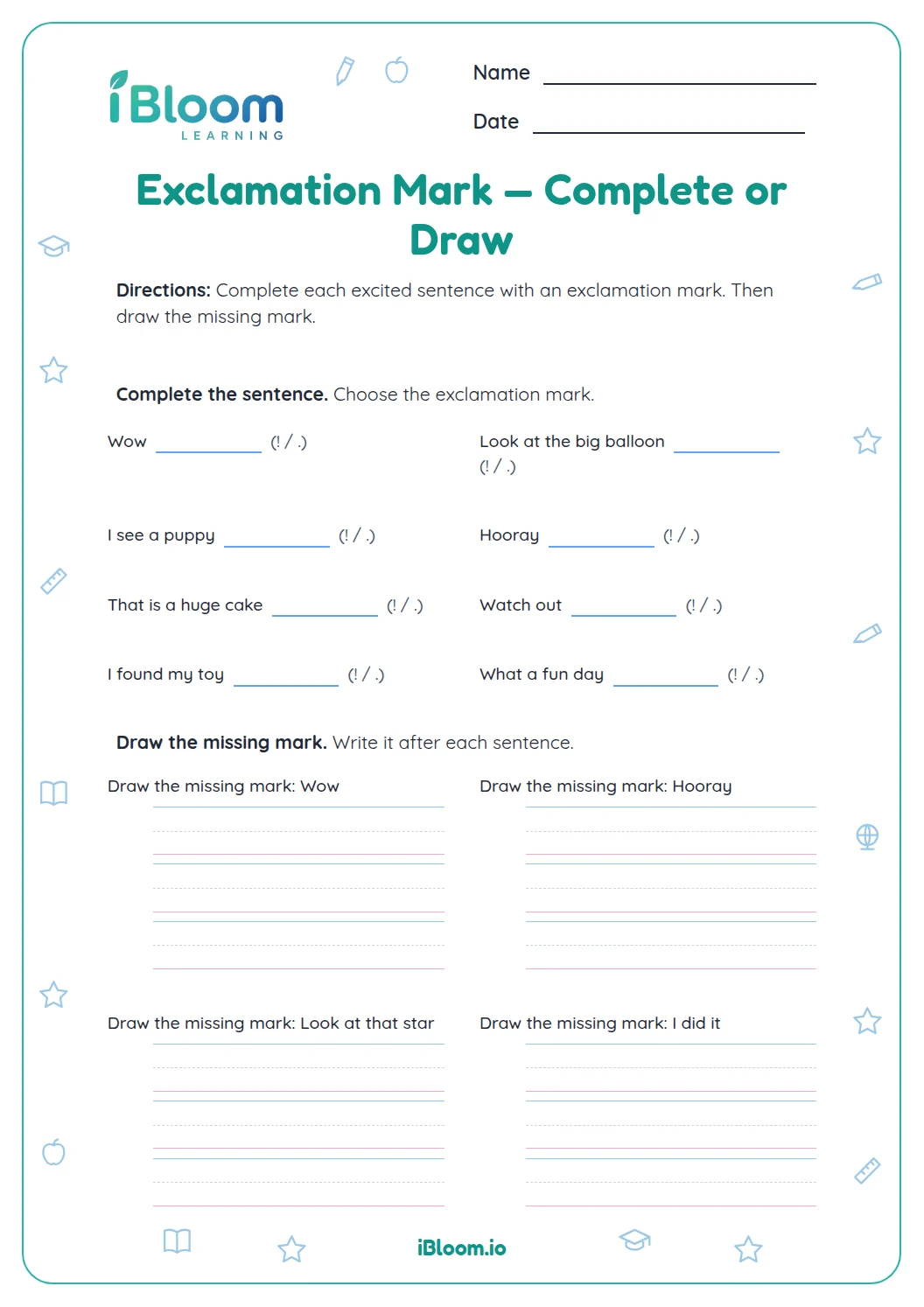
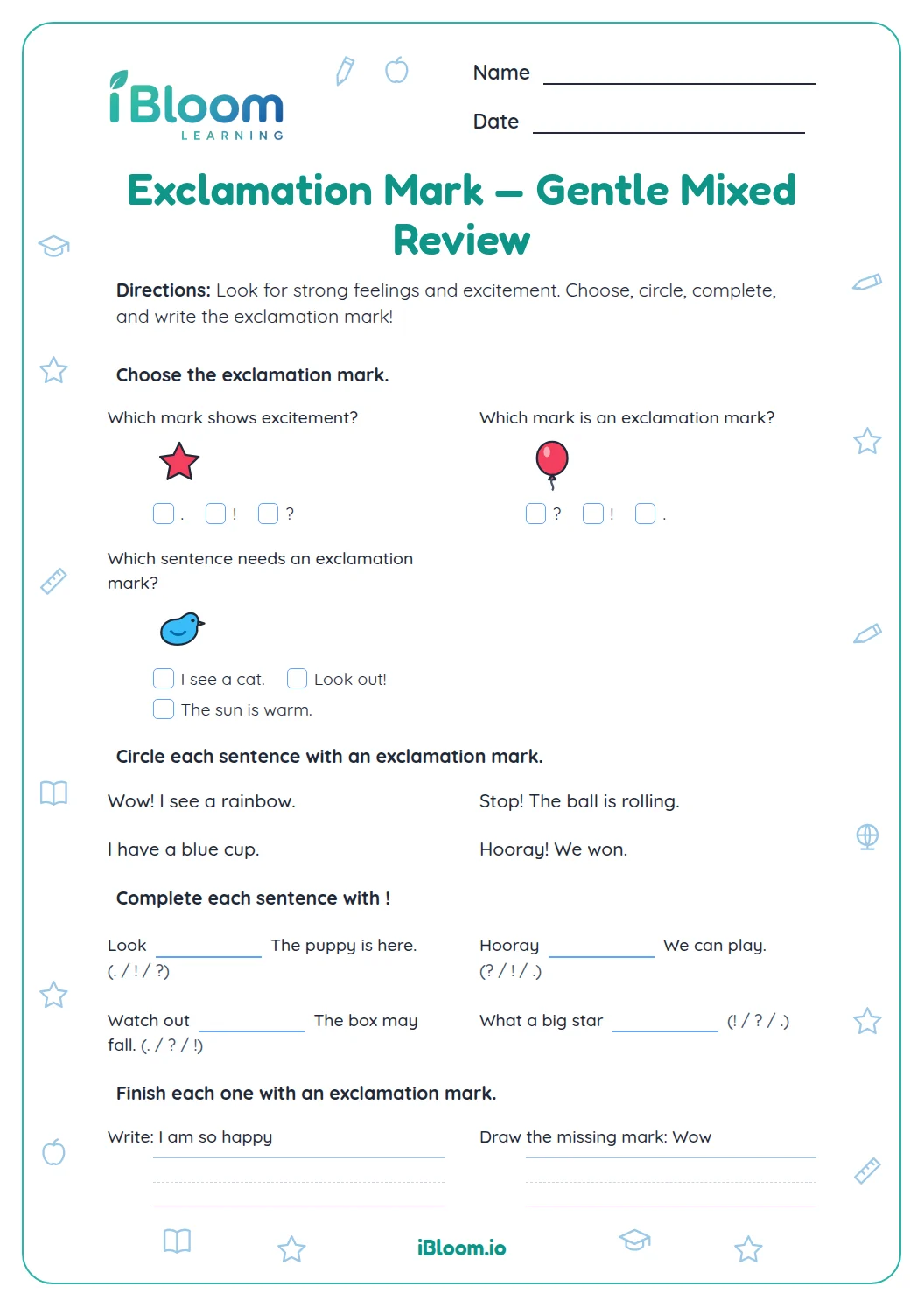
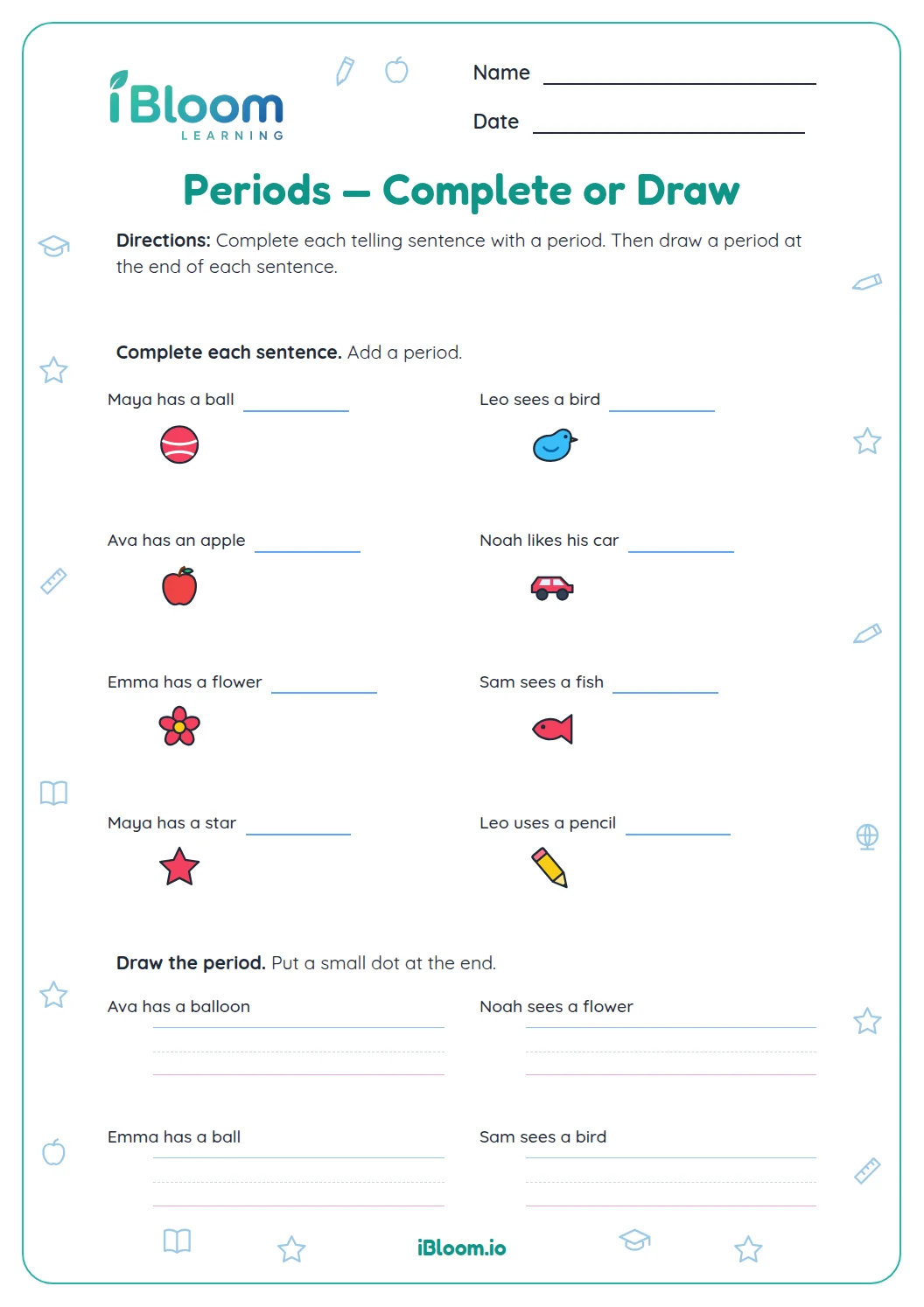
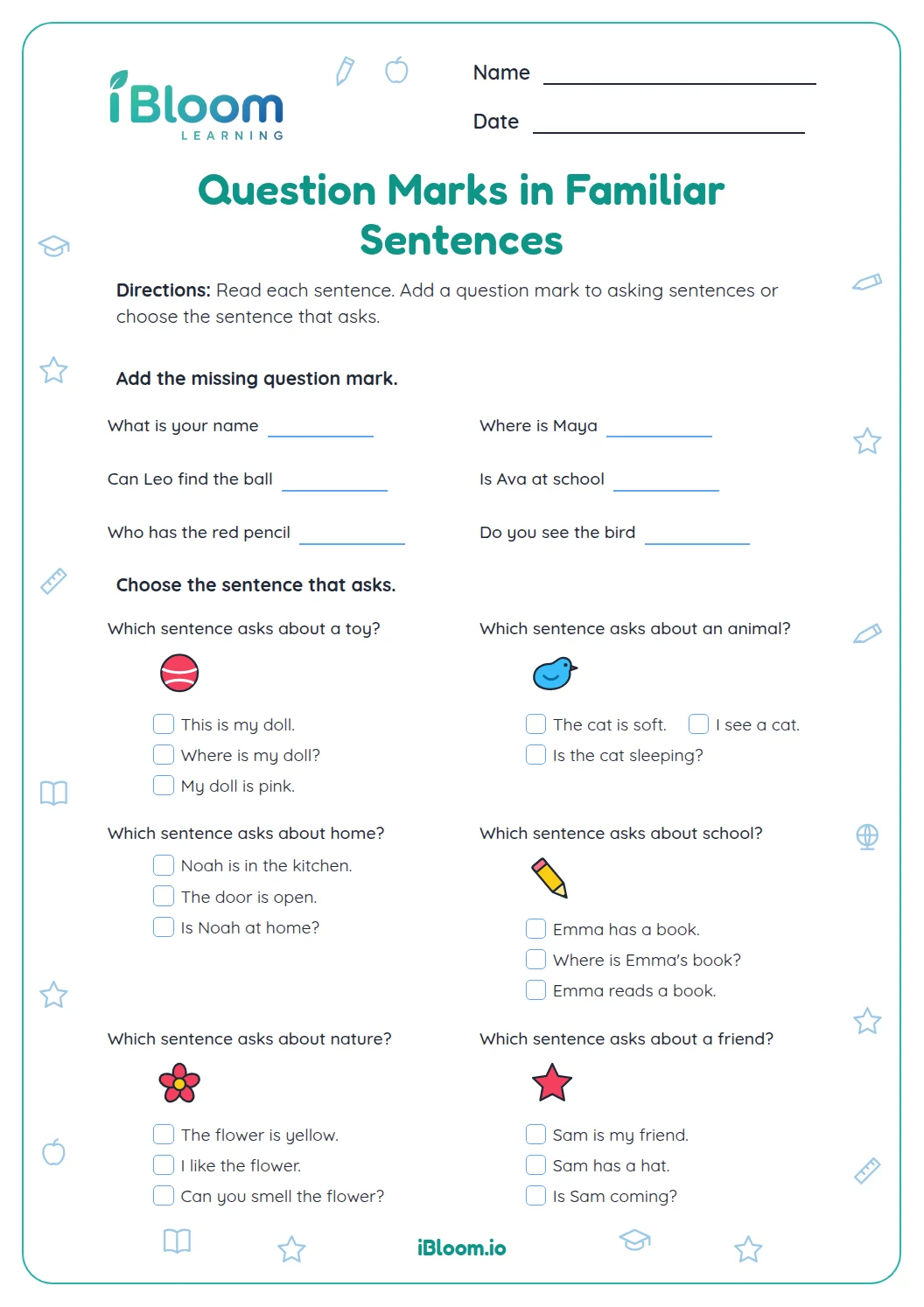
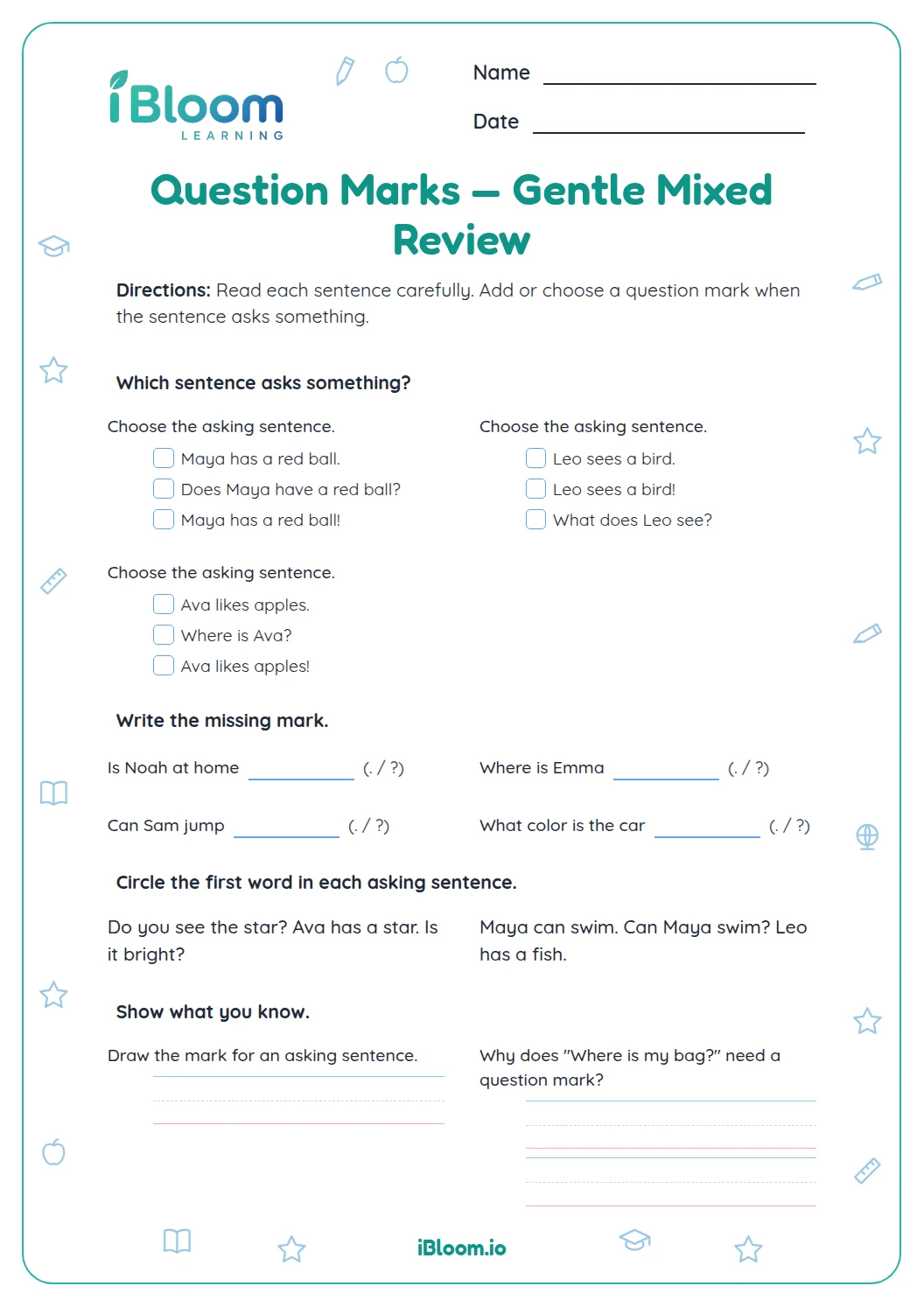
This printable punctuation worksheet gives beginning writers practice choosing a period, question mark, or exclamation point to finish a sentence. Fifteen short sentences include picture clues, followed by two prompts to draw named marks. The answer key shows the choices and examples of the drawn marks.
Aligned to L.K.2.b
Which ending mark fits the sentence?
Part A has 15 sentences with a blank at the end. A statement such as “The sun is bright ___” ends with a period. A question asks something, and an excited sentence may use an exclamation point. The picture clues help young readers make sense of each sentence.
- 1Where is my hat ___
- 2This asks a question, so finish it with ?
What do the last two prompts ask children to draw?
Part B names a question mark and an exclamation mark. Children draw each mark carefully and can compare its shape with the examples in the answer key.
How to use this worksheet
- 1Read the sentence aloud with an adult if needed.
- 2Ask whether it tells, asks, or shows excitement.
- 3Choose the matching mark from the three options.
- 4Draw the named punctuation mark in each final prompt.
- 5Check the choices and mark shapes with the key.
Common mistakes and quick fixes
The mistake
Using a question mark for a sentence that tells something.
The fix
Ask whether the speaker is asking a question; statements usually end in a period.
The mistake
Choosing an exclamation point for every sentence.
The fix
Save it for a strong feeling or excited exclamation.
The mistake
Drawing a question mark without its dot.
The fix
Make the curved hook and add a dot underneath.
Common Core alignment
Capitalize and punctuate a sentence with an ending mark.
On this sheet: The first 15 items ask learners to recognize periods, question marks, and exclamation points at sentence ends.
Show the official wordingHide the official wording
Recognize and name end punctuation.
What to practice next
Make more practice
Further reading
Questions parents and teachers ask
How many questions are on this worksheet?
There are 17 questions on this printable. The tasks focus on sentence-ending punctuation, and the separate answer key makes it easy to check each response after the learner finishes. The items are numbered in sequence, so learners can work from the first section to the last.
How do children decide between a period and an exclamation point?
A period usually finishes a calm statement. An exclamation point can finish a sentence that expresses excitement or a strong feeling, as in “What a funny clown!” Read the sentence aloud and listen for its tone before choosing. Ask the child to read the sentence aloud and explain what it is doing.
How should I use the answer key?
Let the learner finish a part before opening the key. Compare each response with the model, then reread the sentence or passage detail that supports it. For written answers, the key gives a sample response; another answer can work when it is accurate and supported.
How long does the worksheet take?
Allow about 20 minutes for 17 questions, with extra time for reading or discussing responses. A child can complete one part at a time and return to the rest later. The answer key is separate so it can stay out of view during practice.
What materials are needed?
Print the worksheet and its answer key, and have a pencil ready. The activities use the printed page, so no extra materials are needed. An adult may read directions aloud for a younger learner, then invite the child to choose or write each answer.