




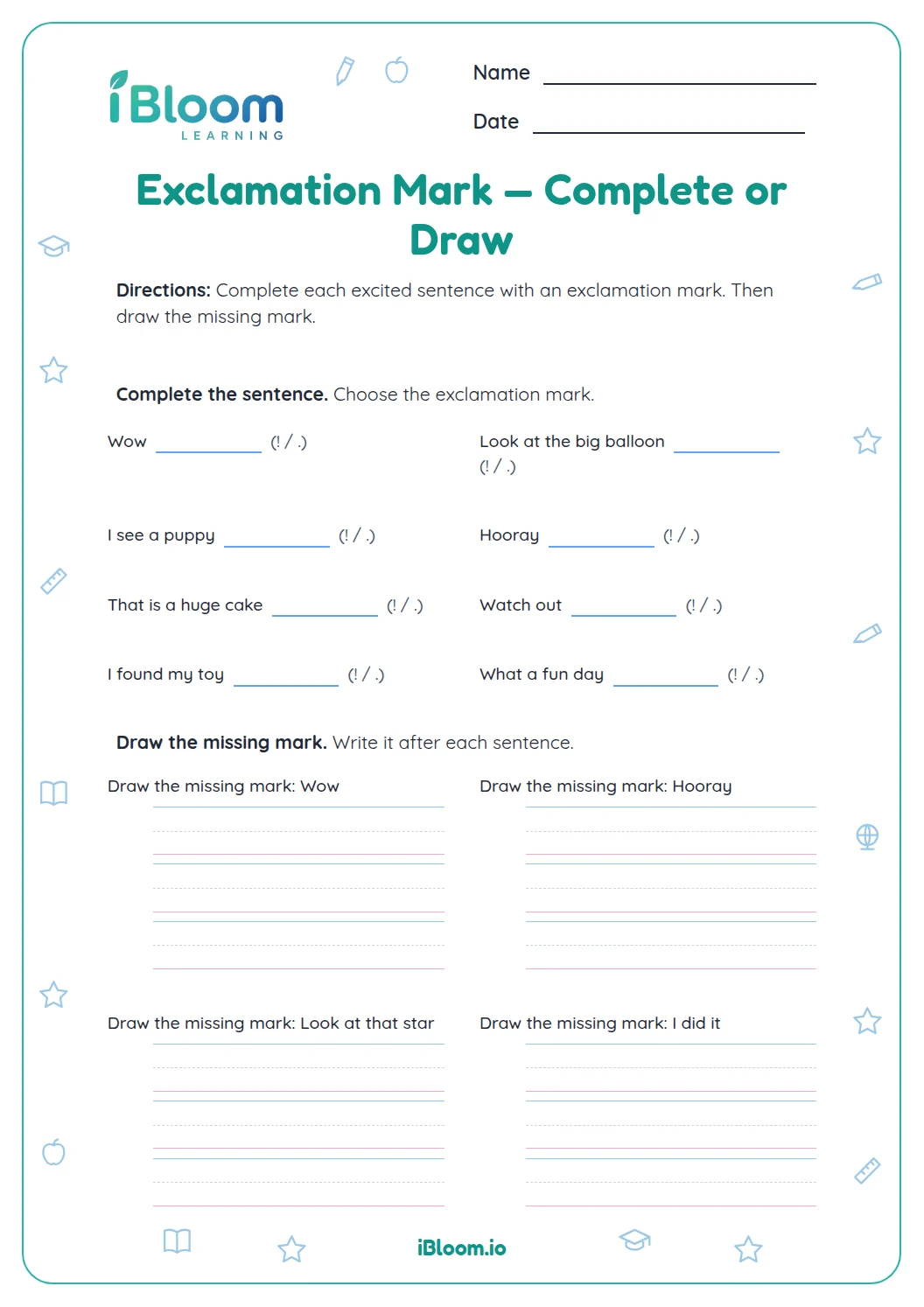

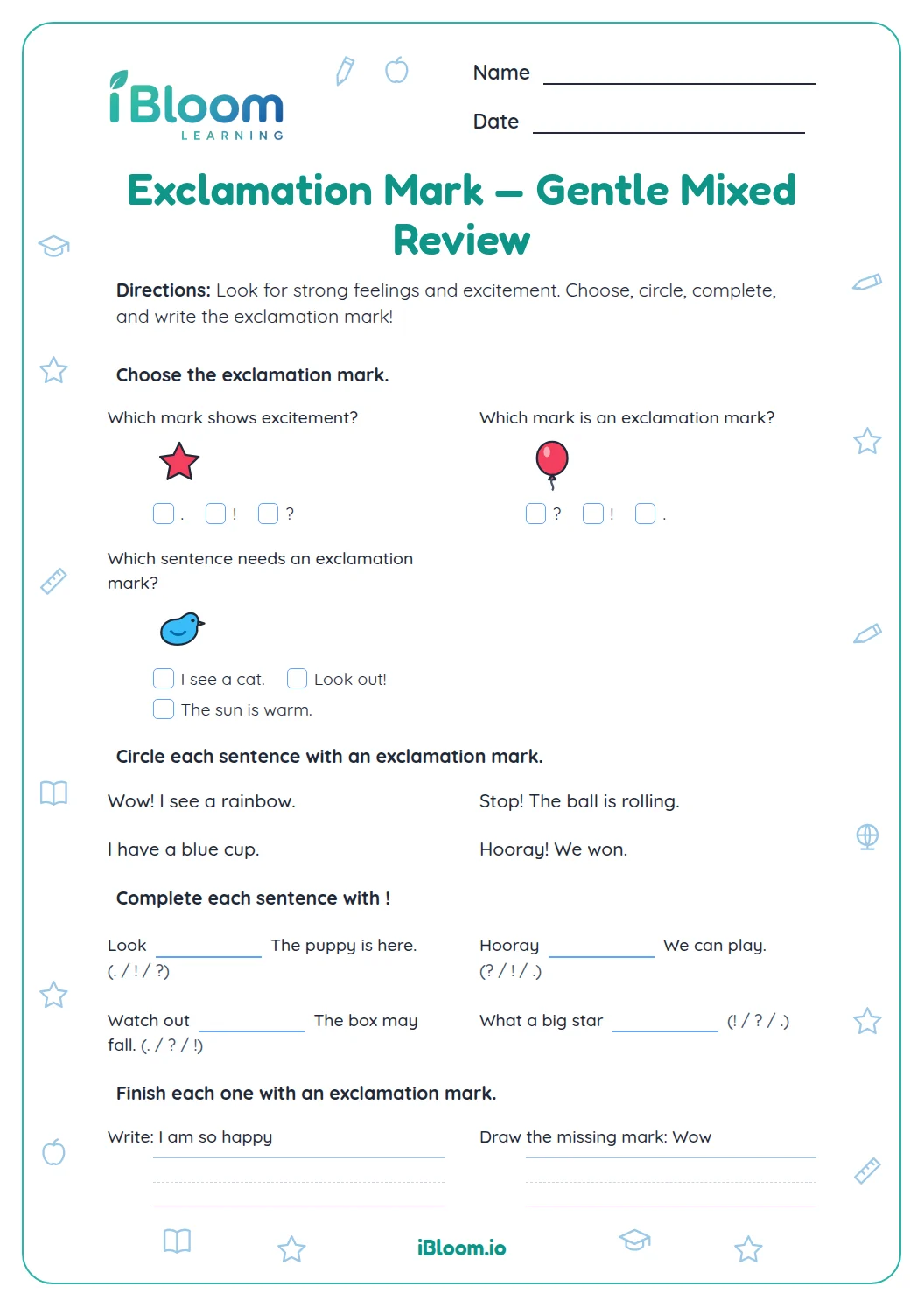
About this worksheet
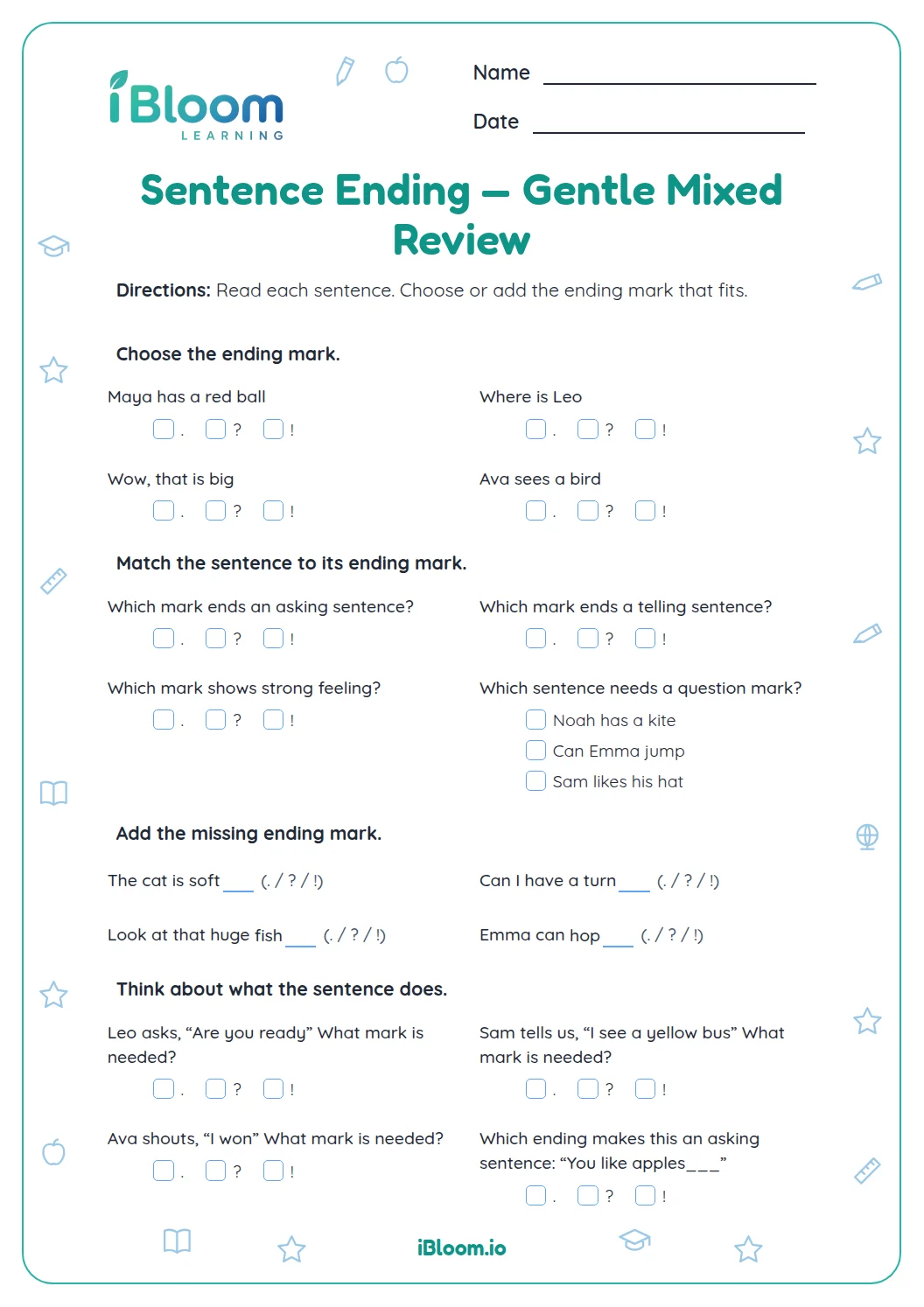
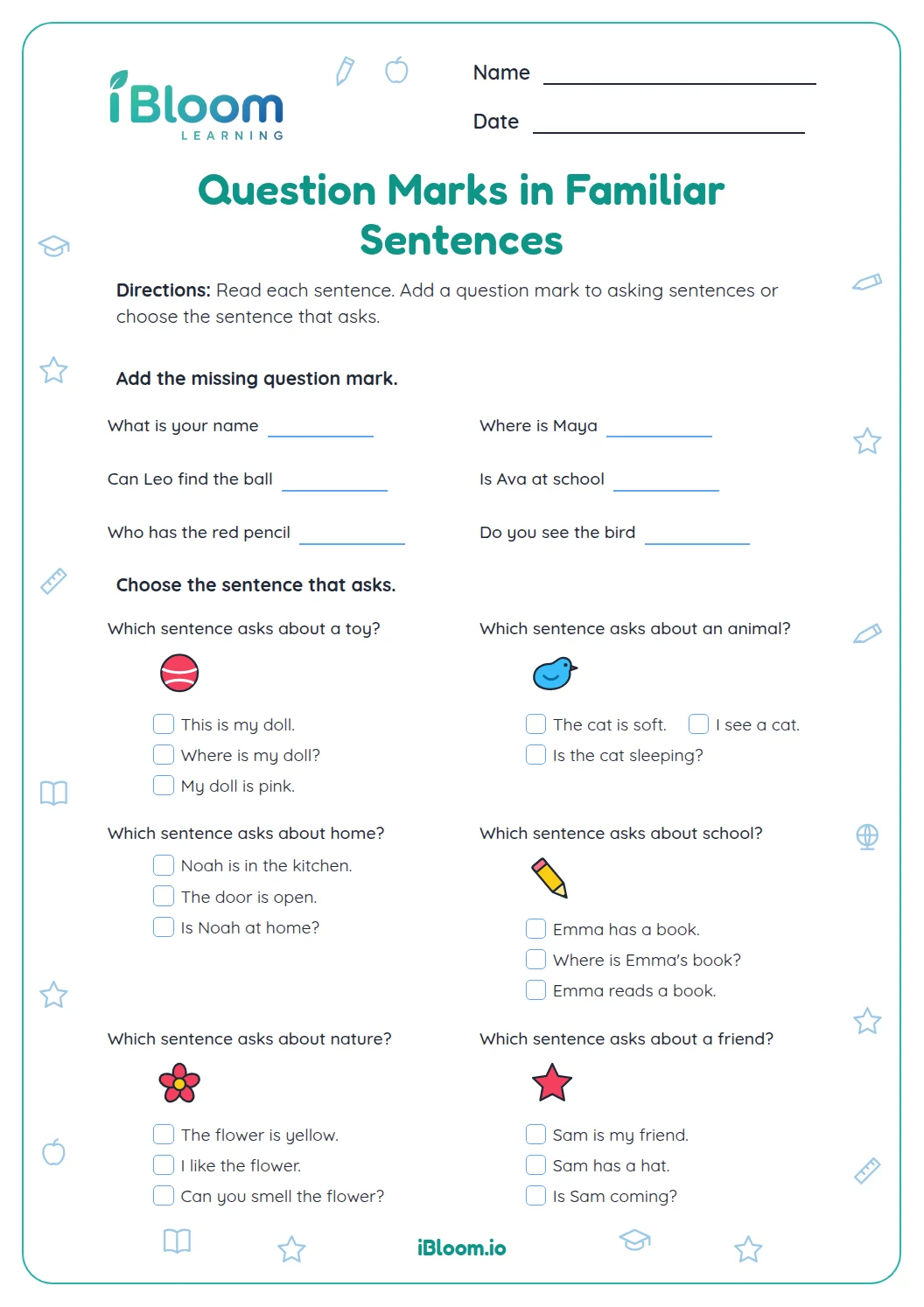
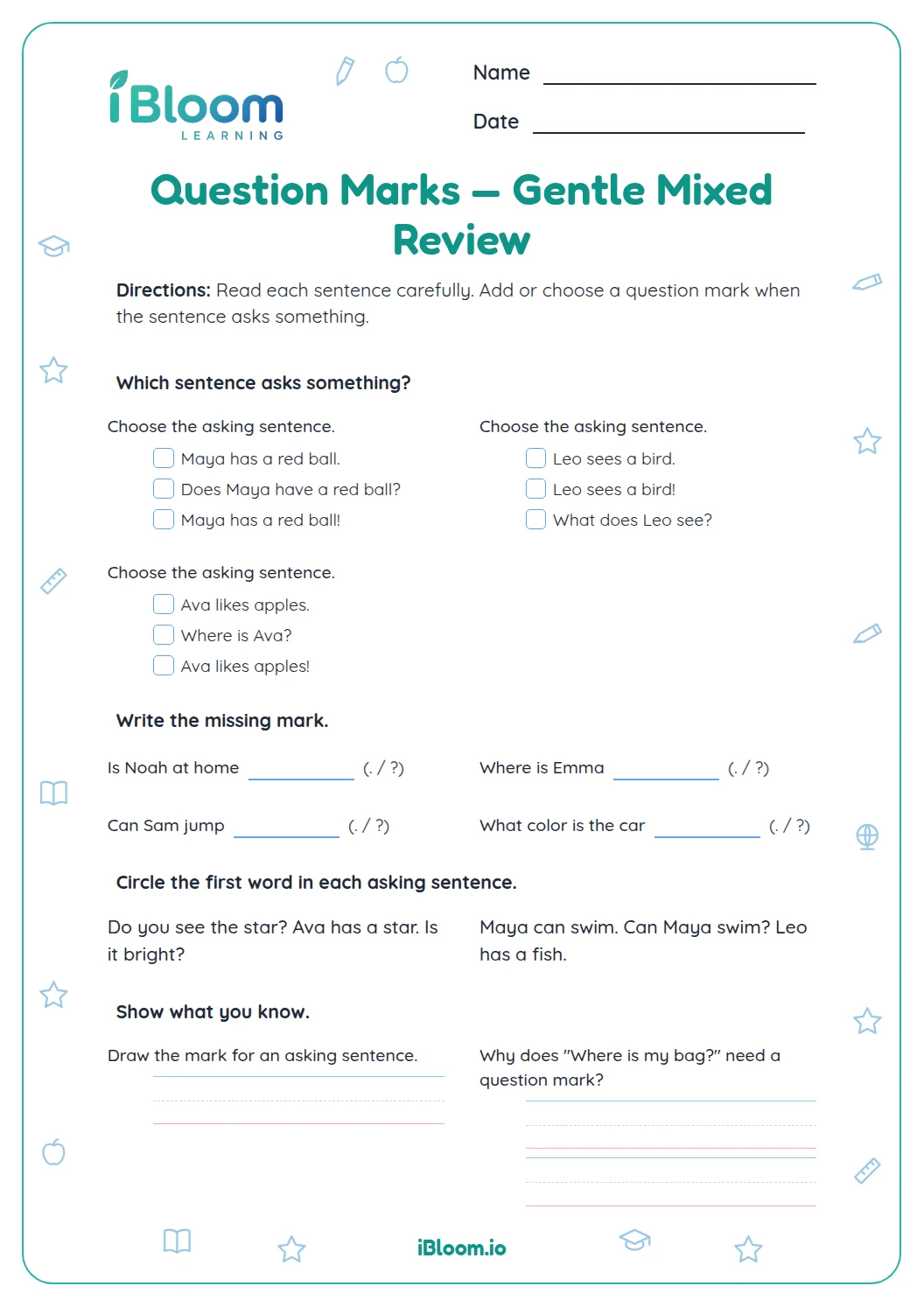
This free printable worksheet helps Pre-K and Kindergarten children choose the mark that ends a sentence. A grown-up reads each sentence aloud, and the child decides if it tells something, asks something or shows excitement. Every sentence is about something familiar, such as a ball, a dog, a balloon or a birthday, and each comes with a small picture. Children fill in the bubble for a mark in nine questions and write a mark on a line in six. The practice supports Common Core L.K.2.b, recognizing and naming end punctuation. A separate answer key shows the right mark for each sentence.
Aligned to L.K.2.b
What is on this worksheet?
Fifteen short sentences in three parts, each with a picture to look at while the grown-up reads. Children are not expected to read the sentences on their own; the sheet is for listening, thinking and choosing.
Part A is the easiest: six sentences with the three marks printed under each one, and children fill in the bubble beside the one that fits. Part B asks them to write the mark on a line, which adds a little handwriting. Part C goes back to choosing, with three more sentences to listen to.
- Part A, Pick the ending mark: six sentences with pictures (questions 1 to 6)
- Part B, Write the ending mark: six sentences, write a mark on the line (7 to 12)
- Part C, Which mark fits: three more sentences to listen to and choose (13 to 15)
- Period, question mark and exclamation point named on every choice
- A two-page answer key
How can a young child tell which mark fits?
Listening is the best clue. When your voice goes down at the end and the sentence just tells something, the mark is a period. When your voice goes up because you want an answer, it is a question mark. When the sentence is a happy or surprised shout, it is an exclamation point.
Little words give hints too. A sentence that starts with Where or Can is often asking, and one that starts with Yay, Wow or Ouch is often excited. Children do not need to read the words to hear the difference.
- 1Maya has a new ball → . (it tells)
- 2Where is Leo’s toy car → ? (it asks)
- 3Yay, I got a gold star → ! (it shows excitement)
Why use familiar sentences and pictures?
Children this age learn marks best when the sentence is about something they already know. A ball, a pet fish and a birthday are easy to picture, so the only new thing is the mark at the end.
The pictures also help a grown-up read the sentence in the right voice. A picture of a gift makes “What is in the gift” sound like a real question, and a birthday cake makes “Hooray, it is my birthday” sound happy.
What is different about writing the mark in Part B?
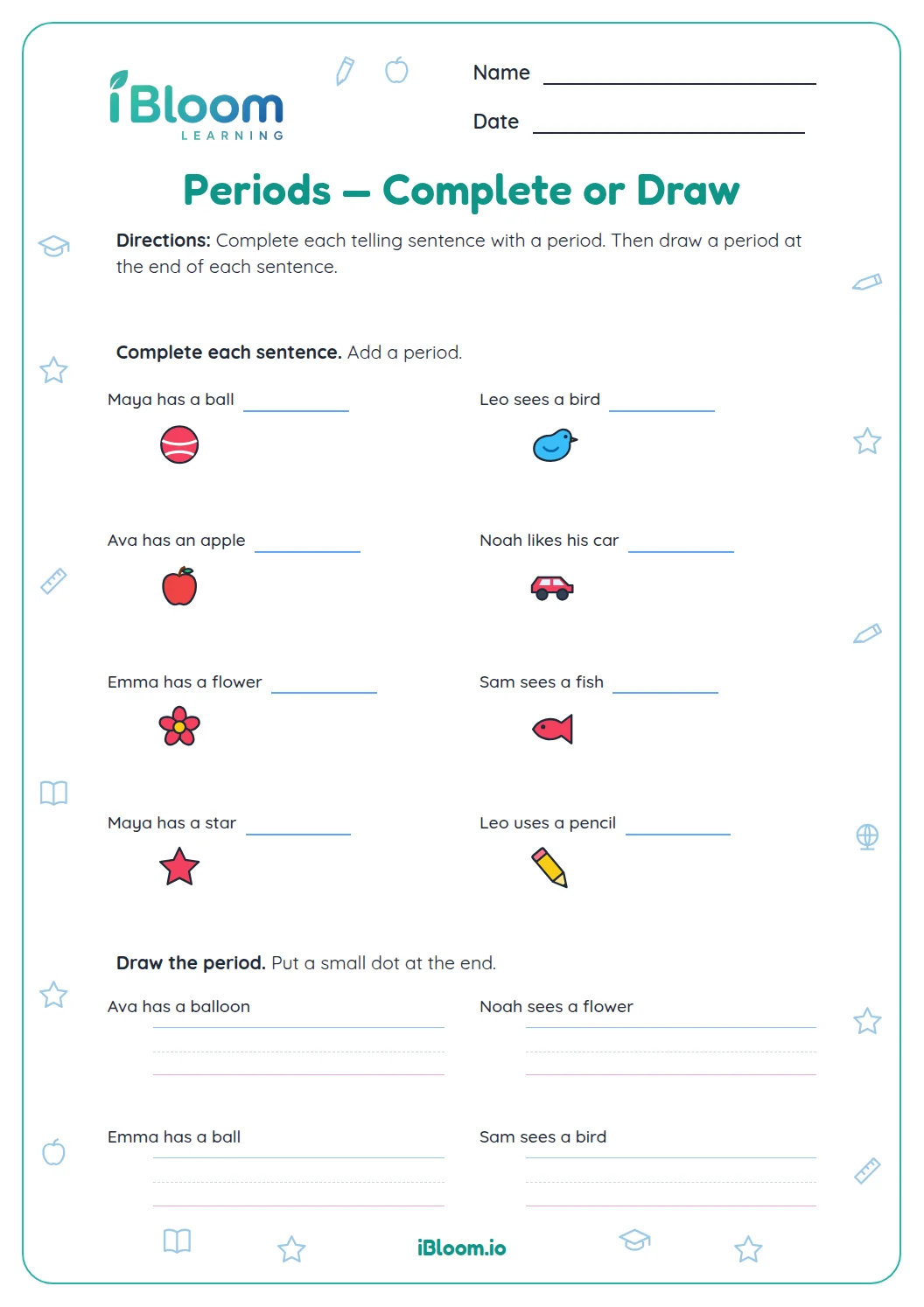
Part B asks children to make the mark with a pencil, a small step in handwriting. A period is a dot, a question mark has a curve and a dot, and an exclamation point is a line with a dot.
The mark goes right after the last word, as if it sits on the line. Praise a mark in the right place, even if it is a bit wobbly, and let drawing it count as the skill.
How to use this worksheet at home or in class
- 1Hold up the page and name the three marks together: period, question mark, exclamation point.
- 2Read the first sentence aloud twice in a natural voice. Ask: “Is it telling, asking or excited?”
- 3Let your child fill in the bubble, then read the rest of Part A one sentence at a time.
- 4For Part B, show how to start the mark right after the last word, and let your child write it in the blank.
- 5In Part C, read each sentence with the voice it needs and ask your child to say why they chose the mark.
- 6Check with the answer key, then ask your child to say one telling, one asking and one excited sentence of their own.
Common mistakes and quick fixes
The mistake
Choosing a period for an excited sentence, such as “Yay, I got a gold star” in question 4.
The fix
Read it again in a happy voice and listen for the shout. Words such as Yay, Wow and Hooray are good clues that an exclamation point is needed.
The mistake
Choosing a period for an asking sentence that does not start with who, what or where, such as “Can you hold the balloon” in question 6.
The fix
Ask “Is someone waiting for an answer?” If the answer is yes, the sentence asks something and needs a question mark.
The mistake
Writing the mark at the start of the line or floating in the air, instead of right after the last word in Part B.
The fix
Say “last word, then mark.” Touch the last word with a finger, then slide to the end and write the mark there.
Common Core alignment
Most US states use the Common Core standards or a close state version. This Kindergarten language standard names the skill on every question of this page.
Recognize the period, question mark and exclamation point that end sentences.
On this sheet: Every question asks children to choose or write the period, question mark or exclamation point for a sentence.
Show the official wordingHide the official wording
Recognize and name end punctuation.
What to practice next
Make more practice
Further reading
Questions parents and teachers ask
Does my child need to read the sentences?
No. A grown-up reads each sentence aloud, and the child listens and chooses the mark. Pictures help children connect the sentence with something familiar. If your child is already reading, let them read a sentence quietly and then say it aloud, so they can hear whether it tells, asks or shows excitement.
What are the three ending marks called?
The three marks are the period, the question mark and the exclamation point. This worksheet prints all three names with every choice, so you can say the name each time your child picks one. Hearing the names alongside real sentences helps children recognize and name each mark.
Why are the sentences so short?
The sentences are short on purpose, so a grown-up can read each one in a single breath. A sentence such as “The sun is warm today” is easy to hear as a telling sentence. Keeping them brief lets children focus on the mark at the end, which is the one skill practiced here.
My child writes the mark but it looks messy. Is that a problem?
Not at all. Young children are still learning to control a pencil, so a wobbly dot or a curl that is a little too big is normal. Look for the right mark in the right place, right after the last word. Neater writing comes with practice and does not need to be perfect here.
Can a sentence take more than one mark?
Sometimes a sentence could end with a period or an exclamation point, depending on how it is said. On this worksheet each sentence was written to have one clear answer, with clue words such as Where, Yay or Wow. Use those clues, and read each sentence aloud in the voice it needs.
What should we do after this worksheet?
Practice each mark on its own with the Periods, Question Marks and Exclamation Mark worksheets. At home, play a short game: say a sentence, and your child names the mark it needs. Spotting end marks in picture books during bedtime reading is also a great way to keep the skill going.