







About this worksheet
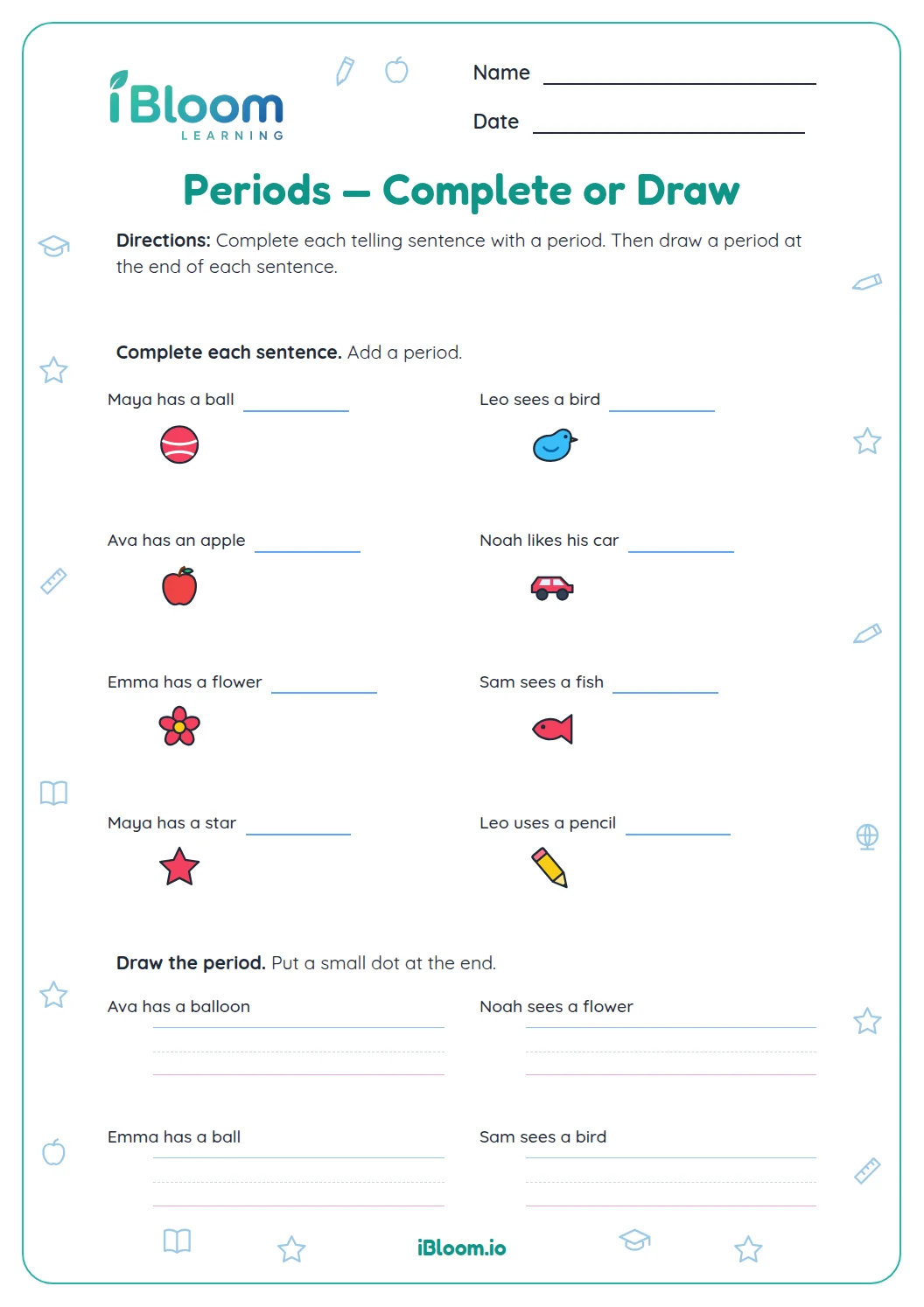
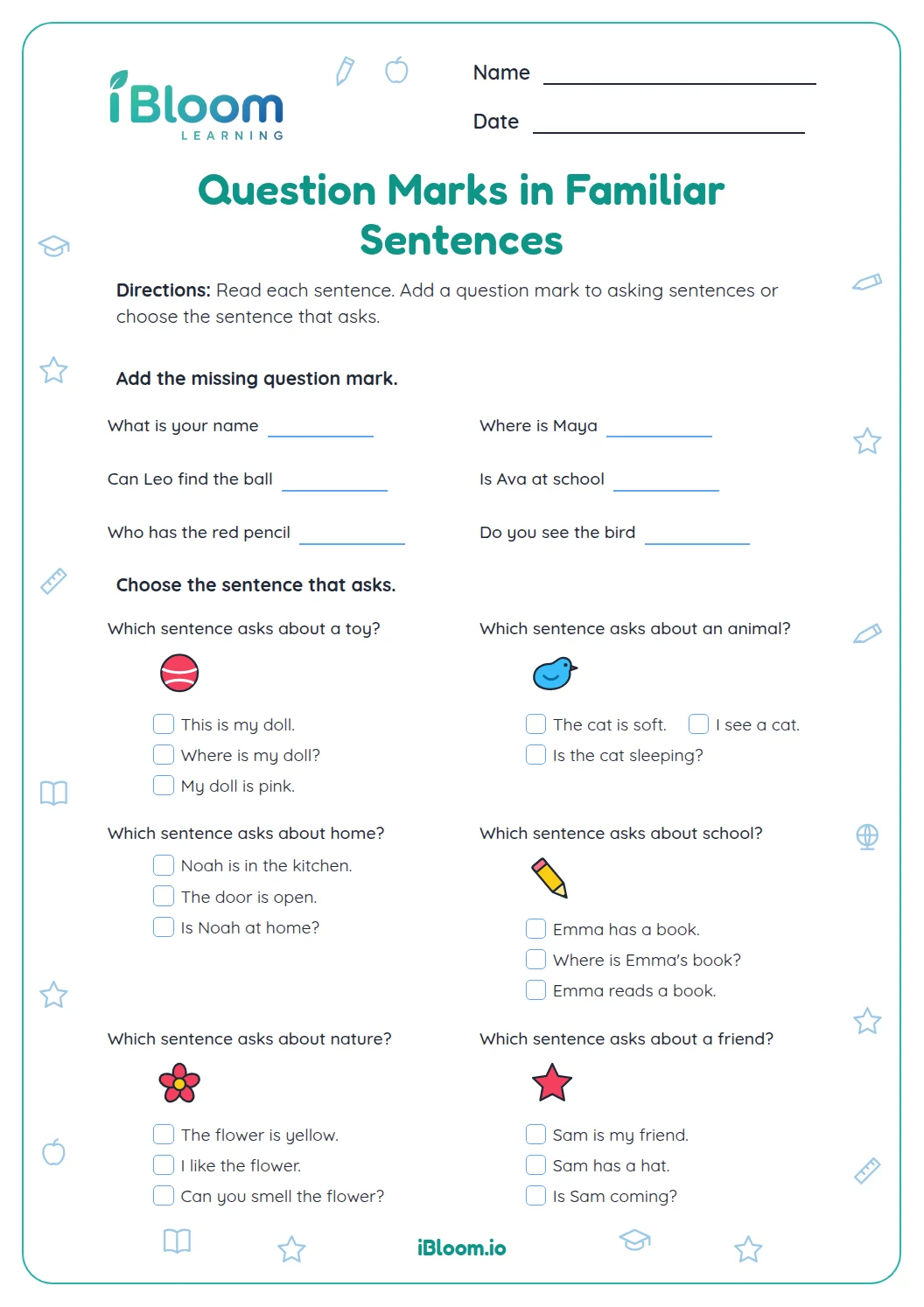
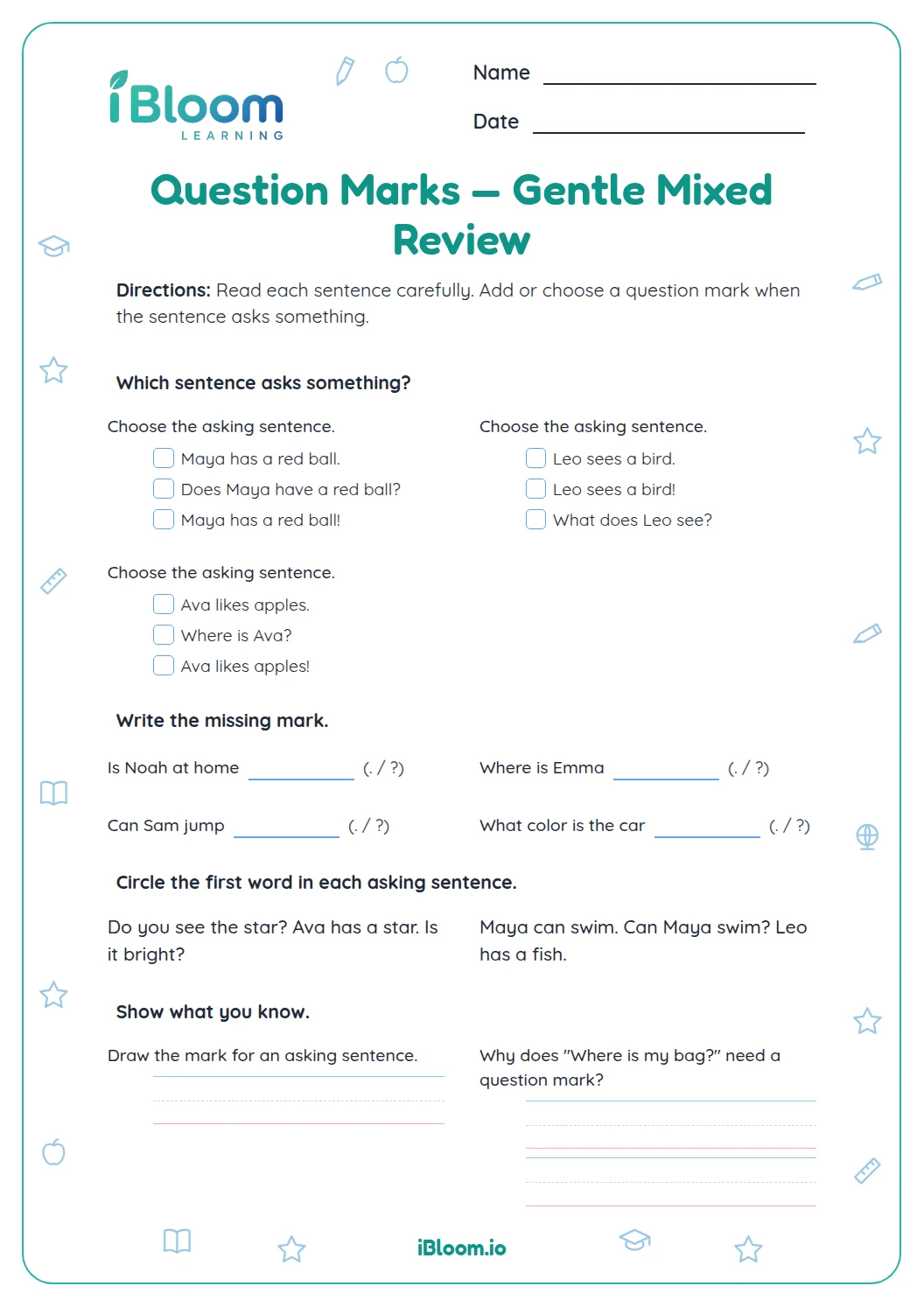
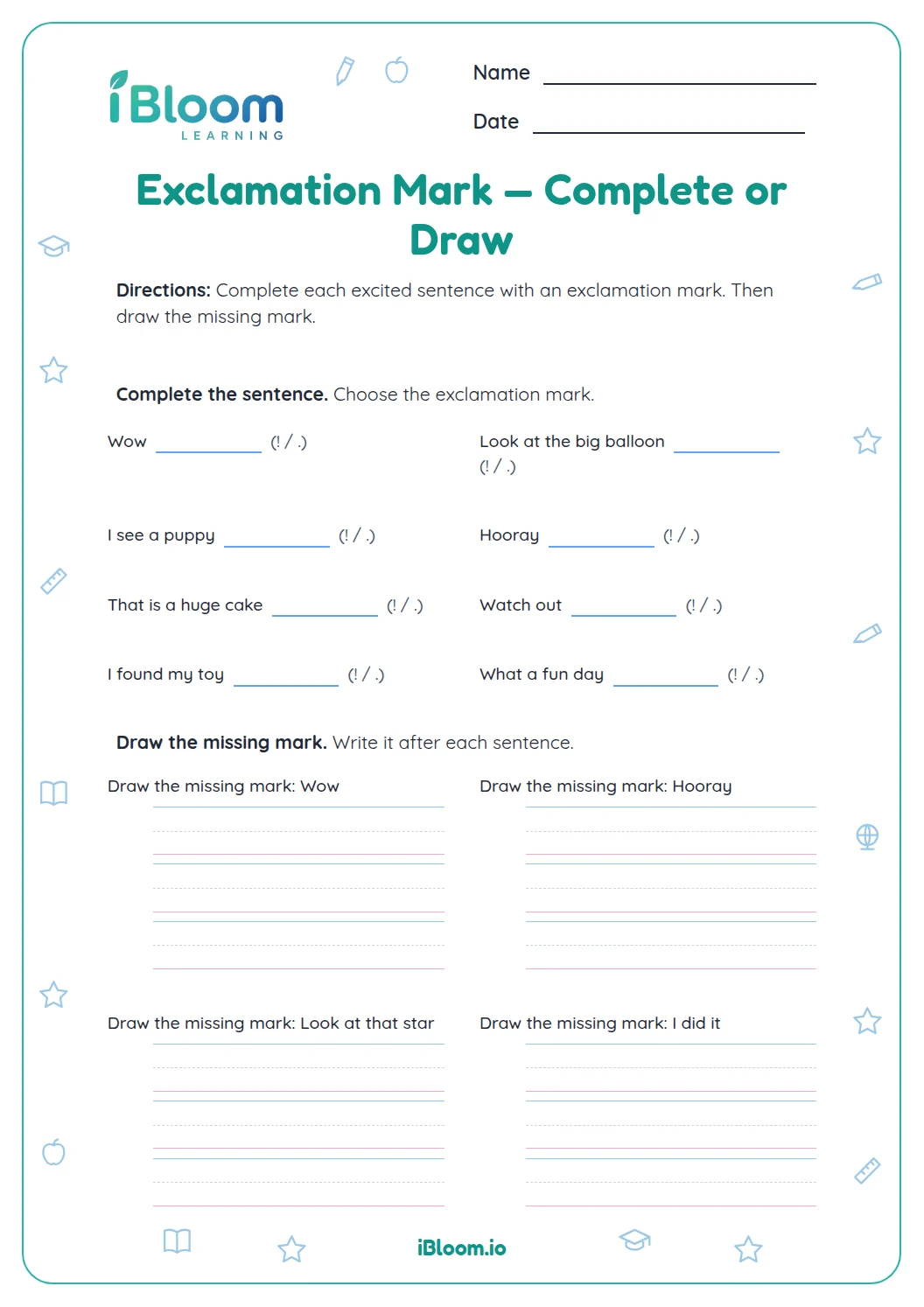
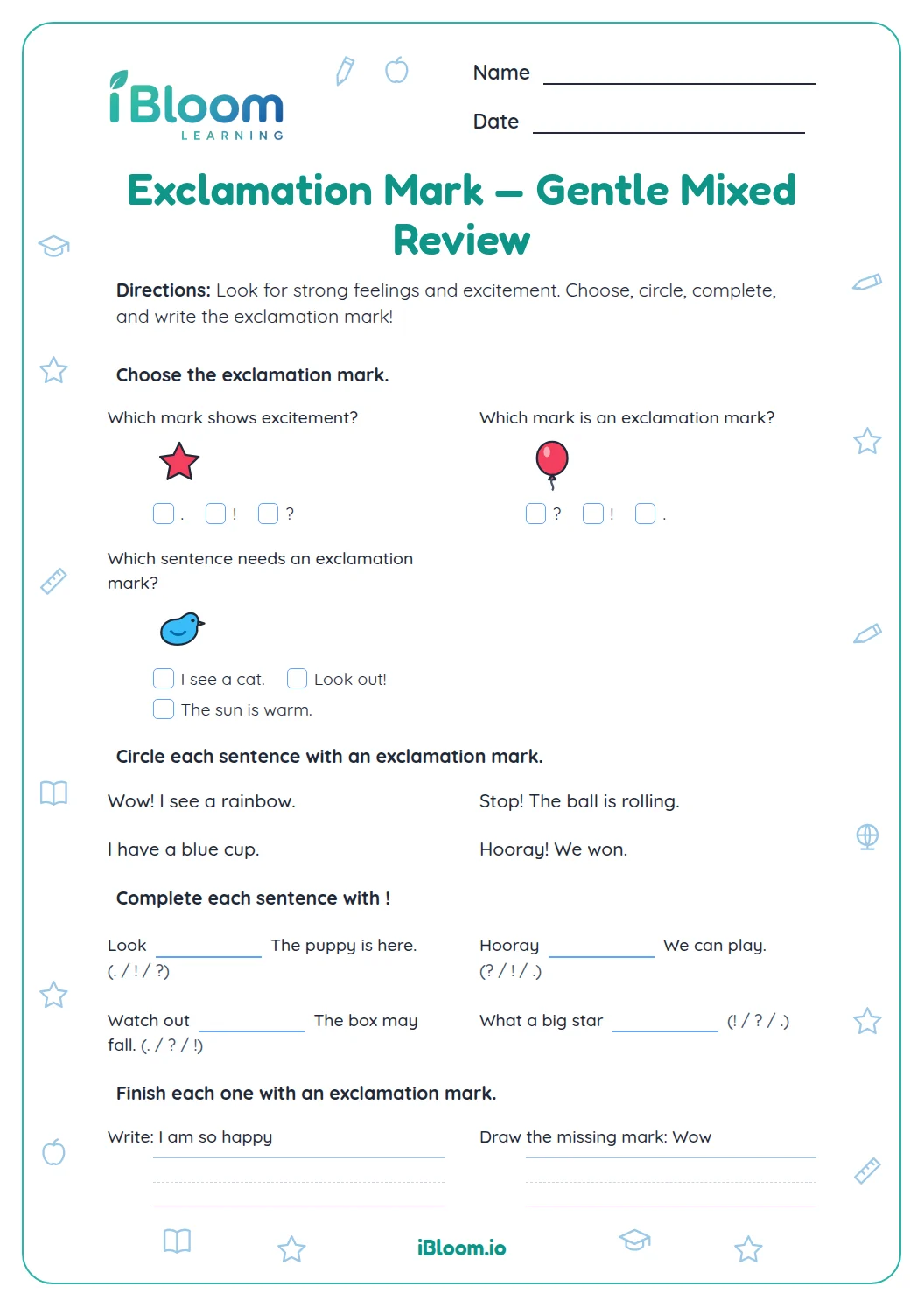
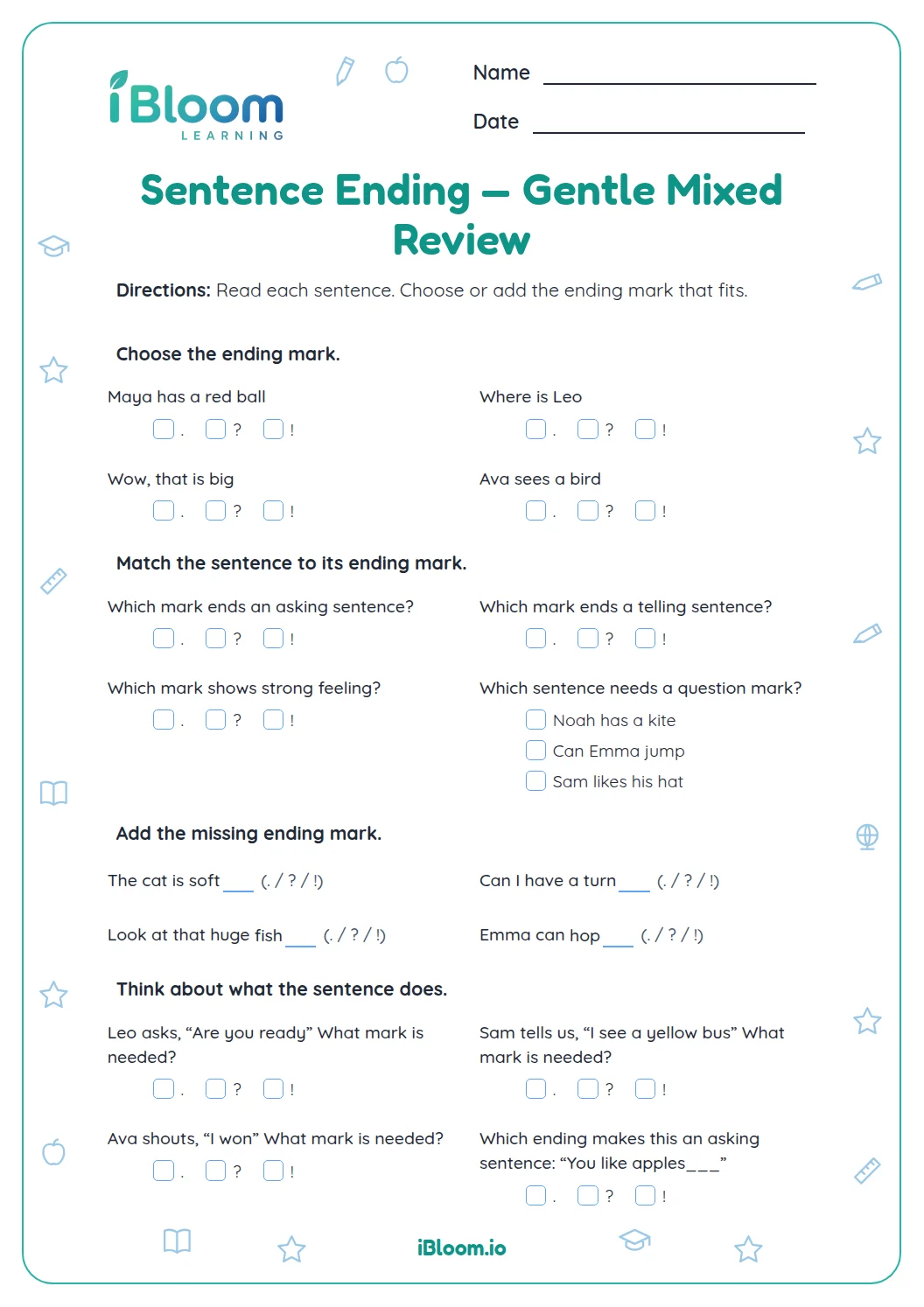
This free preschool and kindergarten worksheet gently reviews periods, question marks, and exclamation marks. Children first name the three marks, then find each mark by its name. They then choose an ending for six short sentences with picture clues and finish three more sentences by writing the missing mark. Each sentence is labeled Telling, Asking, or Excited to make its purpose clear. An adult can read all the words aloud. The fifteen tasks practice recognizing and naming end punctuation in Common Core L.K.2.b, and a separate answer key supplies each choice and written ending.
Aligned to L.K.2.b
Which marks will children name?
Part A shows ?, ., and ! and gives three names to choose from. It then asks children to find each mark by its name. Say the names aloud and point to the shapes: a question mark curls, a period is a dot, and an exclamation mark has a tall line above a dot.
Let children point to the answer before coloring its circle if the names are hard to read. The target is recognizing the printed punctuation mark and connecting it with its name.
How do the sentence labels help?
The labels Telling, Asking, and Excited tell children how to understand the sentence. Read the label, then the sentence aloud in the matching voice, then let the child choose a mark. Excited labels make it clear when the intended ending is an exclamation mark.
Question 8 asks “Is it a cat” and has a cat picture. The sentence asks for an answer, so it ends with a question mark. In question 9, “Wow, a big dog” is labeled Excited and takes an exclamation mark.
- 1Label: Asking
- 2Sentence: Is it a cat
- 3Choose: ?
- 4Read the finished sentence: Is it a cat?
What do children write in the final part?
Part C has three sentences with a blank at the end. Children write just one ending mark for each: a period for a telling sentence, a question mark for an asking sentence, and an exclamation mark for an excited sentence.
Pictures of a fish, bus, and gift help children follow the sentences while listening. Read the finished sentence once more after the mark is added and point to where that mark ends the sentence.
How to use this worksheet
- 1Name ?, ., and ! together, then choose each name and matching mark in Part A.
- 2Read the label and sentence for each Part B picture aloud.
- 3Ask whether the sentence tells, asks, or expresses excitement; let the child color one answer circle.
- 4In Part C, help the child locate the blank and write only the ending mark.
- 5Read the completed sentences aloud and compare the marks with the answer key.
Mistakes to check and ways to help
The mistake
Choosing a period for “Is it a cat” because the words have ended.
The fix
Ask whether someone needs to answer the sentence. An asking sentence takes a question mark.
The mistake
Choosing an exclamation mark simply because a picture is interesting.
The fix
Use the sentence label and words. The sun sentence is labeled Telling and ends with a period.
The mistake
Putting the written mark before the sentence in Part C.
The fix
Follow the words from left to right and put the mark in the blank after the last word.
Common Core alignment
Name periods, question marks, and exclamation marks and choose them for short sentences.
On this sheet: Children identify each mark by name and distinguish telling, asking, and excited sentences.
Show the official wordingHide the official wording
Recognize and name end punctuation.
What to practice next
Make more practice
Further reading
Questions parents and teachers ask
Can I read the whole worksheet aloud?
Yes, adult reading support is built into the directions. Read the punctuation names in Part A and each labeled sentence in Parts B and C. Children can focus on recognizing the marks, deciding what the sentence does, and placing an ending at the final blank.
Does the worksheet include all three common ending marks?
Yes, it reviews the period, question mark, and exclamation mark. Children name and find each one in Part A, select each type in Part B, and write each type in Part C. The repeated formats give several opportunities to connect a mark’s shape, name, and sentence purpose.
Why are some sentences labeled Excited?
The label makes the intended strong feeling clear, so the expected ending is an exclamation mark. Read “Wow, a big dog” with excitement, then ask the child to choose its mark. The worksheet also labels Telling and Asking sentences to make the three purposes easy to compare.
What if my child cannot write a question mark yet?
Let your child point to a question mark in Part A and trace its shape with a finger first. In Part C, an adult can help form the mark after the child selects it. Keep the child’s decision about punctuation separate from the effort of drawing its shape.
How many pictures and answers are included?
The worksheet has nine picture clues, one beside each sentence in Parts B and C. Part A has six tasks for naming or finding punctuation marks. The answer key covers all fifteen tasks, including the three written endings, so an adult can check the choices and final marks.