





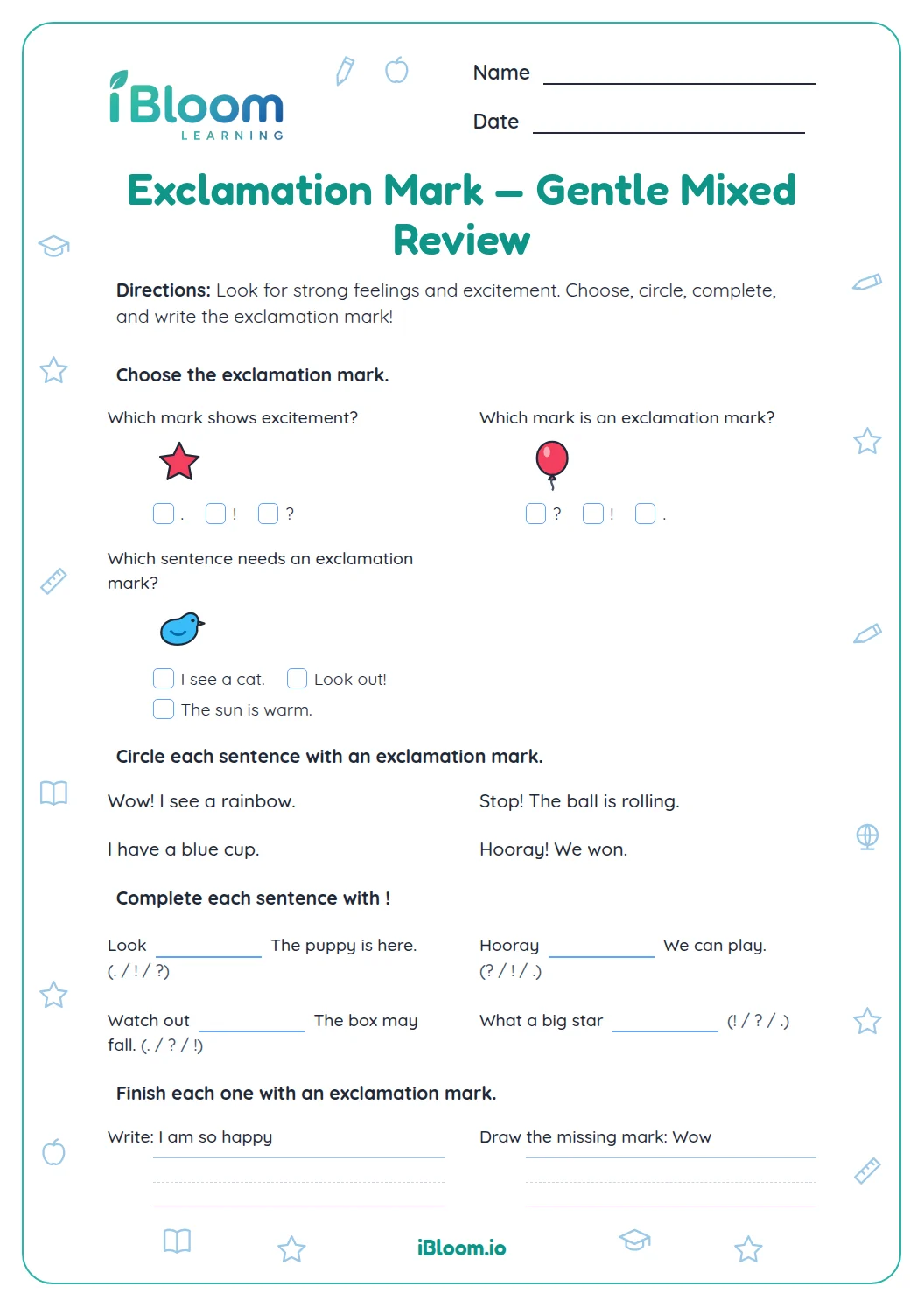
About this worksheet
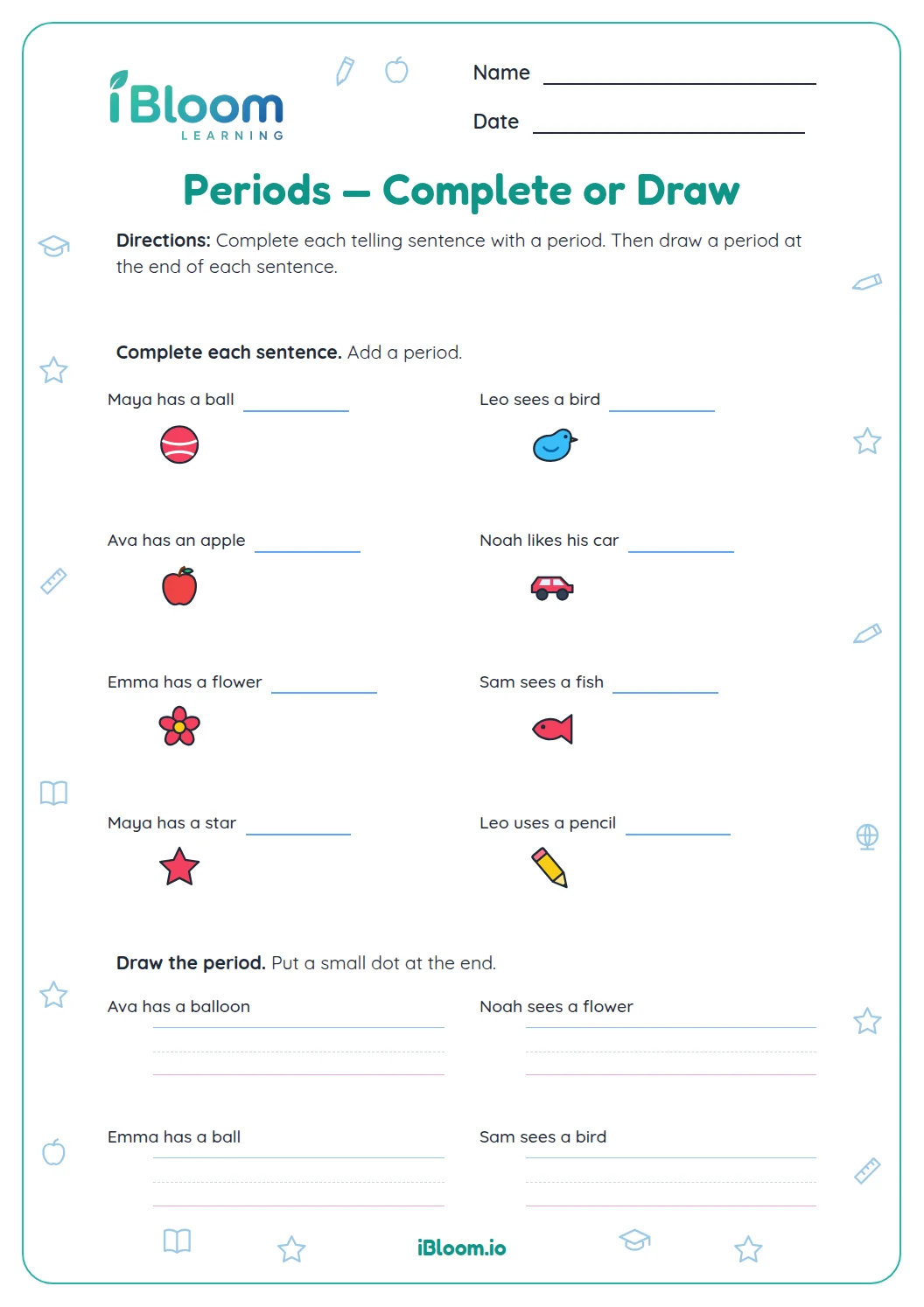
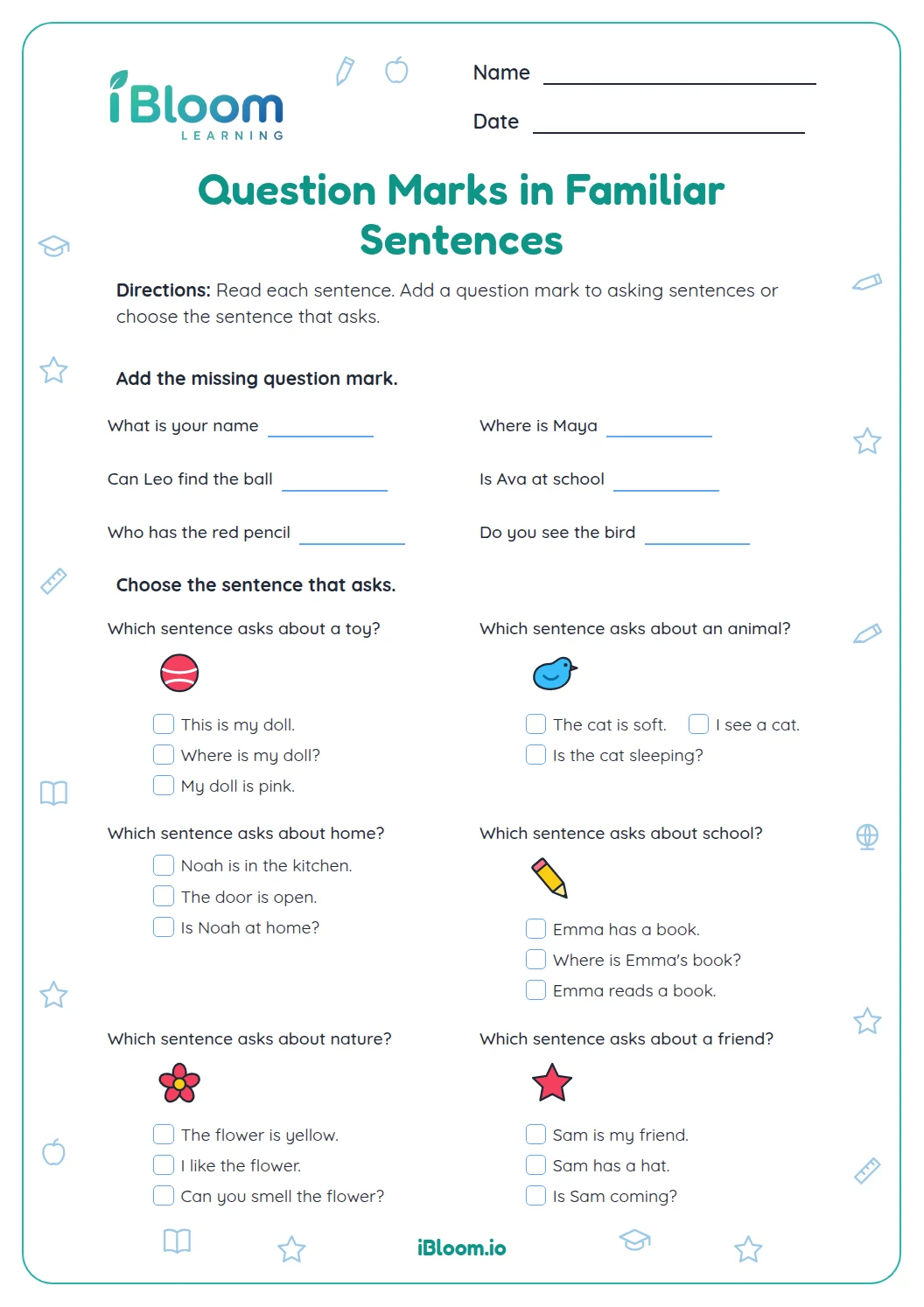
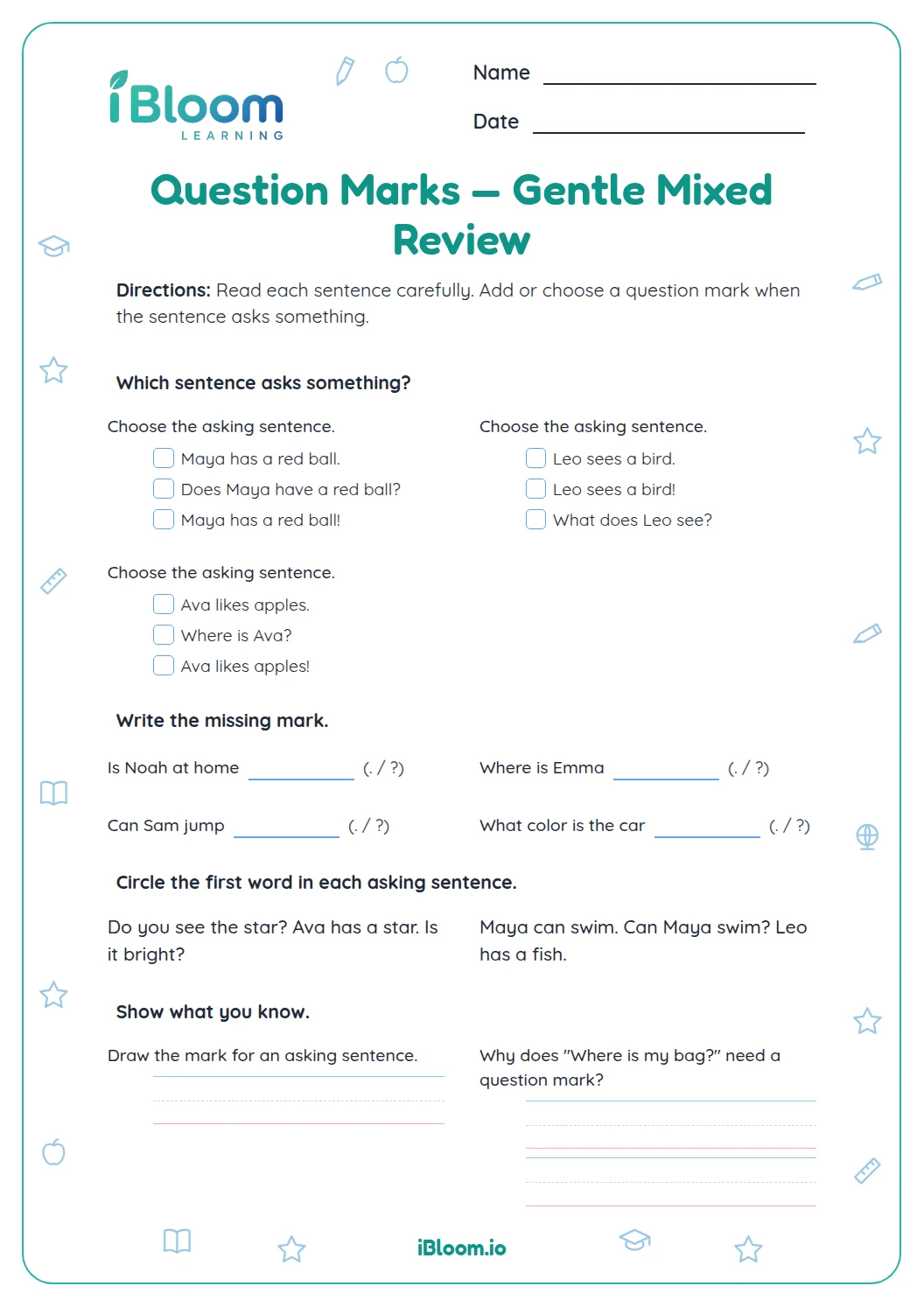
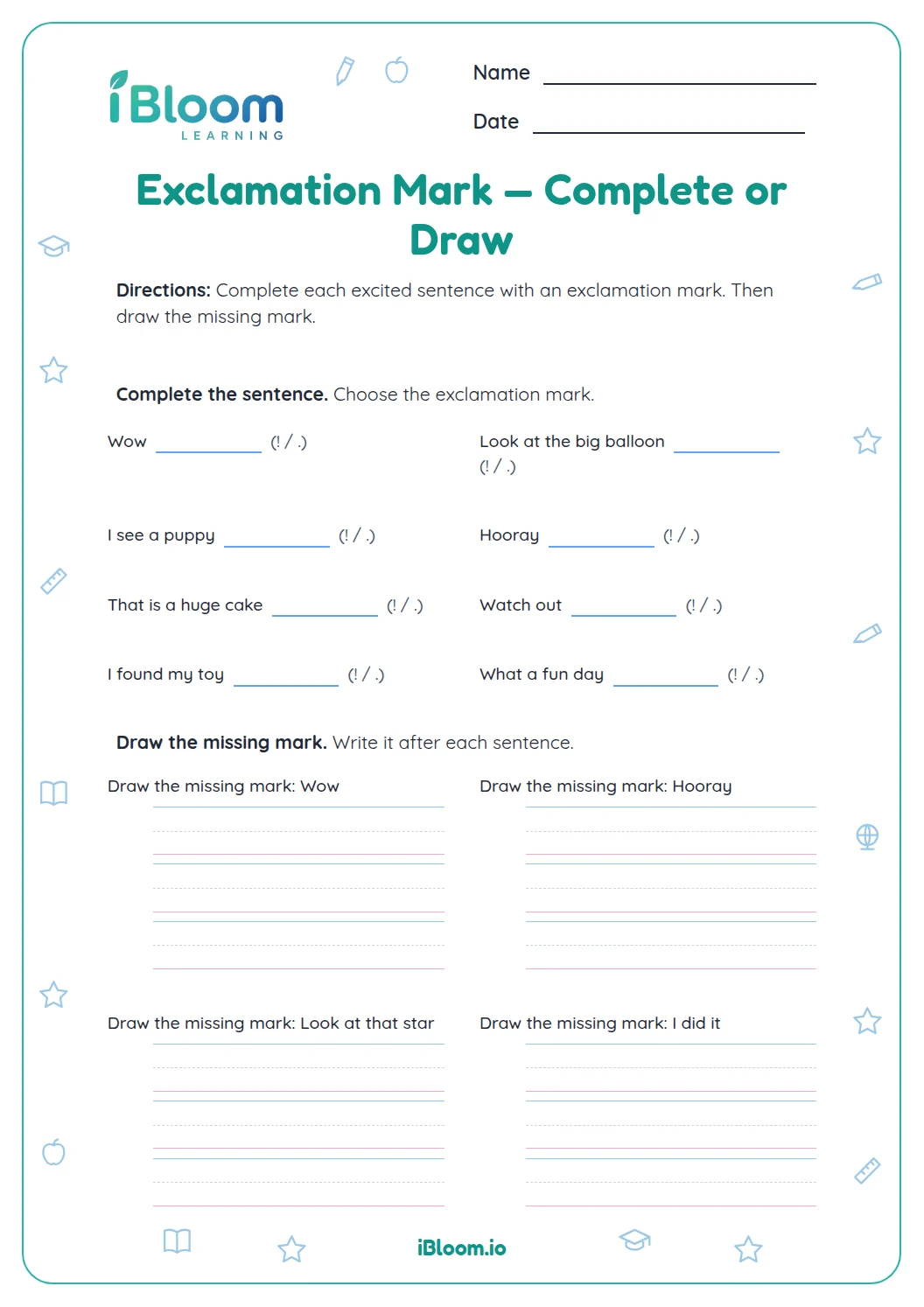
This Kindergarten punctuation sheet gives 14 short sentences. Learners choose an ending mark for six sentences, then write the mark at the end of eight more. The items use periods for statements, question marks for questions, and exclamation marks for excited sentences. It practices CCSS L.K.2.b, and a separate answer key identifies the expected mark for each.
Aligned to L.K.2.b
Which mark finishes each sentence?
The six questions in Part A ask learners to choose a period, question mark, or exclamation mark. The sentence wording and small picture give clues about whether it tells, asks, or expresses excitement.
- A period ends a telling sentence.
- A question mark ends a question.
- An exclamation mark can show excitement or a warning.
How can a learner choose the mark?
Read the sentence aloud and listen to how it ends.
- 1Can you see the cat
- 2The sentence asks something.
- 3Choose a question mark.
What happens in the second part?
In Part B, learners write the ending mark after each sentence. The answer line gives room for a clear punctuation mark, and each item includes a picture that matches the sentence.
How to use this worksheet
- 1Look at the picture and read the sentence.
- 2Decide whether the sentence tells, asks, or shows excitement.
- 3Choose a matching mark in Part A.
- 4Write the mark at the end of each Part B sentence.
- 5Check the answer key after finishing.
Common slips and quick fixes
The mistake
Using a period after a question.
The fix
If the sentence asks something, finish it with a question mark.
The mistake
Choosing an exclamation mark for every sentence.
The fix
Use it for excitement or a warning; ordinary telling sentences end with periods.
The mistake
Drawing the mark before the final word.
The fix
Put the ending mark at the very end of the sentence.
Common Core alignment
Recognize and name the end punctuation used in sentences.
On this sheet: The questions directly practice this skill.
Show the official wordingHide the official wording
Recognize and name end punctuation.
What to practice next
Make more practice
Further reading
Questions parents and teachers ask
Which ending marks does this worksheet practice?
It practices periods, question marks, and exclamation marks. Learners choose among the marks in Part A and write the correct mark after each sentence in Part B. The pictures match words in the illustrated prompts. Each part offers practice with all three kinds of end punctuation.
How can a child tell whether to use a question mark?
A question asks something, such as “Can you see the cat?” Read the sentence and notice whether it asks for an answer. The question mark belongs at the end, after the last word. A question mark signals that the sentence asks something.
When should a child use an exclamation mark?
Use an exclamation mark for a sentence that expresses strong feeling or a warning, such as “Hooray, we won!” The worksheet includes excited statements for learners to finish with the matching mark. Look for an excited voice or a warning in the sentence.
Do the pictures match the sentences?
The first few items include small pictures that match words in their sentences, such as a dog, cat, or trophy. The later prompts use short text and answer lines, similar to the old sheet’s sentence practice. Pictures support early reading.
What does the answer key show for Part B?
The key gives the expected mark for each of the seven Part B sentences. A learner can compare the mark they wrote with the answer and check that it appears at the end of the sentence. The key also helps adults check placement at the sentence end.