






About this worksheet
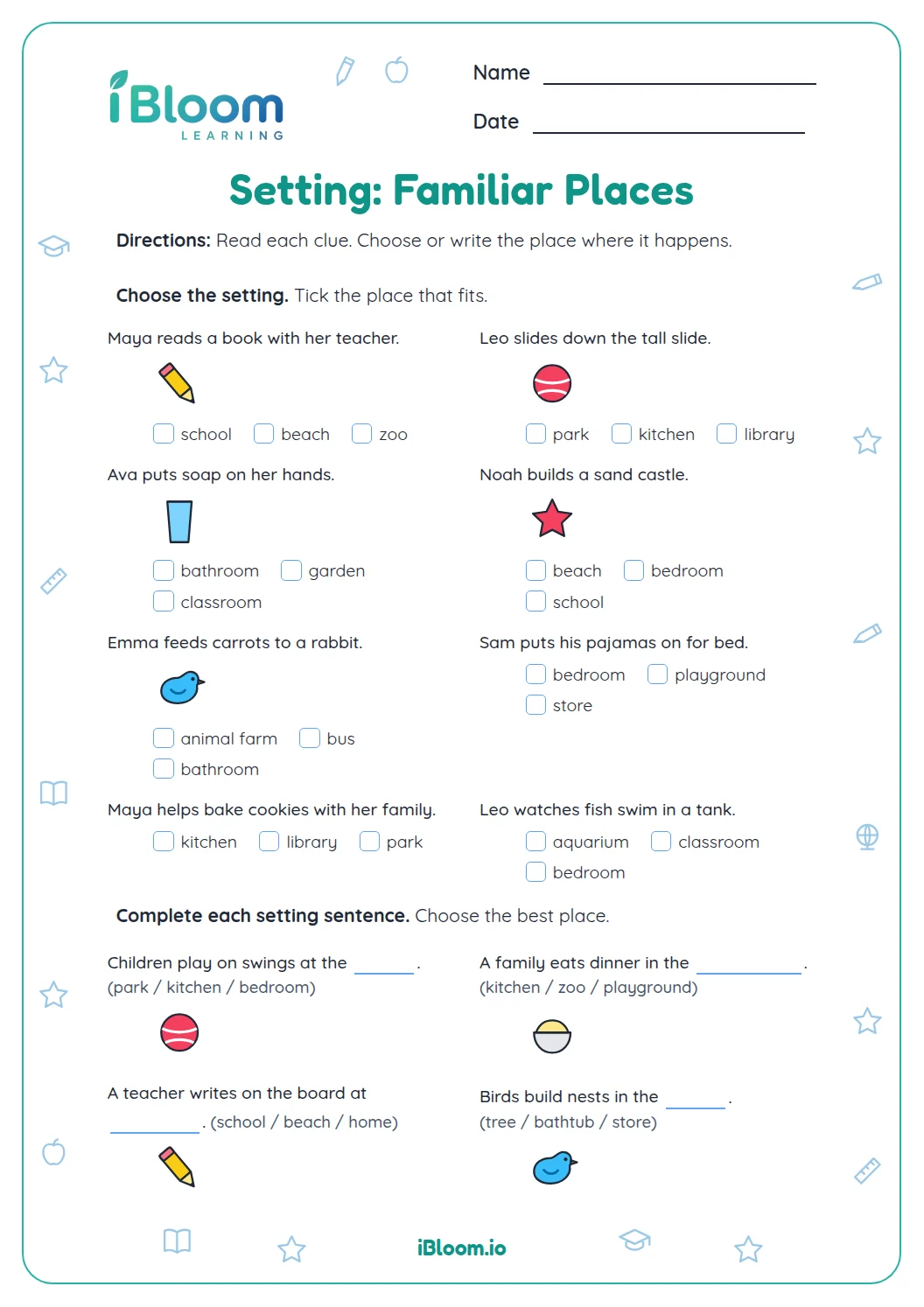
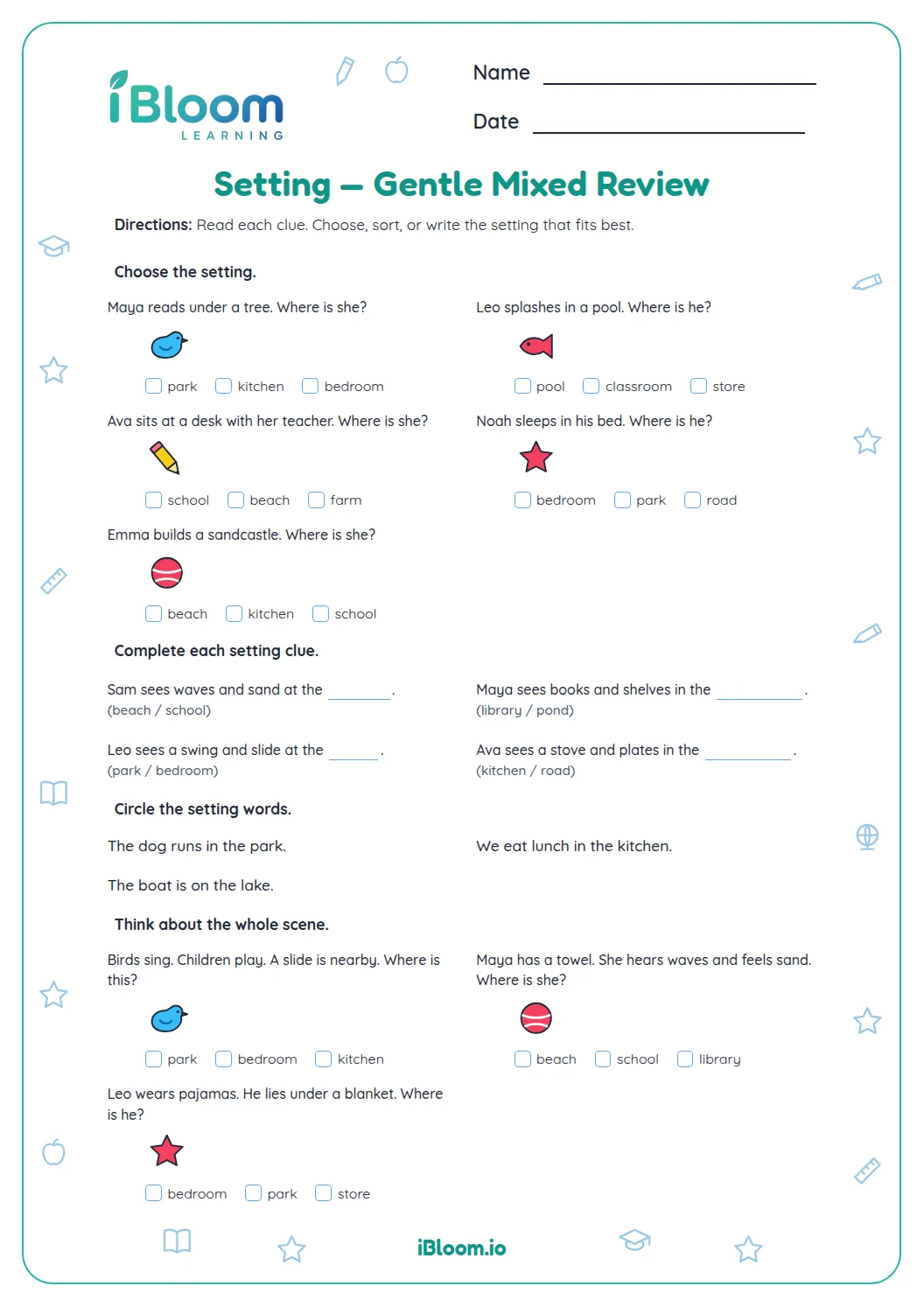
This free printable worksheet is for preschool–kindergarten learners practicing matching familiar story clues to places and drawing a setting that fits. It has 16 questions: 12 picture-supported place choices and 4 setting drawings. A separate answer key lets learners check the work.
What does a setting tell us?
A setting is where or when an event happens. The first questions pair familiar animals and activities with places such as a pond, garden, or beach.
- 1A fish swims → pond
- 2A child builds a sandcastle → beach
How can picture clues help?
The picture pair gives a visual reminder of the animal or place clue. Use it with the words in the question to choose a place where the activity could happen.
What should a setting drawing show?
A drawing should include a place that fits the prompt. A duck swimming might be drawn in a pond, while a child building a snowman could be in a snowy yard.
How to use this worksheet
- 1Look at the picture clues and listen to or read the question.
- 2Think of a place where the animal or activity could happen.
- 3Choose the place that fits best.
- 4For drawing prompts, include a clear clue to the setting.
- 5Talk about how the place matches the prompt.
Common mistakes and quick fixes
The mistake
Choosing a place that has no connection to the clue.
The fix
Ask where the animal lives or the activity usually happens.
The mistake
Drawing only the animal or activity.
The fix
Add a place detail such as water, trees, sand, or snow.
The mistake
Confusing an object with a setting.
The fix
Name the larger place around the object, such as a pond or garden.
What to practice next
Make more practice
Questions parents and teachers ask
What does setting mean?
A setting is where or when something happens. This worksheet focuses on places: a fish may swim in a pond, and a child may build a sandcastle at a beach. Learners choose places and draw settings for familiar prompts.
How many questions are included?
There are 16 questions: 12 picture-supported choices and 4 drawing prompts. The first group asks children to choose a place for an animal or activity. The final prompts invite them to draw a setting that fits. An adult can read the choices aloud when needed.
Why are there pictures beside the choices?
The paired pictures give a visual clue to the animal, activity, or place named in the question. Children can use both the illustration and the words to decide where the event could happen. An adult may read each prompt aloud.
What should a child draw for a setting question?
The drawing should show a place that fits the prompt. For a duck swimming, a pond with water is a clear choice. For a snowman, the child might draw a snowy yard. Other clear, fitting places can also work.
Can more than one setting be right?
Sometimes. A kitten might play in a yard or in a room, and a bird may find a nest in different kinds of trees. The key gives examples; accept a drawing or choice when it clearly fits the animal or activity.
How long does this sheet take?
Plan for about 10 to 15 minutes, including time to talk about choices and draw four settings. A young learner may benefit from an adult reading each prompt aloud and asking what clue helped them pick the place.