








About this worksheet
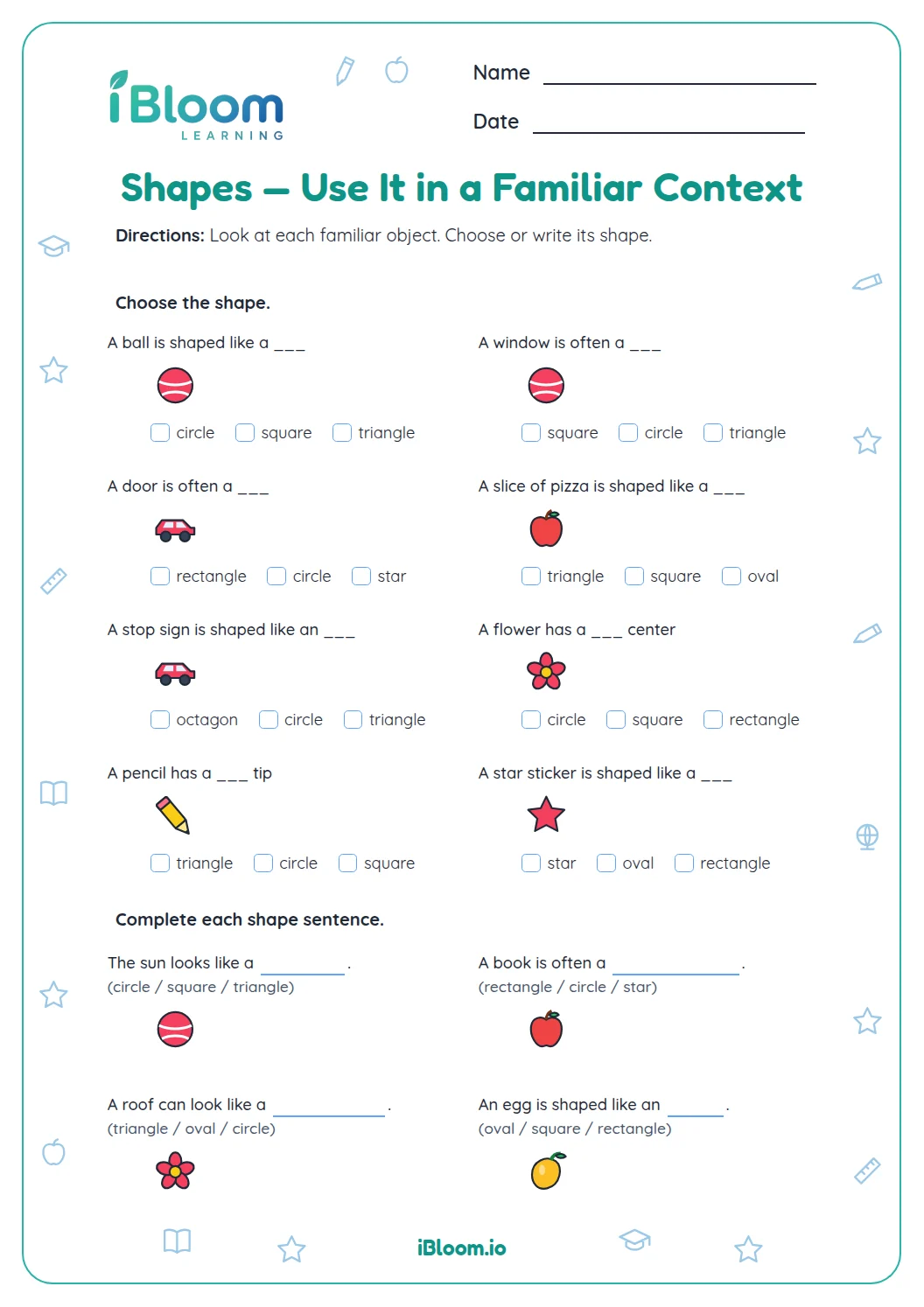
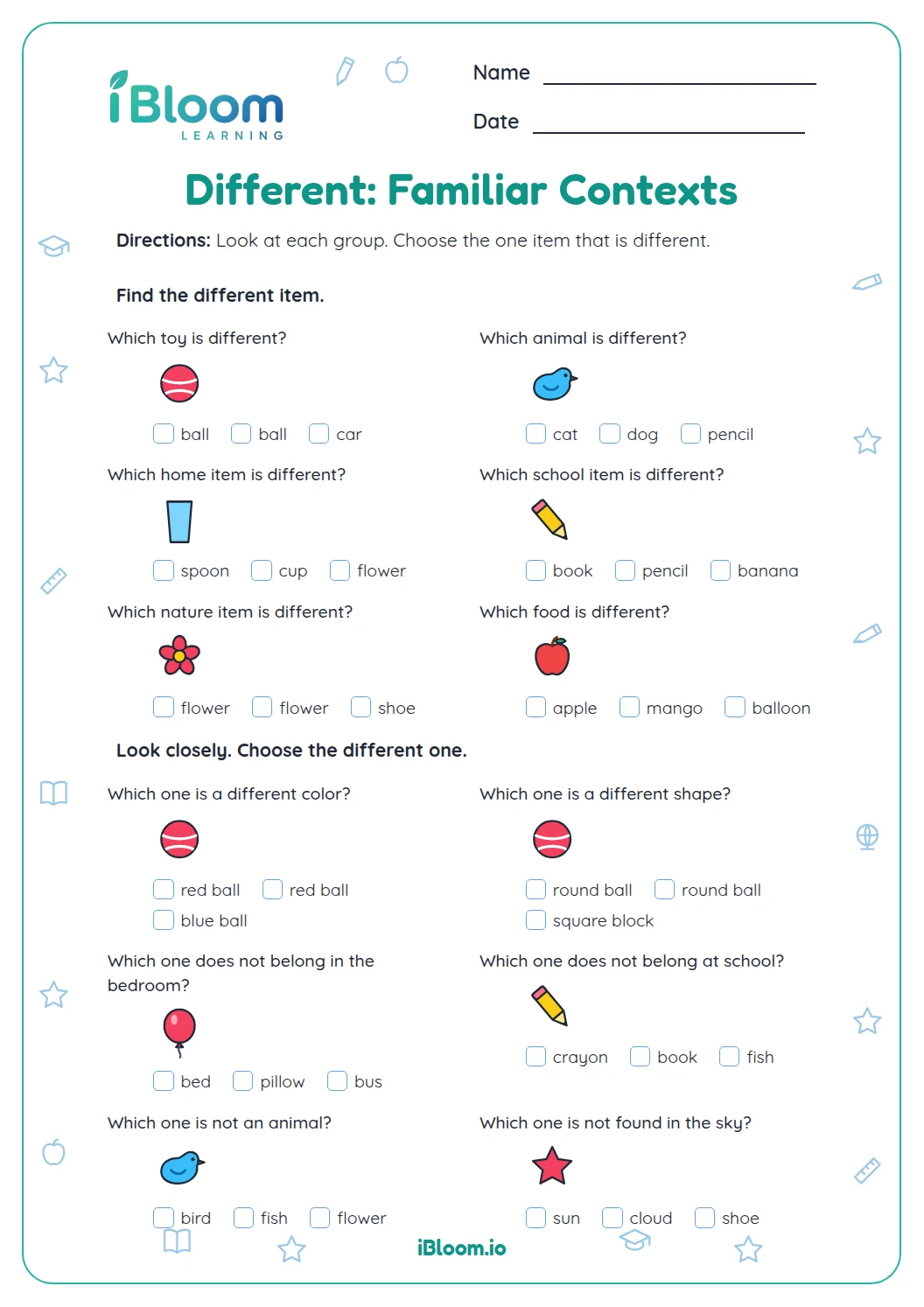
This printable gives preschool and kindergarten learners 14 shape questions. Children identify circles, triangles, squares, rectangles, and ovals by looking at their sides, corners, and curved edges. A compact answer key lists the matching shape for each item.
Aligned to CCSS K.G.A.2
Which shapes appear?
The drawings include familiar circles, triangles, squares, rectangles, and ovals. Children match the visible shape to a short clue.
How can a child spot a triangle?
Count the straight sides and corners in the drawing before choosing.
- 1Which one has three sides?
- 2Choose the triangle: it has three straight sides.
What features can children compare?
Sides, corners, and curved edges help distinguish the shapes. For instance, a circle has no corners, while a square has four.
How to use this worksheet
- 1Name both pictured shapes.
- 2Read the clue carefully.
- 3Count sides or corners when needed.
- 4Choose the shape that matches.
Common mix-ups and quick fixes
The mistake
Mixing up a circle and an oval.
The fix
Compare whether the outline is evenly round or stretched.
The mistake
Calling any four-sided shape a square.
The fix
Check whether all sides look equal.
The mistake
Losing count of a triangle’s sides.
The fix
Touch each straight side once as you count.
Curriculum alignment
Children name familiar shapes from their drawings and compare visible features.
Name familiar shapes shown in different sizes or orientations.
On this sheet: The pictured items ask children to name familiar shapes.
Show the official wordingHide the official wording
Correctly name shapes regardless of their orientations or overall size.
What to practice next
Make more practice
Further reading
Questions parents and teachers ask
Which shapes are pictured?
The worksheet pictures circles, triangles, squares, rectangles, and ovals. Each item presents a short clue that helps a child focus on a shape’s name or visible feature. Children can point to the drawing before answering and describe what they notice.
How many questions are on the sheet?
There are 14 illustrated questions across the worksheet pages. Each question asks the learner to choose one shape from the pictured pair, then the answer key provides a quick way to check responses together. The page gives each pictured pair enough room for careful looking.
What should children notice about shapes?
Children can look for straight sides, corners, and curved edges. Counting these features helps distinguish a triangle from a rectangle or a circle from a square. Talk through the visible clues as the child compares the pictures carefully.
Can I read the clues aloud?
Yes. An adult can read each short clue while the child looks at the drawings and names the shapes. Encourage pointing and counting rather than rushing to choose. This keeps attention on the pictured features and shape names.
What does the answer key include?
The key lists the shape that matches each clue. Use it to check responses and talk about the feature that makes the choice fit, such as three sides, four corners, or a curved edge. Ask the learner to name the feature that supports the answer.