




About this worksheet
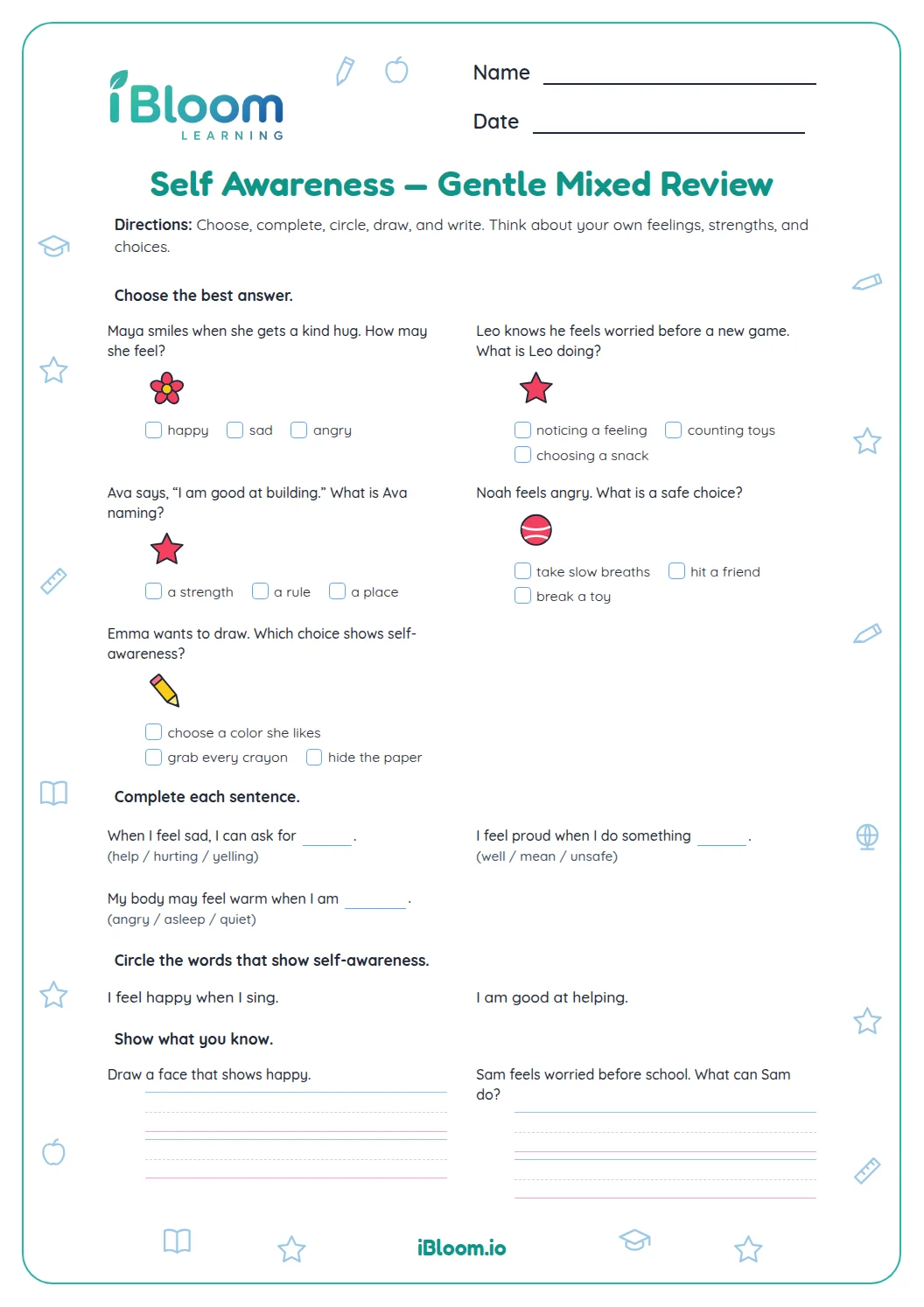
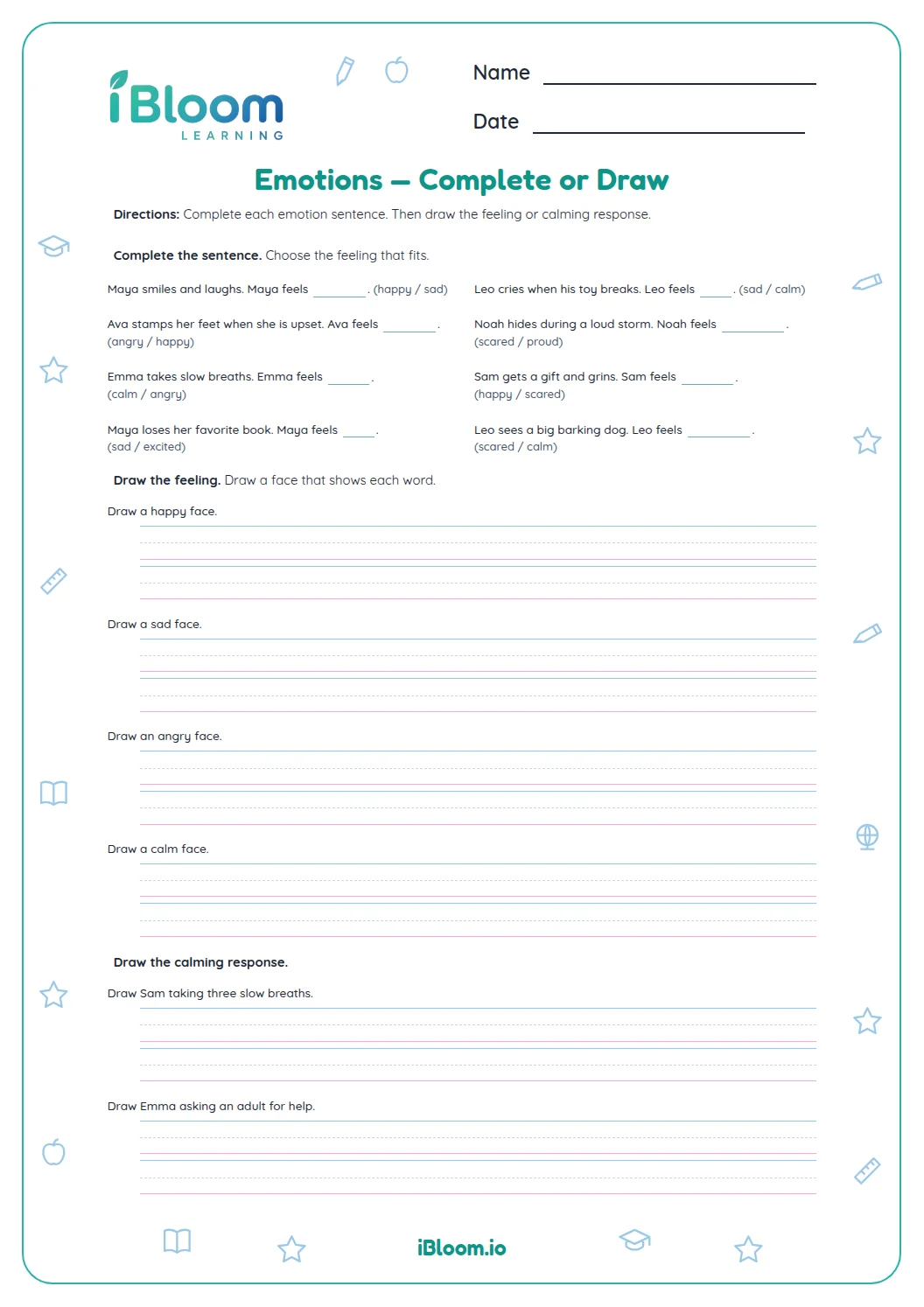
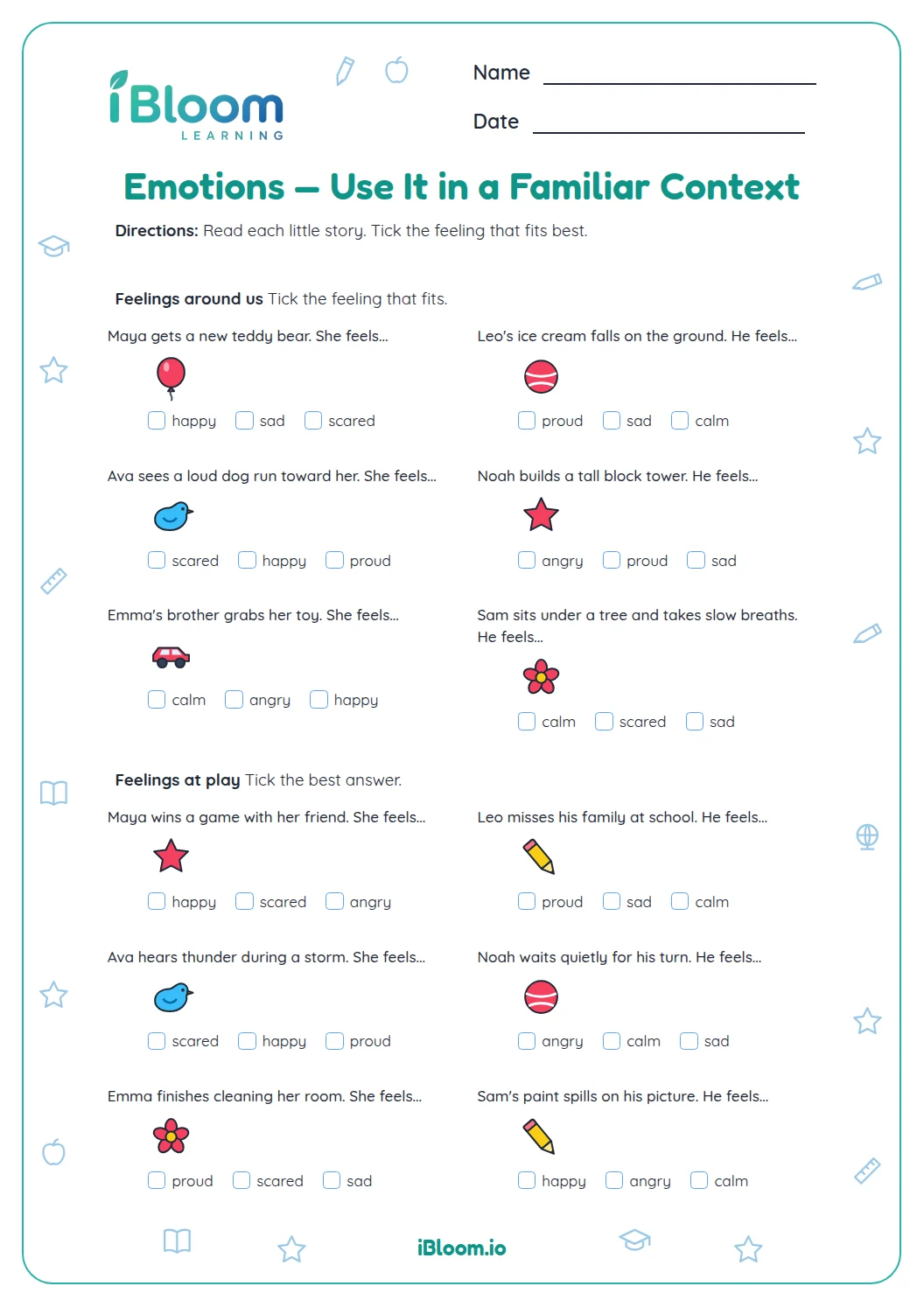
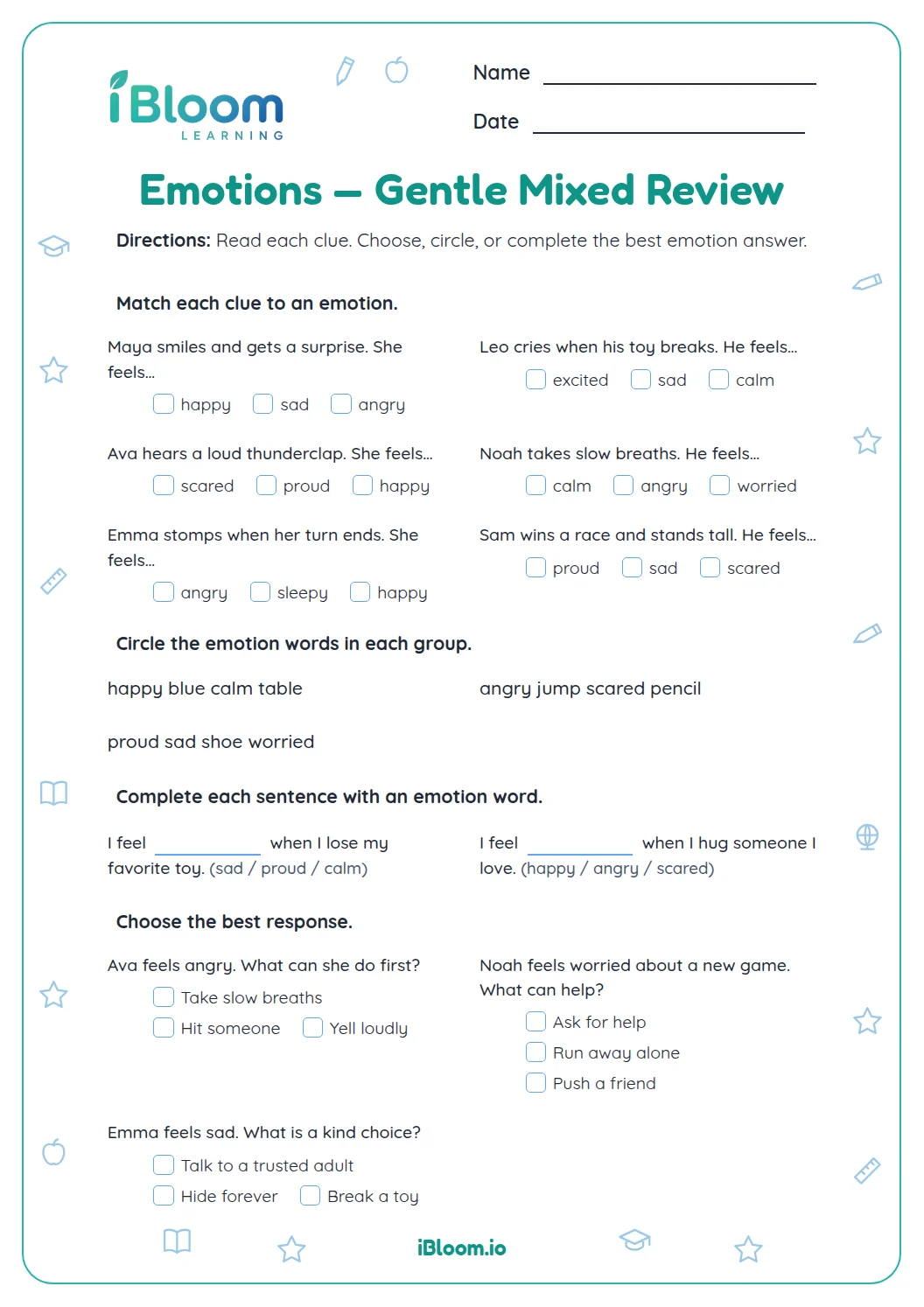
This free printable worksheet helps Pre-K and Kindergarten children notice themselves: their bodies, what they need, how they feel and what they can do. In Part A, children color the picture that finishes four sentences about their senses, such as “I smell with my ___.” In Part B, they choose what helps when they feel hungry, sleepy or cold. In Part C, they draw a happy face, a sad face and a picture of themselves doing something they do well, each in its own box. An adult reads each sentence aloud, and a separate answer key shows the picture choices.
What is self-awareness for young children?
Self-awareness means noticing things about yourself: how your body works, how you feel, what you need and what you can do. For young children it starts with things they can point to, such as the nose that smells or a tummy that feels empty, long before it reaches ideas like personality.
This sheet stays with what a four- or five-year-old can point to or show. Every choice connects a body part or a body signal to something from daily life, and the drawings ask children to show a feeling on a face.
What is on this worksheet?
Ten questions over two pages. An adult reads each sentence aloud, and the child colors the circle beside the matching picture. Every choice has two or three large pictures, so no reading is needed to answer. The last three questions are drawing boxes.
- 1I feel sleepy. I can rest in a ___.
- 2Pictures: a ball or a bed
- 3A ball is for playing. A bed is for resting.
- 4Answer: the bed
- Part A, My body: 4 questions about smell, hearing, sight and taste
- Part B, What do I need: 3 questions about feeling hungry, sleepy and cold
- Part C, Draw it: 3 boxes for a happy face, a sad face and yourself doing something you do well
- Answer key with the right picture filled in for questions 1 to 7 and a note on what each drawing can show
How do the senses help children know themselves?
Knowing which part of the body does which job gives children words for what is happening to them: “My ears hear a loud noise,” or “My tongue tastes something sweet.” Naming a body part is often the first step toward saying what they need.
How should an adult handle the drawing boxes?
Part C has no wrong answers. A circle with a curved smile is a fine happy face, and a turned-down mouth or a tear makes a sad face. For “Draw yourself doing something you do well,” let your child pick anything: kicking a ball, building a block tower, helping to feed the cat. Ask them to tell you about it, and you can write their words beside the box.
The two faces are a chance to talk about feelings. Ask, “When do you feel happy? What makes you sad?” and listen without fixing the answer.
How to use this worksheet at home or in class
- 1Start by asking, “What do you use to smell a flower?” Let your child point to their nose before you open the sheet.
- 2Read question 1 aloud and point to each picture. Say the name of each one, then let your child color the circle.
- 3Continue through Part A. If your child hesitates, say the sentence again and touch the body part you are naming.
- 4Before Part B, ask, “How does your tummy feel when you are hungry?” Then read the sentence and link the feeling to a picture.
- 5In Part C, read each drawing prompt aloud. Ask your child what a happy face and a sad face look like before they draw.
- 6Check the circles with the answer key, then ask your child to tell you about each drawing.
Common mistakes and quick fixes
The mistake
Coloring the first picture without looking at the others.
The fix
Point to each picture and name it aloud before your child colors a circle.
The mistake
Mixing up two senses, such as coloring the eye for “I hear with my ___.”
The fix
Have your child cover their eyes and listen while you clap. They still hear it, so the ears do the hearing.
The mistake
Leaving a drawing box empty because the picture has to be perfect.
The fix
Say that any face with a smile counts as happy. Draw one together on scrap paper first if your child wants to see how.
What to practice next
Make more practice
Further reading
Questions parents and teachers ask
What is self-awareness for preschoolers?
It is noticing things about yourself, such as which body part does which job, how you feel and what you can do. On this worksheet, children connect their senses to the nose, ears, eyes and tongue, and connect hunger, sleepiness and cold to what helps. These are first steps before talking about bigger feelings.
Does my child need to read to complete this worksheet?
No. An adult reads each sentence aloud, and children answer by coloring the circle beside a picture or by drawing. Nothing on the sheet needs writing except the name at the top, which a child can trace, scribble or ask you to write. Kindergarten children may enjoy reading short sentences such as “I see with my ___” themselves, with a little help.
What should my child draw for “something you do well”?
Anything they feel good about: kicking a ball, building a tower of blocks, writing a letter or singing a song. There is no right picture. Talking about it is part of the activity, so ask what they are doing in the drawing and how they feel when they do it.
Why does the sheet use body signals instead of feeling words?
Body signals are an easy place to start because children can feel them right now. A rumbling tummy or heavy eyes is concrete, while words like proud or disappointed can come later. Matching a signal to what helps, such as an apple, a bed or a coat, shows children they can notice something and act on it.
Is there an answer key, and how long does it take?
Yes. The answer key is a separate two-page set with the correct circle filled in for questions 1 to 7 and a short note on what each drawing can show. Plan on about 15 minutes with an adult reading aloud. The three drawing boxes take longest, so you can come back to them later in the day.