


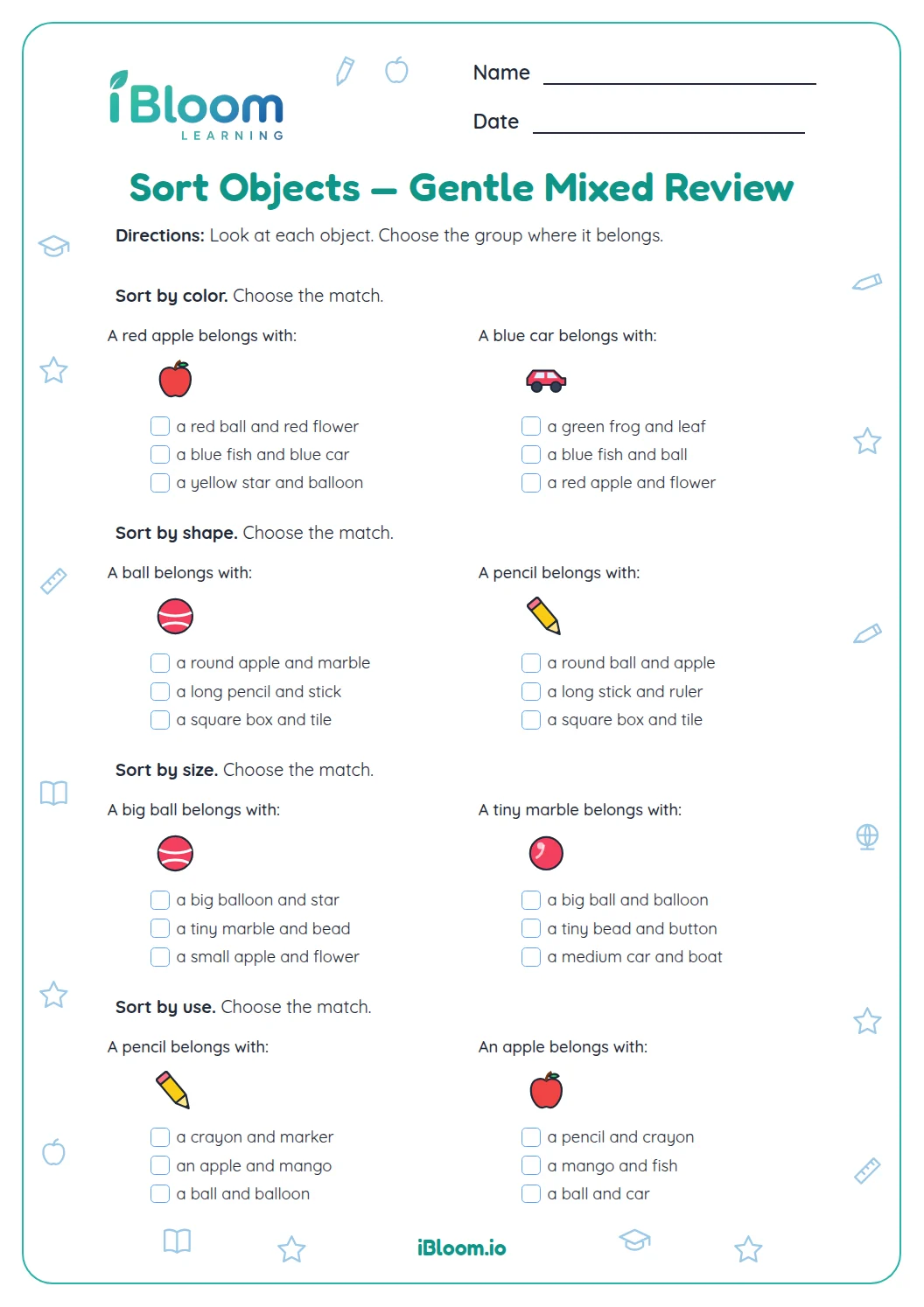


About this worksheet
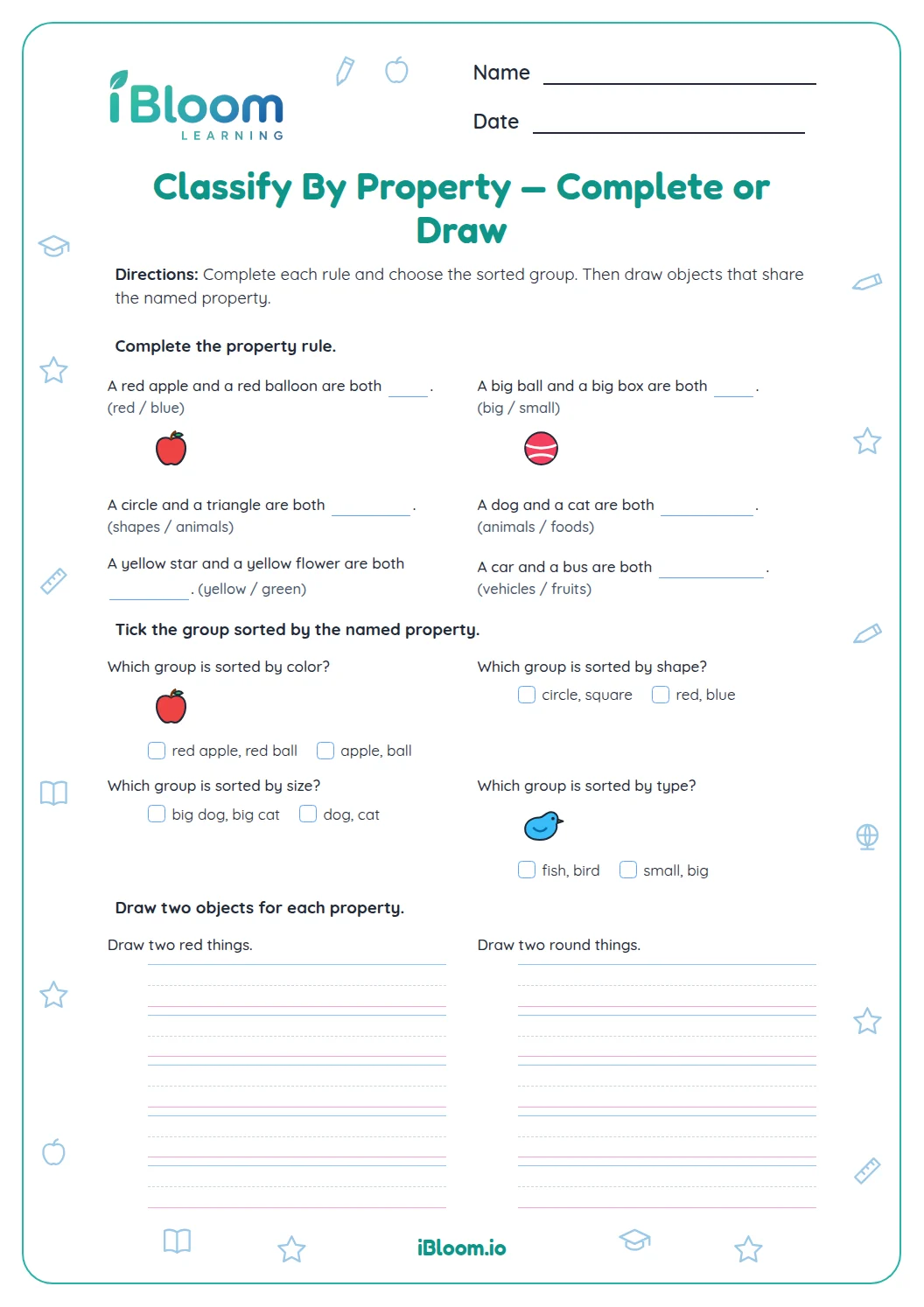
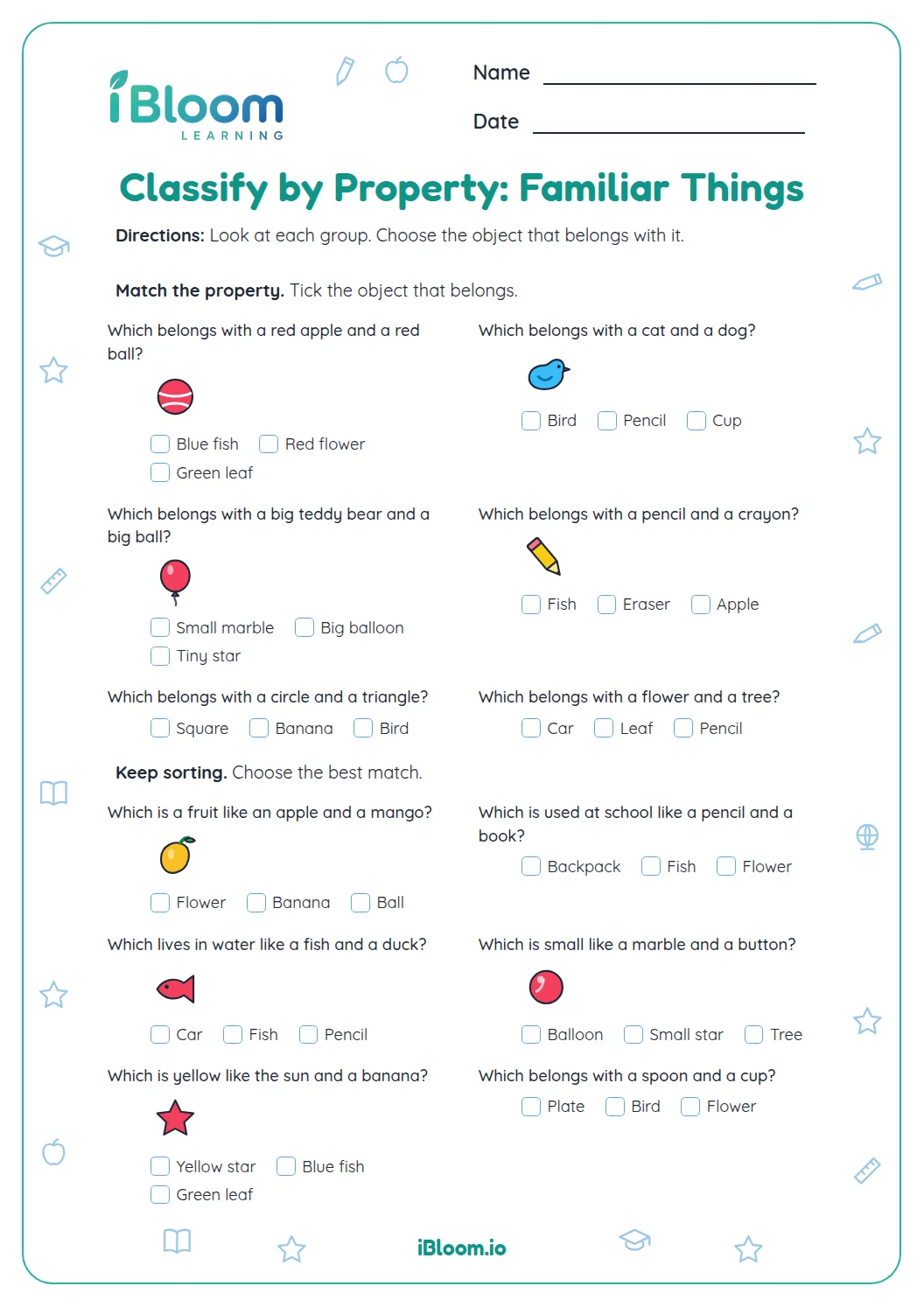
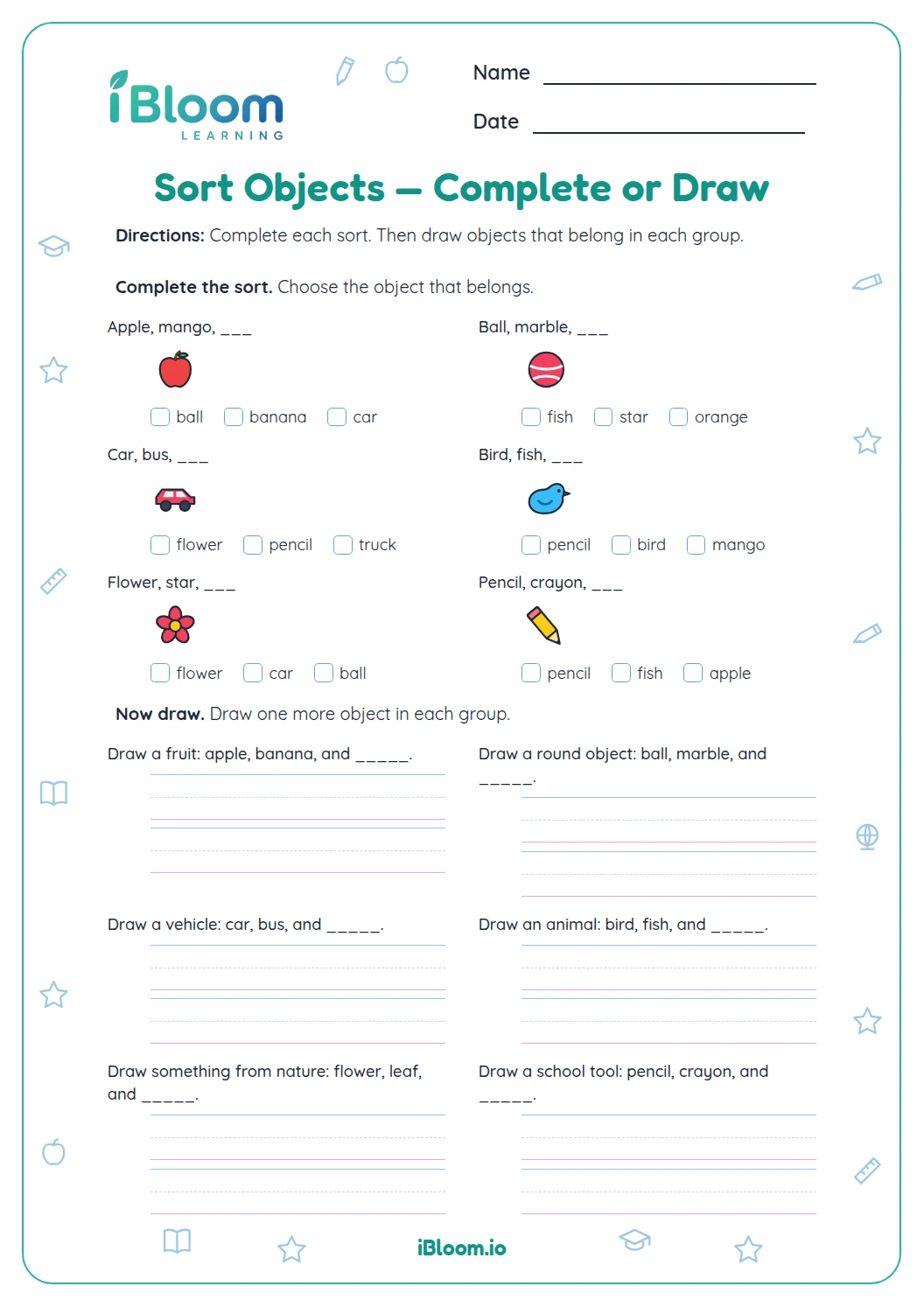
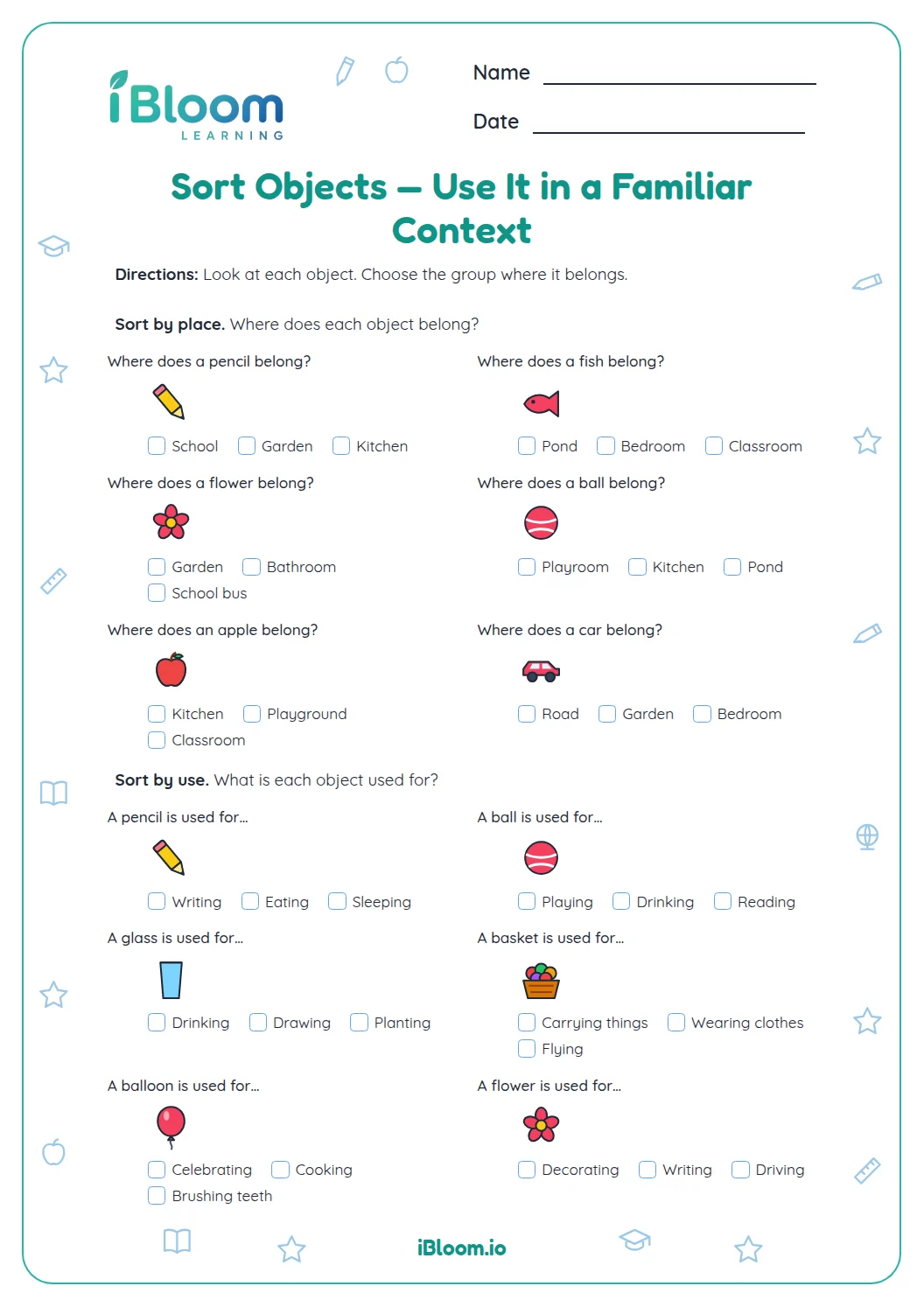
This free printable worksheet gives preschool and kindergarten children 12 tasks about sorting by color, shape, size and type. Part A asks children to name a property from a short clue, with pictures of familiar objects in four questions. Part B has four blanks for sorting-rule names. Part C asks which object belongs in a fruit, round, red or big-toy group. An adult can read every direction and record spoken answers. The classification work practices Common Core L.K.5a, grouping common objects into categories. A separate answer key marks choices and supplies the four written labels.
Aligned to L.K.5a
Which four properties do children name?
Color tells whether an object is red or blue. Shape tells whether it is round or square. Size tells whether it is big or small. Type tells what kind of thing it is, such as a fruit, vehicle or animal.
Pictures support the object vocabulary. For the size questions, read the words big and small in the prompts and choices; these words supply the size information.
How do children keep the sorting rule consistent?
An object can belong to several groups. An apple can be a fruit and red, but the question names which property to use. In question 9, children choose another fruit, even though the choices may share other features.
- 1Group: apple and pear. Rule: fruit.
- 2Choices: car, banana, ball.
- 3Choose banana because it is a fruit.
What makes an answer correct in Part C?
Question 9 needs another fruit: banana. Question 10 needs a round shape: B, the circle. Question 11 needs the red object named in the choices: red car. Question 12 needs the big toy: big teddy bear.
Ask the child to finish the sentence “It belongs because…” using the named rule. If a child chooses a different object, reread the rule and check that one feature together.
How to use this worksheet
- 1Name the familiar objects in the picture clues together.
- 2Read each Part A description and ask which property it names.
- 3Use the four printed rule words to complete Part B; record spoken answers if needed.
- 4For Part C, repeat the group rule before reading the choices.
- 5Check each answer with the key and ask the child to explain one match.
Mistakes to notice and fix
The mistake
Calling round a color.
The fix
Trace the round outline with a finger and name it as a shape.
The mistake
Choosing the ball for the fruit group because it looks round like an apple.
The fix
Repeat the rule fruit. Banana fits that type; a ball is a toy.
The mistake
Choosing a small toy for the big-toy group because both are toys.
The fix
Check both words: the object must be a toy and its label must say big.
Common Core alignment
Group familiar objects by color, shape, size or type.
On this sheet: Children identify category rules and select objects that belong to fruit, round, red and big-toy groups.
Show the official wordingHide the official wording
Sort common objects into categories (e.g., shapes, foods) to gain a sense of the concepts the categories represent.
What to practice next
Make more practice
Further reading
Questions parents and teachers ask
Can a preschool child use this sheet without reading?
Yes, an adult can read the prompts and choices while the child points to an answer. Name the pictured objects first. In Part B, the adult may record the child’s spoken rule word. Keep the discussion focused on one property at a time: color, shape, size or type.
What does type mean in these questions?
Type means the kind of thing an object is. Bird and fish belong to the animal type; apple, pear and banana belong to the fruit type. Children name type as a rule in Parts A and B, then choose a banana for the fruit group in Part C.
Do the size questions require measuring the pictures?
No, the size questions use the words big and small. Question 4 labels two objects small, question 6 asks for size as the rule, and question 12 asks for a big toy. Read the words aloud so children use the stated size when deciding which answer fits.
Why is the circle correct in question 10?
Shape B fits because its outline is round like a clock face. The three drawings in question 10 are a triangle, a circle and a square, labeled A, B and C. Ask the child to trace each outline and choose the one that matches the round-shape rule.
Does this worksheet need color printing?
The written clues name the colors, so an adult can read them aloud on a black-and-white copy. Question 1 states that the apple and cherry are red. Question 11 names a red group and offers color words in the choices. Color printing lets children compare those clues with the illustrations.