








About this worksheet
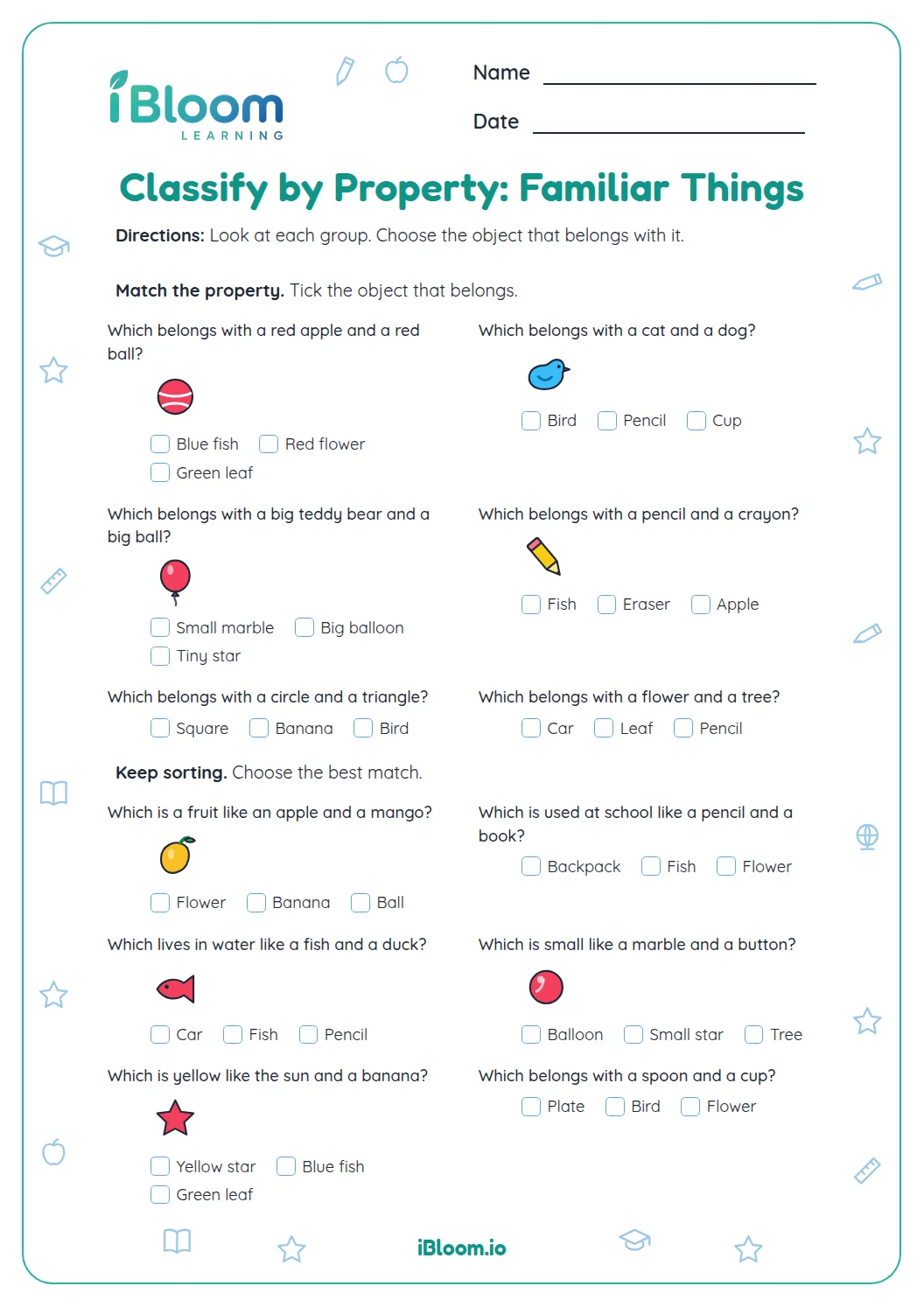
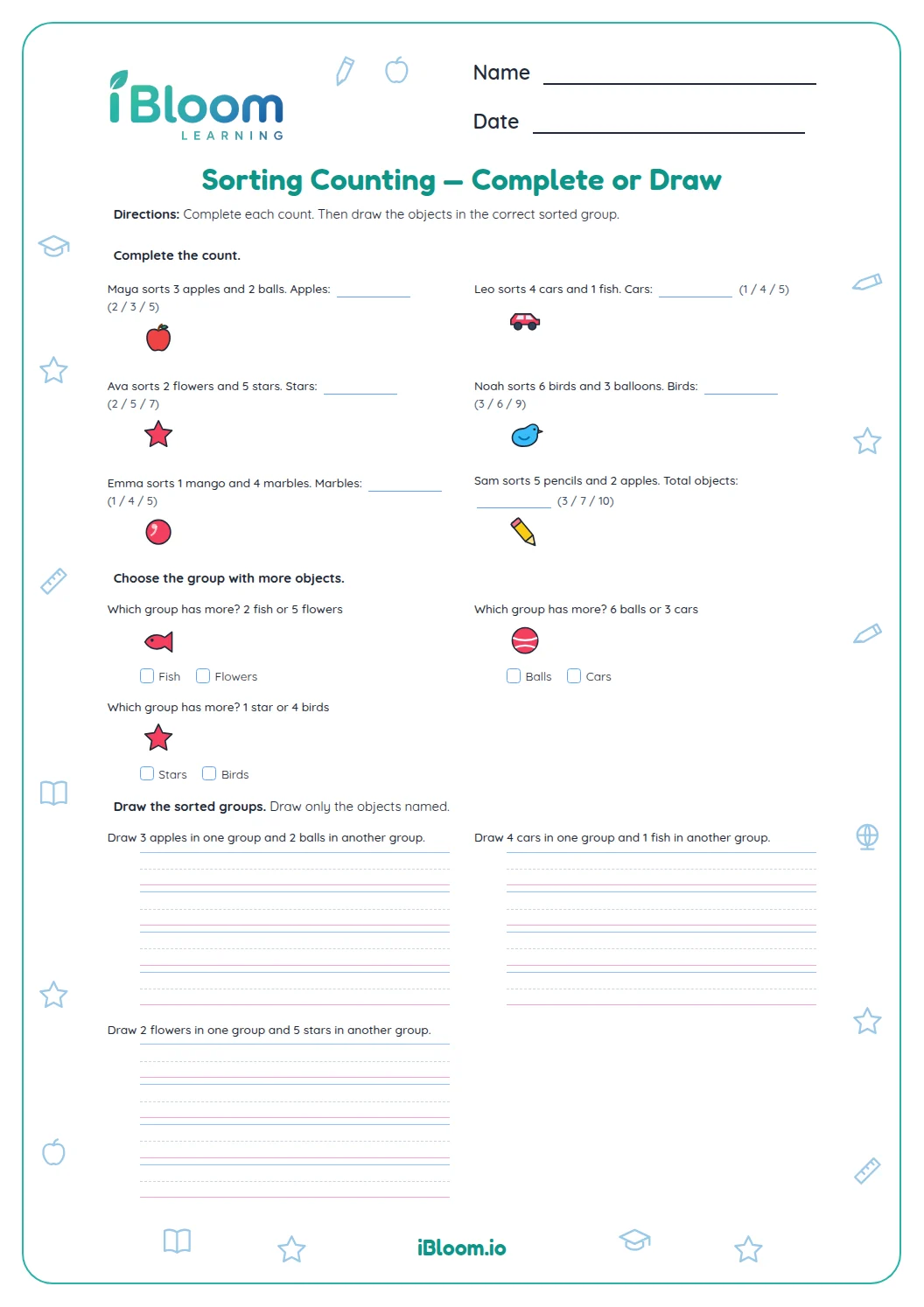
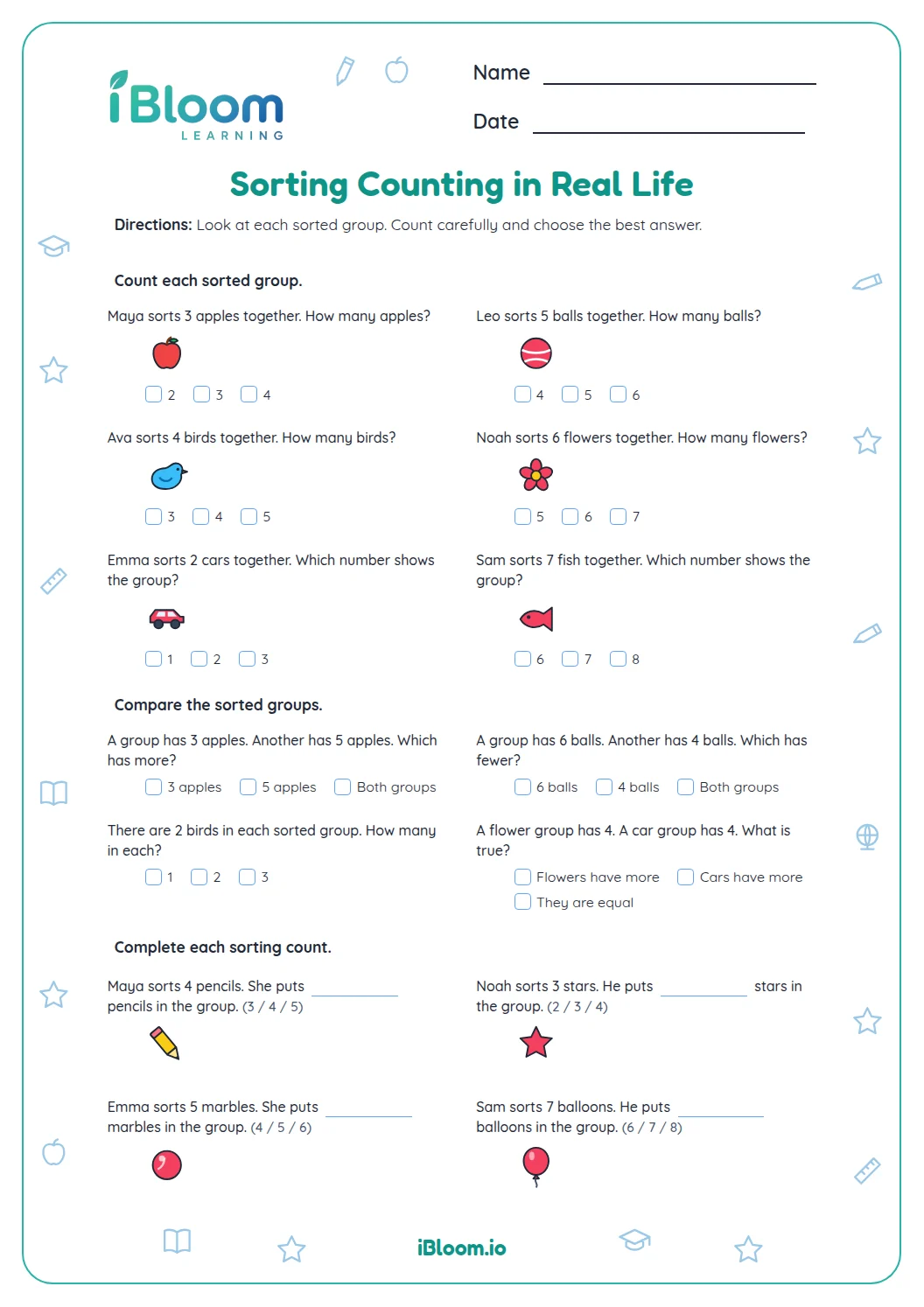
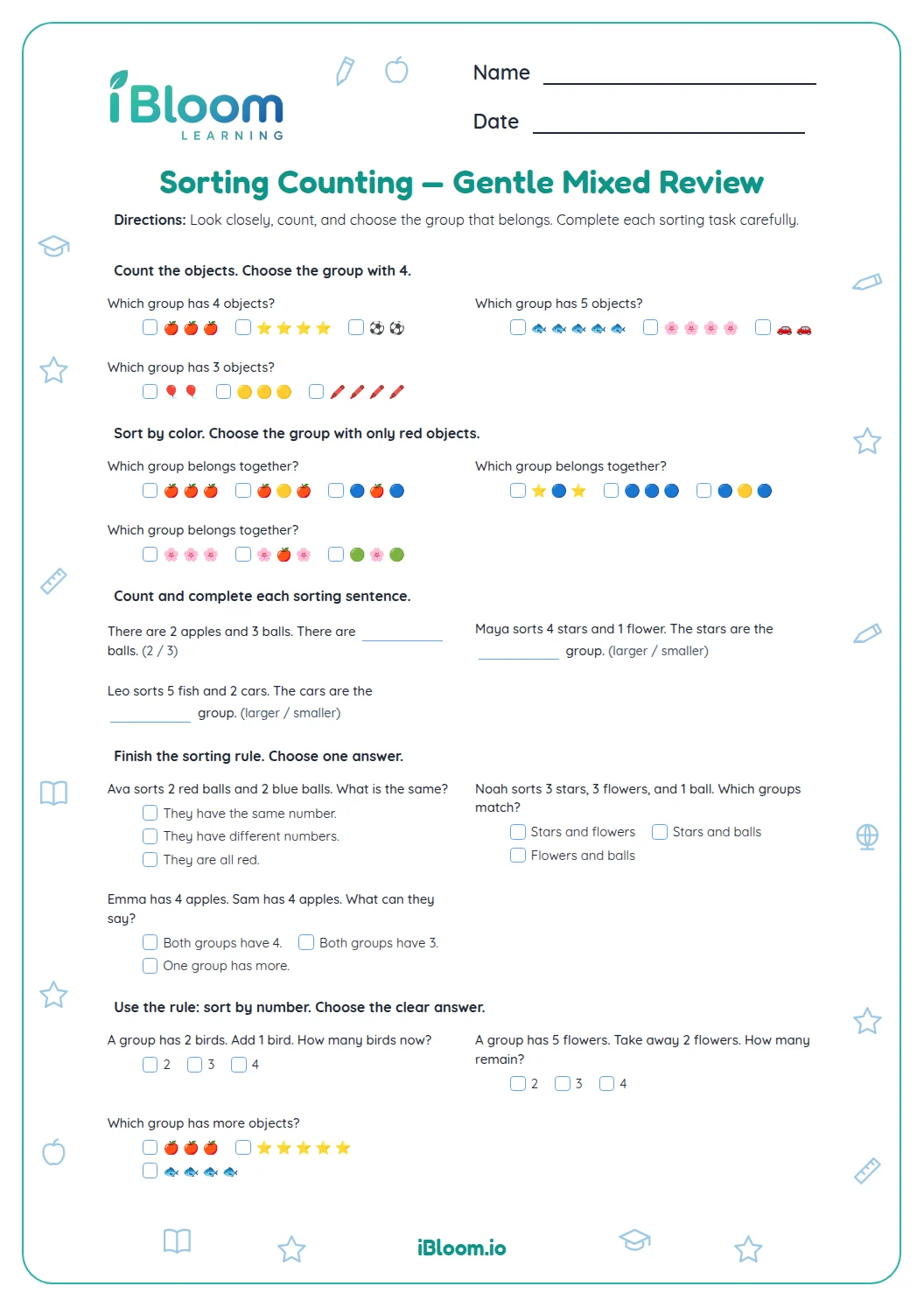
This free printable Pre-K and kindergarten worksheet turns sorting and counting into a tidy-up game. A grown-up reads each question aloud. In Part A children look at one picture, such as a banana or a kite, and choose its group: food, toys, animals or school things. In Part B they look at a mixed row of pictures and count only one group, and in Part C they draw four things that belong in a toy box. It practices Common Core K.MD.B.3 and K.CC.B.5. A two-page answer key is included.
Aligned to K.MD.B.3 and K.CC.B.5
What does sorting into four groups mean?
Sorting means deciding which things belong together. On this worksheet the four groups are food (what we eat), toys (what we play with), animals (living creatures) and school things (what we use at school). Each picture goes in exactly one group.
Four groups ask more of a child than two, so a short question from a grown-up helps with each choice: Can you eat it? Do you play with it? Is it alive? Do you use it at school?
How do children count one group out of a mixed row?
In Part B the row holds pictures from several groups, and the question names one. The child first finds the pictures in that group, then counts only those, touching each one once and saying the numbers in order.
Counting the whole row is an easy slip to make. A light pencil dot on each picture in the group, before counting, keeps the two jobs apart: first sort, then count.
- 1Count the foods. The row shows an apple, a cat, bread, a ball, a carrot and a pencil.
- 2Find the foods: apple, bread, carrot.
- 3Touch each one and count: 1, 2, 3.
- 4Leave out the cat, the ball and the pencil.
- 5Answer: 3
Why does the sheet use food, toys, animals and school things?
These are things children see at home and in class every day, so the sorting rule comes from what they already know. The tidy-up theme fits too: food goes in the kitchen, toys in the toy box, and school things in a backpack.
A few pictures sit close to the line on purpose. A teddy bear looks like an animal but is a toy, so question 9 gives children a chance to say why it goes with the toys.
What is on this worksheet?
Eleven questions in three parts, spread over two pages.
- Part A, Tidy up: which group? Six single pictures (banana, kite, pencil, frog, cat and bread), each sorted into one of four groups (questions 1 to 6)
- Part B, Sort and count: four mixed rows of pictures, counting the foods, animals, toys and school things in turn (questions 7 to 10)
- Part C, Draw and count: draw four things that go in a toy box (question 11)
- A matching two-page answer key
How to use this worksheet at home or in class
- 1Warm up with real things: put an apple, a toy block, a crayon and a picture of a dog on the table, and sort them into four piles.
- 2Read question 1 aloud and ask, "Can you eat it?" Let your child point to the group before marking the circle.
- 3Finish Part A at your child's pace. For any pause, ask the short question for each group: eat, play, alive, school.
- 4In Part B, ask your child to find only the pictures in the group and touch each once. A pencil dot on each helps keep track.
- 5For question 11, let your child draw anything that belongs in a toy box, then touch each picture and count to 4.
- 6Check with the answer key together, and talk about any picture that was tricky, such as the teddy bear.
Common mistakes and quick fixes
The mistake
Counting every picture in the row, not only the group, so question 7 gives 6 instead of 3.
The fix
Find the group first. Put a pencil dot on each food, then count only the dots: 1, 2, 3.
The mistake
Sorting by how a picture looks, as in putting the teddy bear with the animals.
The fix
Ask what it is for. A teddy bear is something to play with, so it goes with the toys. Ask the same questions again: eat, play, alive, school.
The mistake
Losing track in the second line of pictures and counting one twice or skipping one.
The fix
Touch each picture once and move left to right, line by line. Putting a dot on it as you count makes a record you can check.
Common Core alignment
Most US states use the Common Core Math standards or a close state version. These two standards name the sorting and counting skills this worksheet practices.
Sort objects into categories and count how many are in each.
On this sheet: Parts A and B: children classify pictures as food, toys, animals or school things, then count each group.
Show the official wordingHide the official wording
Classify objects into given categories; count the numbers of objects in each category and sort the categories by count.
Count to answer how many, and count out a given number of objects.
On this sheet: Parts B and C: children count a group of up to 5 pictures, and draw out exactly 4 things.
Show the official wordingHide the official wording
Count to answer “how many?” questions about as many as 20 things arranged in a line, a rectangular array, or a circle, or as many as 10 things in a scattered configuration; given a number from 1-20, count out that many objects.
What to practice next
Make more practice
Further reading
Questions parents and teachers ask
What does it mean to sort and count four groups?
Children put things into four categories, then say how many are in a group. On this sheet the categories are food, toys, animals and school things. Sorting uses the question "what kind of thing is it?" and counting uses the question "how many?" Each is a separate step.
Do children need to read the words on the sheet?
No. A grown-up reads every question aloud, and the pictures carry the meaning. Children only need to find the group they hear and mark a circle. Reading the four group names together before starting helps, and the names repeat from question to question.
Why is a teddy bear counted as a toy and not an animal?
A teddy bear is something to play with, not a living animal, so it belongs with the toys. Question 9 asks children to count toys, and the teddy bear is one of the four. Asking "Can you play with it?" and "Is it alive?" helps decide.
What are the answers to Part B?
Question 7 has 3 foods (apple, bread, carrot), question 8 has 3 animals (dog, fish, hen), question 9 has 4 toys (kite, ball, teddy bear, nesting doll) and question 10 has 5 school things (pencil, book, backpack, crayon, scissors). The answer key shows all eleven.
What should my child draw in question 11?
Any four things that could go in a toy box, such as a ball, a kite, a bear and a car. Count the pictures together afterwards. A child who draws three or five can fix it by adding or crossing out one, which is good counting practice too.
How long does it take, and is there an answer key?
About 15 minutes with a grown-up reading, and the sheet splits easily: Part A is on page 1, and Parts B and C are on page 2. Yes. A two-page answer key follows the worksheet, so you can hand out the worksheet alone and check afterwards.