
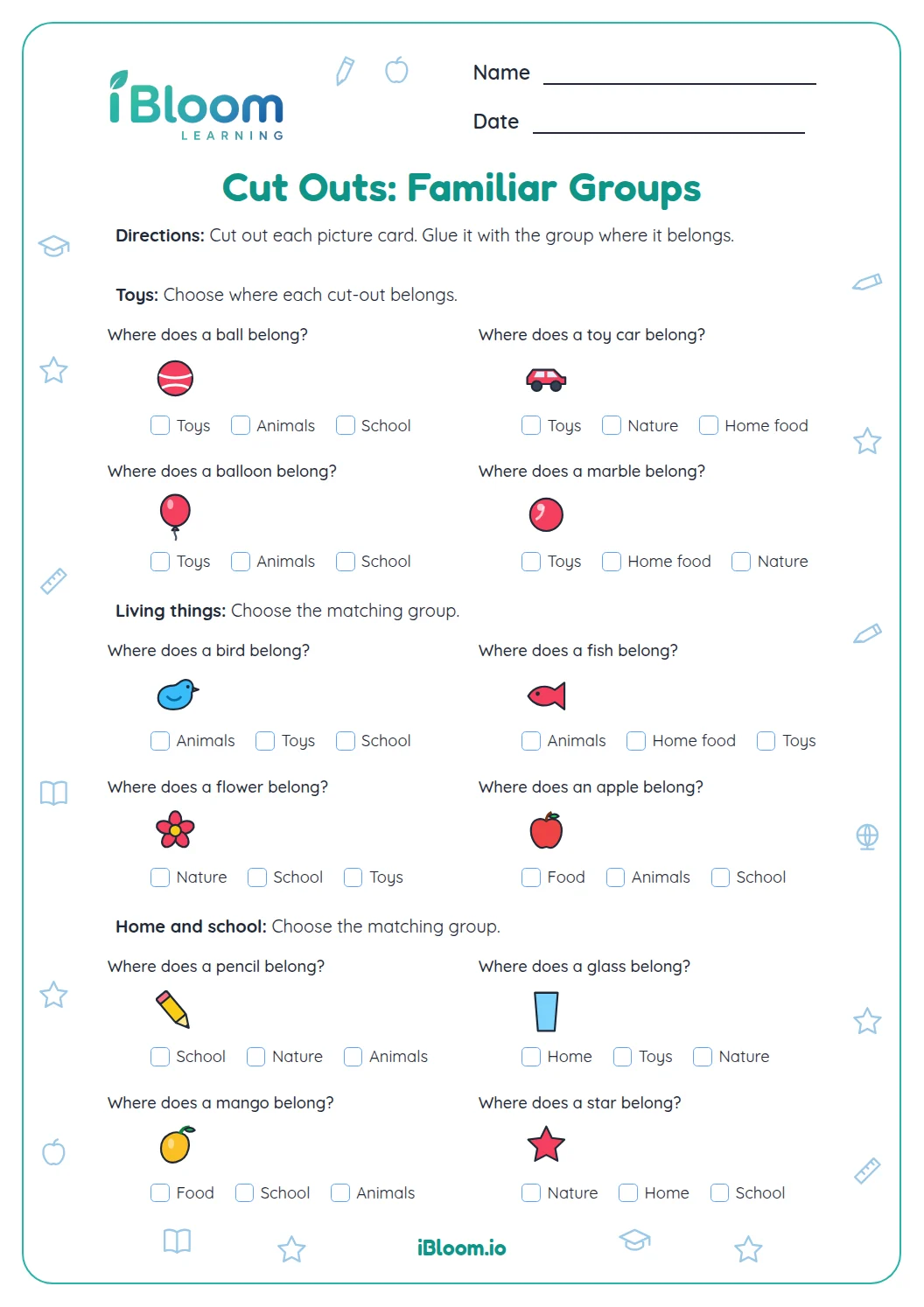


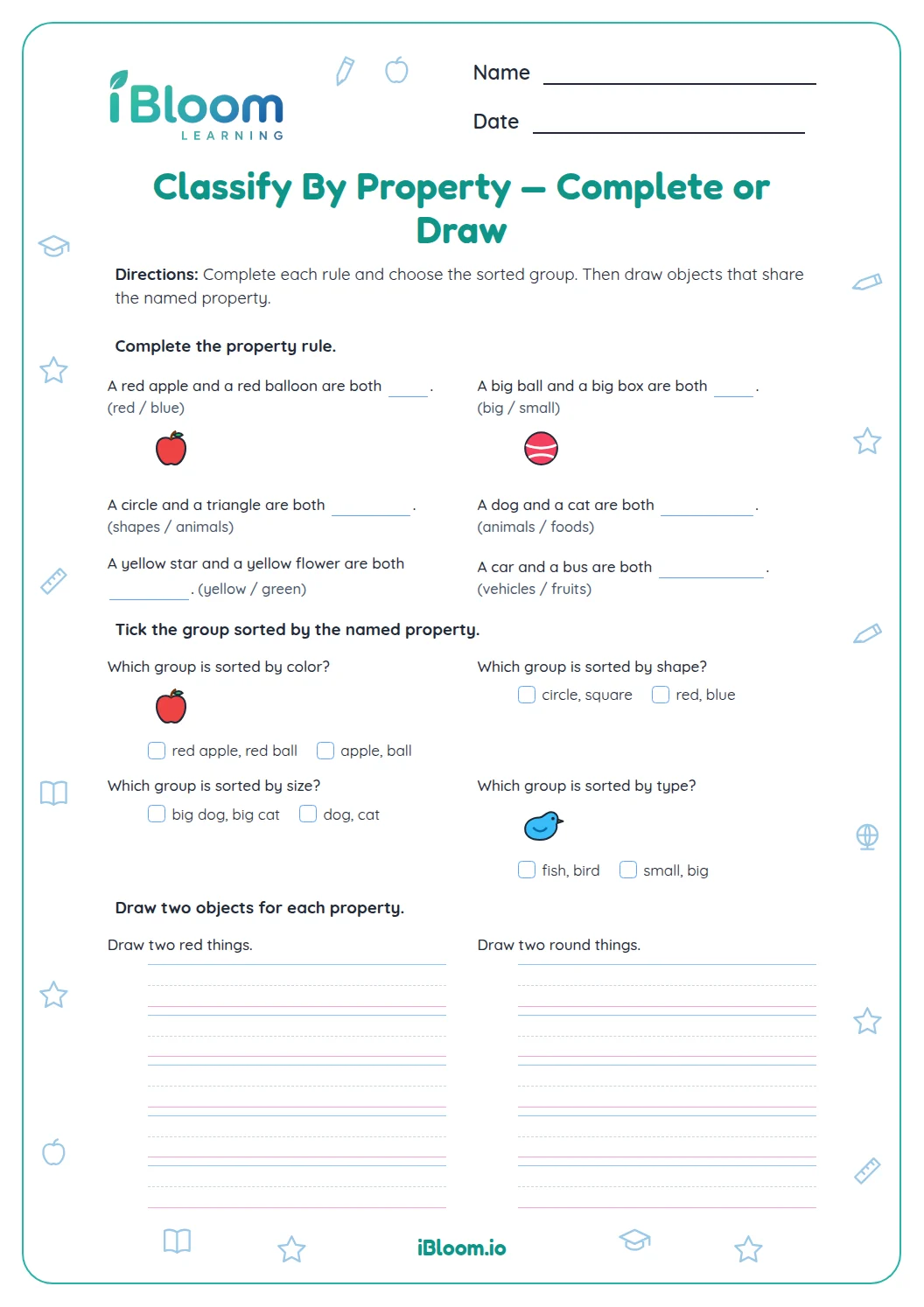
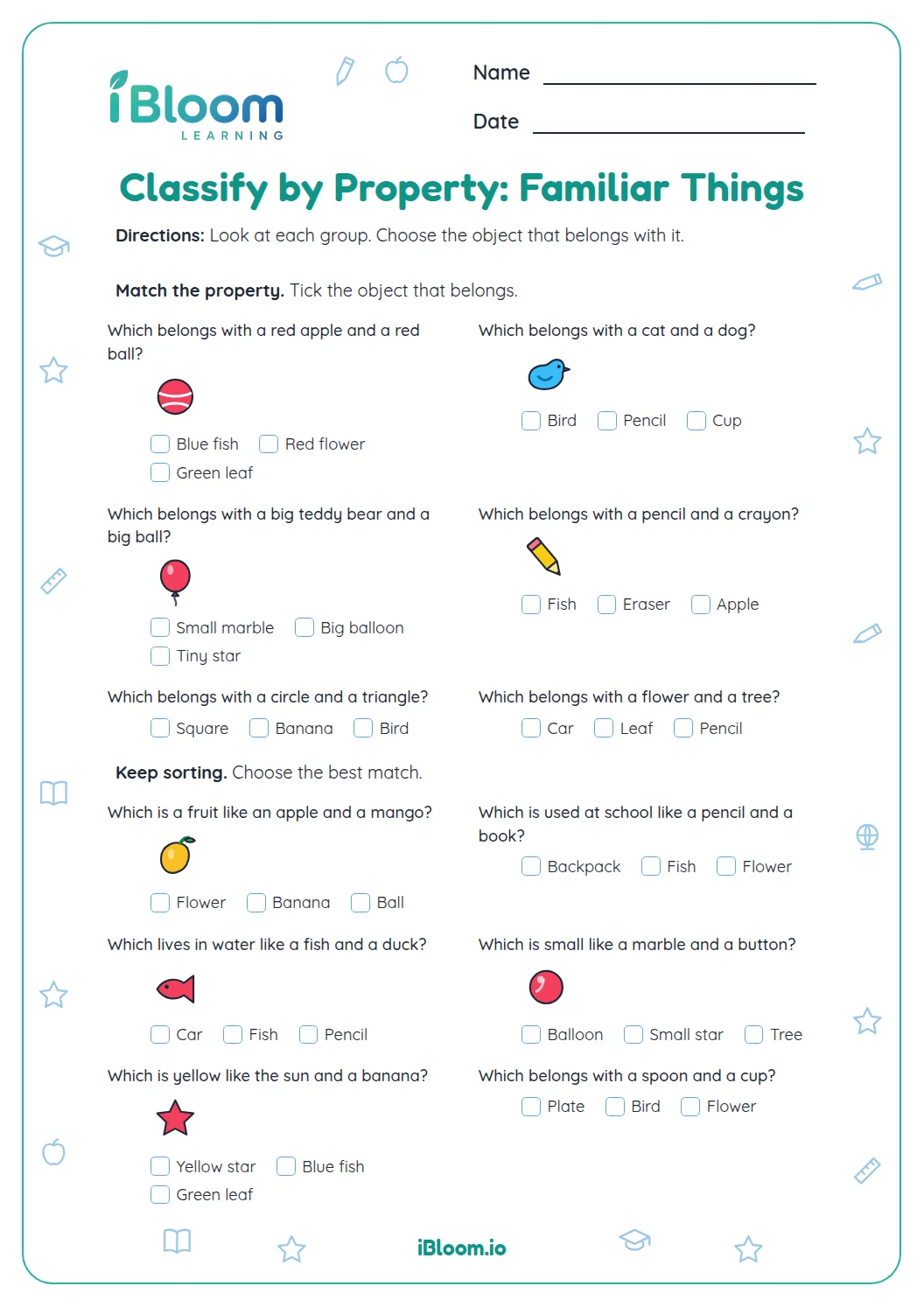


About this worksheet
This printable worksheet gives grades k–2 learners practice with matching shape pieces, sorting shapes by their features, and tracing outlines. It contains 16 questions in clear parts, plus a separate answer key. Use the worked example below to model the first step, then invite learners to explain how they checked an answer.
Aligned to K.MD.B.3
What will learners do on this worksheet?
The worksheet has 16 questions in parts that focus on matching shape pieces, sorting shapes by their features, and tracing outlines. Directions tell learners what to notice and how to record each answer. The separate key gives a quick way to check work.
- 16 questions across two practice pages
- A separate answer key
How can I model one question?
Read the whole question, identify the clue that matters for matching shape pieces, sorting shapes by their features, and tracing outlines, and explain why the answer fits. Then ask the learner to use the same reasoning on the next item.
- 1A square has four corners and four straight sides, so it matches the square cut-out.
- 2A circle has no corners, so choose circle for “Which shape has no corners?”
What should I do if an answer is missed?
Return to the exact direction for that part. Ask the learner to point to the number, word, or feature that supports the answer, then try a similar item before checking the key again.
How can we use the answer key?
Check answers after a part is complete. For a missed response, compare the learner’s reasoning with the key and name the step that changes the result.
How to use this worksheet
- 1Read the directions for Part A before starting.
- 2Work through each part in order and show the steps requested.
- 3Pause after each part to check that every item has an answer.
- 4Use the separate key to check work and explain one correction aloud.
Common mistakes and quick fixes
The mistake
Rushing past a direction.
The fix
Read the part direction again before answering.
The mistake
Using a clue from only part of the item.
The fix
Read the whole prompt and check how the answer fits.
The mistake
Copying an answer without checking it.
The fix
Explain the step or clue that supports the answer.
Classify pictured shapes by their defining features.
On this sheet: Learners classify shapes by matching names and features.
Show the official wordingHide the official wording
Classify objects into given categories; count the numbers of objects in each category and sort the categories by count.
What to practice next
Make more practice
Further reading
Questions parents and teachers ask
What does the first part practice?
Part A asks learners to match a cut-out clue to a shape name. It begins with familiar pieces such as a half-circle, then asks learners to choose matching shapes from three choices. Ask the child to point to the shape feature named in the clue.
What shape clues appear on the page?
Learners use corners, straight sides, and curved outlines to identify circles, triangles, squares, ovals, and diamonds. Ask the child to point to the feature named in the prompt. Ask the child to point to the shape feature named in the clue.
Do children cut out pieces on this worksheet?
This printable asks learners to match shape clues, identify features, and trace dotted outlines. An adult can read each short prompt aloud, then invite the child to point to the matching shape and name the feature that helped.
How should the tracing activities be done?
In the last part, learners trace dotted shapes on the printed outlines. The answer key marks the activity complete when the shapes have been traced. Ask the child to point to the shape feature named in the clue. Ask the child to point to the shape feature named in the clue.
What does the answer key show?
For the choice questions, the key names the matching shape. For the last two activities, it describes the shapes to trace so an adult can check that each outline was attempted. Ask the child to point to the shape feature named in the clue.