




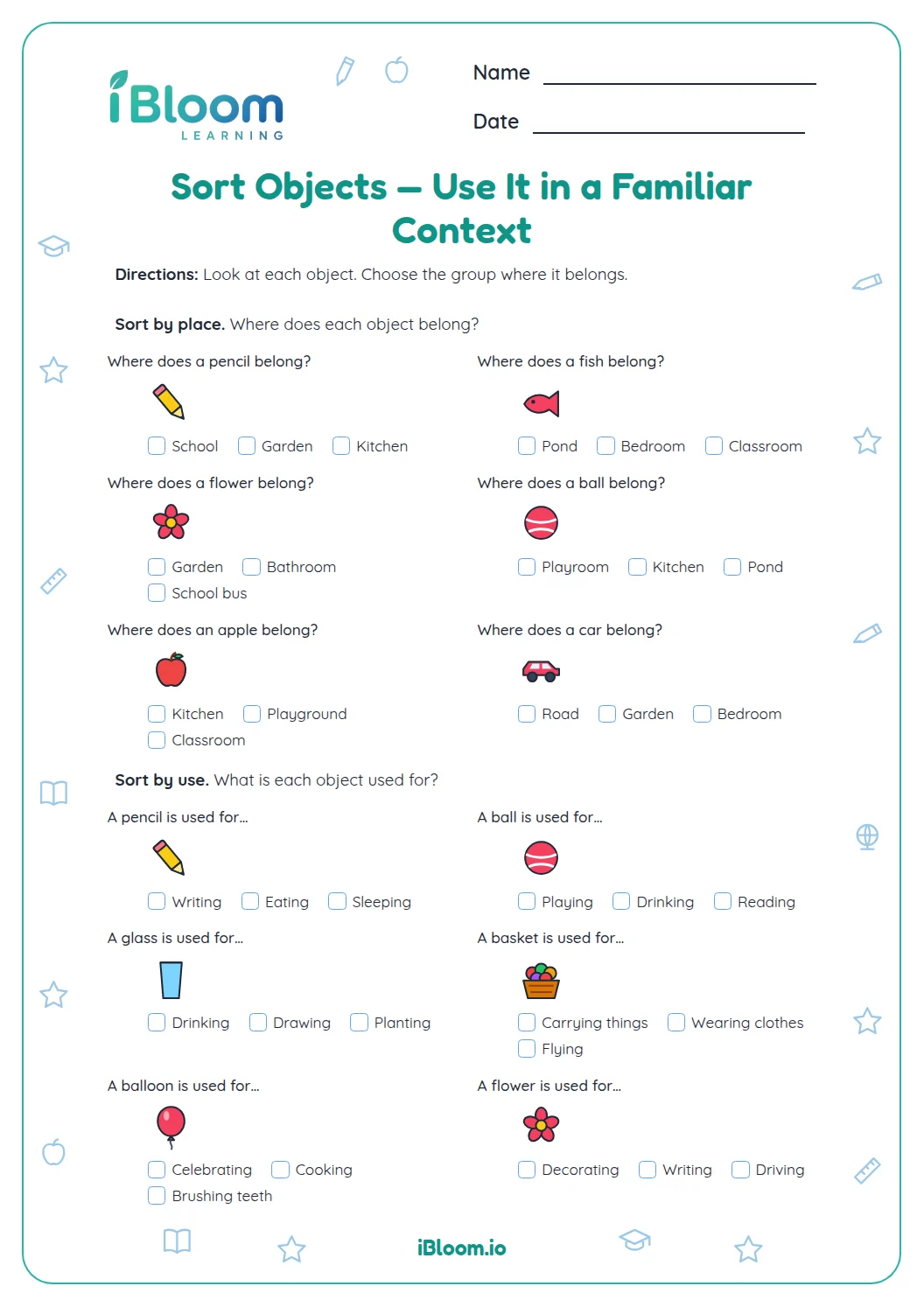
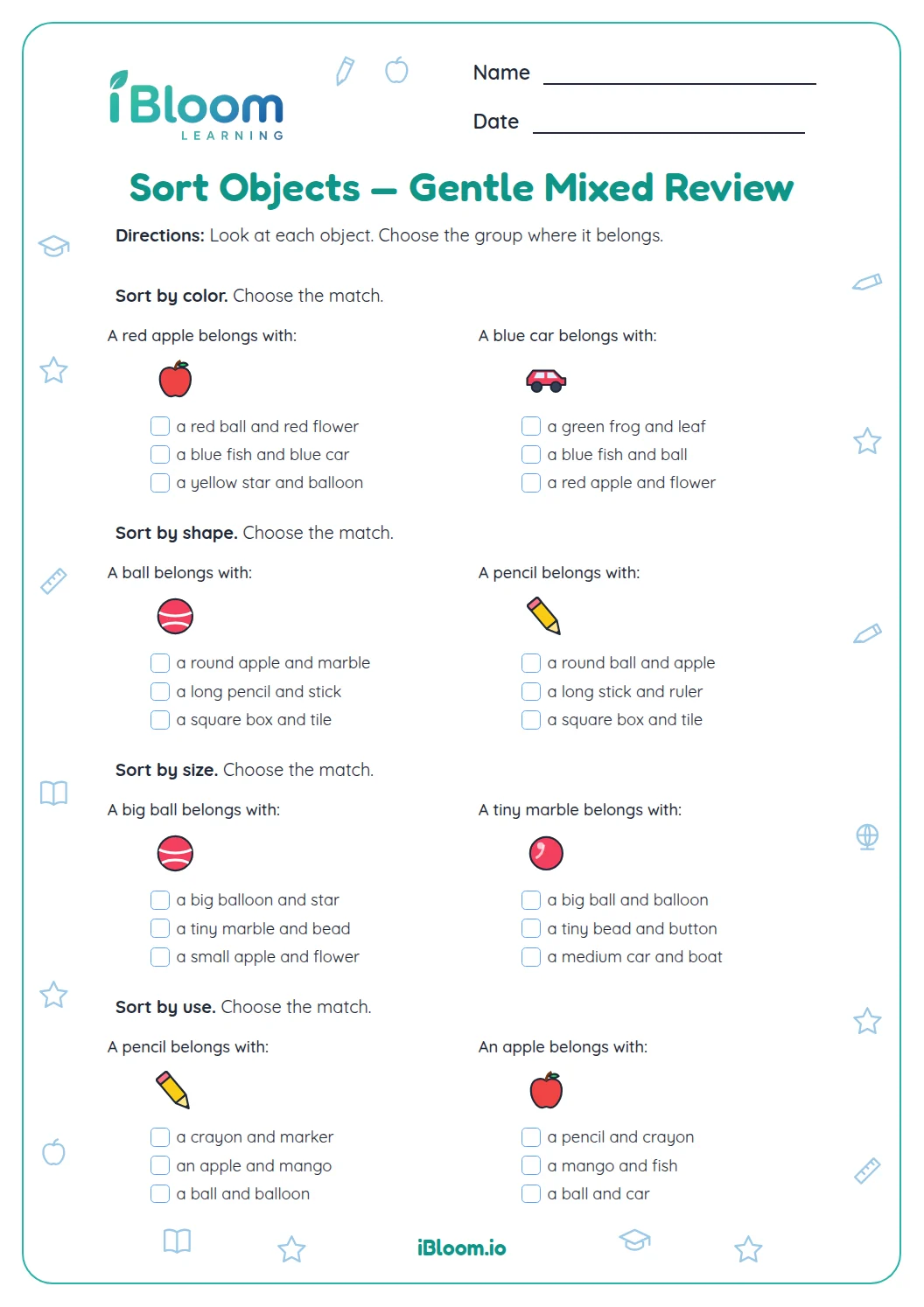
About this worksheet
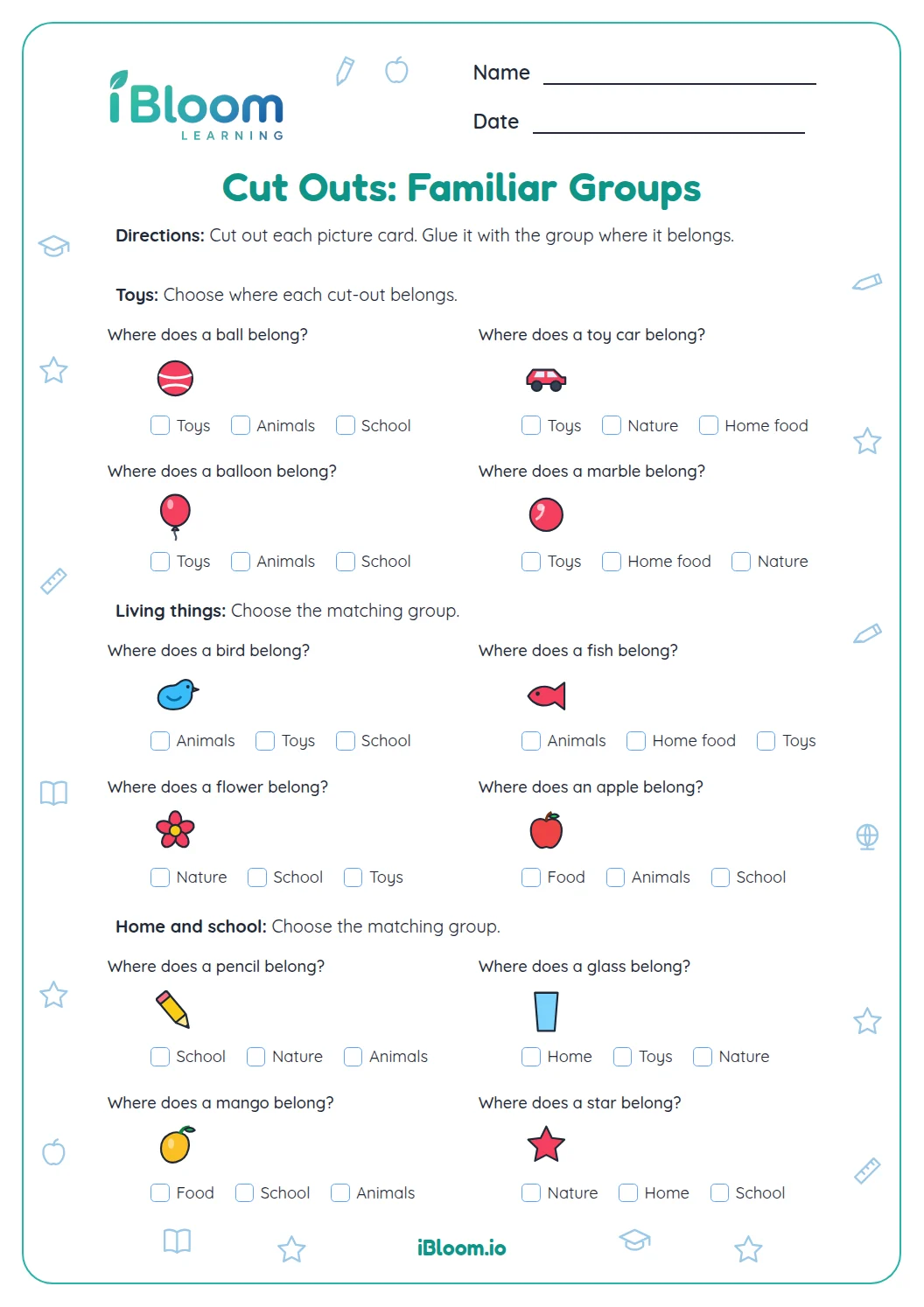
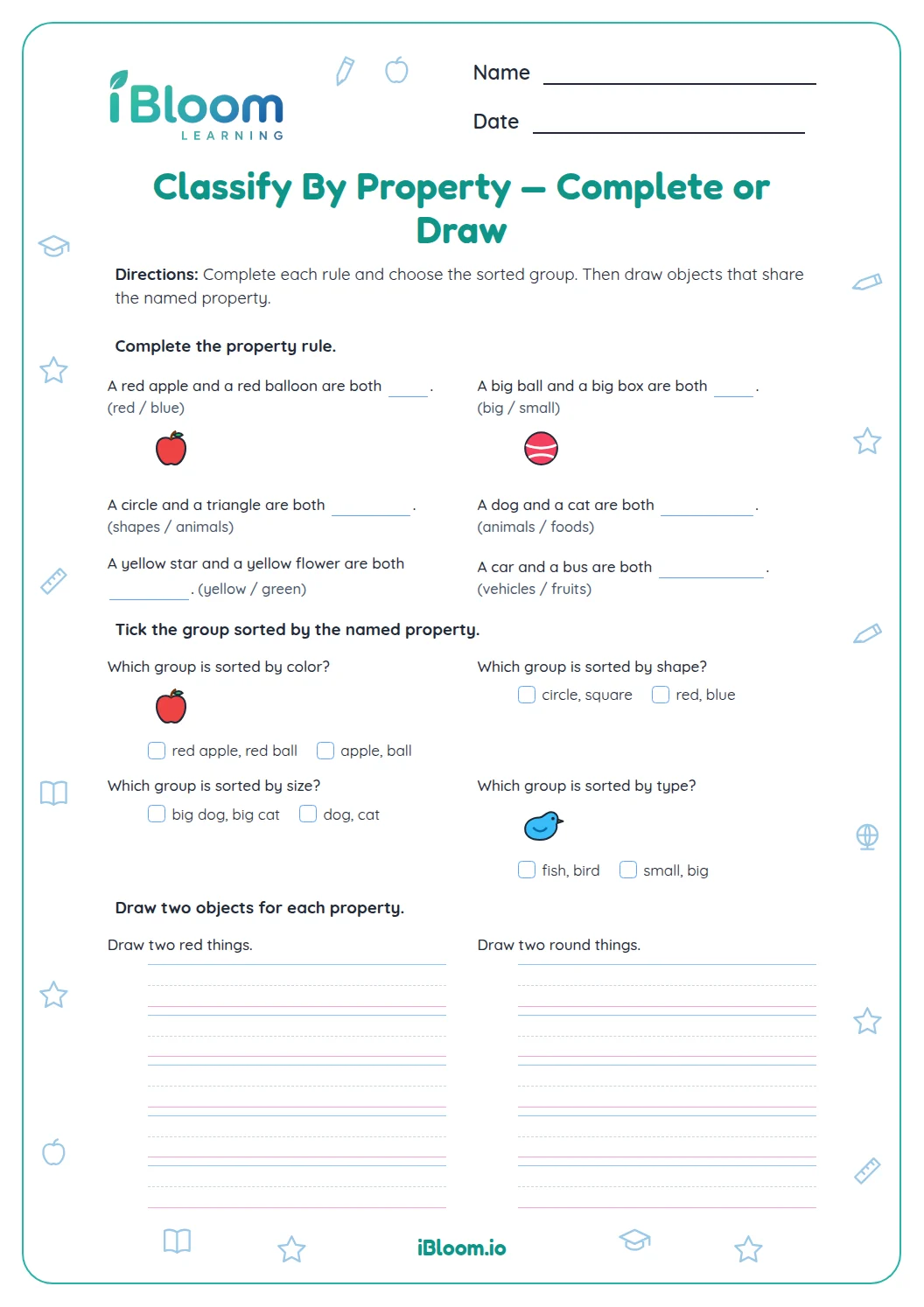
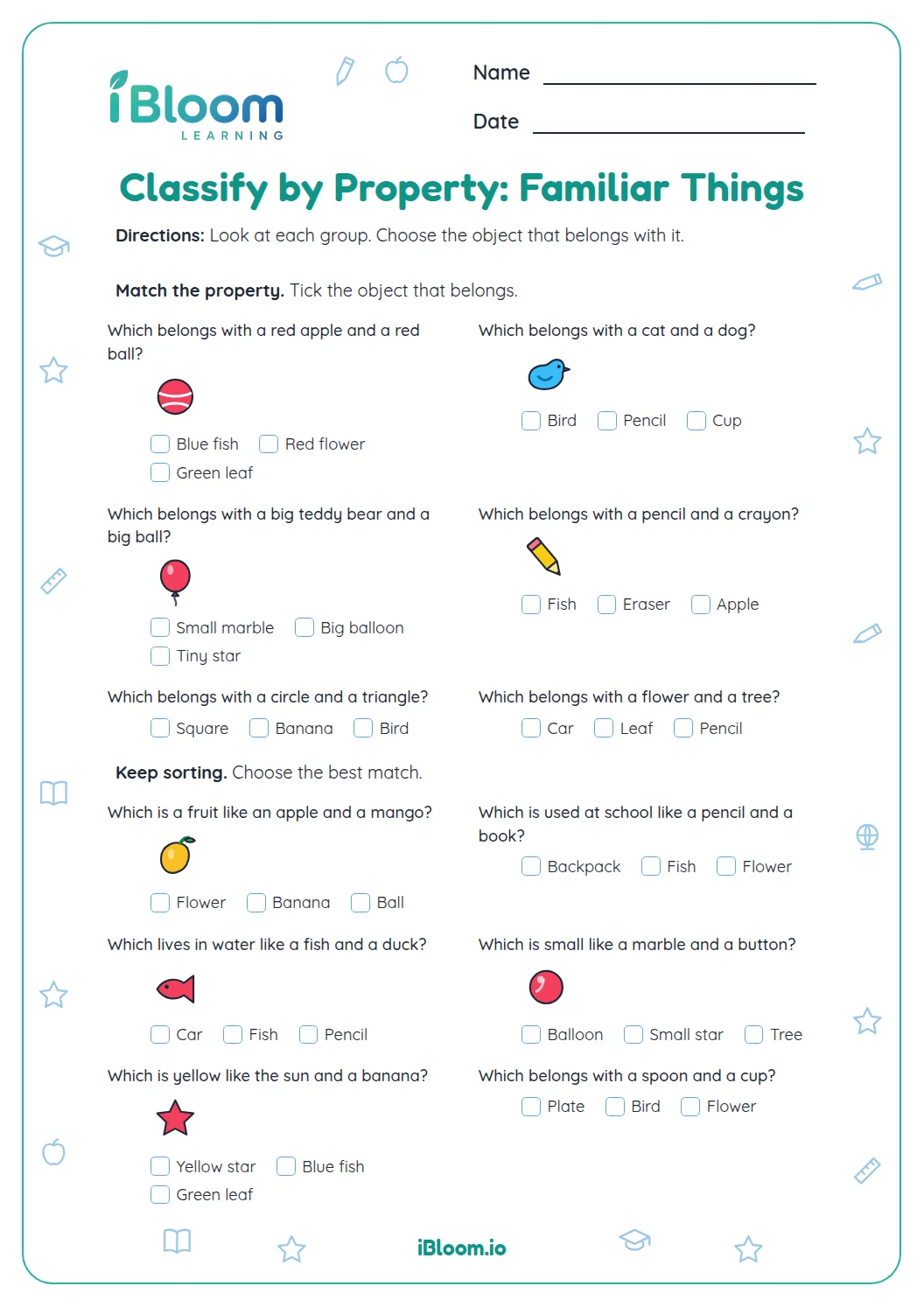
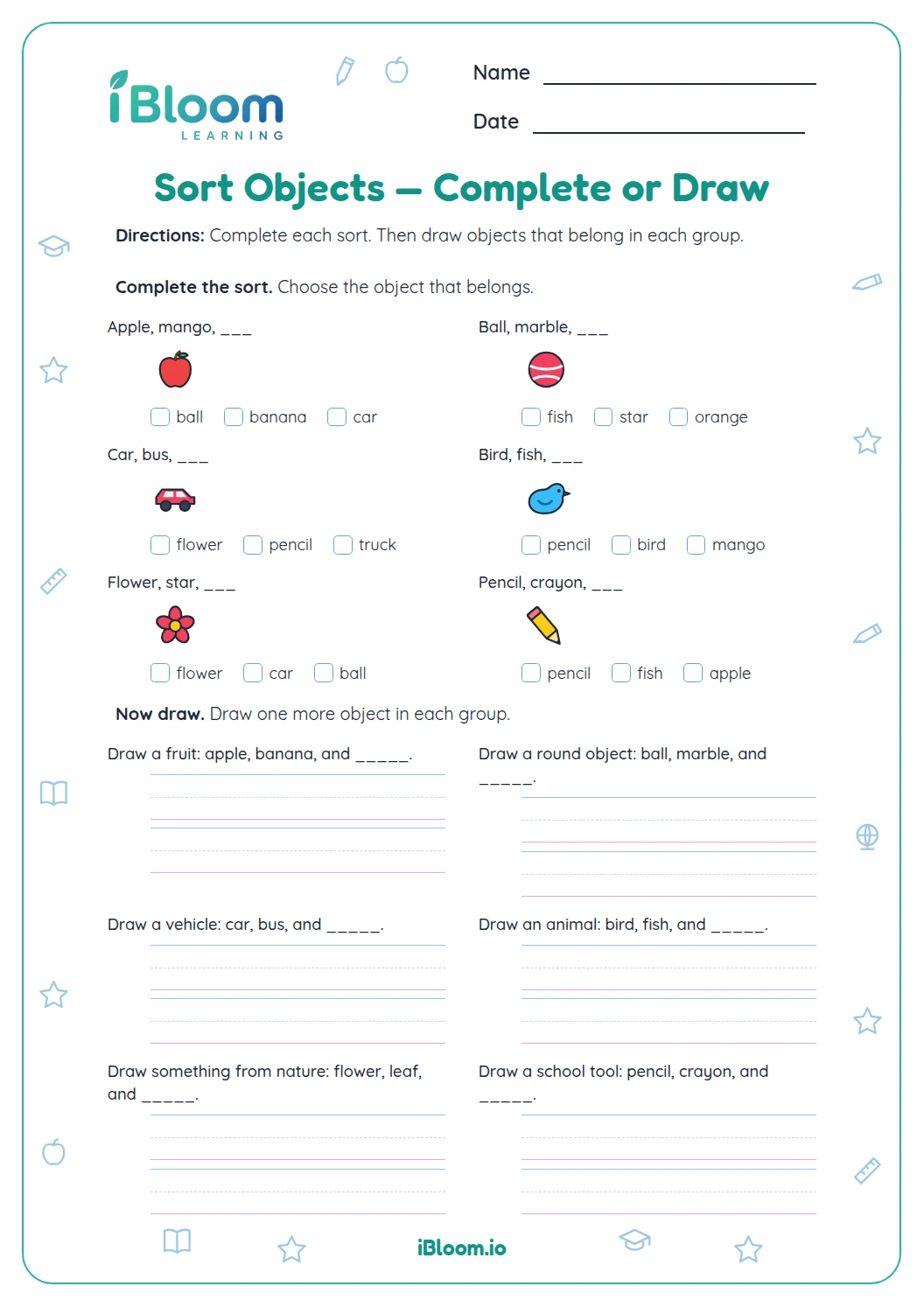
This free printable preschool and kindergarten worksheet uses familiar pictures to practice sorting and classification. Children identify an item by a feature, choose pictures that belong in the same group, find an odd one out, and sort animals into two named groups. The final group question asks children to count each category. There are 14 questions, with a separate answer key that includes a sample response for the open sort. The activities practice CCSS K.MD.B.3.
Aligned to K.MD.B.3
How do children choose a group by its feature?
Part A asks what an item is or what it can do. Children look at the pictures, name each object, and choose the one that matches a clear feature such as being a fruit or growing in a garden.
- 1Apple is a fruit; a car and ball are not.
- 2Choose the apple.
How can children tell which pictures belong together?
Part B names a group, such as animals or foods. Some questions have two correct pictures, so children should choose every picture that fits the category.
What makes an item the odd one out?
Part C gives three pictures where two share the named category and one does not. Part D extends the skill by sorting four animals into pets and wild animals, then counting both groups.
How to use this worksheet
- 1Say the name of each pictured object.
- 2Listen for the feature or group named in the question.
- 3Choose all pictures that fit when the prompt asks “which two.”
- 4For odd-one-out questions, find the two that share a category.
- 5For the final sort, name each group and count its members.
Common mistakes and quick fixes
The mistake
Choosing a picture that is familiar but does not fit the named group.
The fix
Check the feature in the prompt against every picture.
The mistake
Selecting only one picture when two belong.
The fix
Look for every item that matches the category.
The mistake
Sorting by a new rule instead of the given rule.
The fix
Keep the category names in view while placing each picture.
Early math alignment
This worksheet practices sorting objects into groups by shared features at the stated grade level.
Classify pictured objects into groups, count each group, and compare their totals.
On this sheet: Children classify pictures, count two categories in question 13, and compare the group totals.
Show the official wordingHide the official wording
Classify objects into given categories; count the numbers of objects in each category and sort the categories by count.
What to practice next
Make more practice
Further reading
Questions parents and teachers ask
What kinds of sorting are on the worksheet?
Children identify pictures by a feature, choose two or more items in a named group, find an odd one out, and sort four animals into pets and wild animals. The final question asks them to count the members in each group.
Are the picture questions meant to have one answer?
Most questions ask for one picture, but prompts that say “which two” have two correct choices. The answer key lists all pictures that fit those group questions. Question 13 is an open sorting task, so the key gives a model response.
What does odd one out mean?
It means one picture does not share the named category with the others. For example, a spoon does not belong with a hammer and broom when the group is tools. Children should use the category named in the question to decide.
How does the worksheet use counting?
In the last sorting task, children place cat and dog in the pet group and lion and bear in the wild-animal group. They count each group and compare the totals. Here, both groups have two pictures. The answer key shows the picture choices and the sample group counts.
How many questions and pages are included?
The worksheet has 14 picture questions across three pages, followed by a three-page answer key. It includes feature choices, group sorting, odd-one-out choices, a sort-and-count task, and one final feature review. The answer key shows the picture choices and the sample group counts.