
About this worksheet
This Grade 1 printable pairs a short original story about Ben the bear with 12 comprehension questions. Children recall details, follow the sequence of events, infer why Ben looks for warmth, and identify the main idea. A separate answer key includes concise responses and accepts equivalent wording when it matches the passage. It practices CCSS RL.1.1 and RL.1.3.
Aligned to RL.1.1 and RL.1.3
How can a reader use details from Ben’s story?
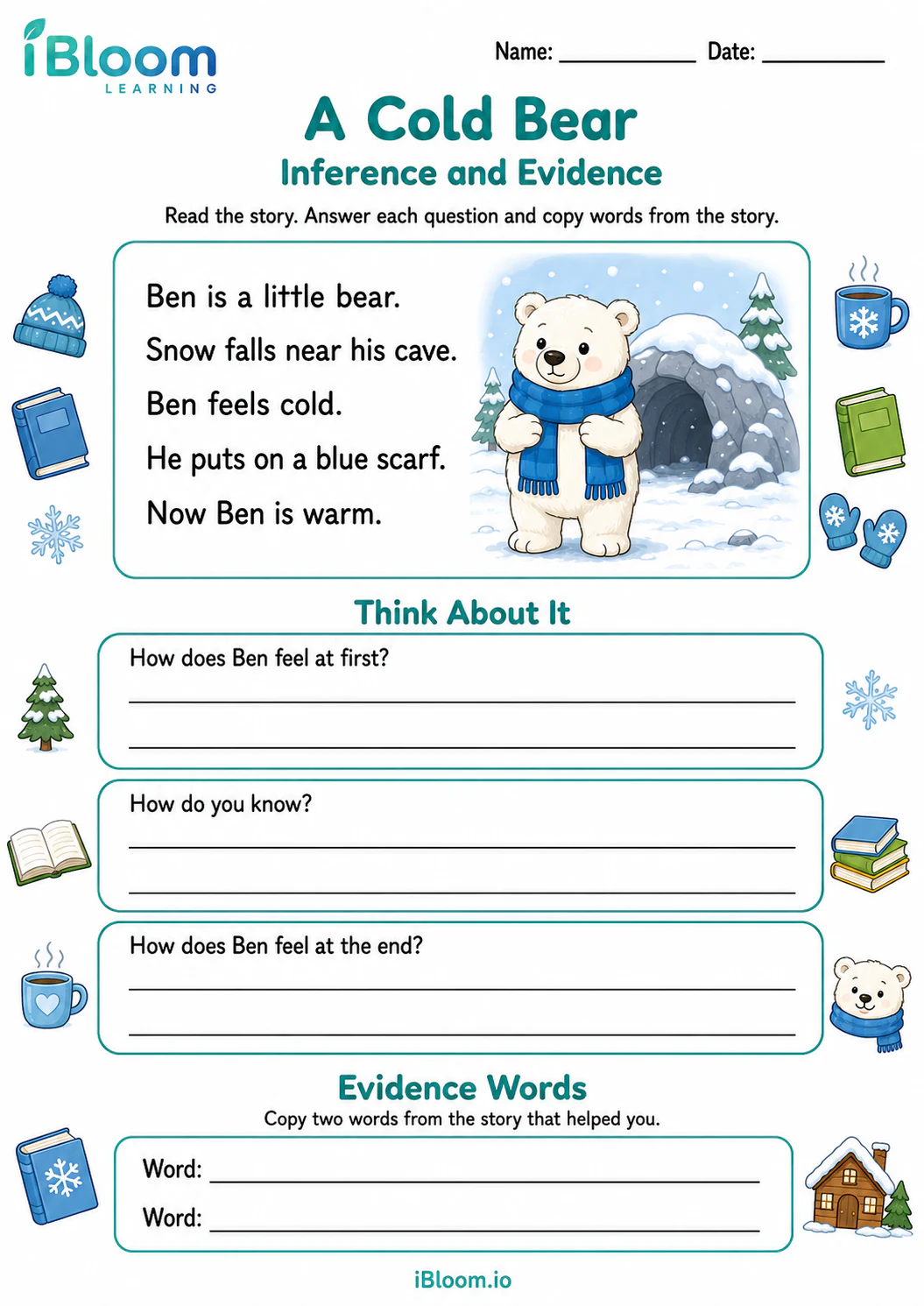
Return to the sentence that gives the detail, then answer in your own words. The story shows Ben feeling cold and putting on a blue scarf.
- 1Question 9 asks why Ben puts on the scarf.
- 2The story says Ben feels cold.
- 3Answer: Because he feels cold.
How is the practice organized?
Part A checks story details and main idea. Part B asks readers to recall the setting and actions, explain why Ben looks for warmth, and make a text-based prediction.
How can the answer key support review?
After finishing, compare each response with the key. For a missed item, reread the prompt and use the relevant relationship or text detail to correct it.
How to use this worksheet
- 1Read the directions and look over the parts.
- 2Try the first item in each part slowly.
- 3Use the key idea to solve the remaining items.
- 4Check each result against the prompt.
- 5Use the answer key to review any missed items.
Common mistakes and quick fixes
The mistake
Using the wrong operation or unit.
The fix
Name what the question asks for and check the unit in the answer.
The mistake
Skipping a check.
The fix
Use the original fact or sentence to verify the result.
The mistake
Rushing through a detail.
The fix
Read the full prompt and mark the information you need.
Common Core alignment
This worksheet gives focused practice with the standards below.
Ask and answer questions about key details in a text.
On this sheet: Ask and answer questions about key details in a text.
Show the official wordingHide the official wording
Ask and answer questions about key details in a text.
Describe story characters and events using key details.
On this sheet: Describe story characters and events using key details.
Show the official wordingHide the official wording
Describe characters, settings, and major events in a story, using key details.
What to practice next
Make more practice
Further reading
Questions parents and teachers ask
How long is the story?
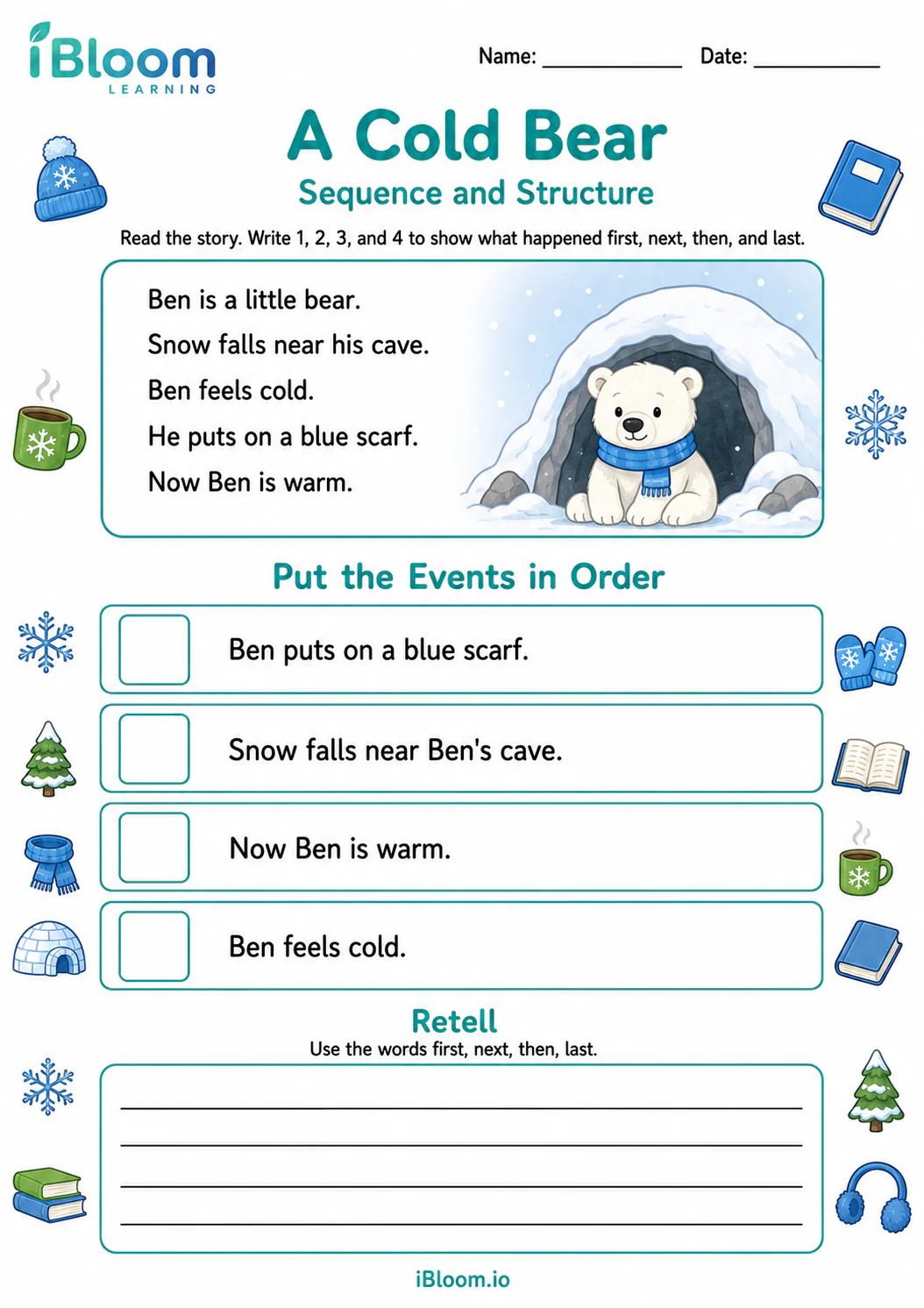
The passage is 68 words. It tells how Ben feels cold by his cave, finds a blue scarf, puts it around his neck, and warms up while watching snowflakes. The short sequence gives readers clear details to revisit for the recall and inference questions.
What comprehension skills do the questions cover?
The 12 items ask about details, sequence, an inference, a supporting detail, and the main idea. The four multiple-choice questions offer a few possible answers; the remaining prompts let children put story details into their own words. This gives a clear chance to review the skill.
Does the answer key allow different wording?
The key gives concise responses for the short-answer questions. Accept different wording when it preserves the story detail; for example, “near his cave” answers where the snow falls. For the prediction, a sensible answer should use the scarf detail from the passage.
Should my child read the passage alone?
A child may read the passage independently or listen as an adult reads it aloud. In either case, encourage a return to the story before answering. Finding the sentence that describes an event helps connect a response to the text.
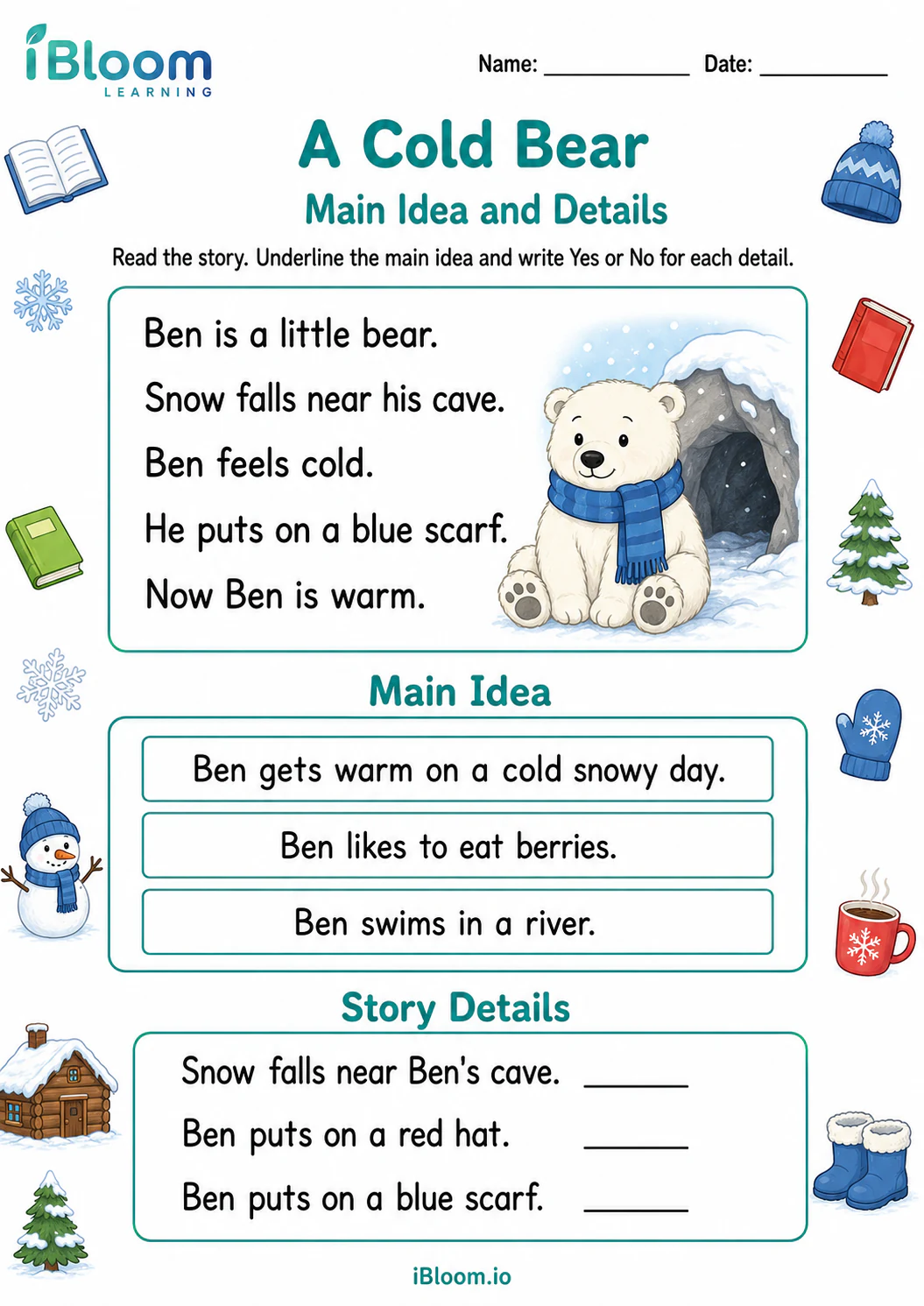
What is the main idea of A Cold Bear?
The main idea is that Ben finds a way to get warm by putting on a scarf. The cold weather introduces his problem, and the blue scarf helps solve it. At the end, Ben is comfortable enough to sit by his cave and watch the snowflakes.