
About this worksheet
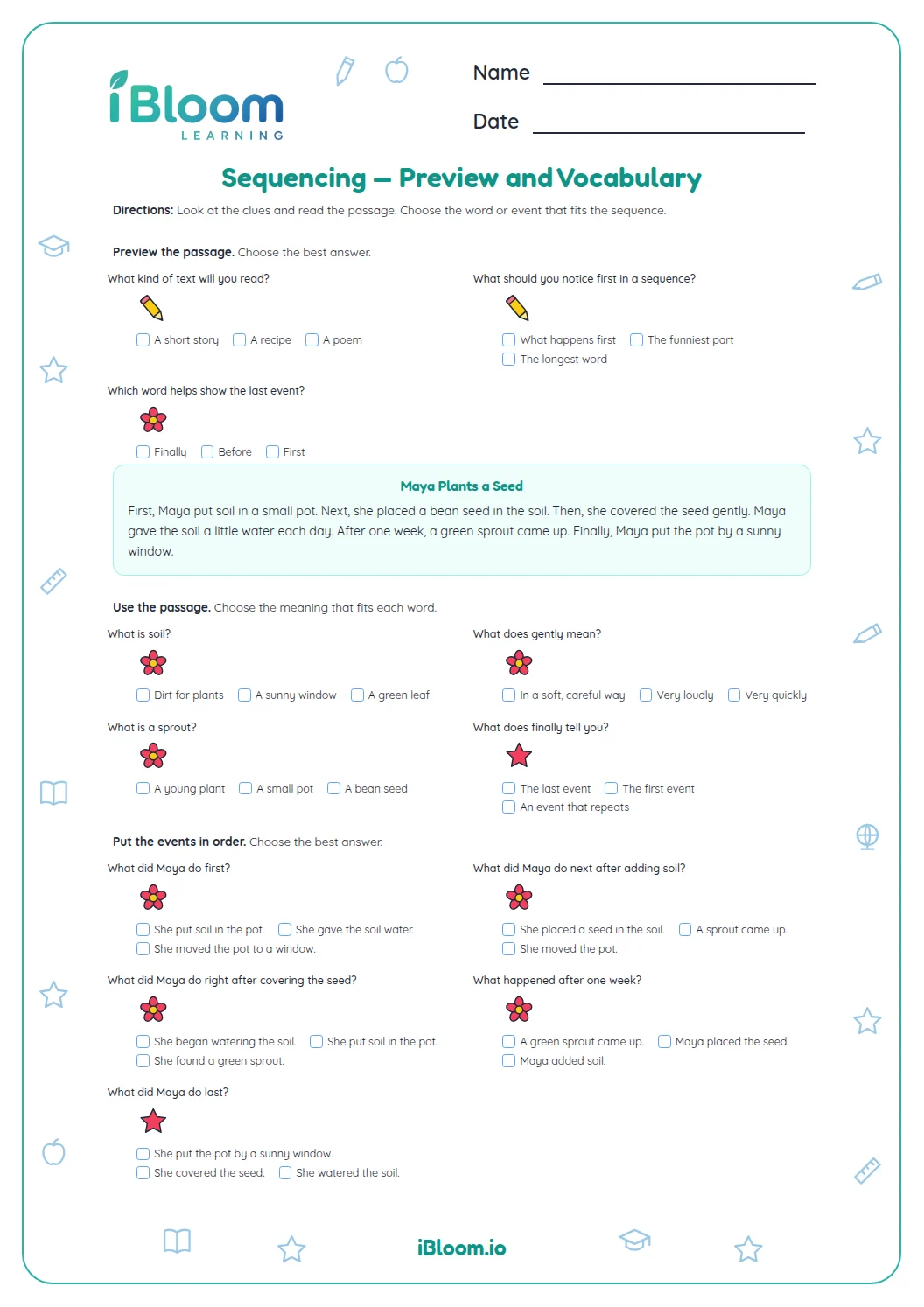
This free printable worksheet helps Grade 1 readers see how a short story is put in order. Children read “Maya Plants a Seed,” where the words First, Next, Then and Last mark each planting step. They pick out the first and last time-order words, say what Maya does next and in the last step, notice that the story tells its steps in the order they happen, number four steps from 1 to 4, and draw the sprout that pops up after six days. It practices Common Core RL.1.3, describing the major events of a story. The 10 questions fill 2 pages, with a separate answer key.
Aligned to RL.1.3
What is on this worksheet?
A short story about Maya planting a bean in a cup, followed by three parts of questions. The passage is 70 words, and each of the four planting steps starts with a time-order word.
The questions move from words to events to a picture. Children first find the words that show the order, then decide what happens next and how the story is organized, then number the steps themselves, and finally draw the ending.
- Part A: read the passage, “Maya Plants a Seed”
- Part B: time-order words, what Maya does next and in the last step, and how the story is ordered (questions 1 to 5)
- Part C: number four steps from 1 to 4 (questions 6 to 9)
- Part D: draw what Maya sees when the sprout pops up (question 10)
How do first, next, then and last help a reader?
These words work like signposts. When a child sees First, they know the story is starting. Next and Then show that more steps follow, and Last shows that the steps are done.
Questions 1 and 2 ask for the first and last words straight from the passage, a quick start before the harder questions. Question 5 then asks how the whole story is organized: in the order things happen, which is exactly what those words signal.
- 1Question 1: Which word tells the first step? → First
- 2Question 2: Which word tells the last step? → Last
- 3Question 3: after the soil, Maya pushes in a bean → “Next, she pushes a bean into the soil.”
How do you put the steps in order?
The four steps in Part C, questions 6 to 9, are printed out of order on purpose. Children find each one in the passage, look at the time-order word in front of it and write a number from 1 to 4.
A helpful trick is to look for First and Last before writing anything. That leaves only two steps in the middle, and Next comes before Then.
- 1Maya fills a small cup with soil. → 1 (First)
- 2Maya pushes a bean into the soil. → 2 (Next)
- 3Maya pours in a little water. → 3 (Then)
- 4Maya sets the cup in a sunny window. → 4 (Last)
Why draw the ending?
Drawing asks a child to picture what happened after the steps. The last sentences of the story say that after six days a tiny green sprout pops up. A good drawing shows a cup with soil and a small green sprout.
A picture also shows what a child understood without the burden of writing. A child who draws the bean instead of the sprout may have missed that time has passed.
How to use this worksheet at home or in class
- 1Read the passage aloud together once. Then let your child read it again and point to each time-order word.
- 2Have your child answer questions 1 to 5. They can touch the words in the passage while they decide.
- 3For Part C, ask them to find First and Last in the story and number those steps before the middle ones.
- 4Before the drawing, ask your child what Maya waits six days for, and talk about how long six days feels.
- 5Encourage them to draw the cup, the soil and the sprout in question 10, and to add details of their own.
- 6Finish by asking your child to tell you how to plant a seed using the words first, next, then and last.
Common mistakes and quick fixes
The mistake
Numbering the steps down the page in the order they are printed, so “sets the cup in a sunny window” in question 6 becomes 1.
The fix
Tell your child the steps are mixed up on purpose. Have them find each step in the story and look at the word before it. First is 1 and Last is 4.
The mistake
Answering question 3 with “She pours in water,” which is a later step.
The fix
Ask your child to find the soil sentence in the story. The sentence right after it says Next, so the answer is the bean.
The mistake
Drawing the bean going into the soil in question 10 instead of the sprout.
The fix
Reread the last part of the story. After six days, something new pops up. Ask your child what it looks like, then add that to the drawing.
Common Core alignment
Most US states teach reading with the Common Core standards or a close state version. This Grade 1 standard fits the sequence work on this sheet.
Describe the main events of a story, using details, such as each step Maya takes.
On this sheet: Maya's four planting steps and the sprout are the major events, and every question asks children to name, order or draw them.
Show the official wordingHide the official wording
Describe characters, settings, and major events in a story, using key details.
What to practice next
Make more practice
Further reading
Questions parents and teachers ask
How long is the passage on this worksheet?
The passage, “Maya Plants a Seed,” is 70 words. Each of the four planting steps begins with a time-order word, so first graders can find each step by looking for it. Children can read it on their own if they are ready, or you can read it aloud together first.
Which time-order words are on the sheet?
The story uses First, Next, Then and Last, and it ends with After six days. Questions 1 and 2 ask for the first and the last word, question 5 asks how the story is ordered, and Part C asks children to number the steps by looking at those words.
Why are the steps in Part C out of order?
They are mixed up on purpose so children have to use the passage and cannot just number them from the top. Children find each step in the story, notice the time-order word in front of it and write 1, 2, 3 or 4. The key gives the correct order.
Does my child have to write sentences?
No sentences are needed. Children color circles for the multiple-choice questions, write one number for each step and draw a picture. A small amount of writing keeps the focus on understanding order. If your child enjoys writing, ask them to tell you the story aloud using first, next, then and last.
What should the drawing in question 10 show?
A good drawing shows a cup with soil and a small green sprout coming up, because the story ends after six days with a tiny green sprout. Extra details, such as the sunny window or Maya smiling, are welcome. The answer key describes what to look for.
What should my child do after this worksheet?
Ask your child to tell you how to make a sandwich or brush teeth, using first, next, then and last. Then try the sequencing or plot worksheets, which use the same idea with other stories. Talking through familiar steps at home gives children more practice with order.