

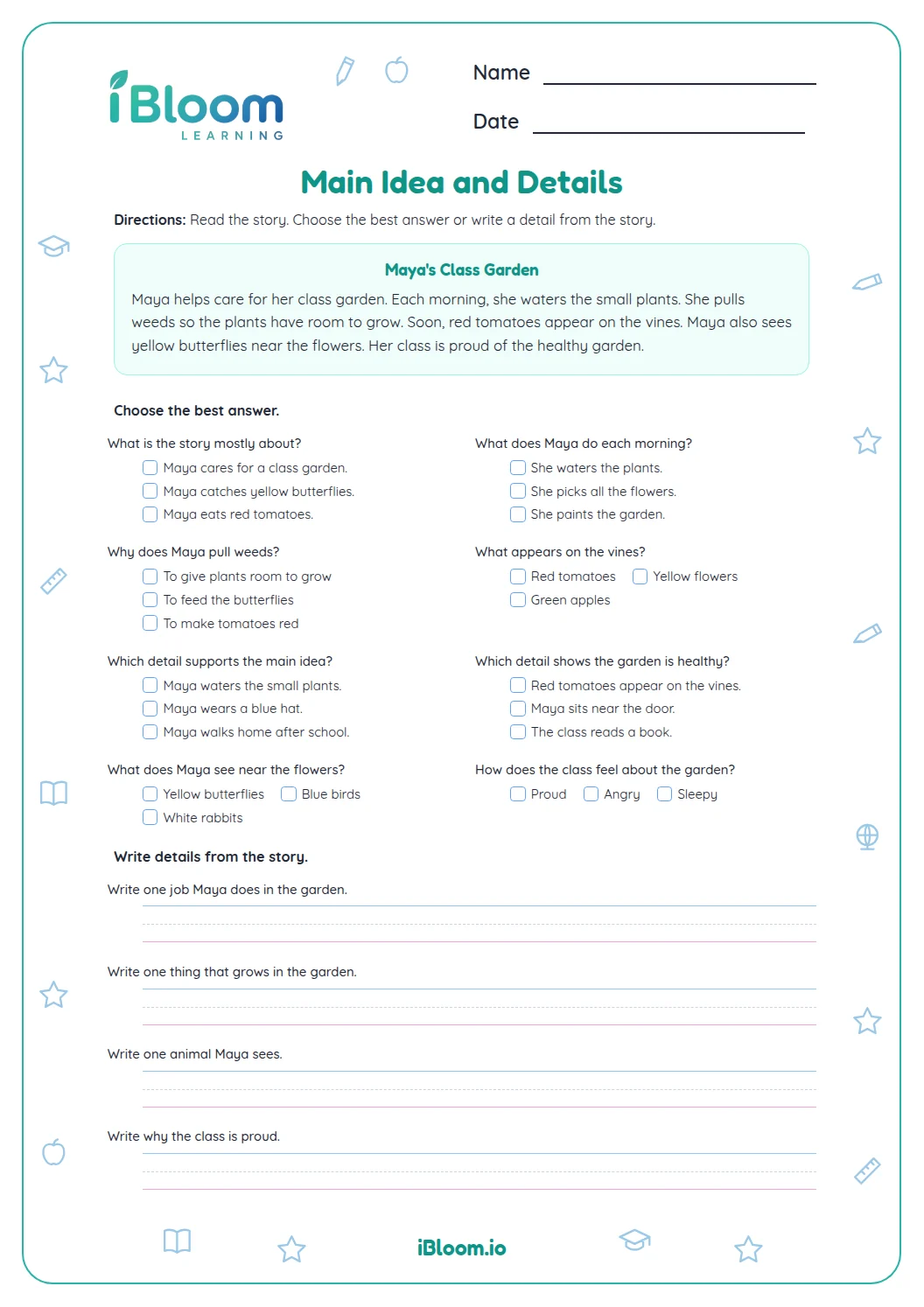

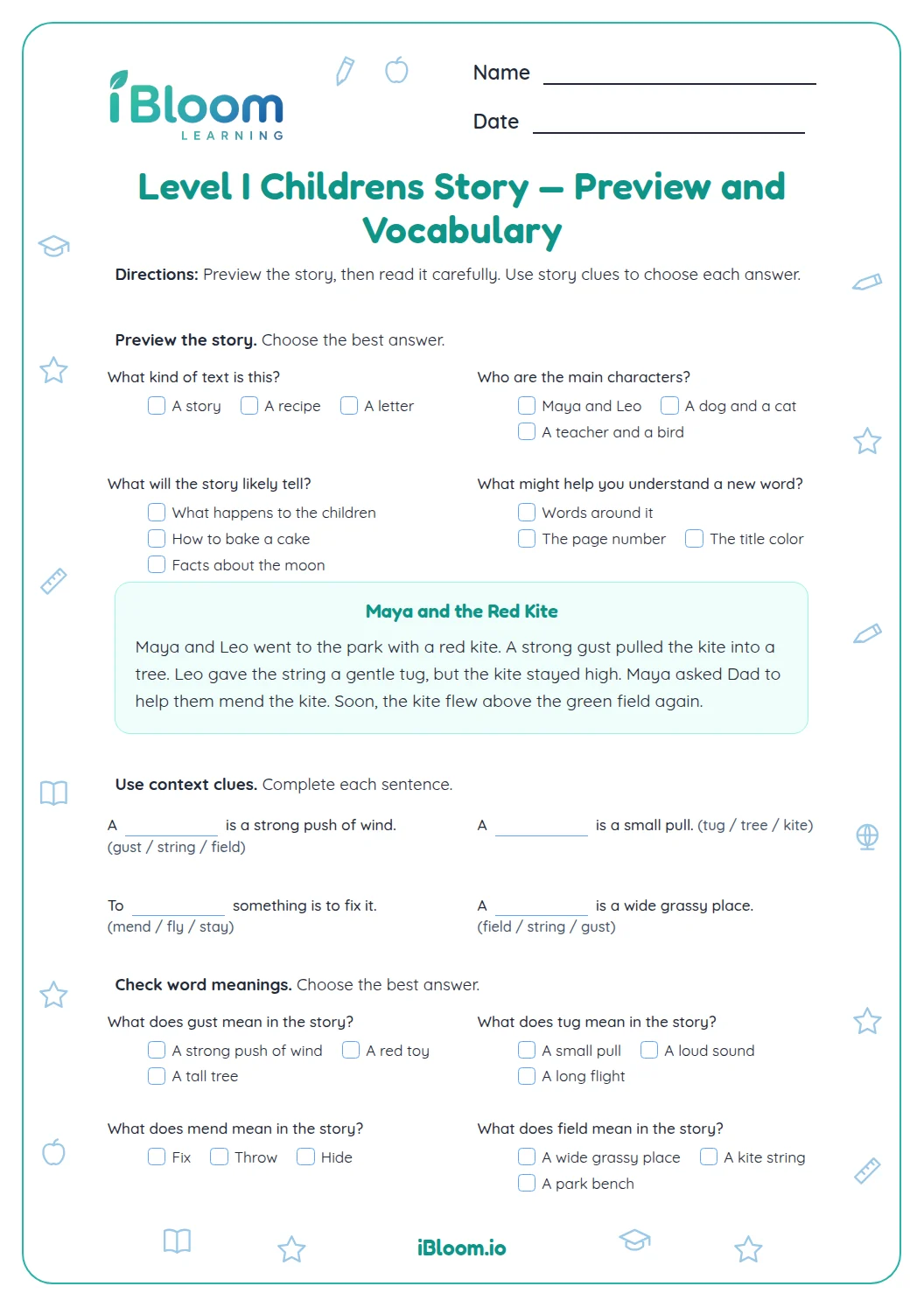

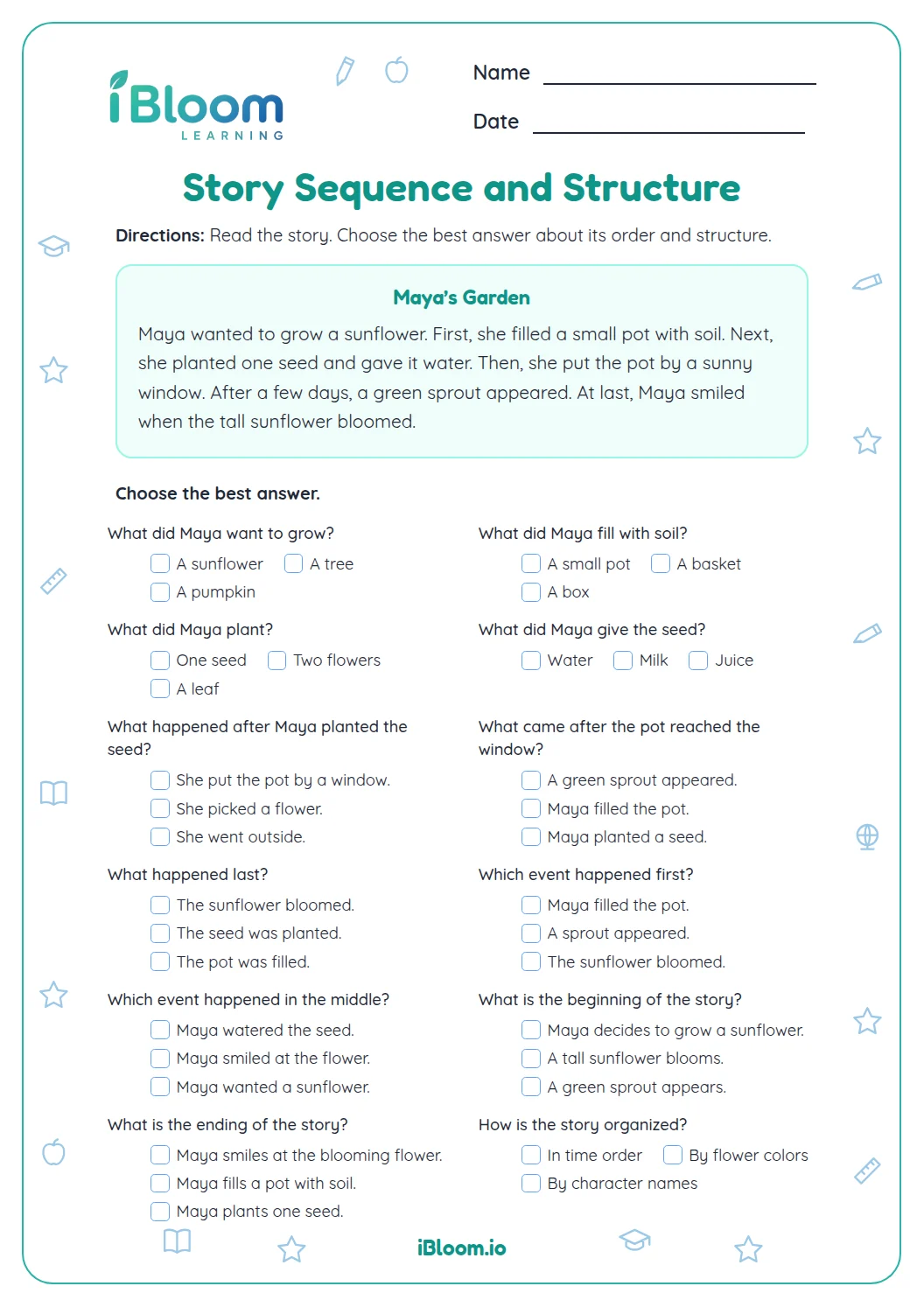

About this worksheet
This Grade 1 worksheet pairs an original 69-word story about Maya’s sunflower garden with 14 comprehension questions. Students first choose answers about people, actions, place, and sequence, then write short responses using details from the story. The questions support CCSS RL.1.1 by asking readers to answer questions about key text details. The answer key includes concise sample responses.
Aligned to RL.1.1
How can a reader find a story detail?
Look back at the sentence that tells who, what, where, or when. The story says Maya planted three sunflower seeds in a garden bed, so those details answer the first questions.
- 1Question: What did Maya plant?
- 2Answer: three sunflower seeds
How can a reader put events in order?
Notice what Maya does first and what happens later. She plants and waters the seeds before tiny leaves appear on Friday.
- 1Filling the pot happens before the leaves appear.
What makes a written response useful?
A short answer can name a detail directly. When a question asks how you know, connect the idea to an action in the story, such as Maya watering the soil each morning.
How to use this worksheet
- 1Read the story once to learn who and what it is about.
- 2Read the question and look back for a matching detail.
- 3For sequence questions, notice time words such as “each morning” and “Friday.”
- 4Write a complete short answer for Part C.
- 5Reread your response and check it matches the story.
Common mistakes and quick fixes
The mistake
Answering from memory without checking the story.
The fix
Point to the sentence that gives the detail before writing.
The mistake
Mixing up what happened first and later.
The fix
Follow the actions in the order they appear.
The mistake
Writing an answer that does not explain how you know.
The fix
Include a story action or detail that supports your idea.
Common Core alignment
This page practices the following Common Core skill.
Ask and answer questions about key details in a text.
On this sheet: Students answer detail, sequence, and inference questions using the story.
Show the official wordingHide the official wording
Ask and answer questions about key details in a text.
What to practice next
Make more practice
Further reading
Questions parents and teachers ask
How long is the story?
The story has 69 words and follows Maya as she plants and cares for three sunflower seeds. Its short sentences leave room for students to reread details while they answer the questions. After each part, pause to reread the story and compare the response with the separate answer key.
Do children need to write full paragraphs?
No. Most written responses need only a short sentence or phrase. The final prompt invites one sentence about what Maya might do next, so children can make a simple prediction. This short page is easy to pause between parts and review together using the separate answer key.
Can answers use different words from the key?
Yes. The key provides sample wording. Accept another answer if it matches a detail or reasonable idea from Maya’s garden story and responds to the question. After each part, pause to reread the story and compare the response with the separate answer key.
What is the difference between a detail and an inference here?
A detail is stated directly, such as Maya seeing tiny green leaves on Friday. An inference combines clues, such as Maya caring for the plants because she waters the soil each morning. After each part, pause to reread the story and compare the response with the separate answer key.
Should I read the story aloud?
You can read it together if that helps your child focus on meaning. Then invite your child to find the matching sentence and answer in their own words. After each part, pause to reread the story and compare the response with the separate answer key.