




About this worksheet
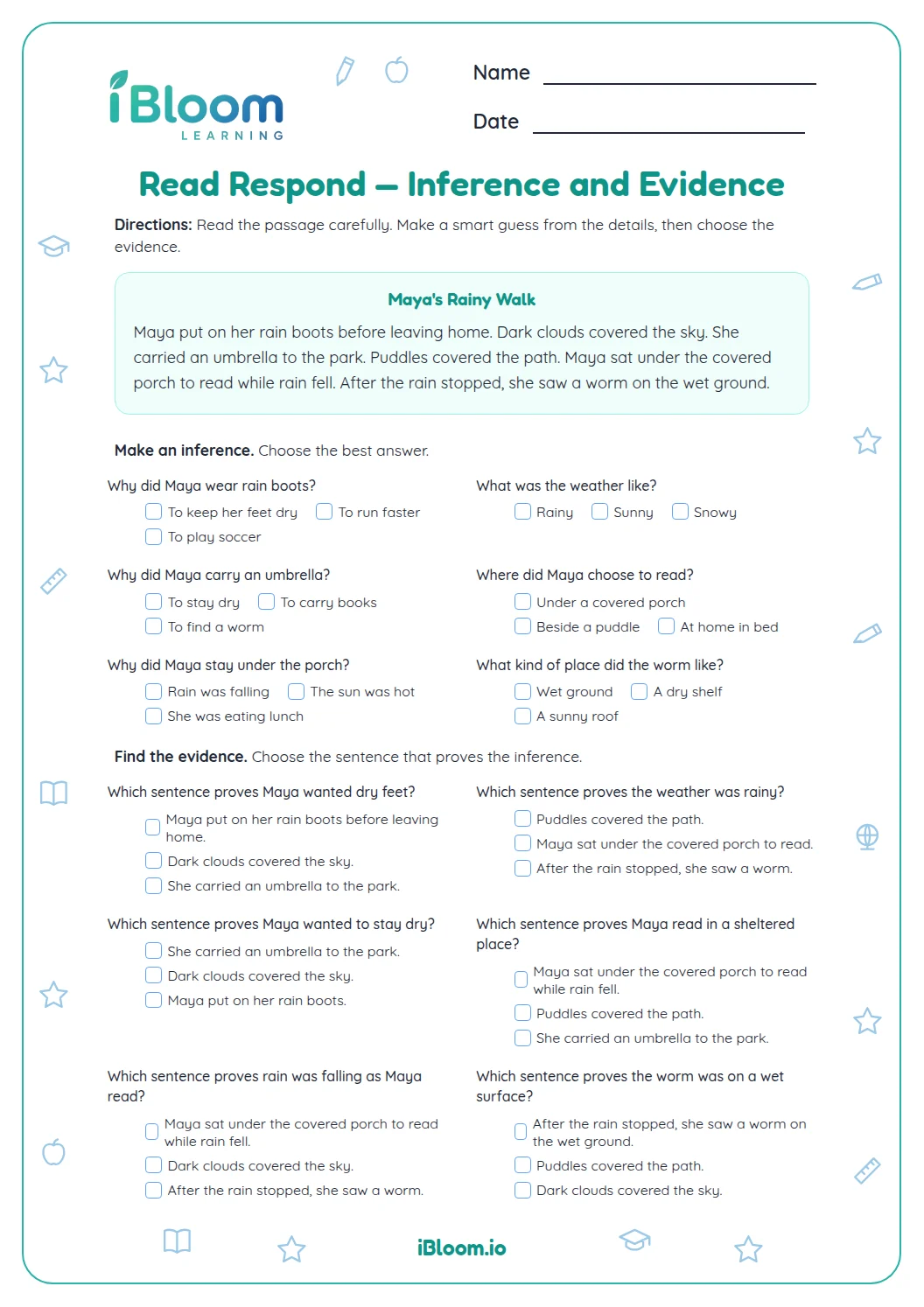
This Grade 1 printable pairs an original 72-word story with 14 questions about inference and evidence. Learners follow Nora as she responds to the rain, then use details such as the puddle and the worm to explain what they can infer. The sheet includes two sets of multiple-choice questions, which learners color, and four short written responses, followed by a separate answer key. Its questions practice CCSS 1.RL.1 by asking readers to answer questions about key details.
Aligned to 1.RL.1
How can a reader make an inference?
An inference combines a story detail with what the reader already knows. Nora puts on rain boots after drops tap on the path; that clue suggests it is raining. Later, a puddle forms around the can, so the reader can infer that rain continued.
Question 3 asks how Nora probably felt when she saw the puddle. Her smile and her gentle help for the worm support “glad.” The answer is an inference because the story never names her feeling directly.
- 1Clue: Nora smiled.
- 2What I know: People may smile when they feel glad.
- 3Inference: Nora probably felt glad.
What counts as evidence in this story?
Evidence is a detail stated in the passage. For question 4, “She picked it up gently” supports the idea that Nora cared about the worm. A response should point to a detail instead of adding an event that is not in the story.
For the written questions, a short sentence is enough. The answer key offers a sample; other answers can work when they fit the passage.
What will learners do on the page?
The passage is followed by 10 multiple-choice questions and four short responses. Learners color a supported answer, then use details to connect a clue to a likely cause, feeling, or next event.
How to use this worksheet
- 1Read the story once for what happens.
- 2Read it again and notice details about the weather and Nora’s actions.
- 3For each multiple-choice item, color the bubble for the best answer and point to its supporting clue.
- 4In written responses, name the detail and connect it to an answer.
- 5Check the sample answers, allowing other text-supported responses.
Common mistakes and fixes
The mistake
Choosing an answer that sounds possible but does not fit a story detail.
The fix
Ask “Which words in the story make me think that?”
The mistake
Treating an inference as a fact the passage states directly.
The fix
Use “probably” for a conclusion and name the detail that led to it.
The mistake
Writing a prediction without a clue.
The fix
Connect the prediction to the last event, such as rain watering the seeds.
Common Core alignment
This worksheet practices the standard below through its own question set.
Answer questions about the story’s key details and use those details as clues.
On this sheet: Learners answer literal and inferential questions using details from the original story.
Show the official wordingHide the official wording
Ask and answer questions about key details in a text.
What to practice next
Make more practice
Further reading
Questions parents and teachers ask
How long is the passage?
The original story is 72 words and follows Nora on a rainy trip to her garden. Fourteen questions follow: ten multiple-choice items and four written responses. Learners color supported choices, and the answer key includes a sample for each written response so an adult can check the story detail.
How many answers are written?
Four questions ask for a short written response. The key gives one sample answer for each, but a child may use different words if the response fits the passage. Ask the learner to point to the clue that supports the answer.
Does the passage state Nora’s feelings?
The passage does not name Nora’s feeling directly. Readers use story details, including her smile and gentle action toward the worm, to infer what she may feel or what her actions suggest. The multiple-choice options ask for a conclusion supported by those clues.
What counts as evidence in the story?
Evidence is a detail the passage states. For example, “She picked it up gently” supports the idea that Nora is trying to help the worm. A response should connect an answer to a real story detail rather than add an event that never happens.
Can I read the passage aloud?
Yes. An adult can read the story while the learner follows the print, then invite the learner to reread the relevant line before answering. This keeps attention on the passage details even when reading the questions independently is still developing.
How many pages will print?
The story and questions use three worksheet pages, and the answer key is three pages. The first page contains the passage and opening questions; later questions continue on the next pages, with the key following the same question order so sections are easy to compare.