





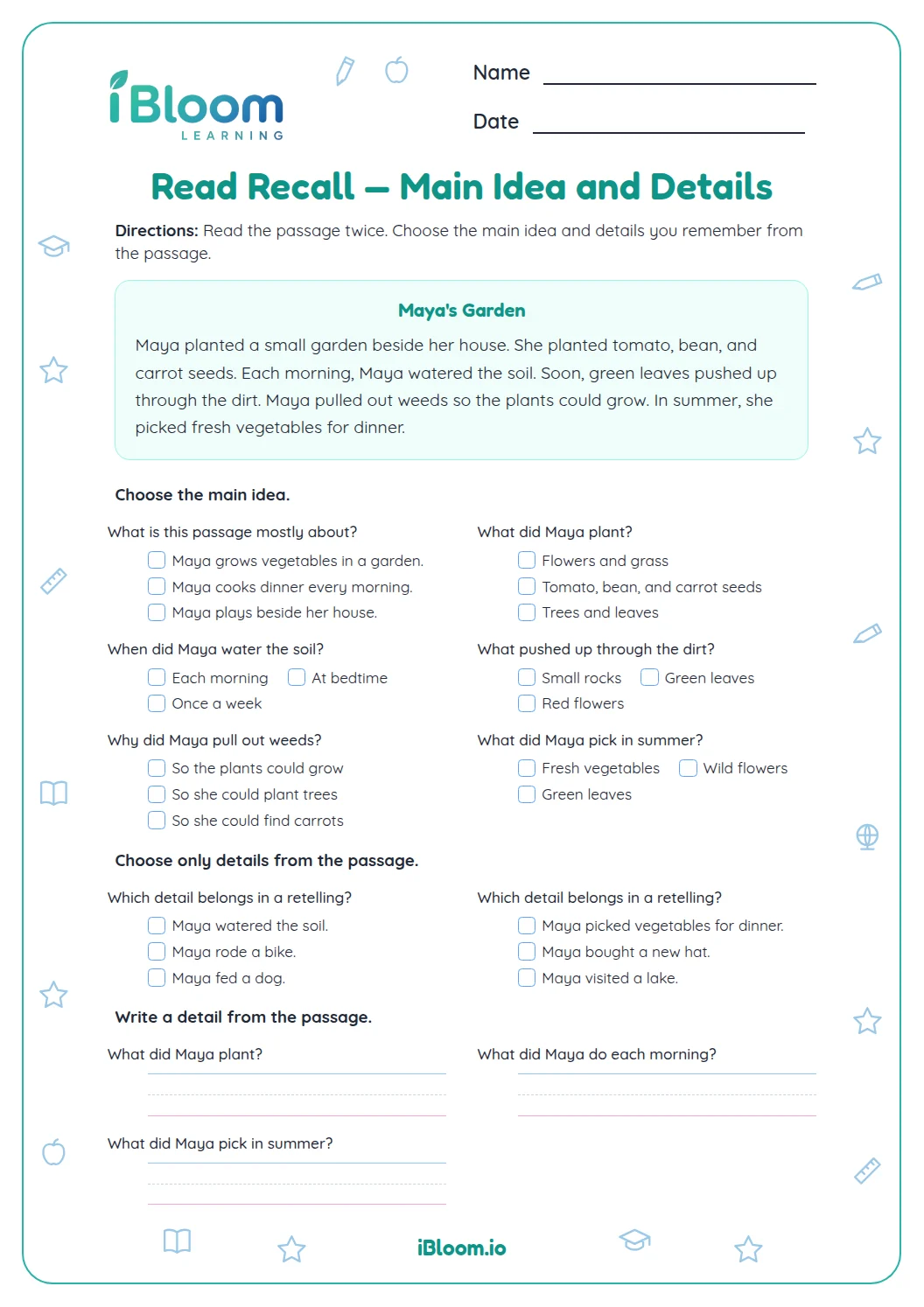
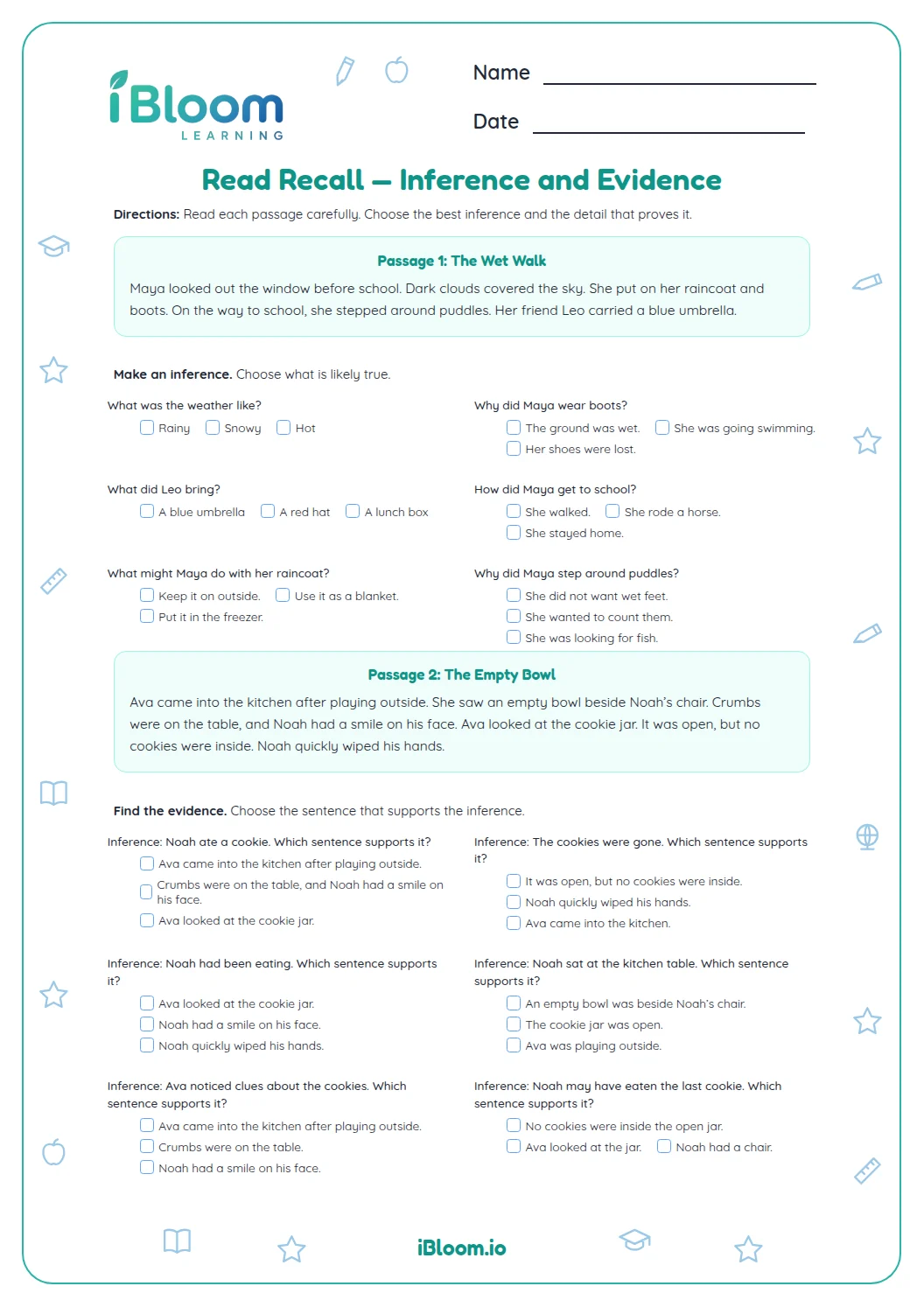
About this worksheet
This Grade 1 reading worksheet pairs an original, 79-word passage with 15 questions about Maya and Leo setting a garden table. Learners find stated details, follow what happens after lunch, and connect clues such as the colors and locations of objects. The questions practice CCSS RI.1.1 and a separate answer key is included. The old color-the-picture activity has been adapted into text-evidence questions because the page template cannot print a child-colorable picture task.
Aligned to RI.1.1
How can a reader find a stated detail?
Look back at the passage and find the sentence that names the person, place, color, or number. For example, “A small blue bowl held three strawberries” gives both the bowl’s color and its contents.
- 1How many strawberries were in the bowl?
- 2Answer: Three
- 3The passage states the number directly.
How do sequence questions work?
Notice time words such as “after lunch.” The passage says Maya carried the bowl inside, while Leo left the napkin on the table. Those details help distinguish one event from another.
What does a text clue help explain?
A question about why they ate outside asks the reader to connect an action with its stated reason: the kitchen was being cleaned. Use the passage’s words to support an answer.
How to use this worksheet
- 1Read the passage once to understand who is there and where they are.
- 2Read one question at a time.
- 3Look back for a sentence that gives the answer.
- 4For “why” questions, connect the action with its reason.
- 5Check the answer key after completing the questions.
Common mistakes and quick fixes
The mistake
Using a detail from the wrong object.
The fix
Reread the whole sentence and match the color or location to the named object.
The mistake
Mixing up what Maya and Leo did.
The fix
Look for each person’s name in the sentence before answering.
The mistake
Answering a “why” question with only an event.
The fix
Find the sentence that tells the reason, not just what happened.
Common Core alignment
This worksheet practices asking and answering questions about a short text.
Answer questions about key details in Maya and Leo’s short passage.
On this sheet: The worksheet directly practices this skill.
Show the official wordingHide the official wording
Ask and answer questions about key details in a text.
What to practice next
Make more practice
Further reading
Questions parents and teachers ask
What is the passage about?
Maya and her dad set a table in the garden, and Leo brings a napkin. The passage describes the colorful objects, why they eat outside, and what Maya and Leo do after lunch. Ask the learner to explain how the text or numbers support that answer.
What kinds of questions are included?
The 15 questions ask about people, setting, colors, a number, object locations, a reason, and events in order. Learners return to the short passage to find evidence for each answer. Ask the learner to explain how the text or numbers support that answer.
Does the worksheet still ask children to color pictures?
The old activity asked learners to color object pictures. This replacement keeps the same passage details about colors but asks children to locate and report those details in the text, because this worksheet template does not provide a colorable picture task.
Is the passage appropriate for Grade 1?
The passage is a short narrative with familiar objects and direct event clues. Its sentences give children clear details to find, while the questions include simple reasons and sequence as well as literal recall. Ask the learner to explain how the text or numbers support that answer.
Is there an answer key?
Yes. A separate key lists a model answer for all 15 questions. Some answers may be phrased differently while still matching the passage, so check for the correct person, object, color, or event. Ask the learner to explain how the text or numbers support that answer.
How can an adult support the reading?
Ask the child to point to the sentence that supports an answer. For questions about why or what happened next, reread the nearby sentences and talk about how the details connect. Ask the learner to explain how the text or numbers support that answer.