



About this worksheet
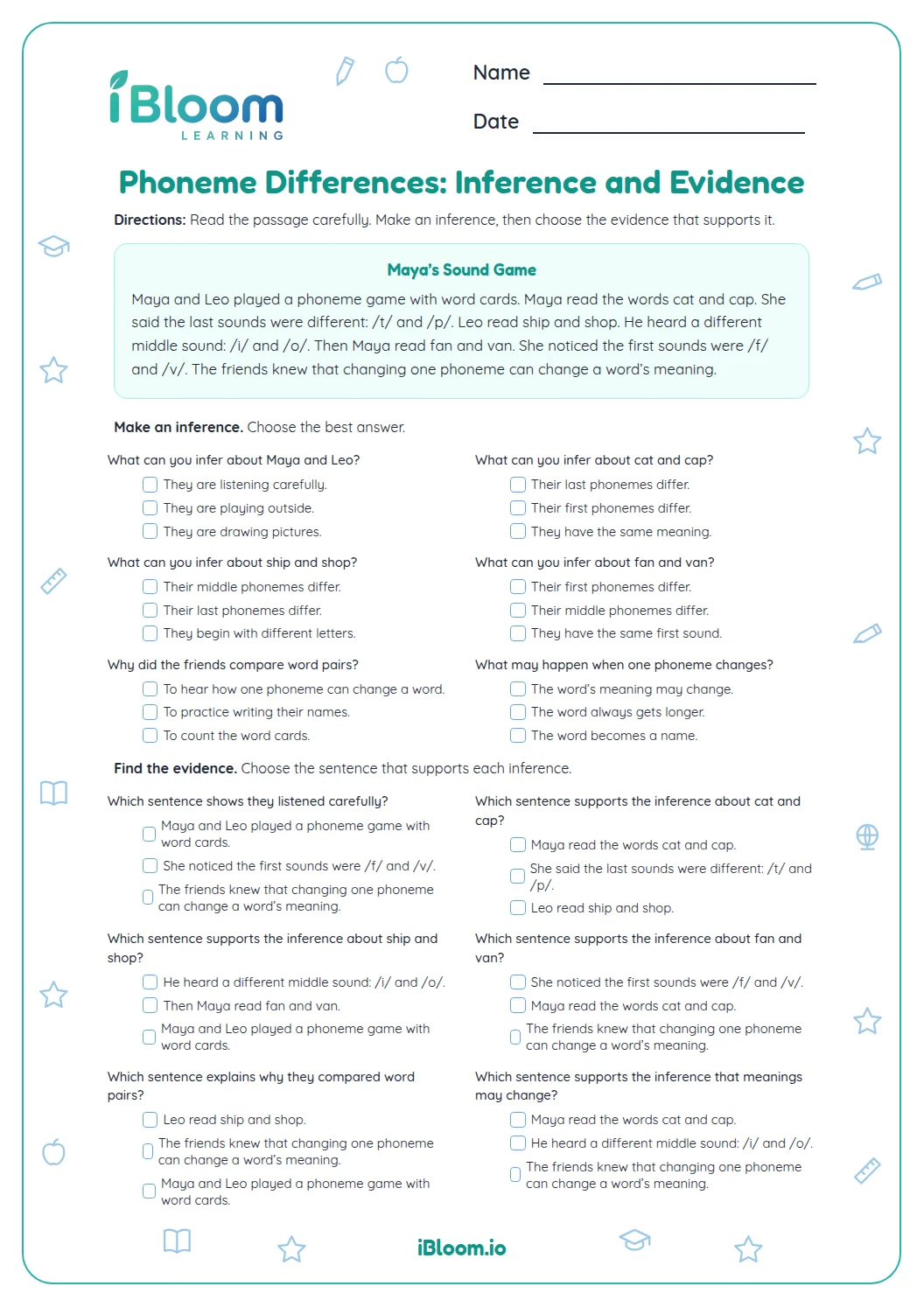
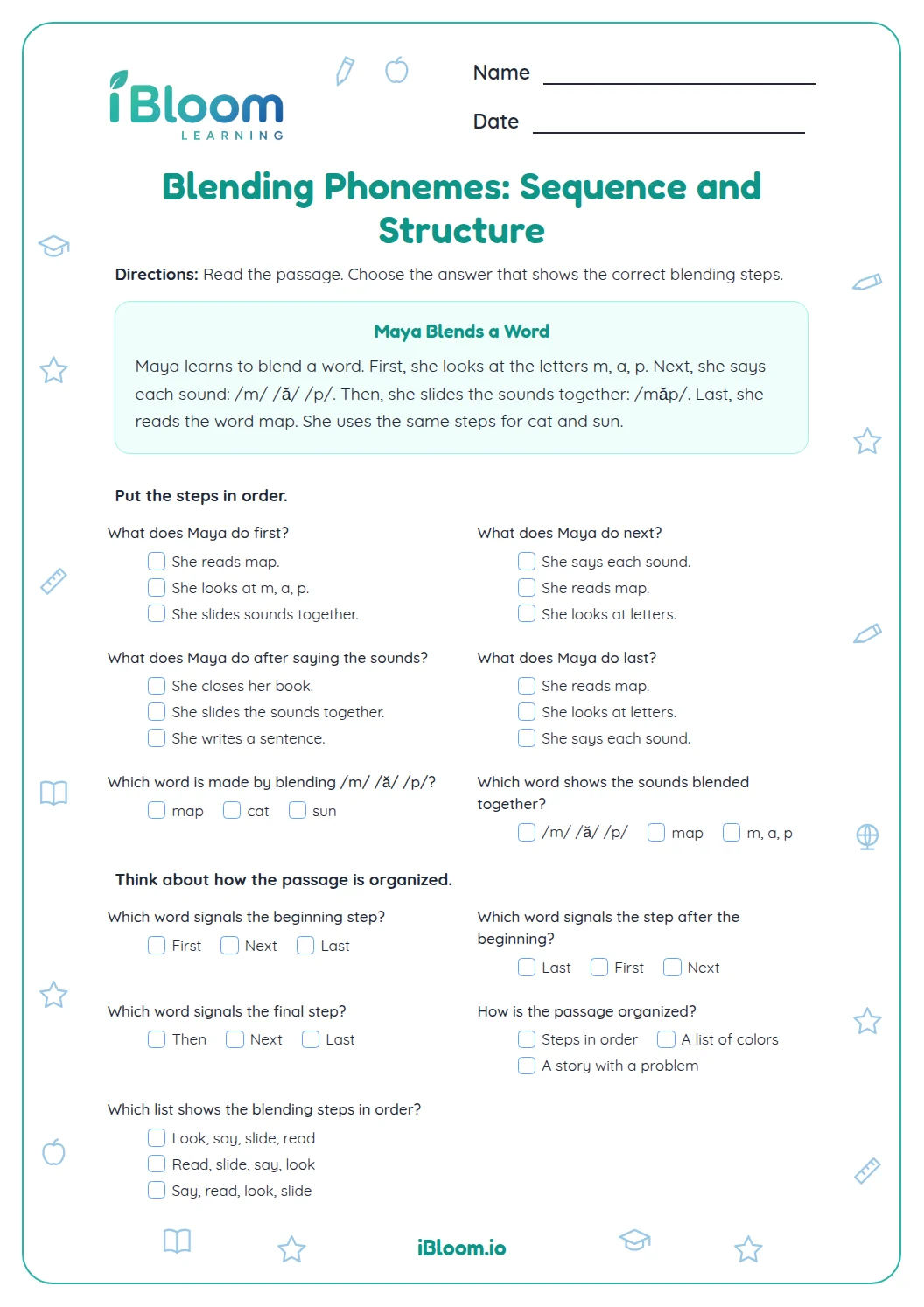
This Grade 1 reading page follows Maya and Leo as they sort word cards with similar sounds, including cap/cat and fan/van. Children answer 14 questions about story details, infer what the partners notice, and select evidence for their ideas. The original passage keeps the phoneme-similarity topic in view while the questions practice inference and evidence. CCSS RL.1.1 is cited for asking and answering questions about key details; a separate answer key is included.
Aligned to RL.1.1
What happens in Maya’s sound sort?
Maya and Leo sort word cards by listening to the sounds. Cap and cat share the first sound but end differently; fan and van share the last sound but begin differently. The story gives young readers a clear setting for thinking about sounds and partner choices.
How can a reader make an inference?
An inference is an idea supported by what the story says. If Maya taps each word slowly, readers can infer that she wants to hear the sounds clearly. The clue is her action, not a sentence that directly states her reason.
- 1Maya tapped each word slowly.
- 2Ask: why might someone tap a word while sorting sounds?
- 3The action helps her hear each sound.
- 4Answer: to hear each sound clearly
Which detail supports an answer?
Part D asks learners to select evidence, such as Maya tapping words slowly or Leo listening and moving a card. Part E combines details: the partners sort together and check cards as a team.
- Original passage about sorting similar-sounding words
- 14 multiple-choice questions
- Details, inferences, and supporting evidence
- Separate answer-key pages
Read, infer, and find evidence
- 1Read the whole passage once to understand what Maya and Leo are doing.
- 2Reread the sentence named in a question.
- 3For an inference, connect an action with a reasonable idea.
- 4For evidence, choose the detail that directly supports the idea.
- 5Check the key and point back to the matching story line.
Common inference and evidence slips
The mistake
Choosing an inference that the story does not support.
The fix
Look for a specific action, such as Maya tapping each word, before deciding what she may be thinking.
The mistake
Picking a true story detail that does not answer the question.
The fix
Match the evidence to the exact idea; Leo moving a card supports that he checked the cards.
The mistake
Mixing up which sound changes in a word pair.
The fix
Say cap and cat slowly: the first sound stays the same while the last sound changes.
Common Core alignment
The questions ask children to answer from a short story and support ideas with details.
Ask and answer questions about details in a story.
On this sheet: Learners answer detail questions and use story actions to support an inference.
Show the official wordingHide the official wording
Ask and answer questions about key details in a text.
What to practice next
Make more practice
Further reading
Questions parents and teachers ask
What is the story about?
Maya and Leo sort word cards by listening to sounds. They group cap and cat because the first sound matches, then fan and van because the last sound matches. Their actions give children clues for the inference and evidence questions.
How does the worksheet practice inference?
Several questions ask readers to figure out why Maya taps each word or what Leo learns from checking the cards. The answer should make sense with the story actions, such as tapping slowly to hear each sound clearly in the story.
What counts as evidence in the passage?
Evidence is a detail stated in the story that supports an answer. Maya tapping each word slowly supports the idea that she is listening closely; Leo listening and moving a card shows how he checks the sort with Maya again.
How does this page connect with phoneme similarity?
The passage names pairs that share some sounds but differ in another: cap/cat share the first sound, while fan/van share the last sound. The questions then ask children to reason about the story and find support in its details too.
Is an answer key included, and how long might it take?
Yes. A separate answer key marks the correct responses for all 14 questions. Plan for about 15 to 20 minutes to read the passage, answer questions, and return to the relevant line when checking evidence in the passage together closely.