







About this worksheet
This free printable Grade 1 worksheet teaches children to hear the one sound that makes two words different, such as fan and van, ship and shop, or cap and cat. It begins with a short story about Pam, her cat Tip and a trip to the shop, then asks three questions about it, three picture-naming questions and three word-pair questions. It practices Common Core RF.1.2.c and RF.1.3.b and suits first graders who are learning to isolate beginning, middle and ending sounds. There are nine questions on two pages, and a separate answer key is included.
Aligned to RF.1.2.c and RF.1.3.b
What is a phoneme difference?
A phoneme is a single sound in a spoken word. Two words can be nearly the same and still differ by one phoneme: fan and van start with different sounds, cap and cat end with different sounds, and ship and shop have the same beginning and end but a different vowel in the middle.
Hearing which sound changed is the skill behind spelling, reading and rhyming. A child who can say that cap and cat are different at the end is also ready to see that the last letters p and t are different.
- 1cap / cat
- 2Say cap: c, a, p.
- 3Say cat: c, a, t.
- 4The first two sounds match, but the last sound is different.
- 5So cap and cat have different last sounds.
Why does the sheet include a story and pictures?
The story uses all of the practice words in a real sentence: cap, cat, fan, van, ship, shop and map. Reading them in context shows children that the sound differences matter, because a map and a cap are different things in the story.
Part C gives each word as a picture with three similar choices. A child who picks cap for a picture of a cap has matched the sounds in the word to the letters, not just guessed from the first letter.
What is on this worksheet?
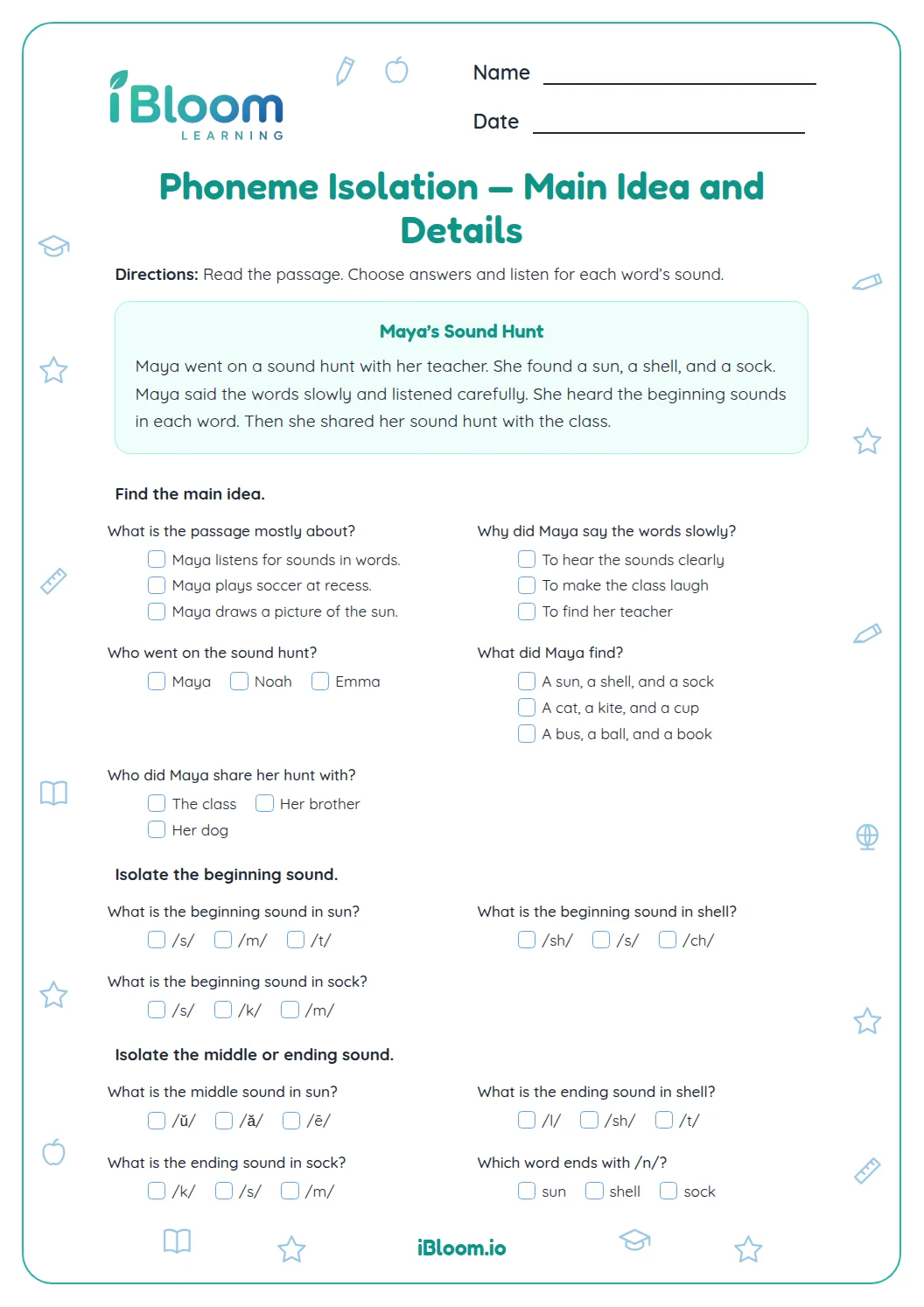
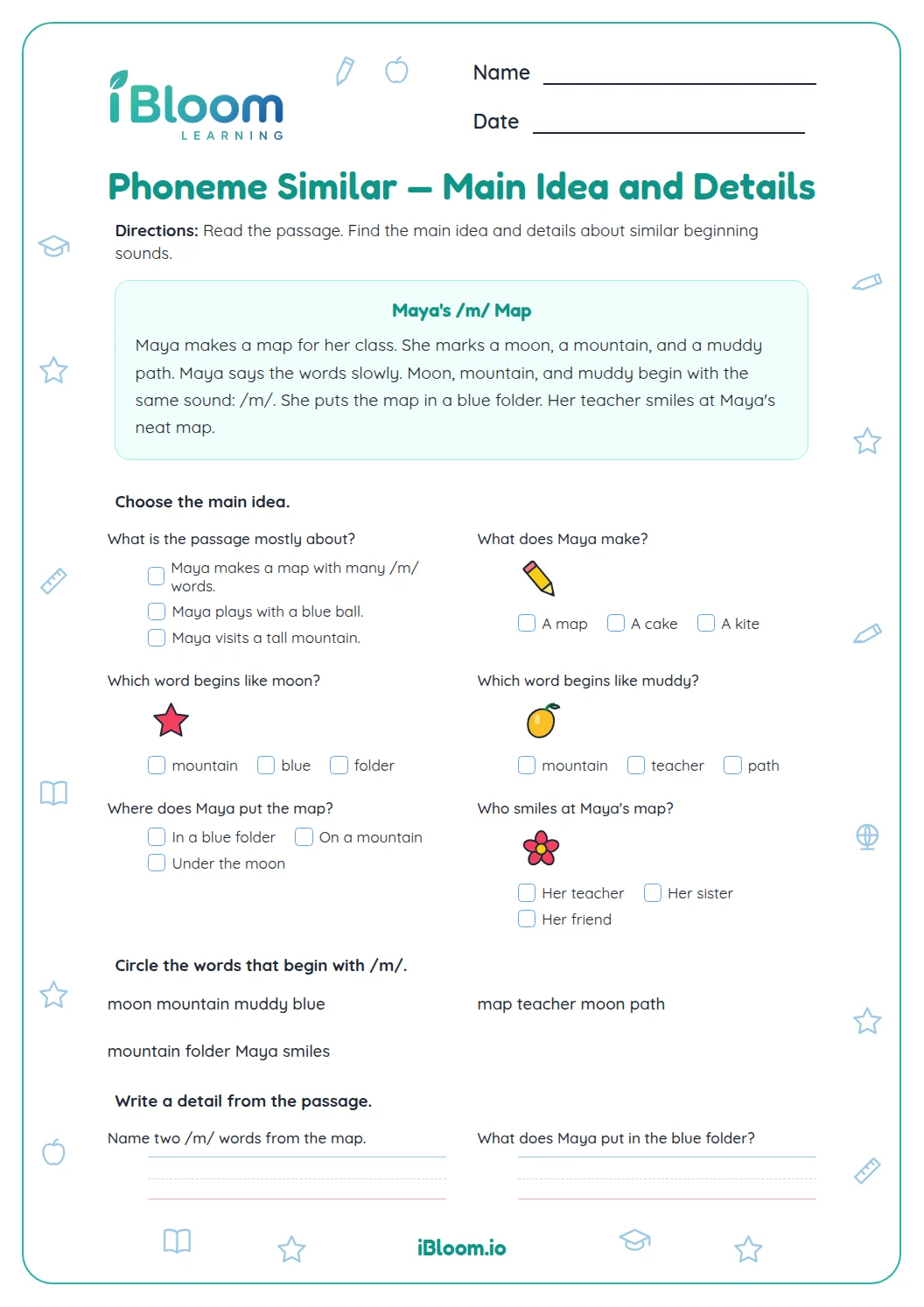
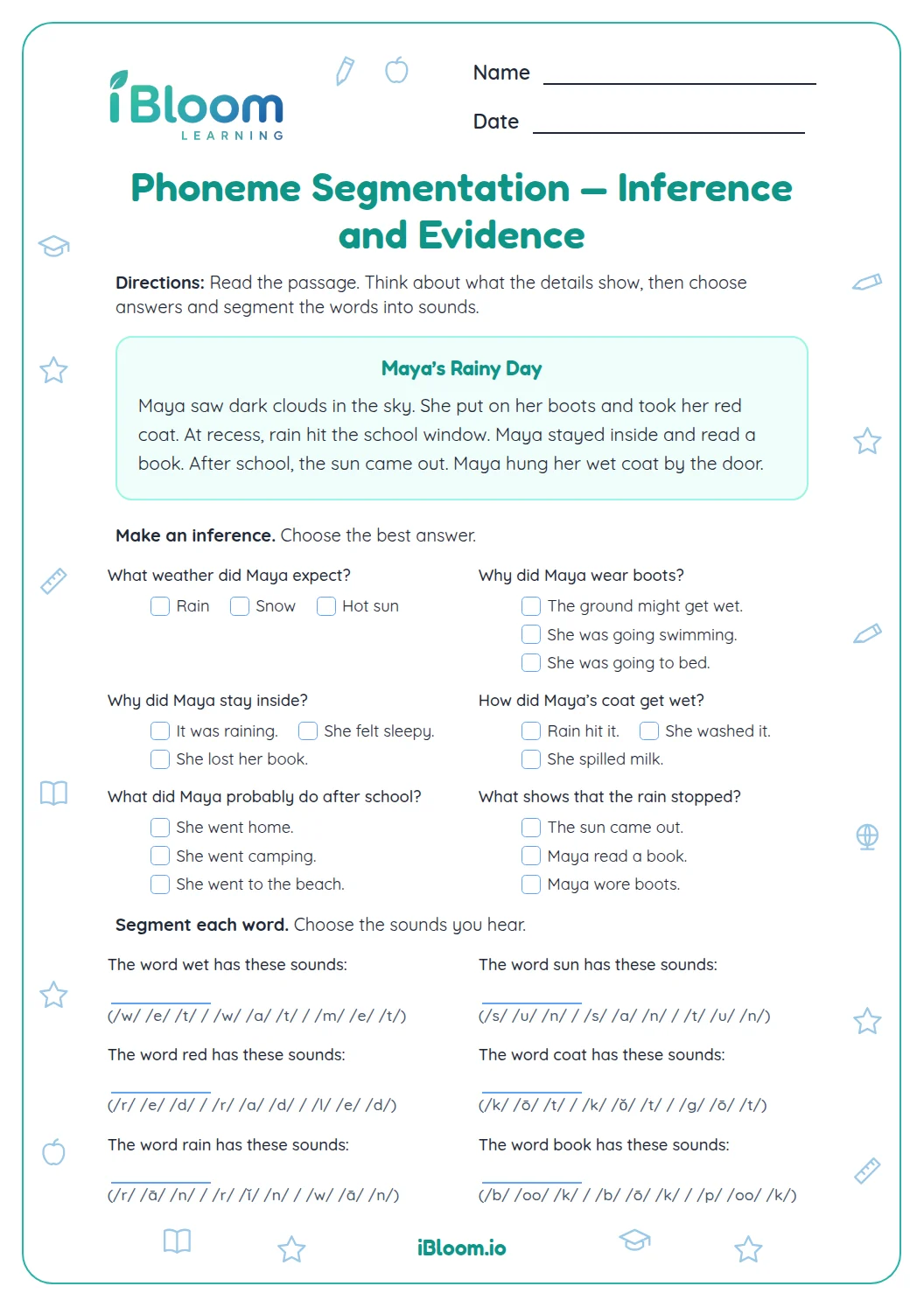
Nine questions after one short passage, which prints as Part A. The questions are in three parts and move from reading the story to listening for sounds.
- Part A, Read the passage: a 64-word story about Pam, her cat Tip and a shop
- Part B, Use the passage: three multiple-choice questions about what happens
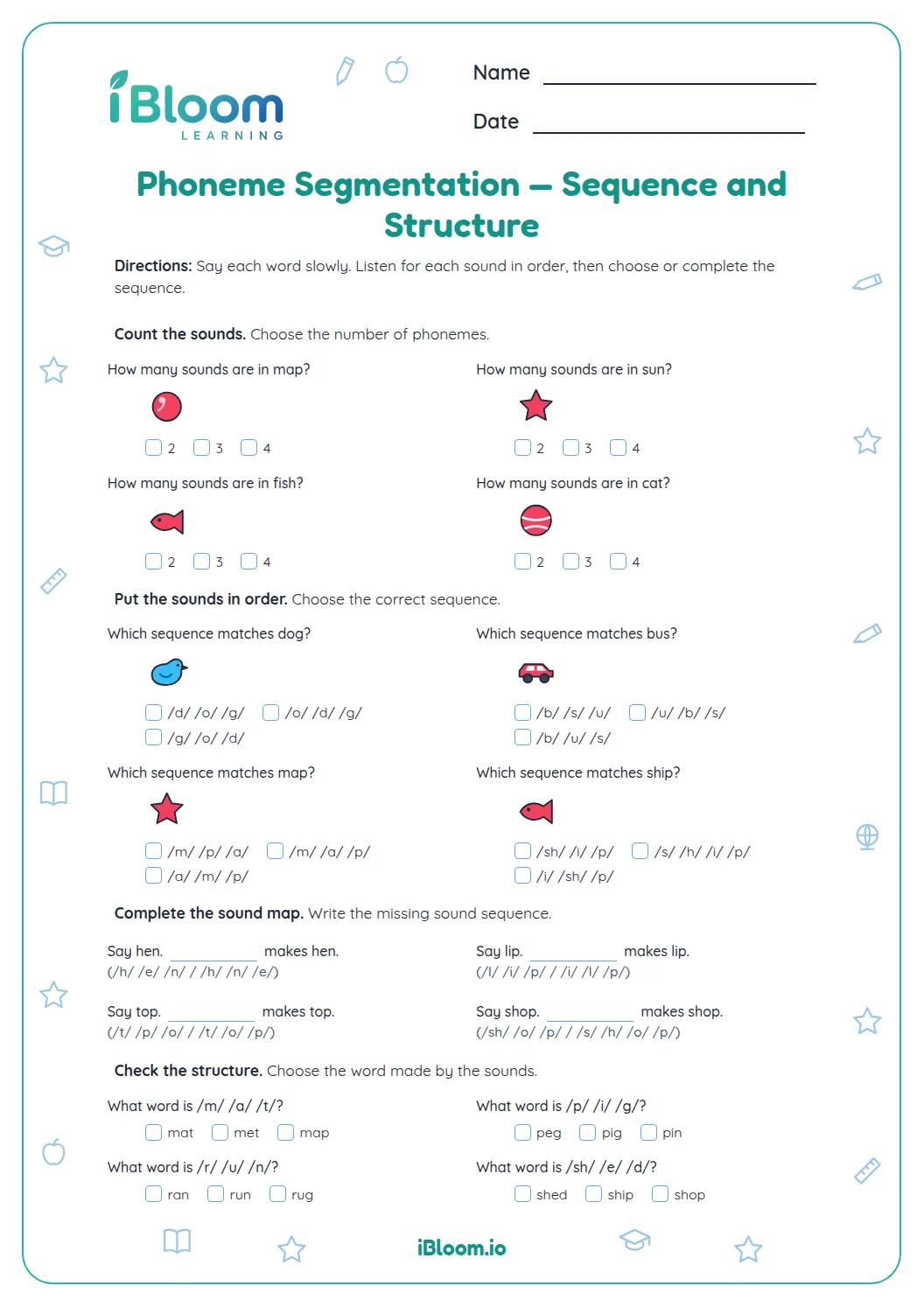
- Part C, Name the picture: three picture words (cap, ship and cat) with three word choices each
- Part D, Find the different sound: three word pairs for the first, middle and last sound
- Answer key on two separate pages
How can you help a child at home?
Say pairs of words and have your child tell you whether the first sound, the middle sound or the last sound changed. Start with pairs that differ at the beginning, which are usually the easiest to hear, and save the middle sound for last. Clap or tap once for each sound to make the sounds easier to track.
How to use this worksheet at home or in class
- 1Read the story aloud once while your child follows with a finger, then let your child read it again alone.
- 2Do question 1 together, and ask your child to point to the sentence in the story that has the answer.
- 3Let your child finish Part B, then go on to the pictures in Part C. Ask them to say each word slowly before choosing.
- 4For Part D, say each pair aloud together. Hold up one finger for each sound in the word, and see which finger is different.
- 5Ask your child to explain one answer using the words first, middle or last.
- 6Check with the answer key and play the sound game with the missed pairs.
Common mistakes and quick fixes
The mistake
Picking cap / cat as the pair with different first sounds, even though both words begin with c.
The fix
Say just the beginnings: c and c are the same. Then say the endings, p and t, and notice that those are different.
The mistake
Choosing a picture word by its first letter only, such as sheep for a picture of a ship.
The fix
Say the whole word slowly: sh-i-p. The middle sound in sheep is long, so the words are not the same.
The mistake
Mixing up middle and last sounds in a pair like ship / shop.
The fix
Count three sounds in each word: sh, i or o, p. Only the second sound changes, so it is the middle sound.
Common Core alignment
Most US states use the Common Core standards or a close state version. This sheet practices the two foundational reading standards below.
Hear the first, middle and last sounds in one-syllable words.
On this sheet: Part D asks which pair differs in the first, middle or last sound, and Part C matches words by their sounds.
Show the official wordingHide the official wording
Isolate and pronounce initial, medial vowel, and final sounds (phonemes) in spoken single-syllable words.
Read simple one-syllable words by sounding them out.
On this sheet: The story and the answer choices use one-syllable words such as cap, van, ship and shop.
Show the official wordingHide the official wording
Decode regularly spelled one-syllable words.
What to practice next
Make more practice
Further reading
Questions parents and teachers ask
What does it mean when two words have different middle sounds?
It means the vowel in the middle changes while the beginning and end stay the same. Ship and shop both start with sh and end with p, but the middle sound is i in one and o in the other. Question 8 asks children to find that pair.
Is cap / cat a pair with different first sounds?
No. Cap and cat both begin with the c sound, so their first sounds are the same. They differ at the end, with p in one and t in the other. Question 9 has children find that pair, and question 7 asks for the pair with different first sounds, which is fan and van.
Do children need to read the story before answering the picture questions?
No, but the story helps. Part C can be done on its own, since each question shows one picture and three word choices. Reading the story first gives children practice with the same words in context and a chance to see cap and ship in print before they choose.
Why are some of the word choices so similar?
The choices are close on purpose, like cap, cat and can, so children have to listen to every sound. A child who looks only at the first letter will not be able to tell cap from cat. The practice is in checking the sounds at the end and in the middle.
How can I make this sheet easier or harder?
For an easier version, read each question and word choice aloud, and let your child point to the answer. For a harder version, ask your child to think of one more word for each pair, such as van with man or ship with chip, and to say which sound they changed.
Is there an answer key for this worksheet?
Yes. Two answer key pages show the correct choice for each story question, the matching word for each picture and the word pair for each sound question. Print the worksheet by itself, keep the key for checking, or download everything as a free PDF from this page.