


About this worksheet
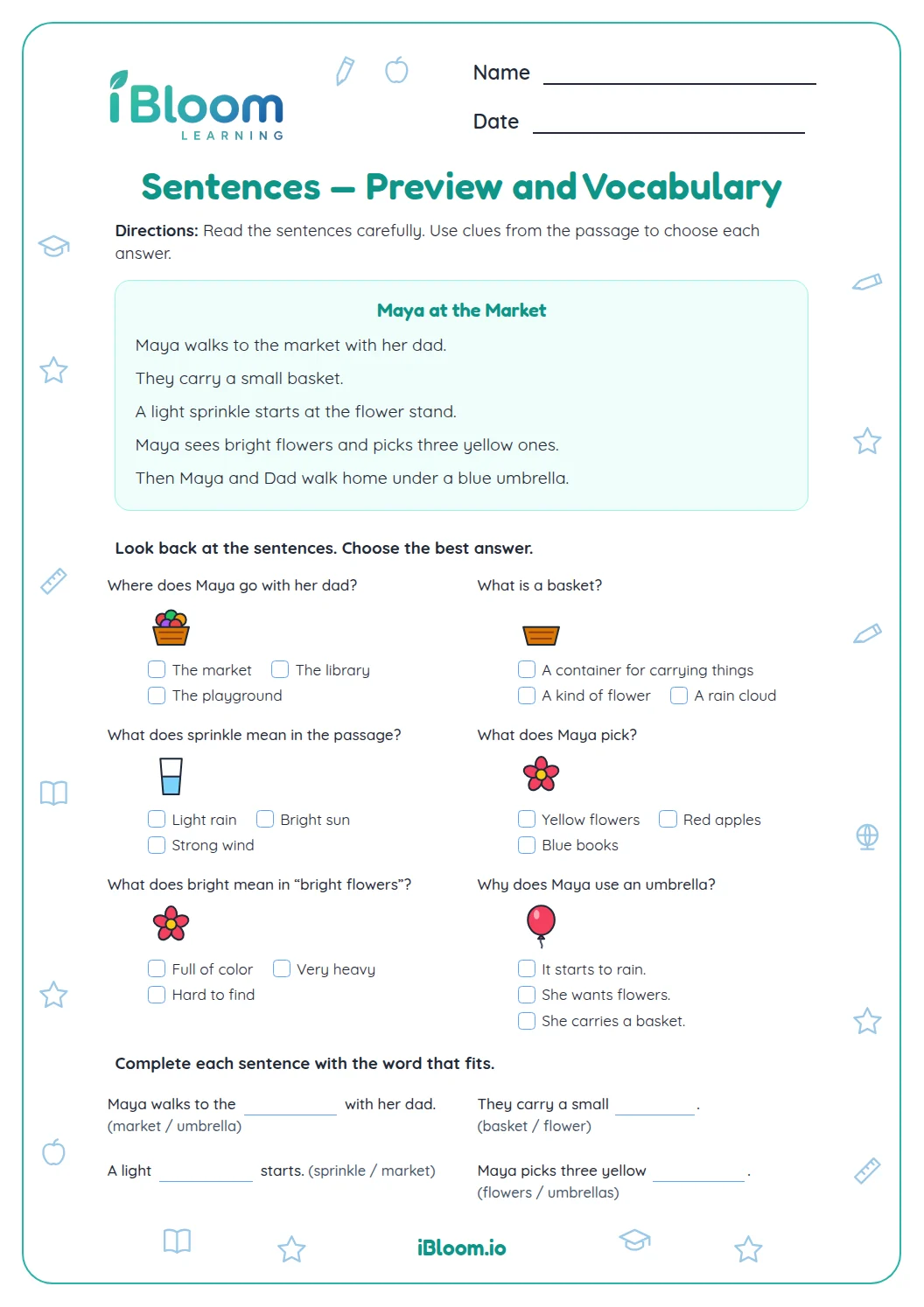
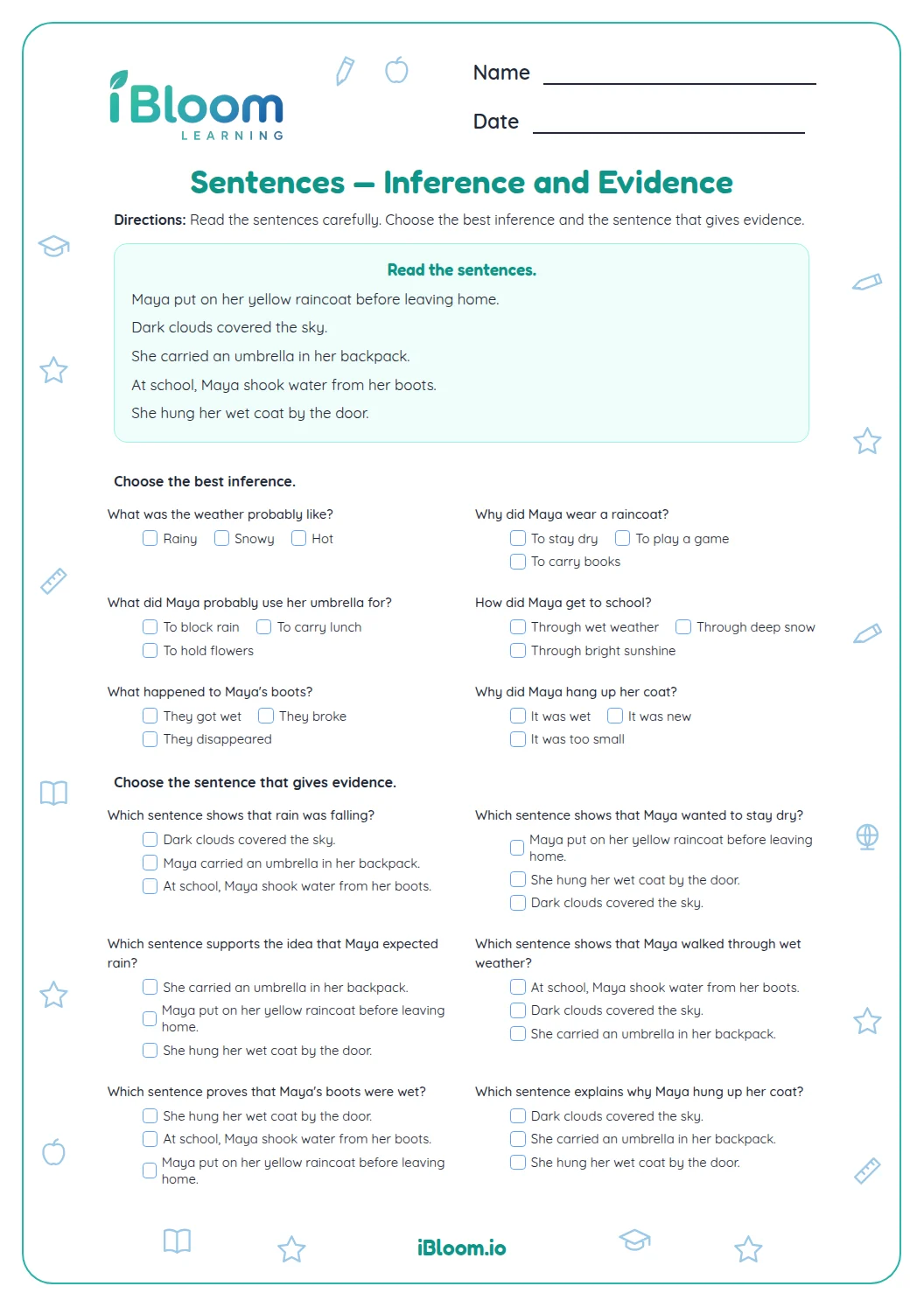
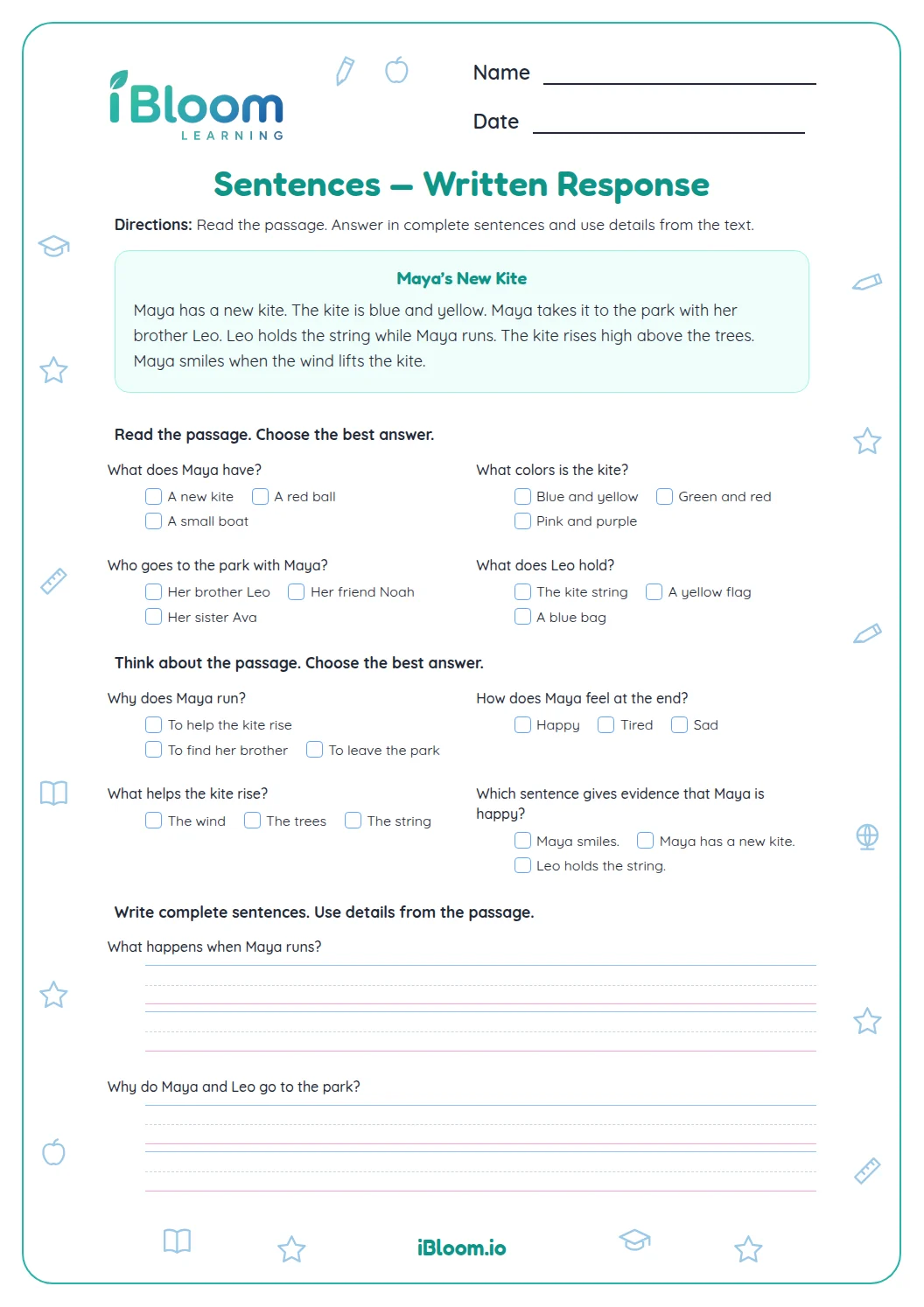
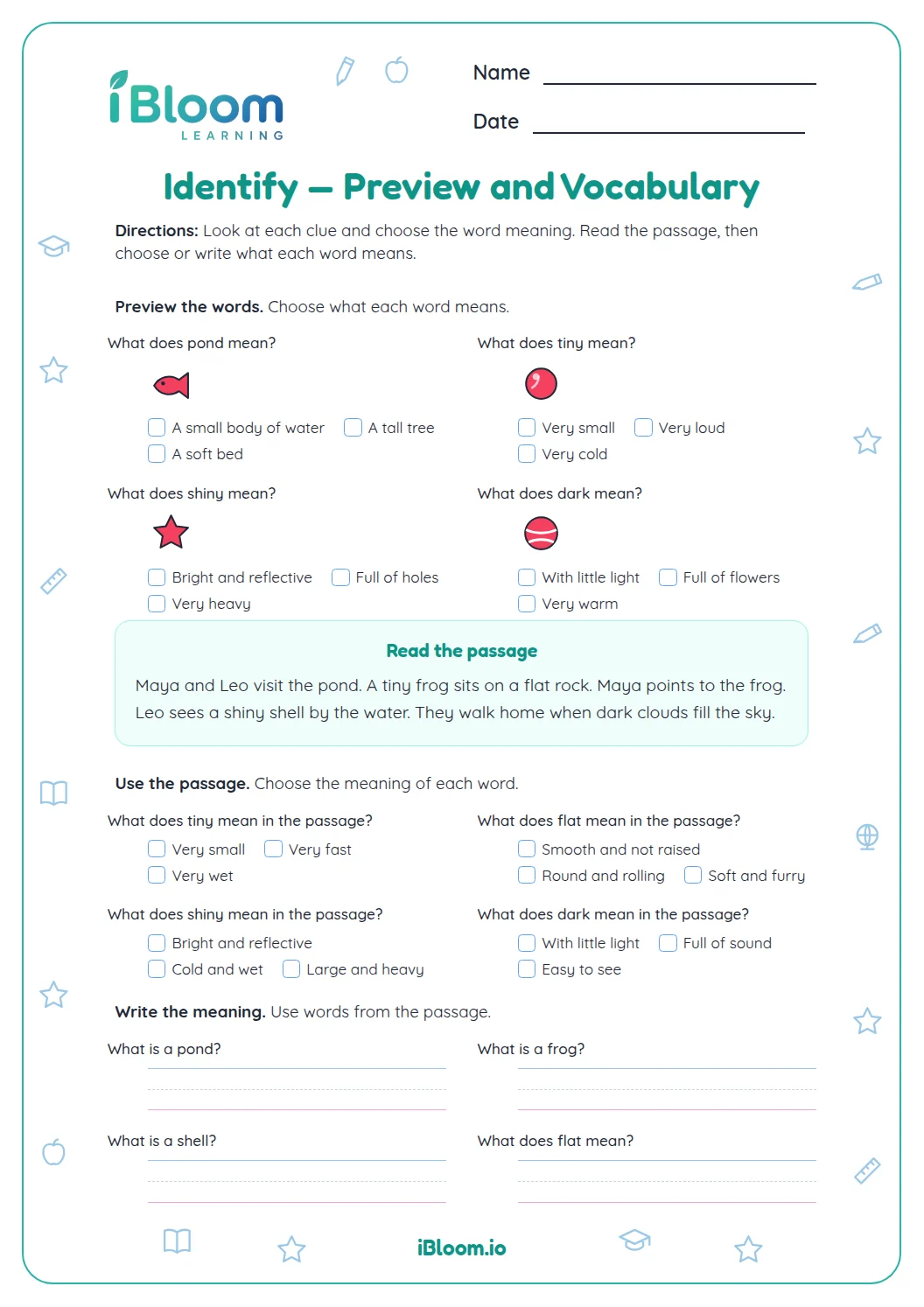
This Grade 1 printable pairs a short kite story with 15 questions on story events, familiar high-frequency words in sentences, and complete sentence structure. Children identify story details, choose a word that completes each sentence, and recognize complete, correctly ordered sentences. A separate answer key is included. The story questions practice CCSS RL.1.3; the word choices include irregularly spelled words addressed by RF.1.3.g.
Aligned to RL.1.3 and RF.1.3.g
How can a reader follow the story events?
Think about what happens first, next, and last. In question 3, the kite has already lifted, so Eli lets out more string. Later it dips to the grass, and they fold it before walking home.
- 1The wind lifts the kite.
- 2Eli lets out more string.
- 3The kite dips to the grass.
How do sight words fit into a sentence?
Read the whole sentence and try each word. In “Eli ___ that the kite is red,” said completes the sentence. Read the sentence aloud to check which word fits the meaning and grammar.
What makes a sentence complete?
A complete sentence tells who or what and what happens. It begins with a capital letter and usually ends with a period. Read each choice aloud to check whether the words make sense in order.
How to use this worksheet
- 1Read the kite story once from beginning to end.
- 2For event questions, remember what happened before and after each action.
- 3Read each sentence blank aloud with its word choices.
- 4Check that a sentence has a naming part and an action.
- 5Look for a capital at the start and punctuation at the end.
Mistakes to watch for
The mistake
Choosing an event that happens at the wrong time.
The fix
Retell the story with first, next, and last before answering.
The mistake
Picking a word by sound without rereading the whole sentence.
The fix
Read the completed sentence aloud and check its meaning.
The mistake
Choosing words that do not tell a full idea.
The fix
Ask who or what the sentence is about and what that person or thing does.
Common Core alignment
The questions connect story reading and word recognition to the standards below.
Describe story characters, settings, and major events using key details.
On this sheet: The first questions identify and order key events in Eli’s story.
Show the official wordingHide the official wording
Describe characters, settings, and major events in a story, using key details.
Recognize and read grade-appropriate irregularly spelled words.
On this sheet: Sight-word choices are practiced in simple complete sentences.
Show the official wordingHide the official wording
Recognize and read grade-appropriate irregularly spelled words.
What to practice next
Make more practice
Further reading
Questions parents and teachers ask
What story do children read?
The passage follows Eli and Dad as they make a red kite, take it to the park, fly it in the wind, and walk home. Questions ask children to notice event order and details, such as what Eli does after the kite rises.
How many questions are included?
There are 15 multiple-choice questions: five about story events, five that use sight words in sentences, and five about complete sentence structure. The short passage comes first, and the answer key follows on separate printed pages for checking. Students can reread each full sentence before choosing.
How should a child answer an event-order question?
Retell the passage in order and use its details to locate the event asked about. After the wind lifts the kite, Eli lets out more string. After it comes down, Eli and Dad fold it and walk home together. Story details help children explain why an event belongs in that place.
What is a complete sentence?
A complete sentence tells a whole idea, usually with a person or thing and an action. “The wind blows.” is complete because it tells what the wind does. “The wind” names something but does not say what it does in the story.
Which standards does this page practice?
The story questions practice CCSS RL.1.3 by asking about key story events. The sight-word choices support RF.1.3.g, recognizing and reading grade-appropriate irregularly spelled words in simple sentences. Children apply familiar words while reading each sentence aloud. The questions apply both standards directly through the passage and sentence choices.