

About this worksheet
This Grade 1 reading comprehension worksheet pairs a short original story with 16 questions about event order and structure. Children read about Sam planting and caring for a seed, then identify details, complete sequence statements, and explain how events connect. Familiar sight words appear throughout the passage. It practices CCSS RL.1.3 by asking readers to describe connections among events and pieces of information in a text. The answer key includes sample responses for written questions.
Aligned to RL.1.3
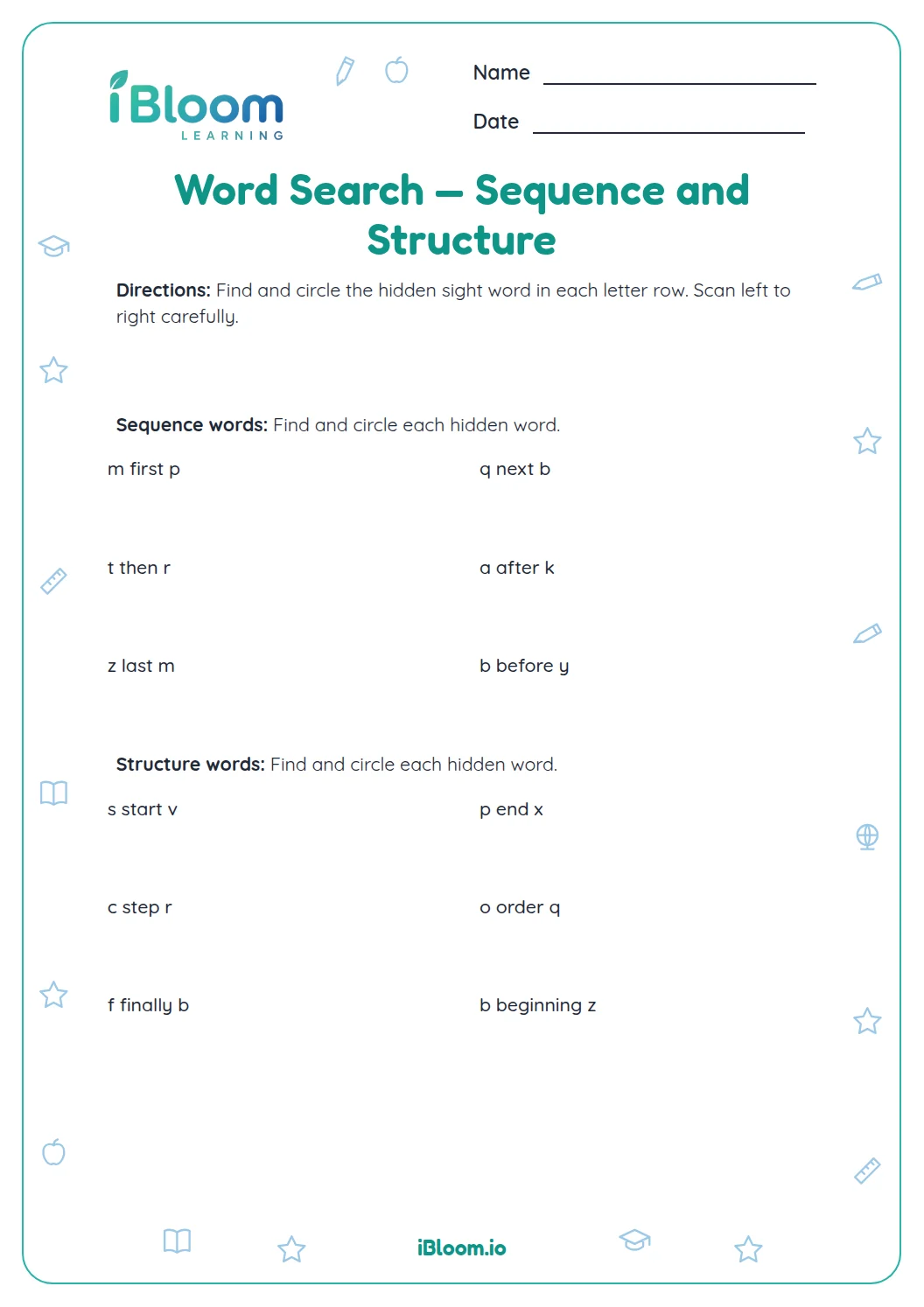
How can first, next, and then show sequence?
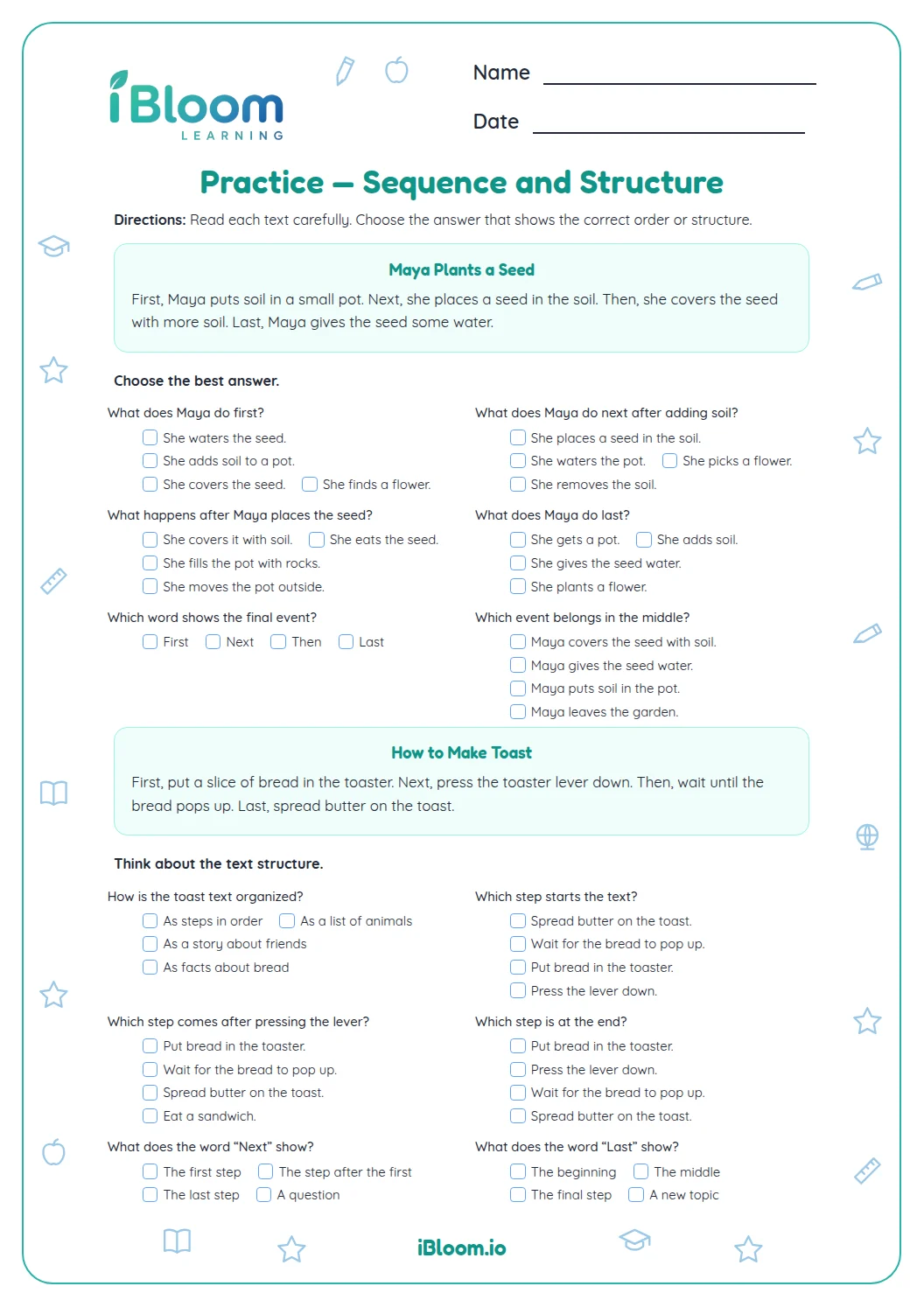
Sequence is the order in which events happen. Signal words such as first, next, and then help readers follow steps. In Sam’s story, he adds soil, places the seed, and gives it water in that order.
What does the story structure help readers notice?
The passage follows a simple time order: Sam plants a seed, cares for it, and later sees a sprout. Readers can use the order to explain how one event connects to the next.
How do sight words support fluent reading?
Short familiar words such as he, the, it, and can appear in the story. Recognizing these words helps a beginning reader keep attention on the events and sequence clues.
- 1Question: What does Sam add first?
- 2Find the sentence: “First, Sam adds soil.”
- 3The signal word first identifies the opening step.
- 4Answer: soil
How to use this worksheet
- 1Read the passage once to understand what happens.
- 2Reread and notice the words first, next, then, and each day.
- 3Answer detail questions by finding the matching sentence.
- 4Use full thoughts for the four written responses.
- 5Check the key; compare written answers with the sample ideas.
Common mistakes and quick fixes
The mistake
Choosing an event that happened but placing it in the wrong order.
The fix
Use the signal words and reread the nearby sentence.
The mistake
Answering from a guess instead of the passage.
The fix
Point to the sentence that supports each choice.
The mistake
Writing a single unrelated word for a how question.
The fix
Tell which events connect and include a detail from the story.
Common Core alignment
The passage questions focus on relationships among events and information.
Describe how key events in Sam’s story unfold.
On this sheet: Questions ask children to identify and explain the order and connections of major events in Sam’s story.
Show the official wordingHide the official wording
Describe characters, settings, and major events in a story, using key details.
What to practice next
Make more practice
Further reading
Questions parents and teachers ask
What is sequence in a story?
Sequence is the order in which events happen. Sam first adds soil, next puts in the seed, and then gives it water. Signal words and details help readers tell which event came before another. The signal words help readers retell the events in their proper order.
What sight words appear in the passage?
The passage uses familiar words such as he, the, it, and can in connected sentences. The comprehension questions focus on event order and structure, while rereading these common words supports attention to the story. Children can point to these familiar words as they read each sentence aloud.
How many questions are on the sheet?
There are 16 questions: eight multiple-choice detail and order questions, four fill-in statements, and four short written responses. The answer key gives the correct choices and sample ideas for the written answers. The key accepts clear answers that match details and order in the story.
Can someone read the passage aloud to my child?
Yes. An adult can read the passage aloud, then invite the child to point to the words that show what happened first, next, and later. This keeps the discussion centered on sequence and connections in the text. Ask the child to find the sentence that tells what happened next.
What is a good answer to the final question?
A strong answer says that First, Next, and Then show the order of the steps. Children can use their own words as long as they explain how those signal words help a reader follow what happens. An adult can ask the child to give one example from the passage.