





About this worksheet
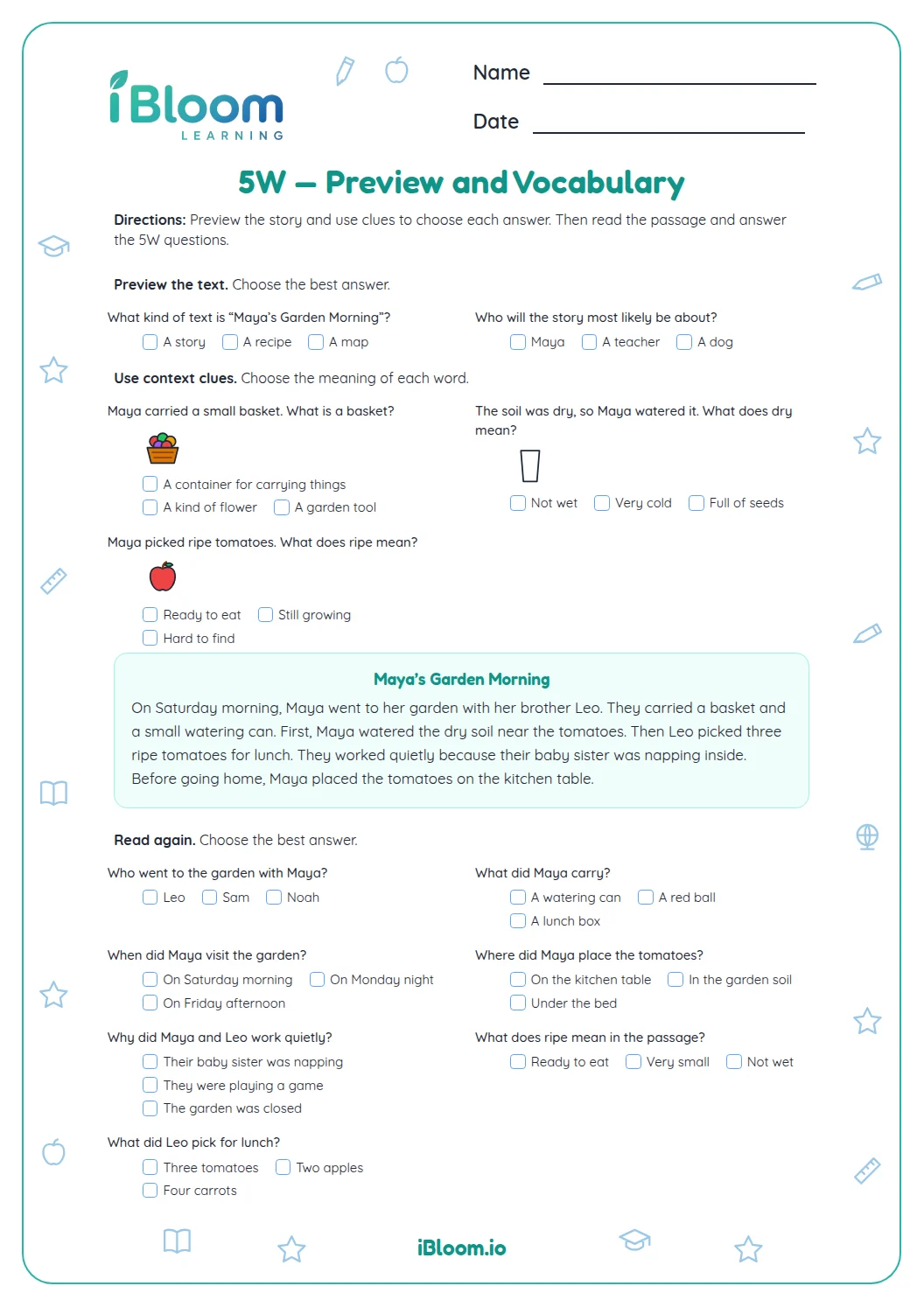
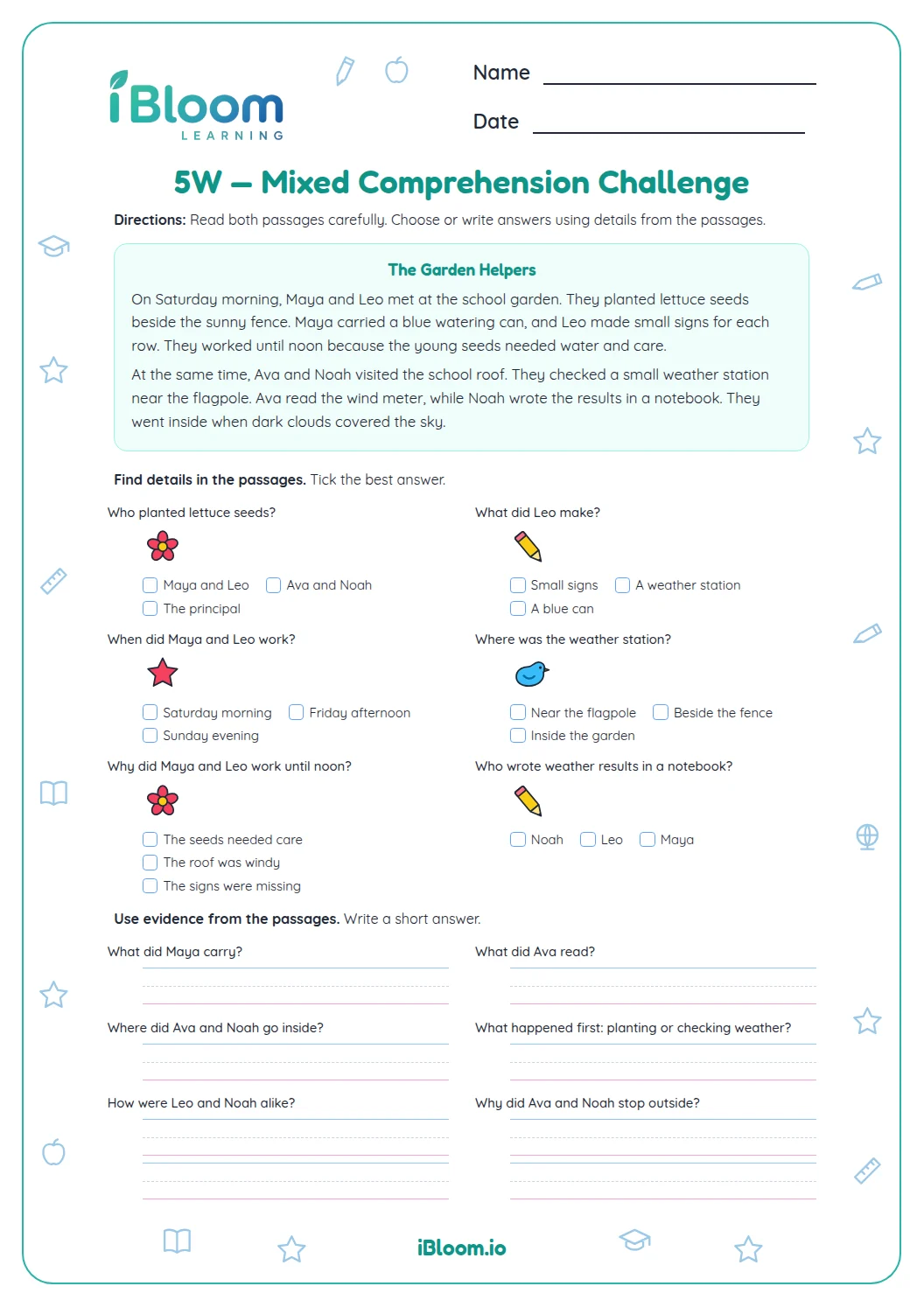
This Grade 2 reading worksheet uses an original short story about Maya and Luis caring for a school garden after rain. Students answer direct who, what, where, and when questions, choose evidence from the story, and make inferences about the characters’ actions. The answer key names the passage clue behind each answer and provides sample responses for the written questions.
Aligned to RL.2.1
What happens in “The Wet Garden”?
Maya notices the garden is wet before class. When Luis asks about watering, she points to puddles and tells him she heard rain. They put out a sign so the beans will not be watered again that day.
How can I find the 5W answers?
Part B asks who noticed the can, where Maya pointed, when she heard rain, and what the children placed by the beans. Look back at the passage to find each detail.
- 1Question: “When had Maya heard the rain?”
- 2Answer: “Before sunrise.” The passage gives that time in Maya’s dialogue.
How do I support an inference with evidence?
Parts B and D ask students to connect clues with a reasonable conclusion. Wet soil and drops on leaves support the inference that rain watered the garden; the sign helps prevent watering it again.
How to use this worksheet
- 1Read the passage once to understand what happened.
- 2Reread the question and notice whether it asks for a stated detail or an inference.
- 3For who, what, where, and when, find the matching words in the passage.
- 4For an inference, connect a clue to what it suggests.
- 5Check that a written answer names a passage detail.
Check your editing
The mistake
Guessing without returning to the story.
The fix
Point to the sentence that gives a detail or clue.
The mistake
Giving a clue but not answering the question.
The fix
State the answer first, then add the supporting detail.
The mistake
Treating an inference as a fact stated word for word.
The fix
Use a story clue to explain a reasonable idea.
Curriculum alignment
This worksheet practices RL.2.1 through the listed tasks.
Answer 5W questions and support an inference with a detail from the story.
On this sheet: Students answer who, what, where, when, and why questions and support inferences with details from the story.
Show the official wordingHide the official wording
Ask and answer such questions as who, what, where, when, why, and how to demonstrate understanding of key details in a text.
What to practice next
Make more practice
Further reading
Questions parents and teachers ask
What is the passage about?
“The Wet Garden” follows Maya and Luis as they care for bean seeds at school after a rainy morning. Maya notices clues that the ground has received water, and the children put a sign beside the beans so they will not be watered again that day.
Does this worksheet include 5W questions?
Yes. Students answer who, where, when, and what questions from the story. Other items ask why a character acted, which details show evidence, and what readers can infer from those details. Students can point to the story sentence that supports each response.
What does text evidence mean here?
Text evidence is a detail from the passage that supports an answer or inference. For example, drops on the leaves and puddles by the gate help explain why the beans do not need more water that morning. Students can point to the story sentence that supports each response.
Can students use different wording in short answers?
Yes. Short answers can use different wording as long as they identify the same passage detail. The answer key gives concise responses, and the written-answer key includes examples students can compare with their own evidence. Students can point to the story sentence that supports each response.
How should I help a student with an inference?
Ask the student to name a clue first, then explain what that clue suggests. In this story, wet soil and drops on leaves suggest that rain watered the garden. The answer should connect the detail to the conclusion rather than repeat the clue alone.