

About this worksheet
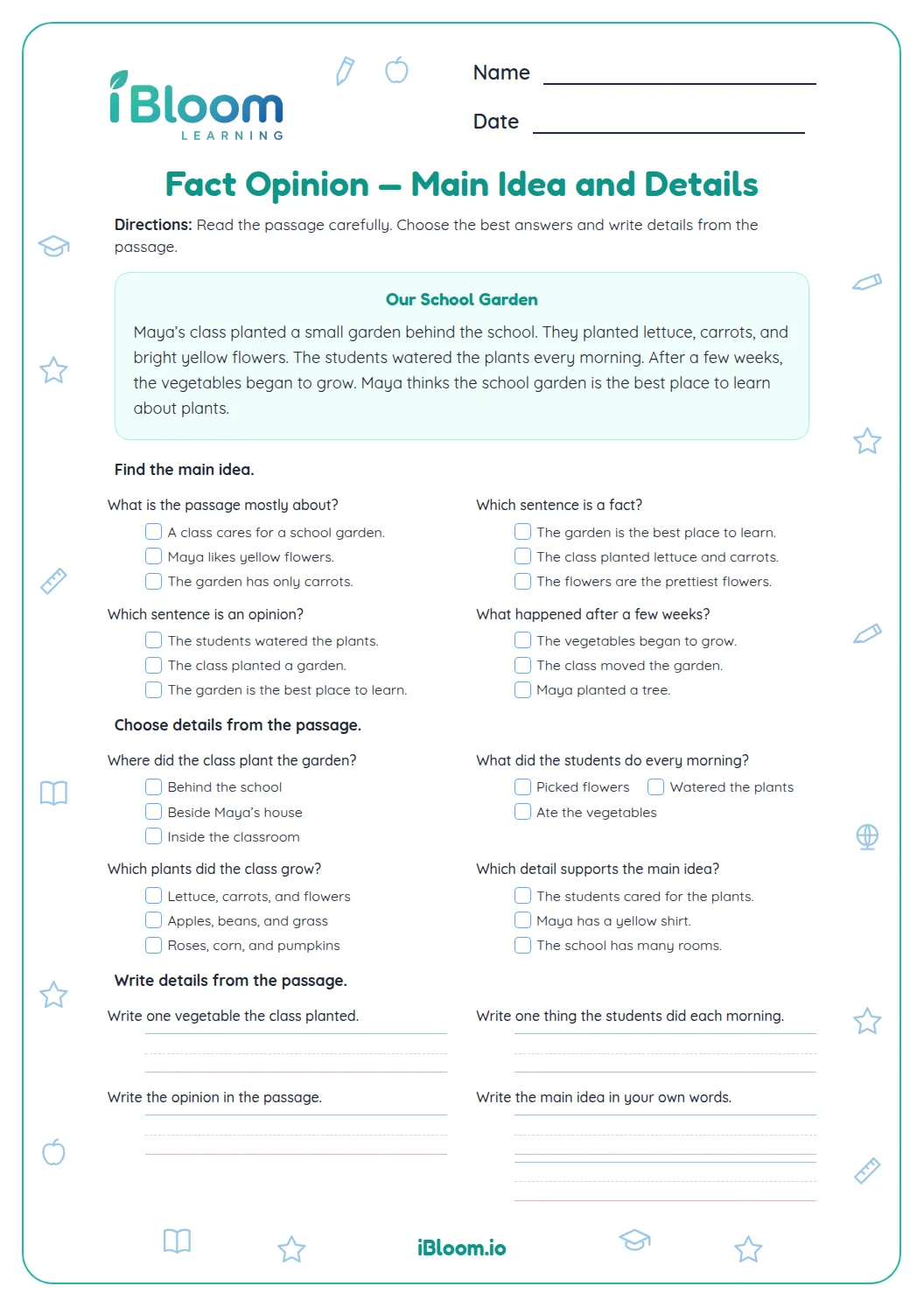
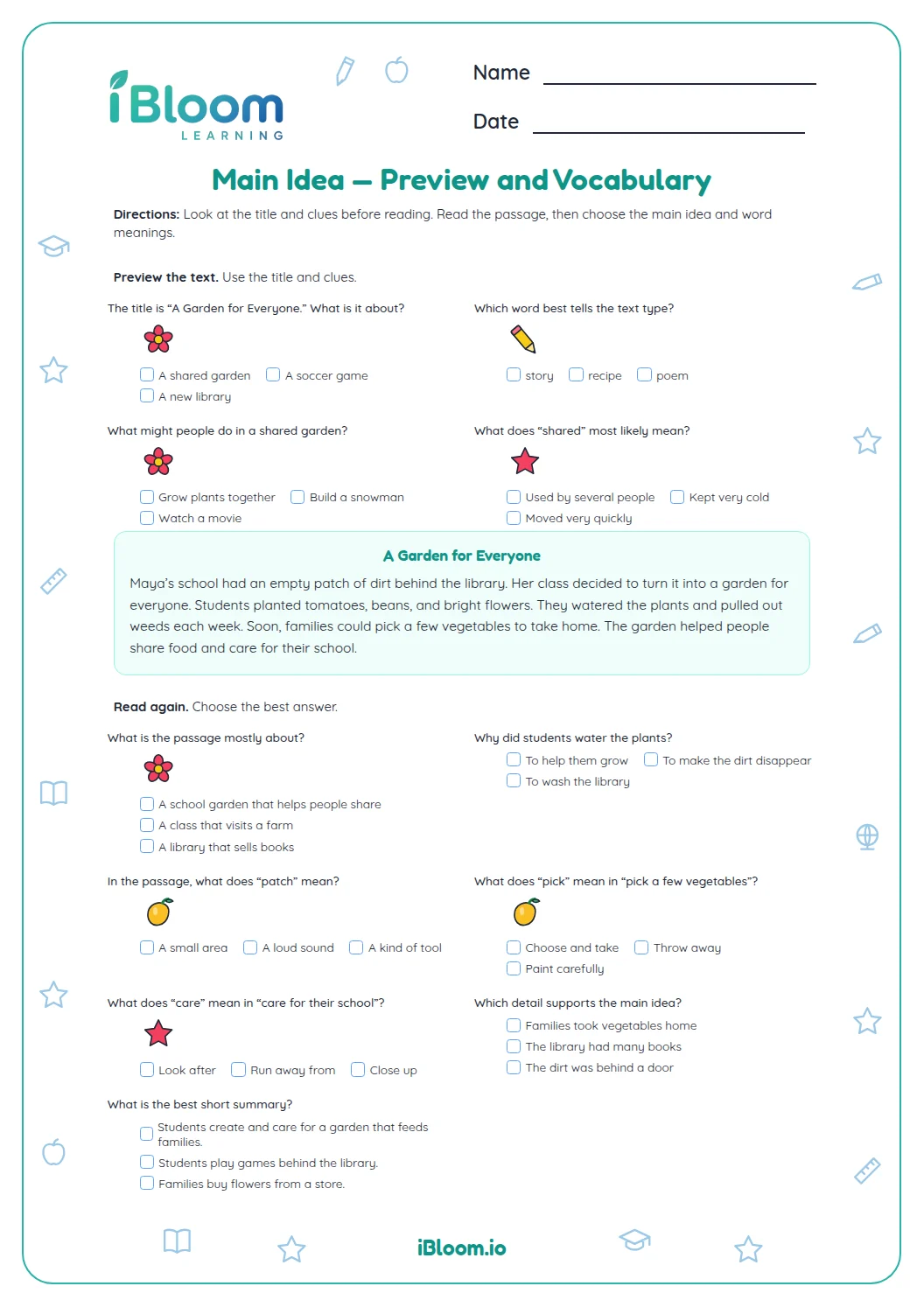
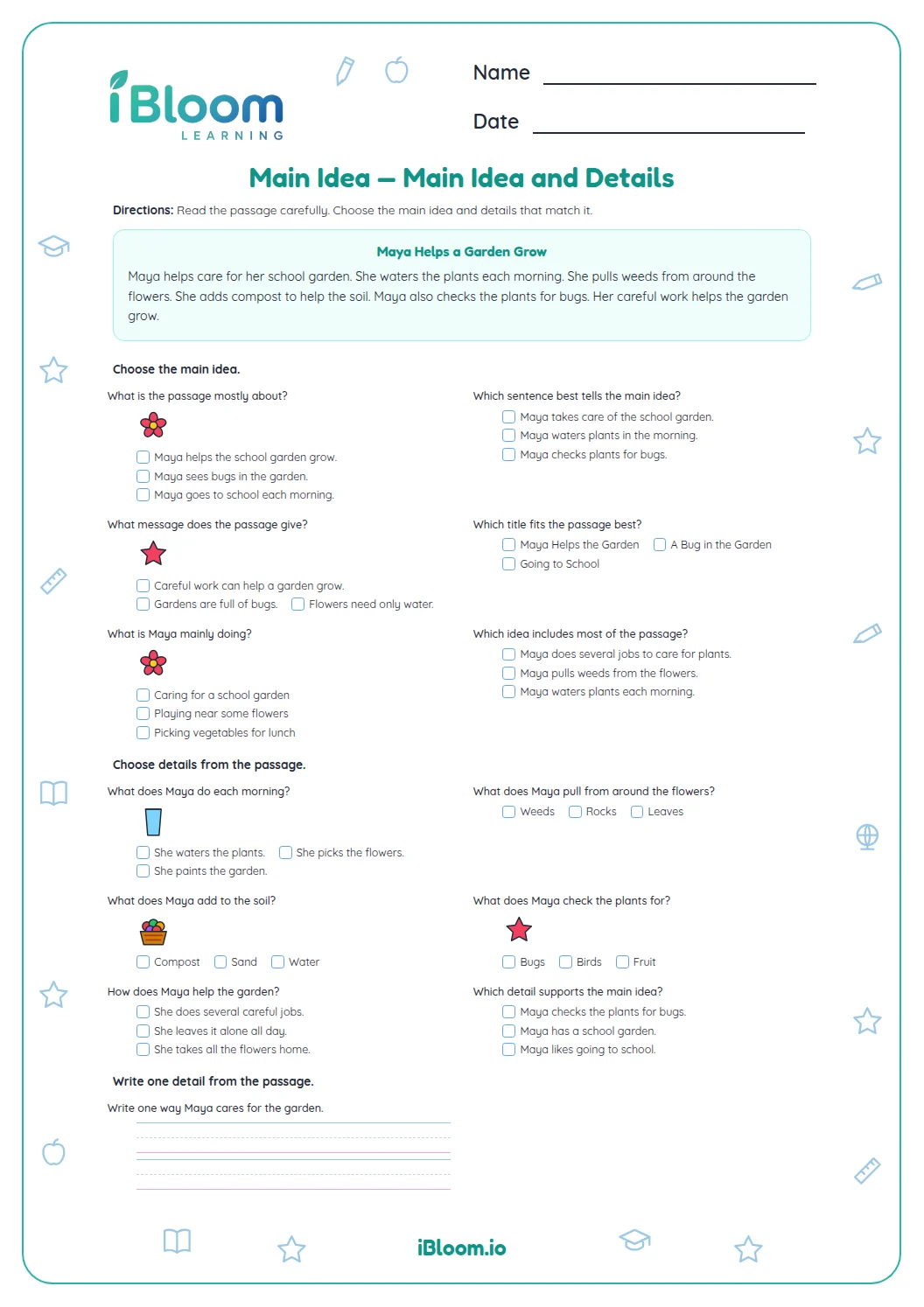
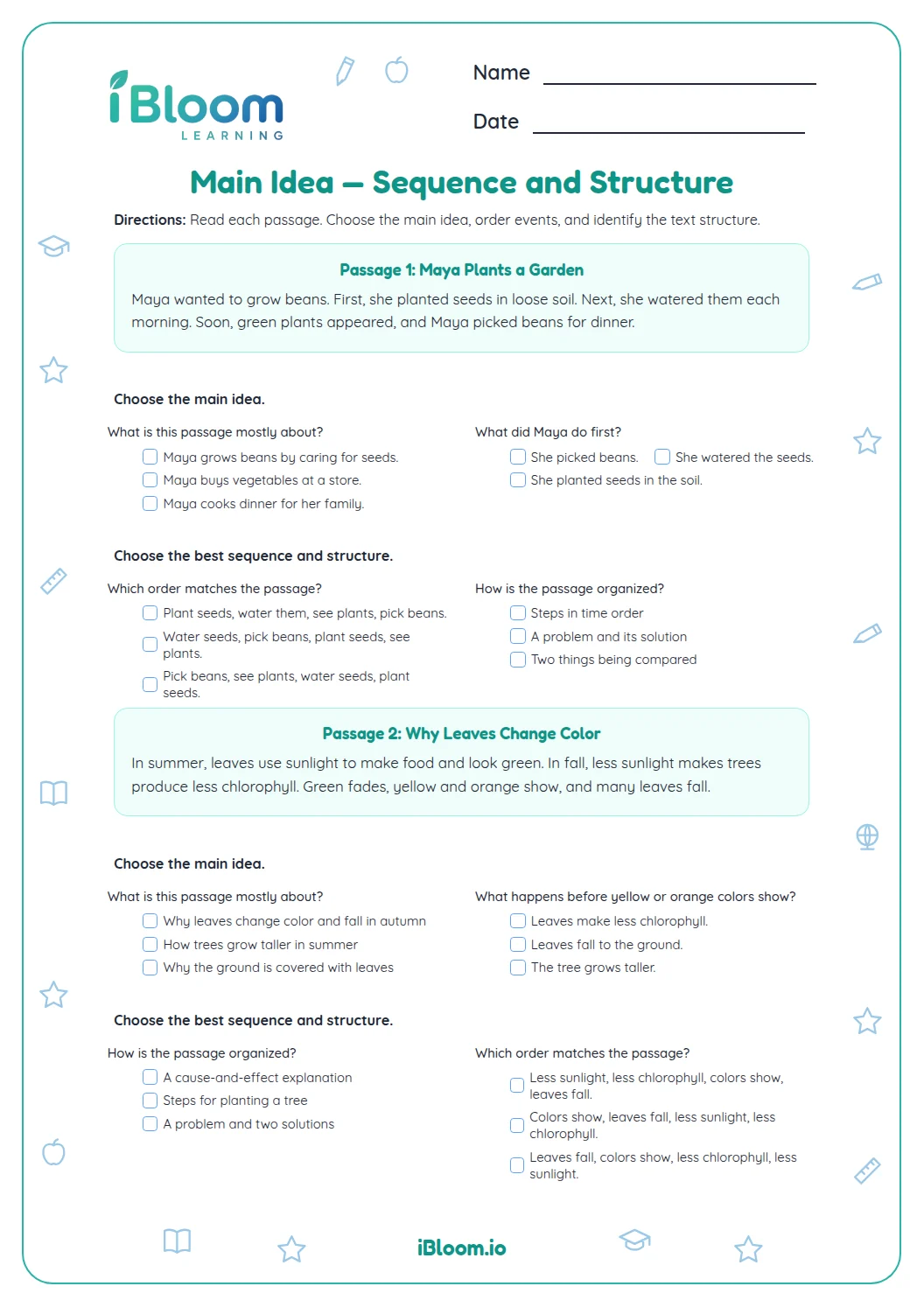
This Grade 2 fact and fiction worksheet pairs a short informational paragraph about bean plants with an original pretend story about Luna the rabbit. Students answer 16 questions about factual details, imagined events, paragraph focus, and how the two texts differ. They also support two short responses with details from the passage. The answer key lists the multiple-choice answers and sample responses. Questions about the information paragraph practice asking and answering about key details, as described in Common Core RI.2.1.
Aligned to RI.2.1
How can a reader tell a fact from fiction?
A factual statement can be checked against evidence. The first paragraph gives information about seeds, water, light, roots, leaves, and measuring a plant. The second paragraph is introduced as pretend and includes Luna’s imagined Moon adventure.
- 1Which statement could be checked by observing a real plant?
- 2“A plant’s leaves help it use light” is stated as information about plants.
How do details help answer comprehension questions?
Return to the paragraph named in the question and locate the sentence with the matching detail. Question 7 asks where Luna plants the bean; the story says beside a crater. Question 15 asks for a plant fact from paragraph one.
- 1Where does Luna plant the bean?
- 2Beside a crater.
How are the two paragraphs different?
The first paragraph explains real plant needs in a factual voice. The second follows a character through an imagined adventure. Question 13 asks students to compare those purposes, while question 14 uses one story detail to support the fiction label.
How to use this worksheet
- 1Read both paragraphs and notice the sentence that introduces the pretend story.
- 2Underline details about real plants in paragraph one.
- 3Underline imaginative events in paragraph two.
- 4For each question, return to the paragraph that contains the answer.
- 5Use one specific detail in each written response.
Common mistakes and quick fixes
The mistake
Calling every written sentence a fact without checking it.
The fix
Ask whether the claim can be checked in the real world or in reliable information.
The mistake
Using a story detail to answer a question about paragraph one.
The fix
Check which paragraph the question names before responding.
The mistake
Saying a story is fiction without an example.
The fix
Name an imagined event, such as the overnight bean ladder.
Common Core alignment
Students ask and answer questions using details in a factual paragraph and an imagined story.
Answer questions about stated details in the information paragraph.
On this sheet: The factual paragraph supports who, what, and how questions about plant details.
Show the official wordingHide the official wording
Ask and answer such questions as who, what, where, when, why, and how to demonstrate understanding of key details in a text.
What to practice next
Make more practice
Further reading
Questions parents and teachers ask
How does this worksheet explain fact and fiction?
The first paragraph shares checkable information about bean plants. The second is clearly introduced as a pretend story about Luna the rabbit traveling to the Moon. Students identify which details are factual and which belong to the imagined adventure.
Can a fact be surprising?
Yes. A fact is something that can be checked with evidence, even if it is new or surprising. The questions point students back to statements about seeds, light, leaves, and measuring plants. The story’s impossible events are clues, and the word pretend makes the author’s purpose especially clear.
What clues show that Luna’s adventure is fiction?
The passage calls it a pretend story, and details such as a rabbit traveling to the Moon or a bean growing into a ladder overnight are imagined. Students use those details to explain why the adventure is fiction.
How can a child check a statement against the passage?
Reread the paragraph and find the sentence that supports the answer. For example, the first paragraph says gardeners may measure a plant, while the second says Luna plants a bean beside a crater. The questions name the paragraph when a detail must come from one part rather than the other.
What should a written response include?
A response should name a detail from the requested paragraph. For a plant fact, a student might say that a bean plant needs water and light. For fiction, the student could mention Luna’s rocket trip or the overnight ladder.
Why does the page include both information and a story?
Reading the two forms side by side gives students examples to compare. They can notice that the informational paragraph presents checkable plant details, while the pretend story describes an imaginative character and adventure. Comparing them helps students notice how a writer can share information in one paragraph and entertain with a made-up character in another.