

About this worksheet
This Grade 2 worksheet follows Maya as she listens for /m/ and /s/, blends phonemes to read map and sun, and reads both words in a sentence. Children answer questions about the sound steps, order words, and the passage’s main idea. The sequence questions practice CCSS RI.2.3 by asking readers to describe connected steps in a text. A separate answer key includes the short answers and model responses.
Aligned to RI.2.3
How does Maya go from sounds to words?
Maya listens for /m/ in map and moon, then /s/ in sun and sock. She blends /m/, /a/, /p/ to read map and /s/, /u/, /n/ to read sun. Finally, she reads both words in a sentence.
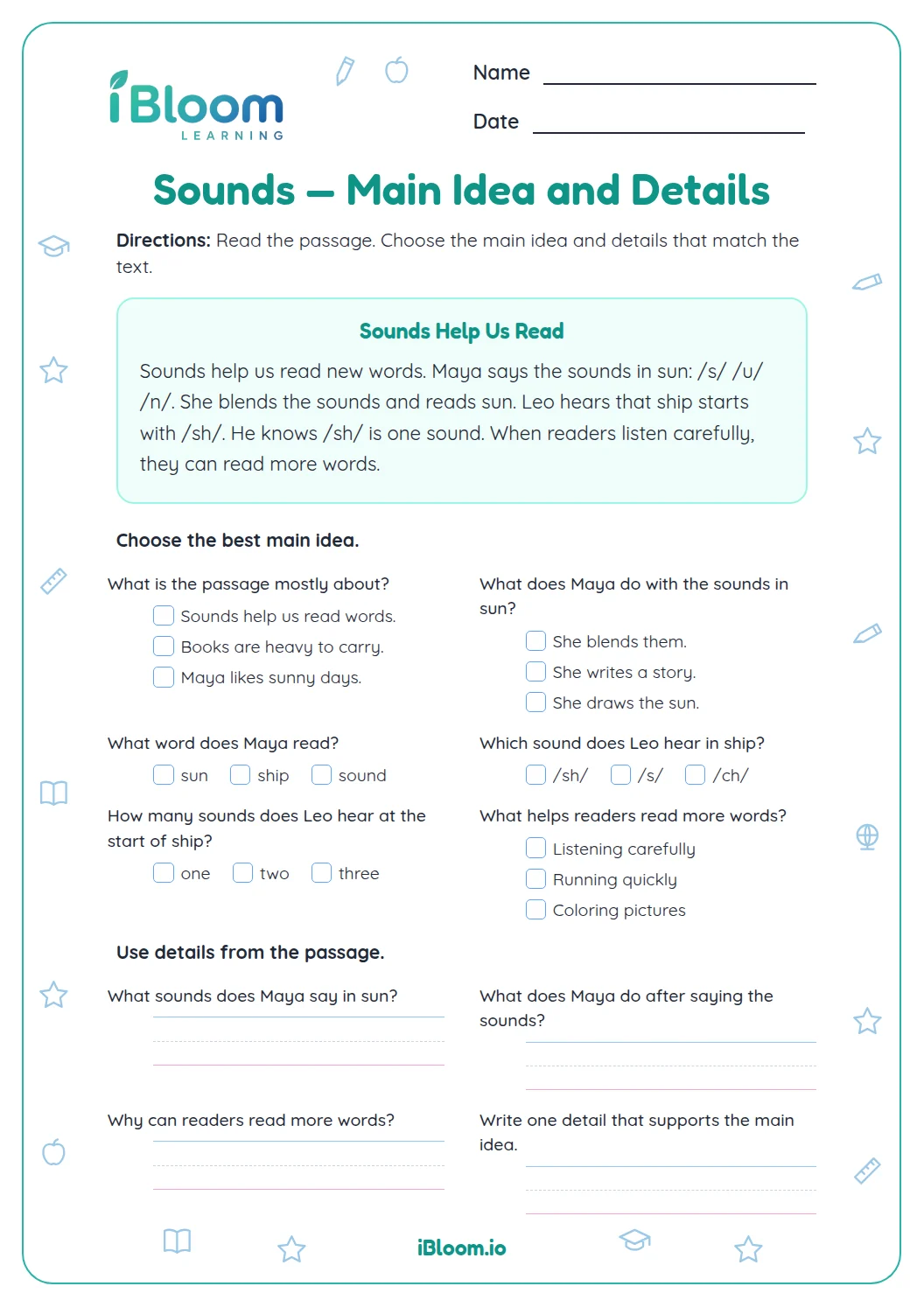
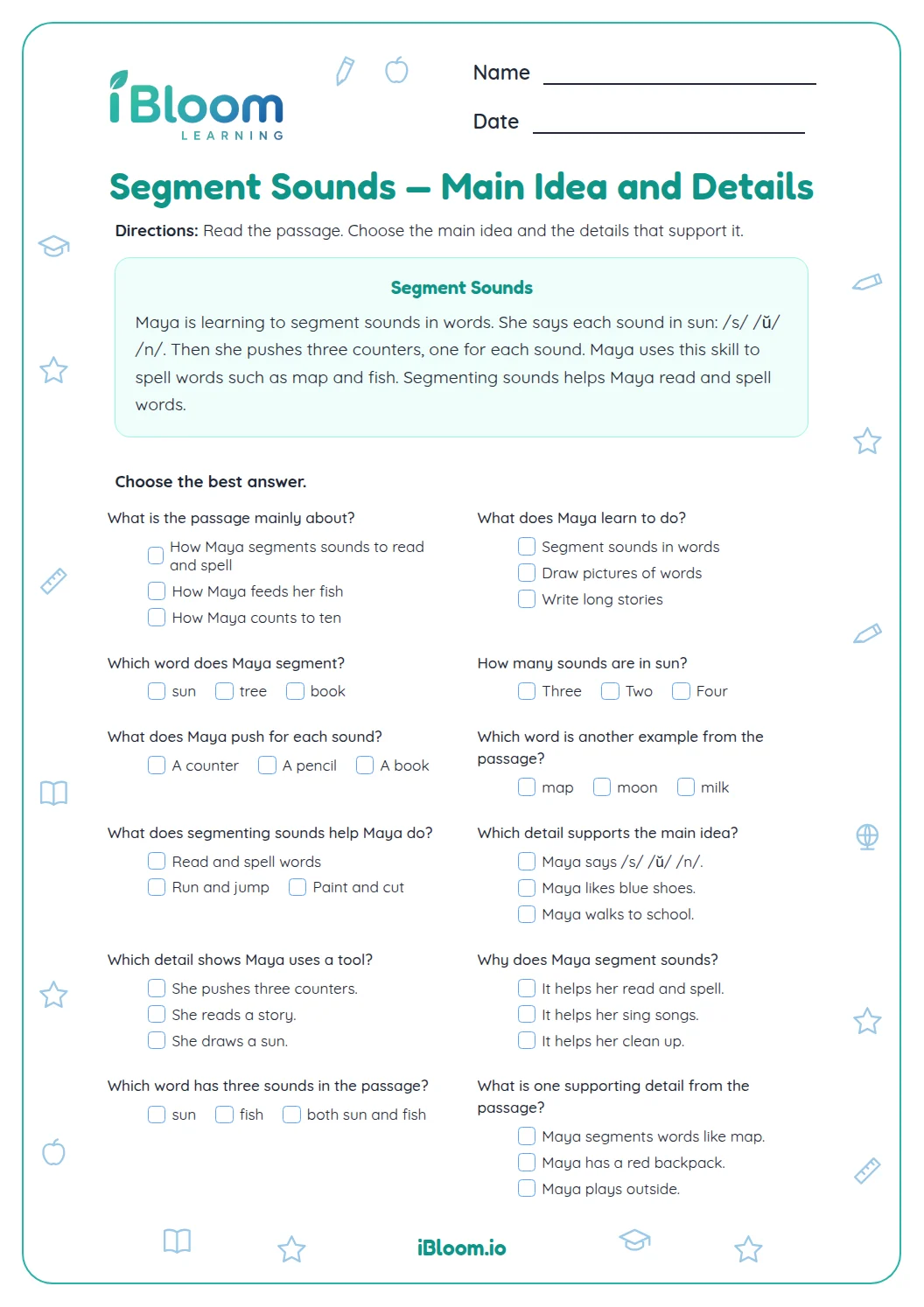
Question 4 asks which sounds make sun: /s/, /u/, and /n/.
- 1Find the sentence about sun.
- 2It lists /s/, /u/, and /n/.
- 3Those phonemes blend to make sun.
How can readers track the order?
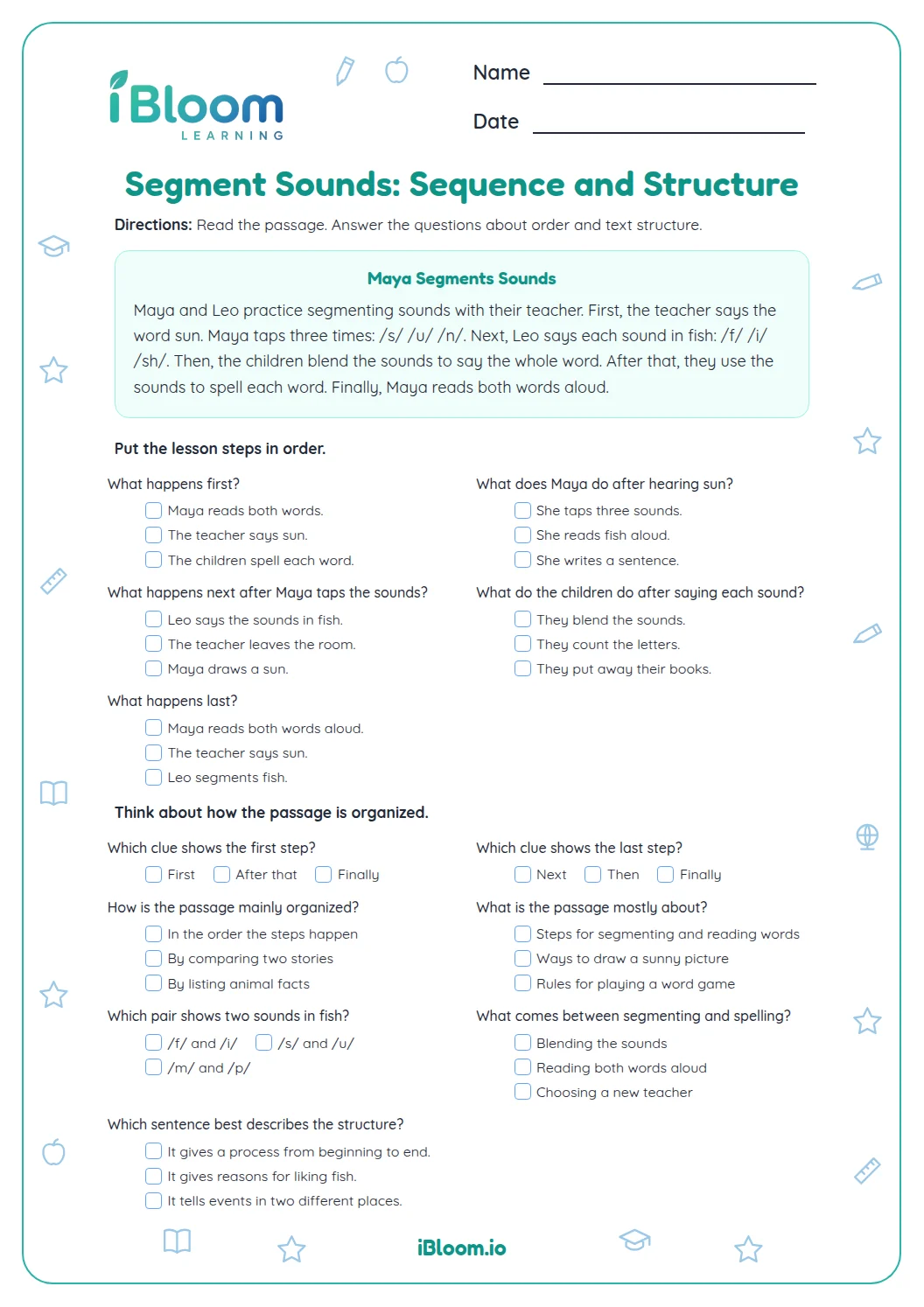
Order words signal each step: first Maya listens for /m/, next she listens for /s/, then she blends sounds to read map, after that she blends sounds to read sun, and finally she reads both words in a sentence. Follow the words in the passage to keep the steps in order.
What question types are included?
Sixteen questions move from selected details to sequence and structure. Every answer comes from Maya’s phonics routine in the passage.
- Five multiple-choice questions check sound and sequence details
- Five short answers identify details from the passage
- Six written responses address actions, order, structure, and main idea
- The key gives sample wording for open responses
How can an adult support this practice?
- 1Read the passage once for the full routine.
- 2Reread and mark First, Next, Then, After that, and Finally.
- 3Say each phoneme separately before blending it into a word.
- 4Return to the passage to check a detail answer.
- 5Retell the steps in order before answering a sequence question.
Common mistakes and quick fixes
The mistake
Switching the order of listening and blending.
The fix
Follow the passage: Maya listens for a sound before blending phonemes.
The mistake
Leaving out one phoneme in a word.
The fix
Say each sound in map or sun, then blend all three.
The mistake
Treating the order words as the main idea.
The fix
Use them to track the steps; the main idea is Maya’s sound practice.
Common Core alignment
The questions ask readers to explain connected steps in a scientific text.
Describe how the steps in the sound process connect in the text.
On this sheet: The passage explains a sequence of scientific events that produces a sound a person hears.
Show the official wordingHide the official wording
Describe the connection between a series of historical events, scientific ideas or concepts, or steps in technical procedures in a text.
What to practice next
Make more practice
Further reading
Questions parents and teachers ask
What sound does Maya listen for first?
She listens for /m/ in map and moon. Then she listens for /s/ in sun and sock. The first part of the worksheet asks children to locate these details and follow what Maya does next. The passage also names moon, sock, map, and sun as examples for those target sounds.
How does Maya read the word map?
She blends /m/, /a/, and /p/ to read map. Saying each phoneme and then joining the sounds helps children follow the routine in the passage. Question 3 asks what she does after listening for /s/. The next step is blending, and that sequence helps connect sounds with a readable word.
What do First, Next, and Finally tell the reader?
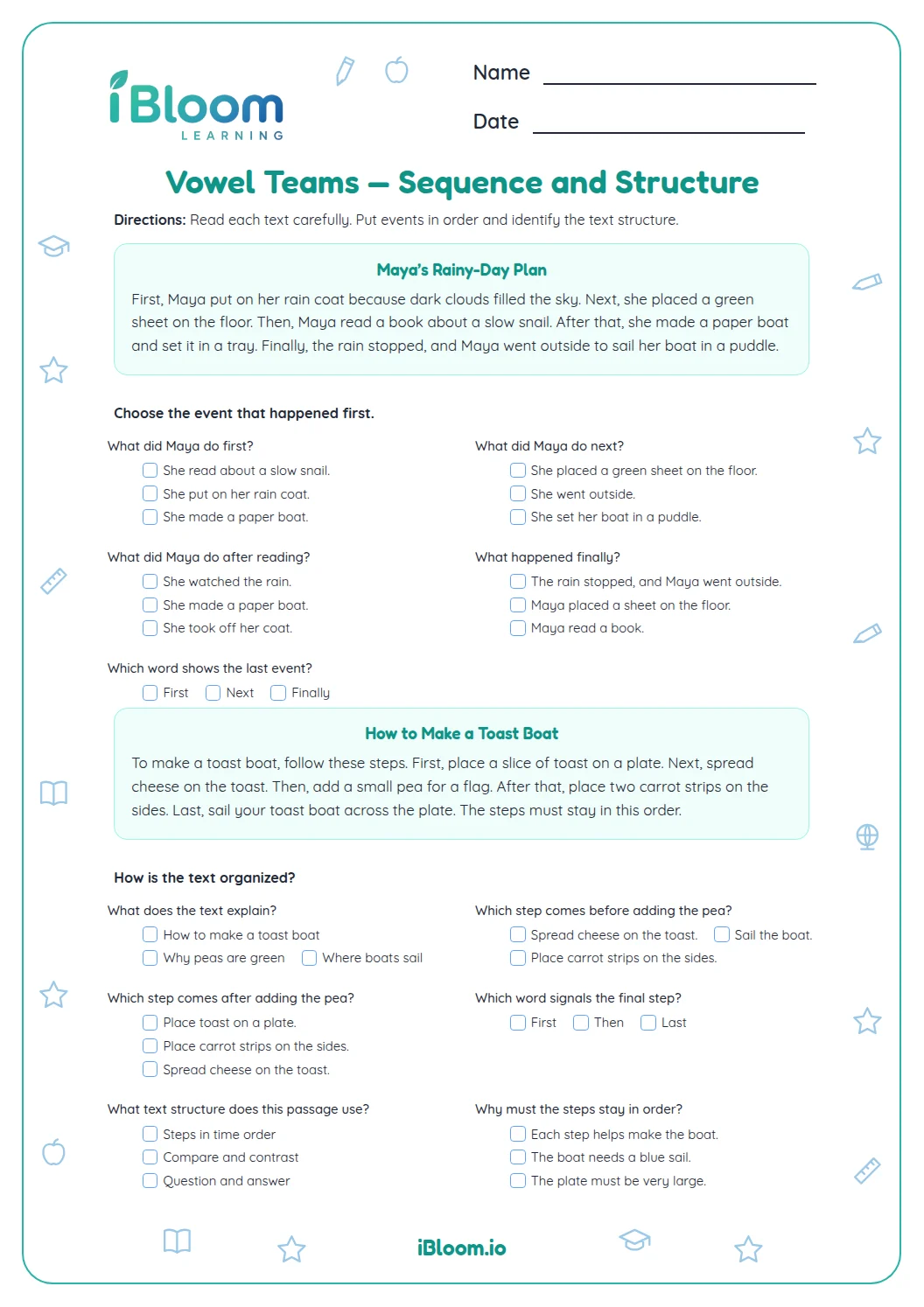
These words show the order of Maya’s actions. She listens for /m/ first, listens for /s/ next, blends the sounds into words, and finally reads map and sun in a sentence. Part C asks children to notice those structure clues.
What is the passage mainly about?
It is about Maya listening for speech sounds and blending phonemes to read words. The passage gives examples of the sounds in map and sun, then shows how she uses the words in a sentence. Details about the target sounds and example words support that central idea throughout the text.
Does the answer key allow different wording?
Yes. Short answers can use different words if they identify the same sound or action from the passage. For example, “She blends the sounds” is acceptable for an answer that describes Maya blending phonemes to read a word.
How can I help a child with the order questions?
Read the passage together and underline each order word. Have the child retell one action at a time, from listening for /m/ through reading the two words in a sentence. Then use the answer key to check that no step was skipped.