


About this worksheet
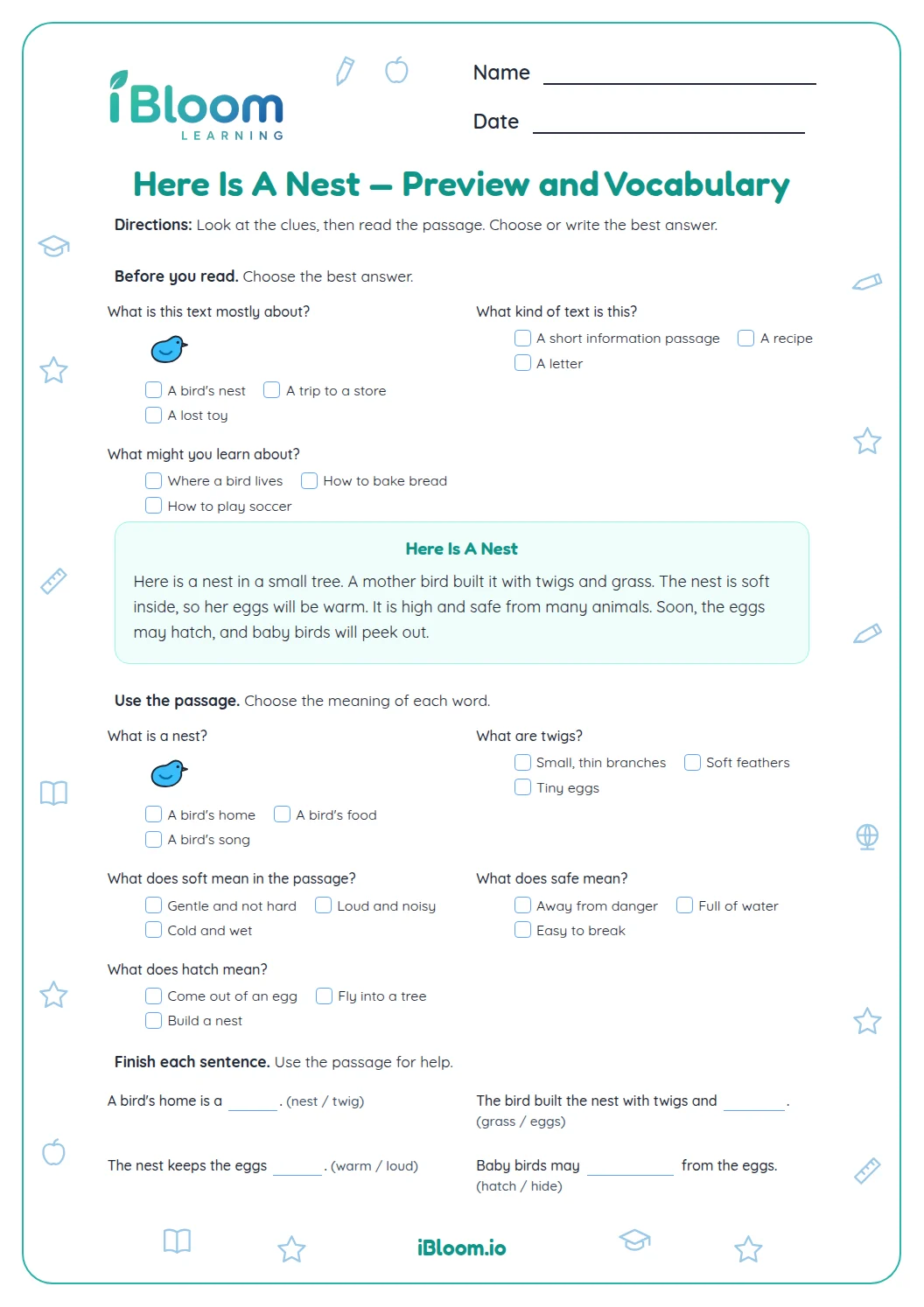
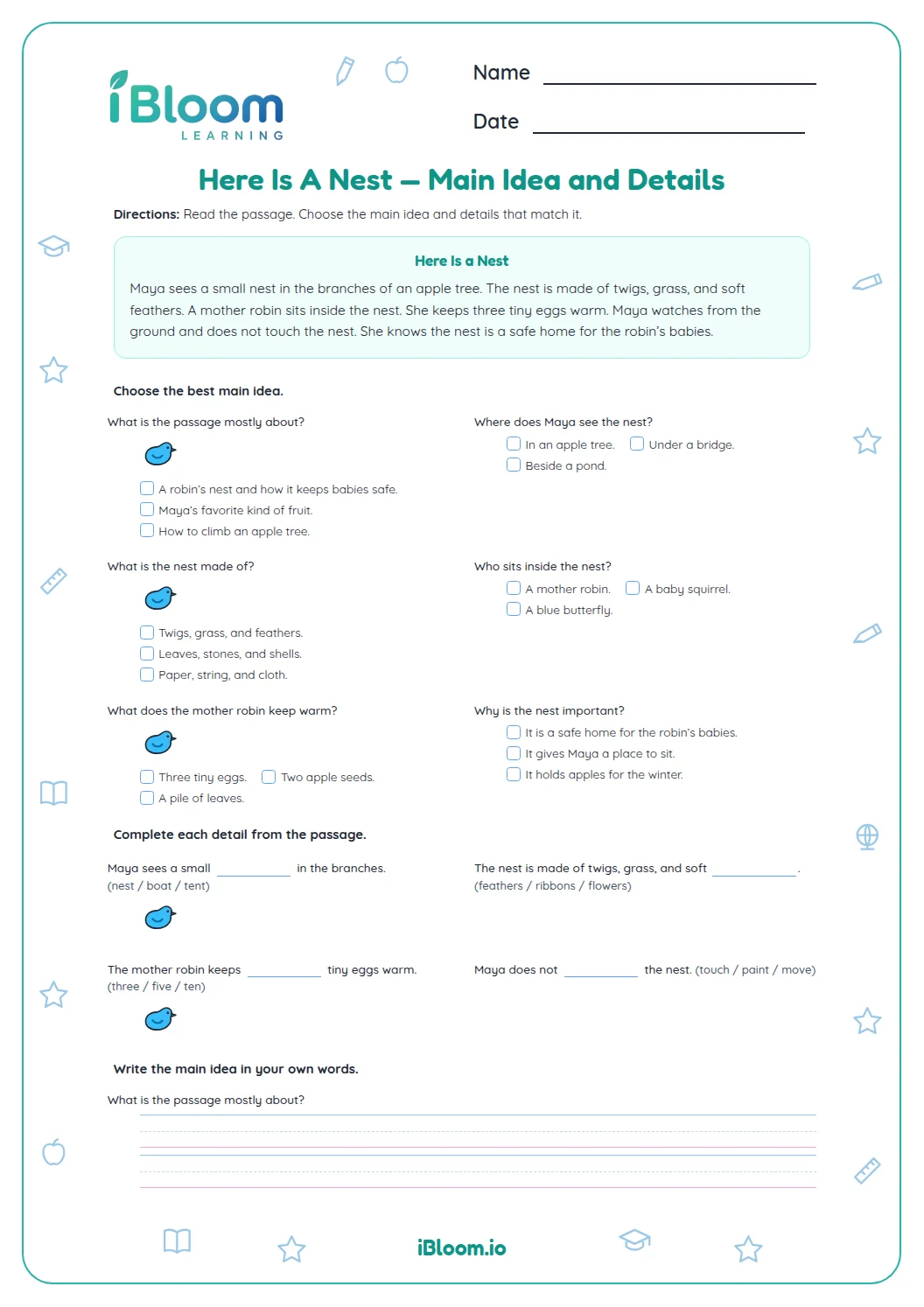
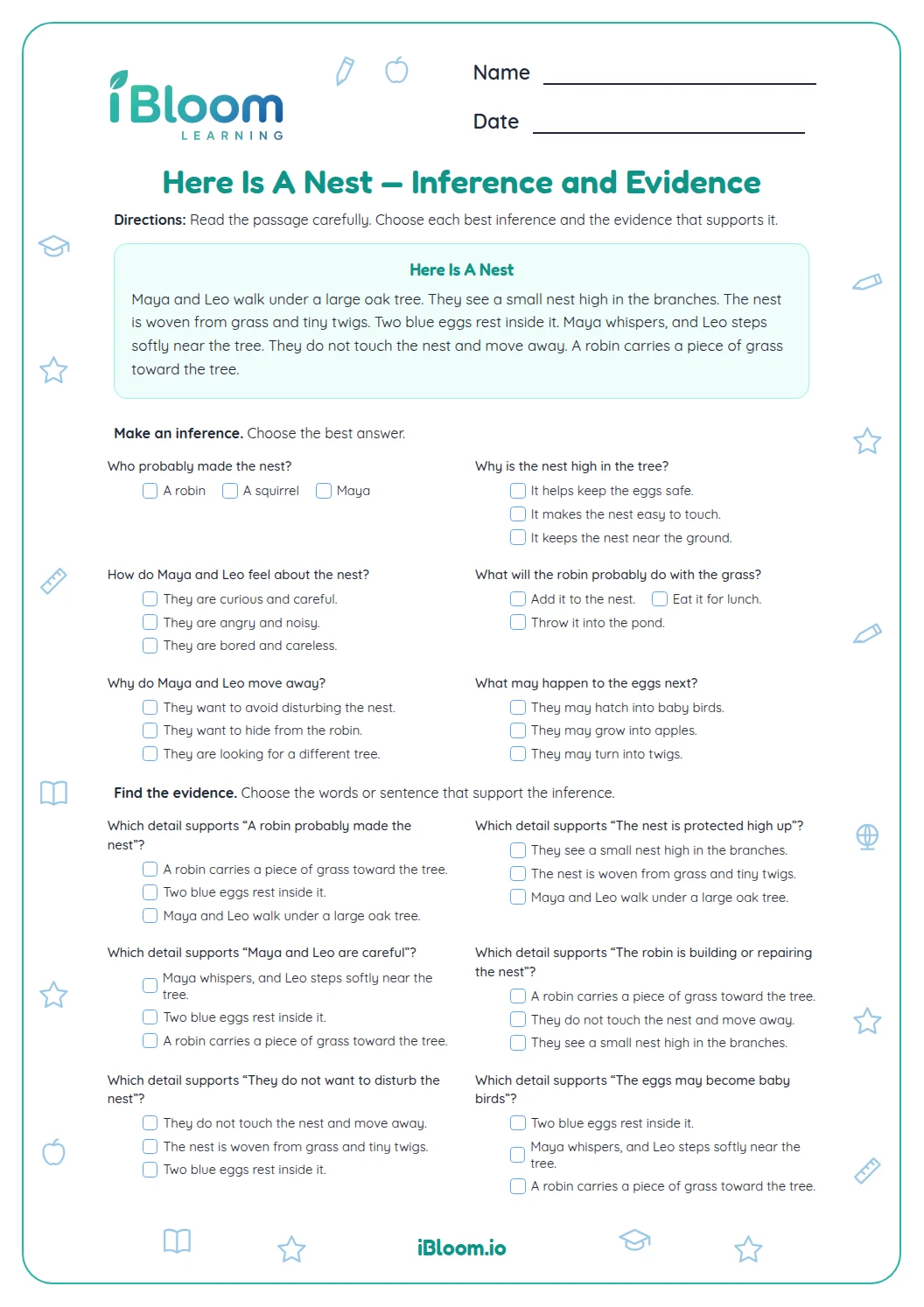
This Grade 2 reading worksheet pairs the short story “Here Is a Nest” with 14 mixed comprehension questions. Students use context to understand a word, find story details, identify the main idea, and explain answers with evidence. The passage features Maya and Leo observing a bird’s nest from a safe distance. These tasks practice Common Core RL.2.1: answering questions to show understanding of key details. A separate answer key includes sample written responses.
Aligned to RL.2.1
Which details help readers understand the story?
Readers can look for who is in the story, where the action happens, and what the characters do. The passage says Maya sees the nest while walking with Leo and that three eggs rest inside it.
How can context explain an unfamiliar word?
Read the whole sentence and test a possible meaning against the surrounding details. In “the crook of an old tree,” the nest’s location and the tree help show that crook means a bend or corner.
- 1“Here is a nest in the crook of an old tree.”
- 2The sentence names a part of the tree where the nest sits.
- 3Crook means a bend or corner.
How can students support an answer?
Choose a detail that directly connects to the question. To explain how the children care for the bird, use the passage detail that they stay quiet and watch from far away.
What kinds of questions are included?
The worksheet mixes multiple choice, fill-in questions, and written responses. Students work with vocabulary, sequence, main idea, cause and effect, and details from the passage.
How to use this worksheet
- 1Read the passage once for the whole story.
- 2Read the question and return to the related sentence.
- 3Choose or write an answer that fits the question.
- 4For written answers, include a specific passage detail.
- 5Check that the detail supports your idea.
Common mistakes and quick fixes
The mistake
Choosing a detail that is true but does not answer the question.
The fix
Match the detail directly to the question words.
The mistake
Guessing a word meaning without rereading its sentence.
The fix
Use nearby words to test which meaning fits.
The mistake
Giving an opinion without evidence.
The fix
Add a detail the passage states.
Common Core alignment
This story review focuses on key details and evidence-based answers.
Ask and answer who, what, where, when, why, and how questions about a text.
On this sheet: Questions ask students to locate key details and explain their thinking with passage evidence.
Show the official wordingHide the official wording
Ask and answer such questions as who, what, where, when, why, and how to demonstrate understanding of key details in a text.
What to practice next
Make more practice
Further reading
Questions parents and teachers ask
What is “Here Is a Nest” about?
Maya and Leo notice a nest in an old tree while they are walking. They see eggs inside and watch the mother bird bring food from a distance. The children stay quiet and leave the nest undisturbed. The short passage gives a clear setting, characters, and sequence for students to discuss.
How can students find the answer to a detail question?
Reread the part of the passage connected to the question. Look for a sentence that states the detail, such as what the nest is made of or what the mother bird carries back to it. For “they,” use the nearby sentence to identify Maya and Leo.
What does crook mean in this passage?
Crook means a bend or corner. In the phrase “the crook of an old tree,” the word describes a place where branches meet and form a sheltered spot for the nest. The surrounding phrase provides a clue to which meaning fits this location.
What kinds of questions are included?
The 14 questions mix multiple choice, fill-in-the-blank, and written responses. Students work with vocabulary, key details, sequence, the main idea, cause and effect, and evidence from the story. The key includes sample written responses that can be supported with details from the passage.
What does the passage say is inside the nest?
Three tiny eggs rest inside the nest. Students can return to that sentence to check the number and location. The story also describes the nest as made of twigs, grass, and soft feathers, details that help readers picture the setting.