


About this worksheet
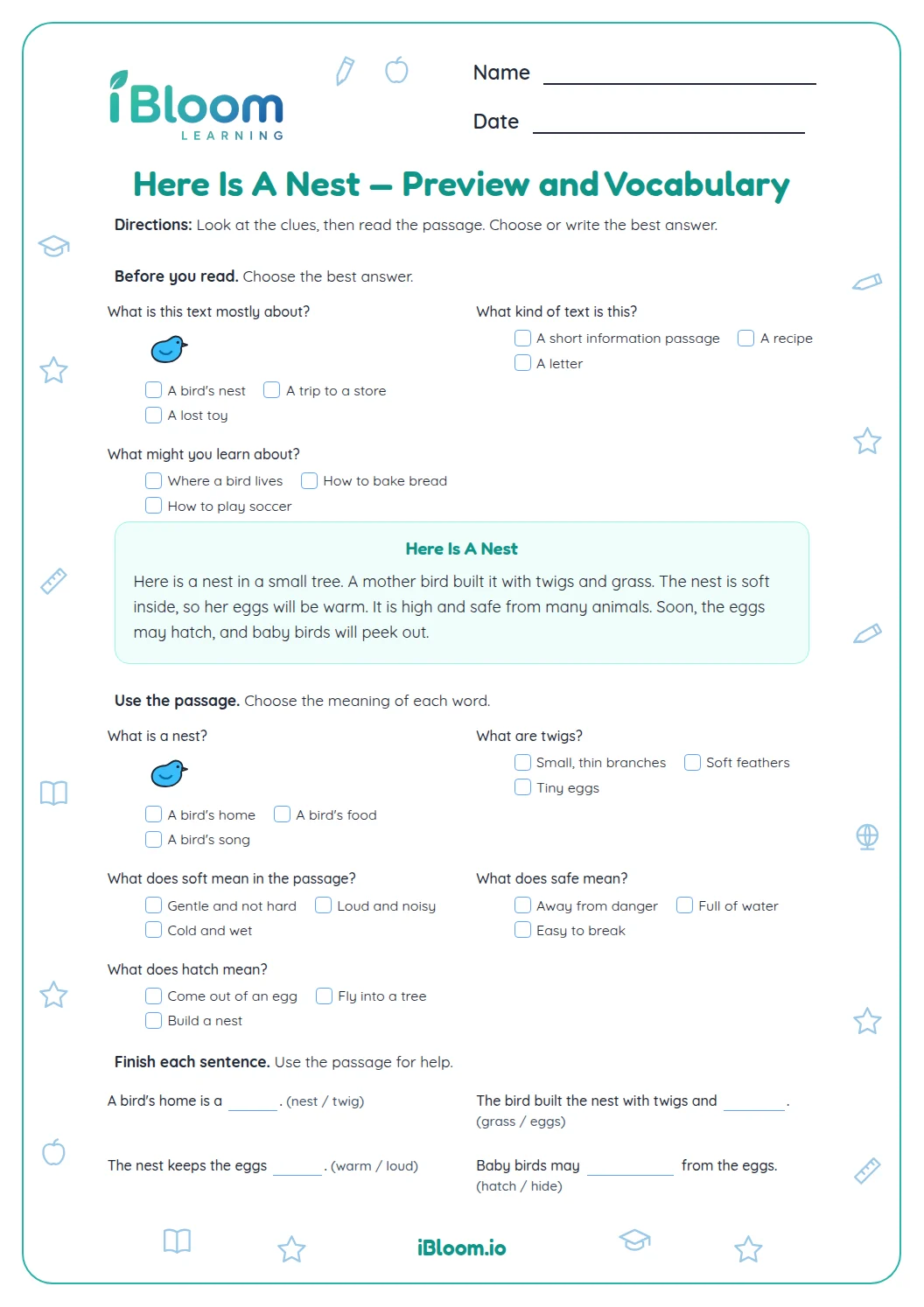
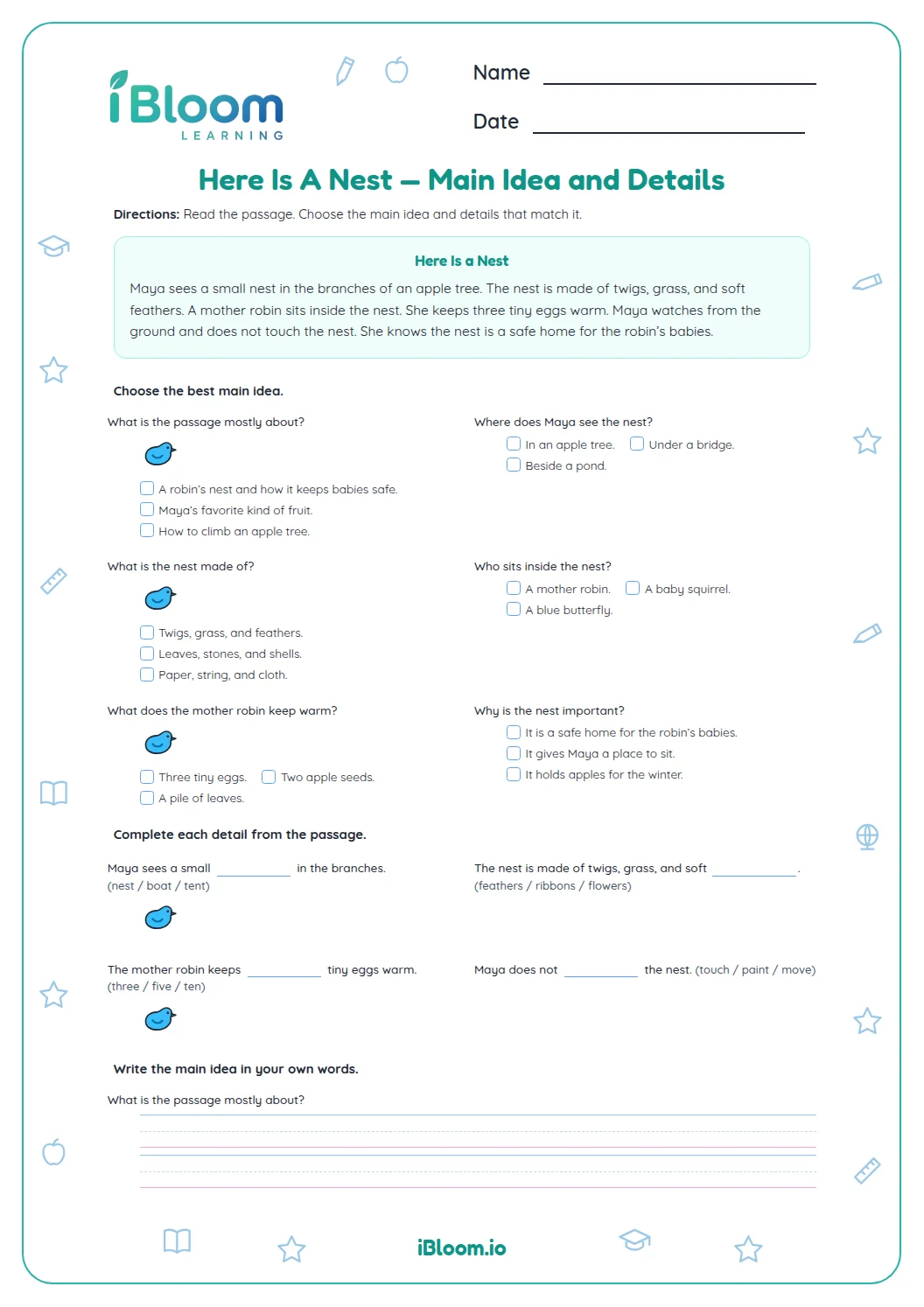
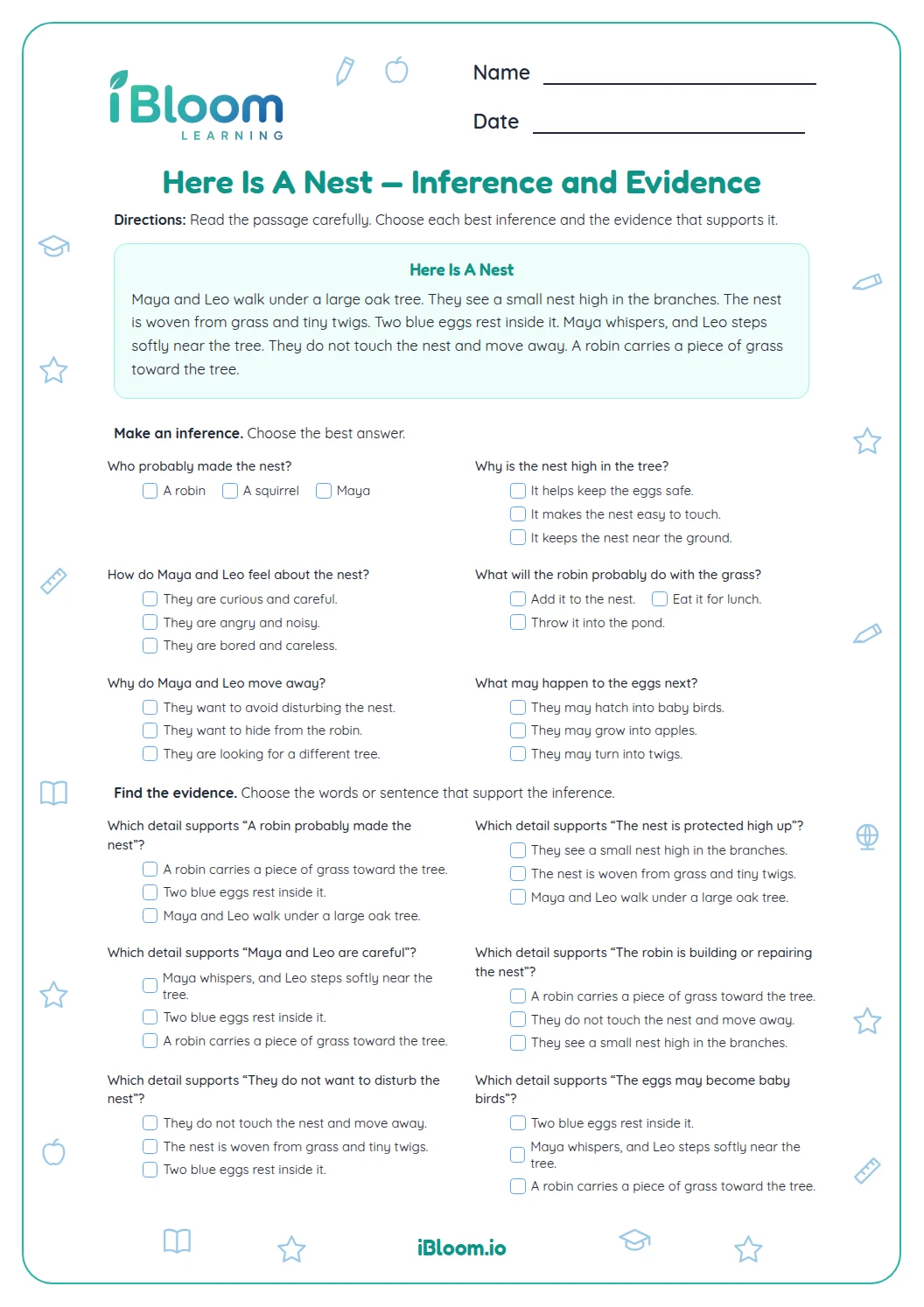
This three-page Grade 2 reading worksheet pairs the original story “Here Is a Nest” with eight multiple-choice questions and six written responses. Children find details about Maya, Leo, and a robin, infer what the robin may do with a worm, identify the story’s lesson, and support responses with text evidence. A separate three-page answer key includes sample responses. The questions practice CCSS RL.2.1 and RL.2.2.
Aligned to RL.2.1 and RL.2.2
What is in “Here Is a Nest”?
The passage introduces Maya and Leo, describes a robin’s nest and the materials in it, and explains why the children watch quietly. The final sentence states the lesson: wild birds need quiet and space.
How can a reader support an answer with evidence?
Return to the sentence that gives the detail, then put it in your own words. For example, the passage says the nest was made from dry grass, twigs, and soft feathers. Those details support a response about how the nest was built.
- 1Question: What was the nest made from?
- 2Find the sentence about its materials.
- 3It says dry grass, twigs, and soft feathers.
- 4Use those details in the response.
How does the story show its lesson?
Maya and Leo see the robin and choose to watch quietly so they do not scare it. The last sentence explains why that choice matters: wild birds need quiet and space. The lesson follows from the children’s careful action and the story’s closing idea.
How to use this worksheet
- 1Read the one-line direction at the start of each part.
- 2Complete the first item together and explain the choice or strategy.
- 3Finish the remaining items without looking at the key.
- 4Compare each answer with the key and mark any item to revisit.
- 5For missed items, explain why the correct response fits.
Common mistakes and quick fixes
The mistake
Giving an answer that is not in the passage.
The fix
Reread the sentence about that event and use its details.
The mistake
Copying a detail without answering the question.
The fix
State the answer first, then add the supporting detail.
The mistake
Naming a topic instead of the lesson.
The fix
Explain what the children learn from choosing to watch quietly.
Curriculum alignment
The reading questions focus on key details and the story’s lesson.
Answer questions about key story details using information from the text.
On this sheet: Questions ask who, what, where, when, why, and how about events in the story.
Show the official wordingHide the official wording
Ask and answer such questions as who, what, where, when, why, and how to demonstrate understanding of key details in a text.
Determine the story lesson and explain it with key events.
On this sheet: Learners explain the lesson about observing wildlife respectfully.
Show the official wordingHide the official wording
Recount stories, including fables and folktales from diverse cultures, and determine their central message, lesson, or moral.
What to practice next
Make more practice
Further reading
Questions parents and teachers ask
What is the lesson of “Here Is a Nest”?
The story’s lesson is that wild birds need quiet and space. Maya and Leo watch the robin quietly so they will not scare it, and the final sentence makes the idea clear. Question 8 asks children to identify this lesson from the events and closing sentence.
How long is the passage?
The passage is 65 words long. It describes Maya and Leo finding a nest, the grass, twigs, and feathers that make it, and a robin carrying a worm. It ends by stating that wild birds need quiet and space.
How many questions are on the sheet?
There are 14 questions: eight multiple-choice questions about details, inference, and the lesson, followed by six written responses. The worksheet has three pages, and its separate answer key also has three pages with sample responses. Children can answer with their own wording when it matches the passage.
Do written answers need to use exact wording?
No. A response can use different words as long as it answers the question accurately and includes requested story evidence. The answer key gives sample wording, not the only acceptable response. For personal responses, a sensible reason is acceptable.
How can I help a child find evidence?
Ask the child to reread the part that describes the nest, the robin, or the children’s choice to watch quietly. Then point to the detail that supports the response. For the lesson, connect the children’s quiet watching to the story’s final sentence.