


About this worksheet
This Grade 3 reading-comprehension worksheet pairs an original four-paragraph story, “Hats in Harvard,” with 14 questions. Readers track story details, explain Eli’s choice, and finish with written responses supported by text evidence. A separate answer key gives short answers and sample responses for open-ended items. The page focuses on reading closely and writing clear answers about the story.
Aligned to RL.3.1
How can readers keep track of the story details?
Notice who is present, what objects matter, and how a character responds. In this story, Noah and Lily use library photographs to design hats showing places in Harvard. Returning to those details helps answer who, what, and why questions.
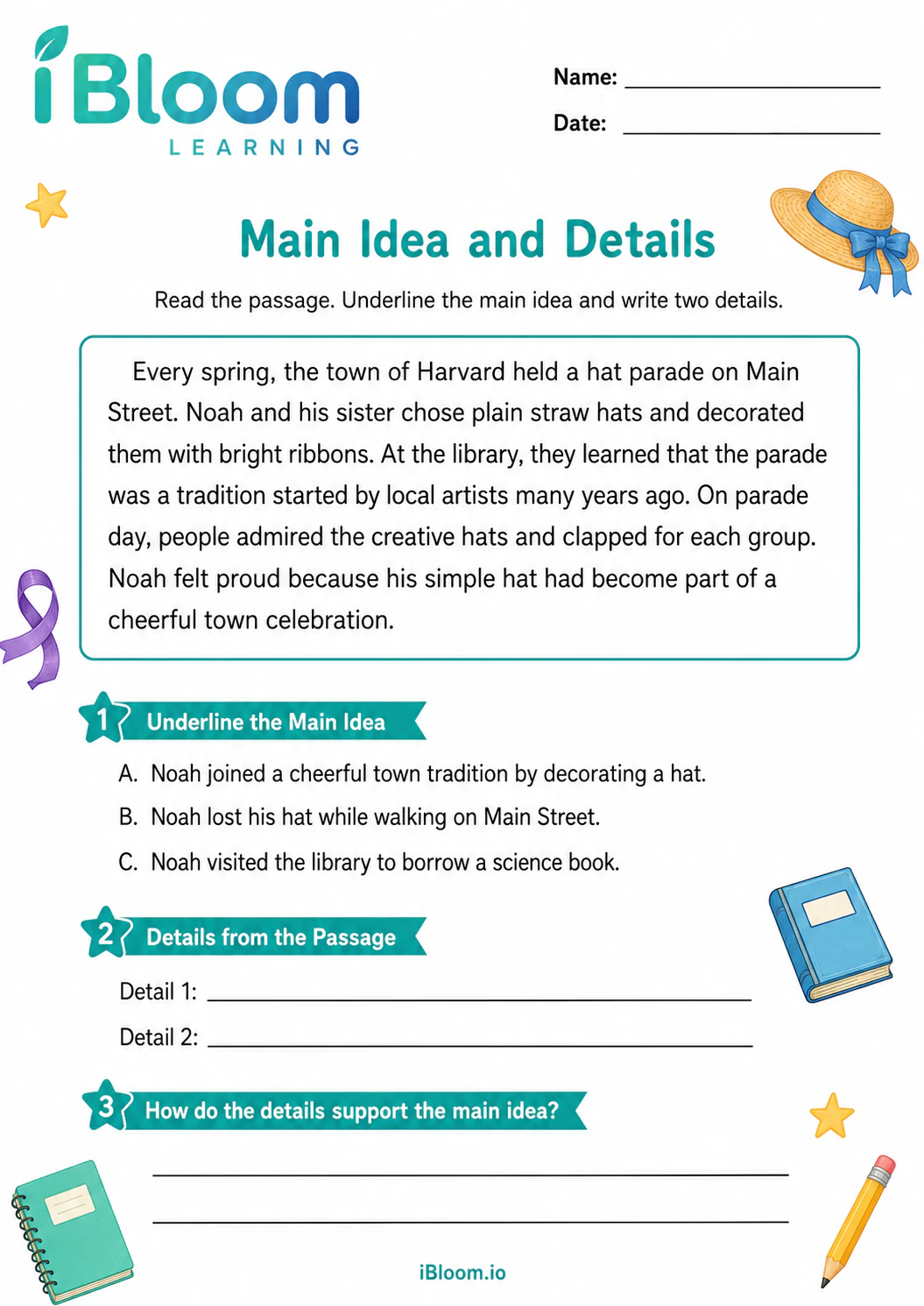
Question 4 asks why Noah felt proud at the first parade. The passage explains that his simple hat became part of the town celebration.
- 1Question: Why did Noah feel proud at the first parade?
- 2Find the first paragraph.
- 3It says his simple hat became part of the town celebration.
- 4Answer: His hat became part of the celebration.
How do written responses use evidence?
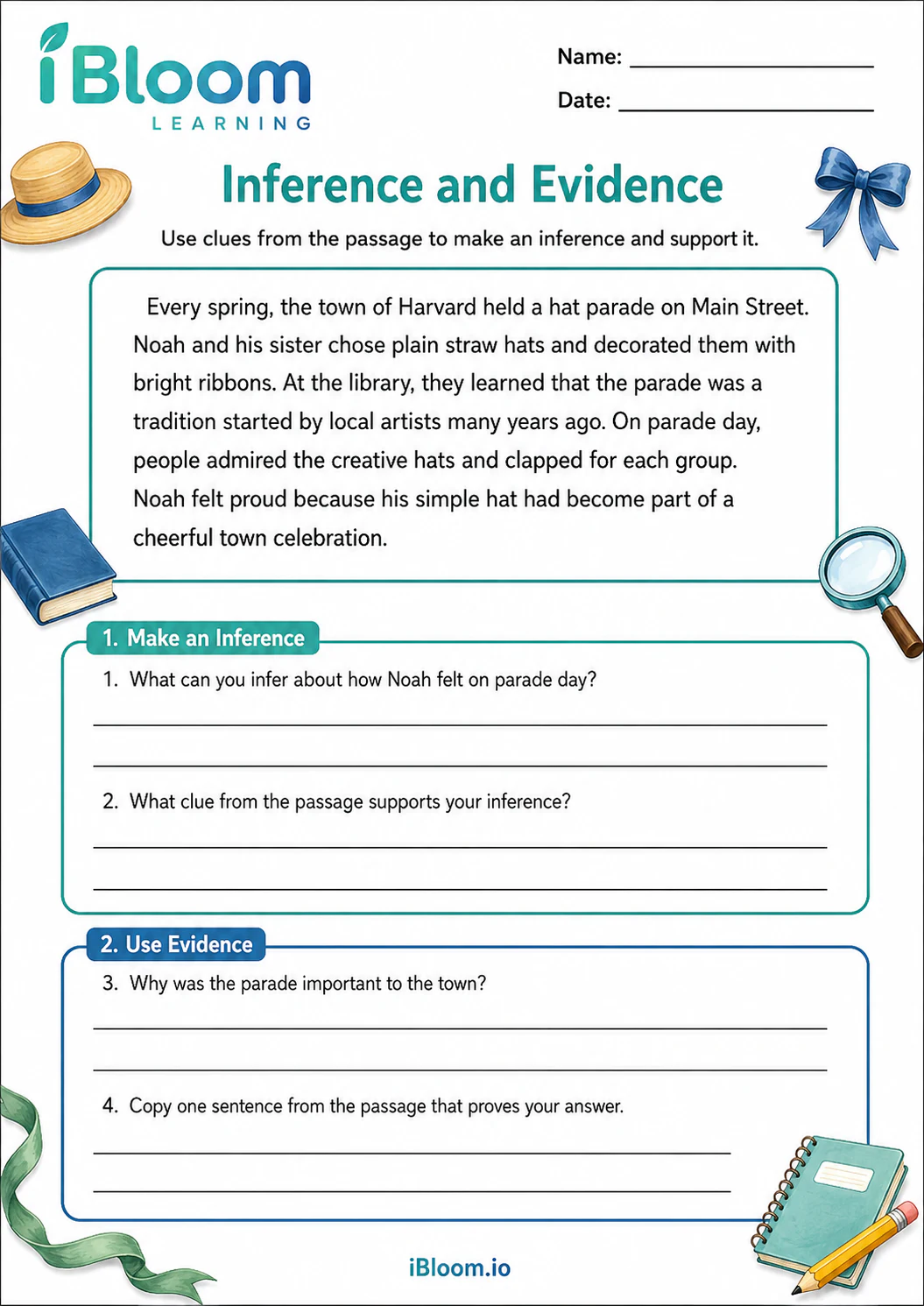
A useful response answers the question first, then includes a detail that supports it. For question 14, Noah catches Lily’s paper wave and helps secure it with another ribbon before it blows away.
How do details connect the town and the parade?
Noah and Lily use library photographs to make hats about places in Harvard. The parade gives them a way to share those details with neighbors, and the artist recognizes the designs as worth displaying.
How to use this worksheet
- 1Read the story once to understand what happens.
- 2Reread and mark the paragraph that contains each answer.
- 3Answer detail questions with the shortest complete response that fits.
- 4For written responses, state an idea and add a supporting story detail.
- 5Compare answers with the key; accept equivalent evidence-based wording.
Common mistakes and quick fixes
The mistake
Answering from memory alone
The fix
Reread the passage and point to the supporting detail.
The mistake
Retelling the whole story
The fix
Answer the question directly, then add one relevant detail.
The mistake
Mixing up which child made each hat detail
The fix
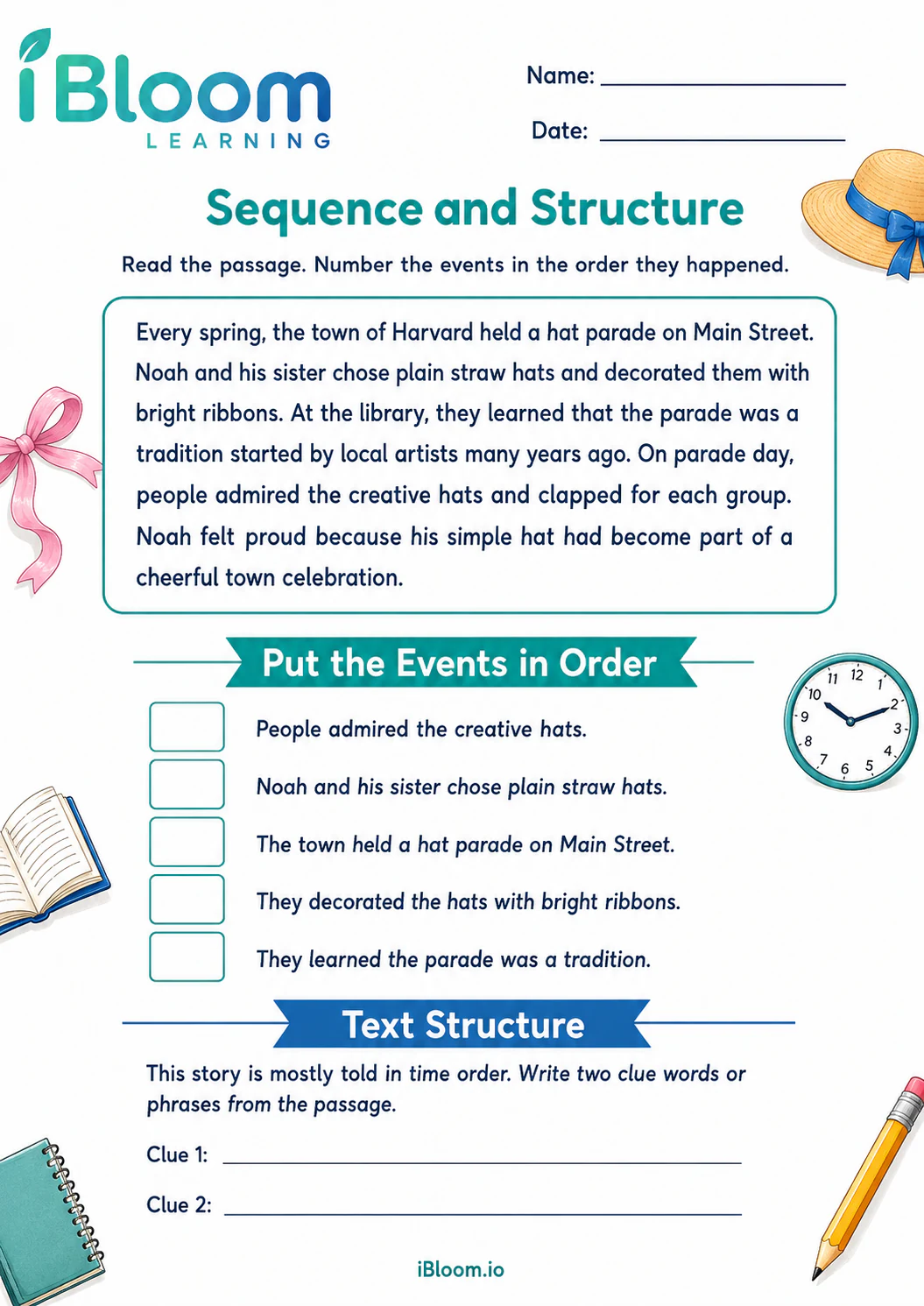
Reread the passage: Lily sketches the train station; Noah cuts out blue waves.
Common Core alignment
This page practices close reading and gathering details for written answers.
Ask and answer questions using explicit details and inferences.
On this sheet: Questions ask learners to retrieve details and infer a character’s response from the story.
Show the official wordingHide the official wording
Ask and answer questions to demonstrate understanding of a text, referring explicitly to the text as the basis for the answers.
What to practice next
Make more practice
Further reading
Questions parents and teachers ask
How long is the reading passage?
The original story is about 170 words in three paragraphs. It follows Noah and Lily as they make hats showing places in Harvard and join the town parade. The questions ask readers to recall details, follow events, and explain how the children use information from the library.
What does the written-response section ask?
The final questions ask how Noah and Lily used library information and how Noah helped Lily when a paper wave came loose. Learners answer in complete sentences and include a story detail. The key gives sample wording while allowing equivalent answers.
What places appear in the library photographs?
The passage names the old train station, the town pond, and the first parade. Question 6 asks for one of these places. Any one of the three named details answers it, and readers can check the second paragraph to confirm the exact place names.
How did Noah help Lily at the parade?
A breeze lifted one of Lily’s paper waves. Noah caught it before it blew away and helped her secure it with another ribbon. Question 14 asks readers to explain this action in a complete response, using the event from the final paragraph as evidence.
How many questions are on the worksheet?
There are 14 questions in three parts: five story-detail questions, five questions about events and choices, and four questions that build toward written responses. A separate answer key includes concise answers and sample wording for the two extended responses.