


About this worksheet
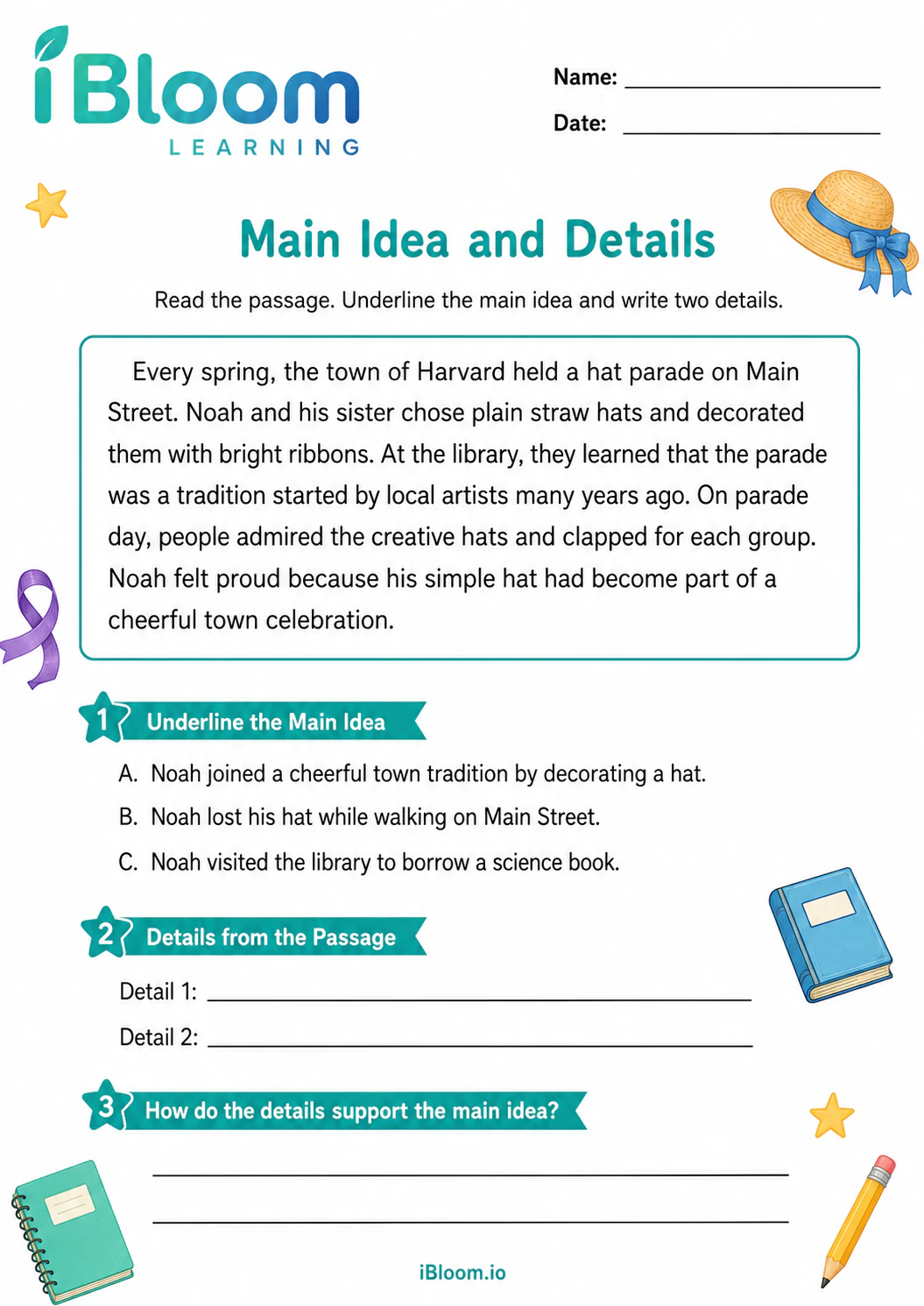
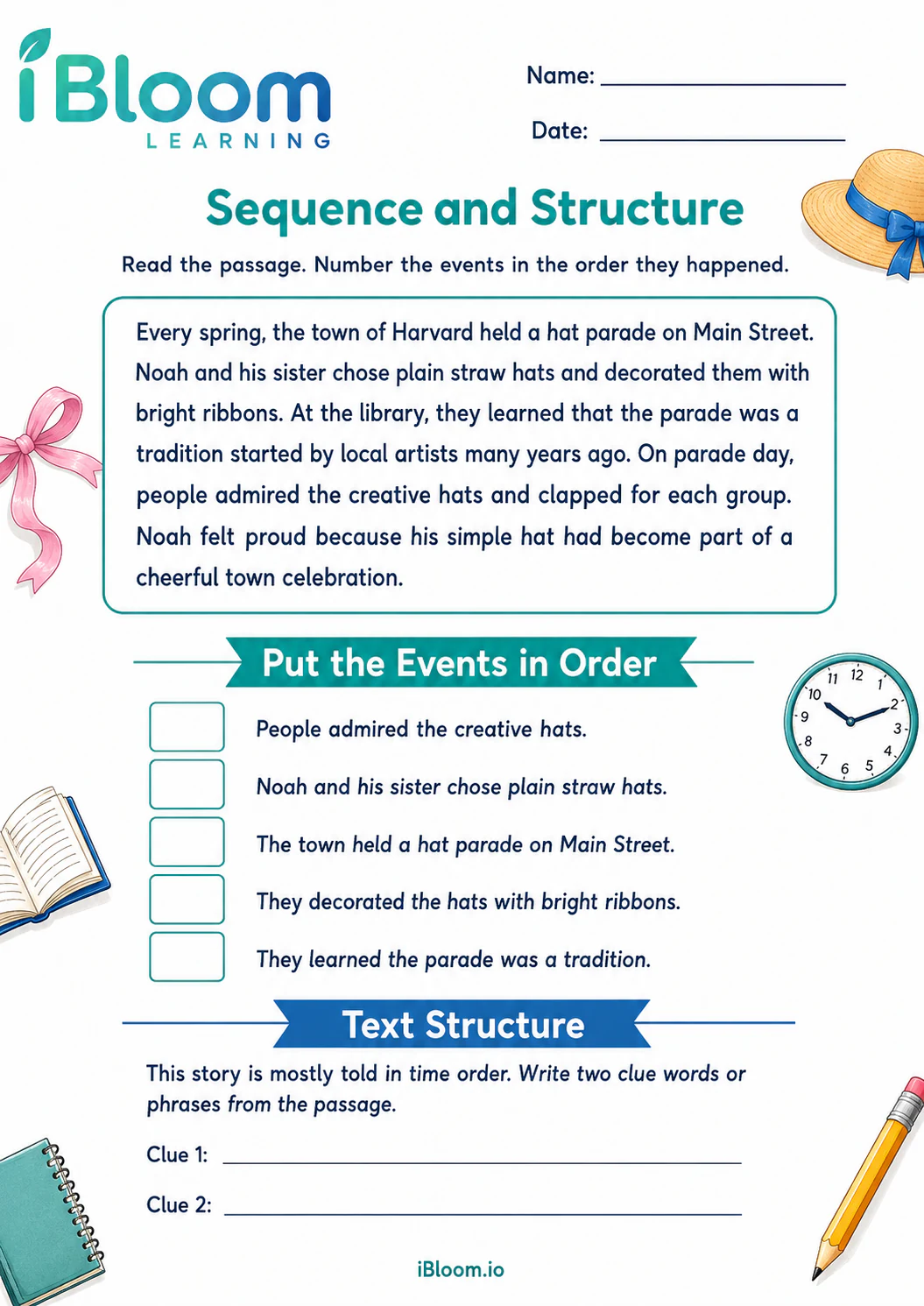
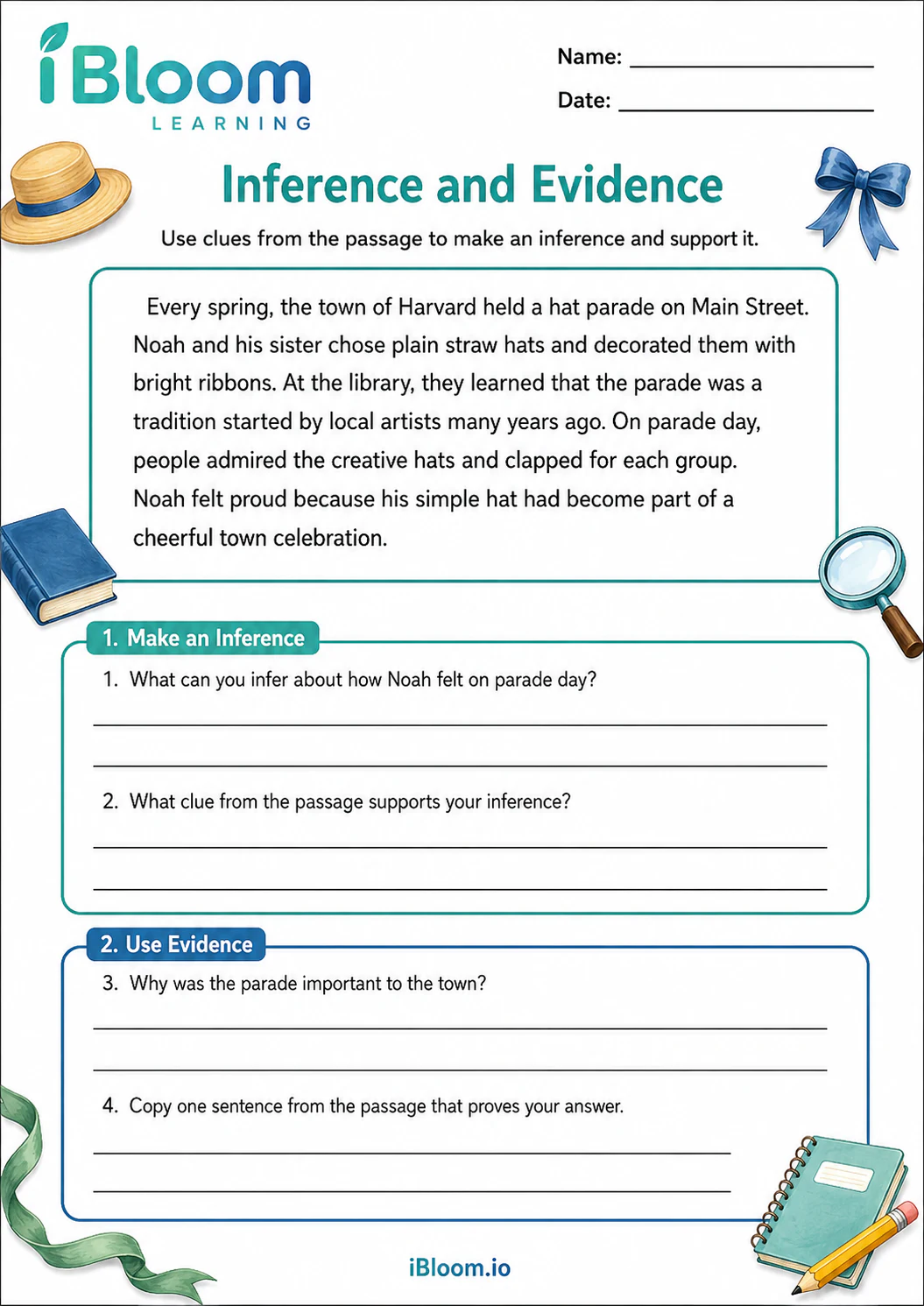
This Grade 3 reading worksheet pairs an original story about Noah and his sister joining Harvard’s spring hat parade with 12 comprehension questions. Children locate story details, use context to understand a word, and explain ideas with evidence from the passage. The work practices CCSS RL.3.1 and provides a separate answer key.
Aligned to RL.3.1
What happens in the Harvard hat parade story?
Noah and his sister decorate straw hats for their town’s spring parade. A librarian explains that local artists began the event many years ago, and the children join neighbors along Main Street.
Where should a reader look for an answer?
Part A asks six questions about details and vocabulary. Part B asks for six brief responses. Encourage children to return to the paragraph that contains the clue and use it to support each answer.
How does the passage support question 5?
Question 5 asks who began the parade. The second paragraph says local artists invited neighbors to show hats they had made many years ago.
How to use this worksheet
- 1Read the passage once to understand the events.
- 2Reread the question and identify its key words.
- 3Return to the paragraph with the relevant detail.
- 4For Part B, answer in a complete thought when asked to explain.
- 5Check that each answer matches the story and key.
Common mistakes and quick fixes
The mistake
Answering from memory without checking.
The fix
Find the sentence in the passage that gives evidence.
The mistake
Mixing up the visitor’s and Mia’s feelings.
The fix
Check who is acting or speaking in the final paragraph.
The mistake
Giving a detail that is true but does not answer the question.
The fix
Use the question’s key words to shape the response.
Common Core alignment
This practice connects each question to a specific grade-level reading or math skill.
Reading comprehension.
On this sheet: Reading comprehension is practiced throughout the worksheet.
Show the official wordingHide the official wording
Ask and answer questions to demonstrate understanding of a text, referring explicitly to the text as the basis for the answers.
What to practice next
Make more practice
Further reading
Questions parents and teachers ask
How long is the passage?
The original story is about 160 words and is followed by 12 questions. It describes Noah and his sister decorating straw hats, learning how their town parade began, and joining the celebration on Main Street. Children can return to the three short paragraphs for evidence.
What skills do the questions practice?
Children find story details, use context around the word “tradition,” and explain ideas using evidence. The multiple-choice and written-response items refer to the passage, so readers can return to it while answering. Several questions ask for an explanation in the child’s own words.
Is there an answer key?
Yes. A separate answer key lists the six multiple-choice answers and gives model responses for the six written questions. Written answers may use different wording when they preserve the story detail or explanation. Adults can use the sample as a guide when reviewing.
Can an adult read the story aloud?
Yes. An adult can read the passage aloud, then invite the child to locate matching details on the page. This keeps the focus on understanding the story and supporting answers with evidence. Children can reread a paragraph themselves when they are ready.
What does “tradition” mean here?
In the story, local artists began the hat parade many years ago, and families joined it each spring. The librarian explains that a tradition is a custom people keep over time. Question 4 asks children to use that context to choose the meaning.