

About this worksheet
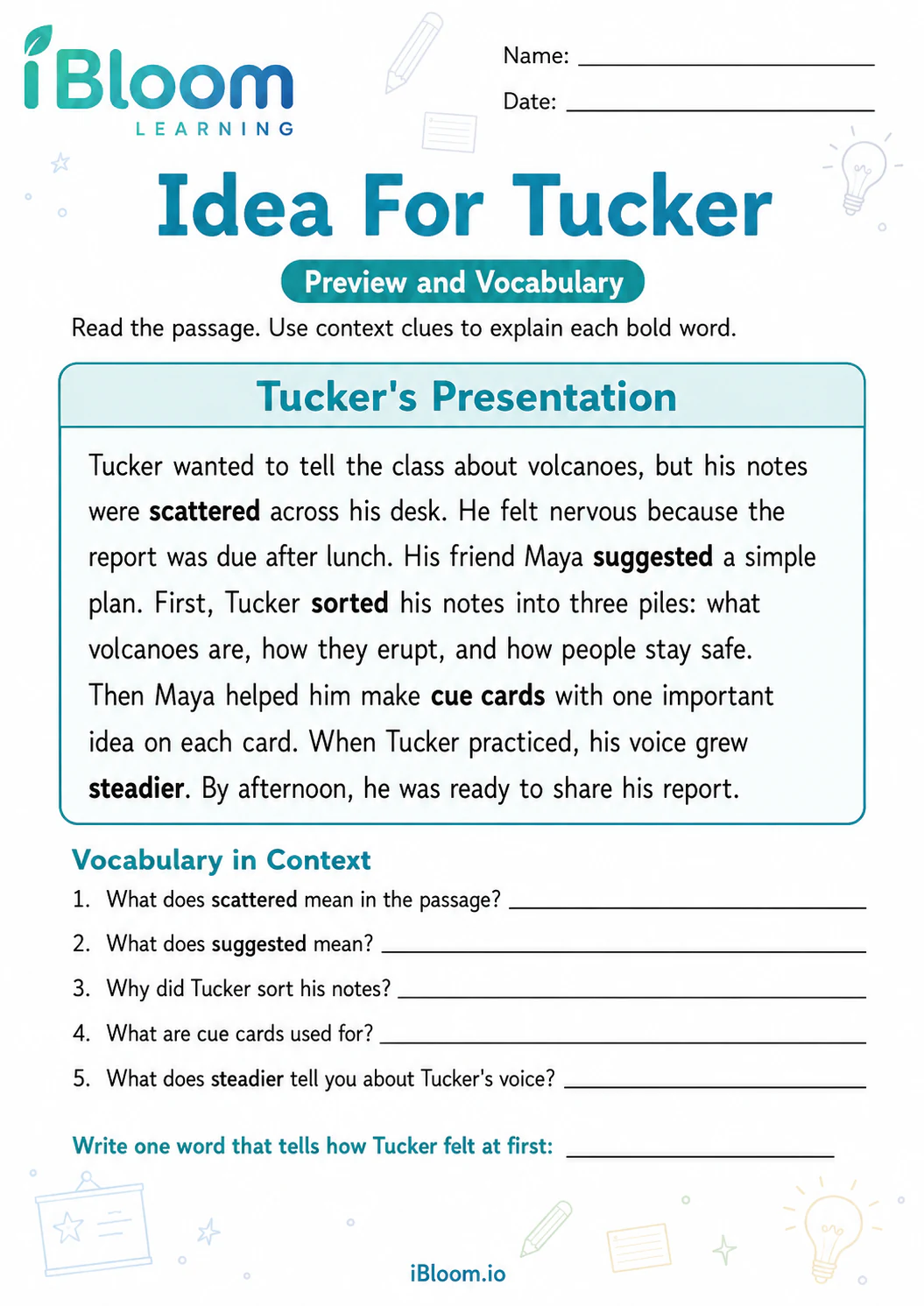
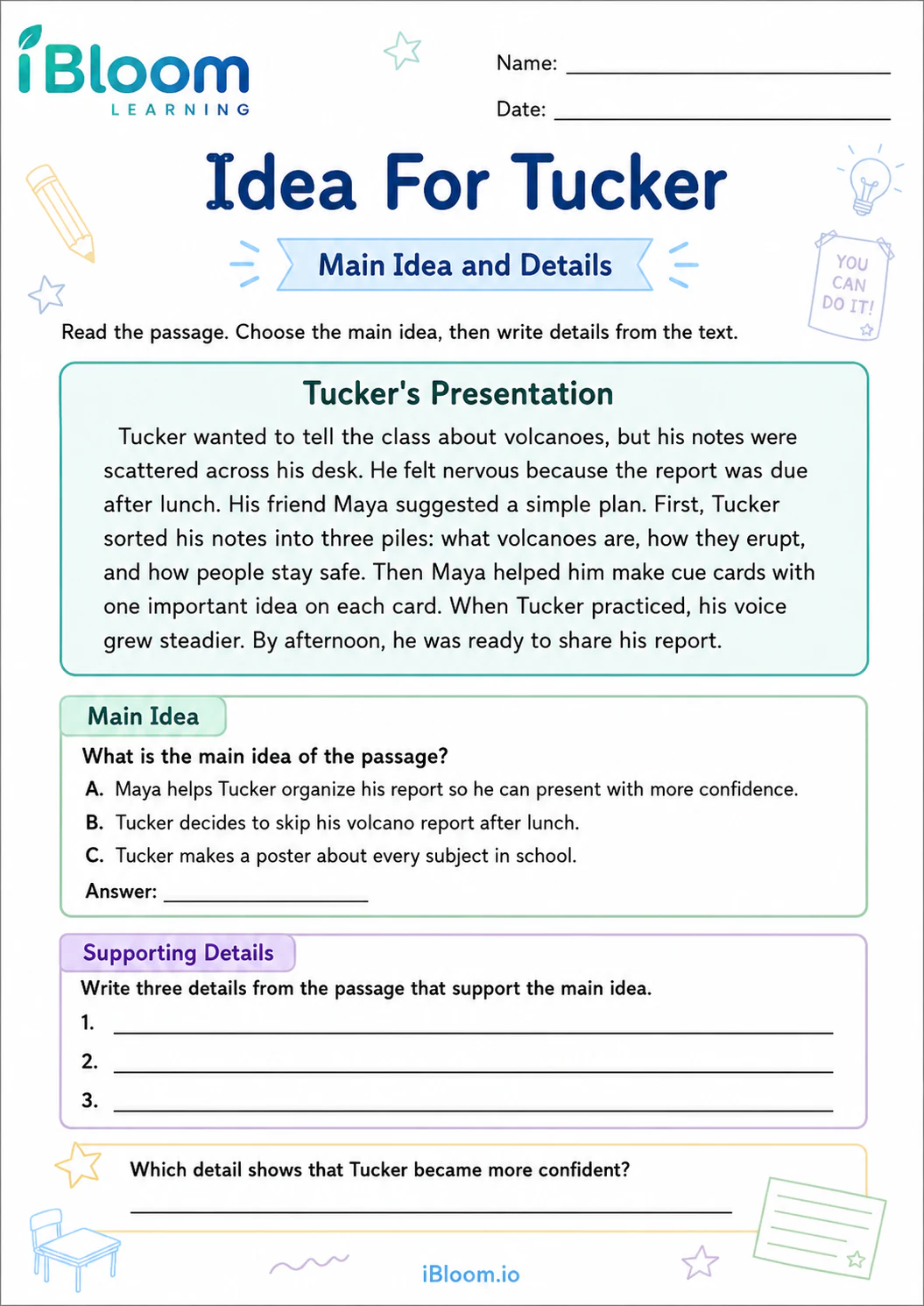
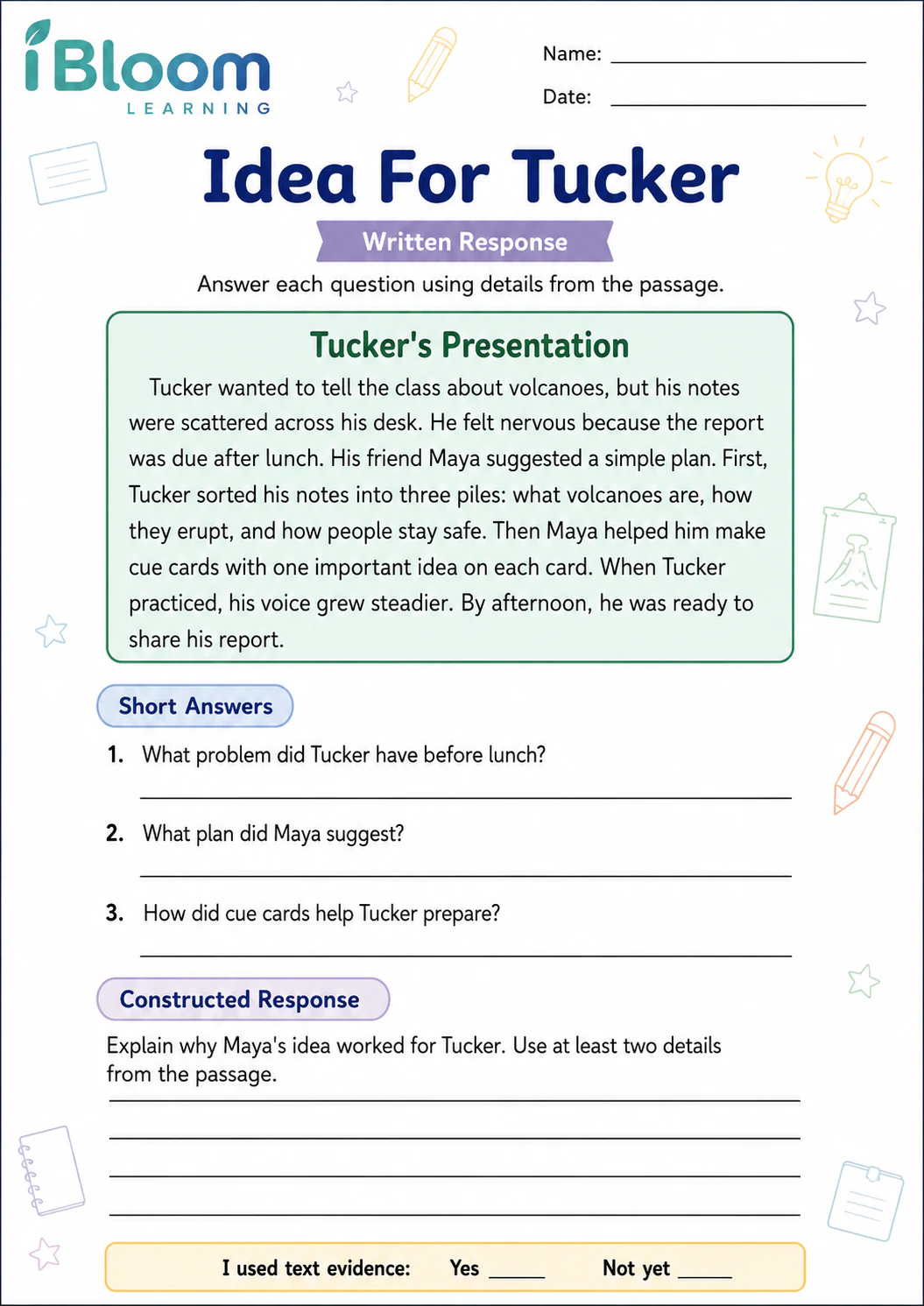
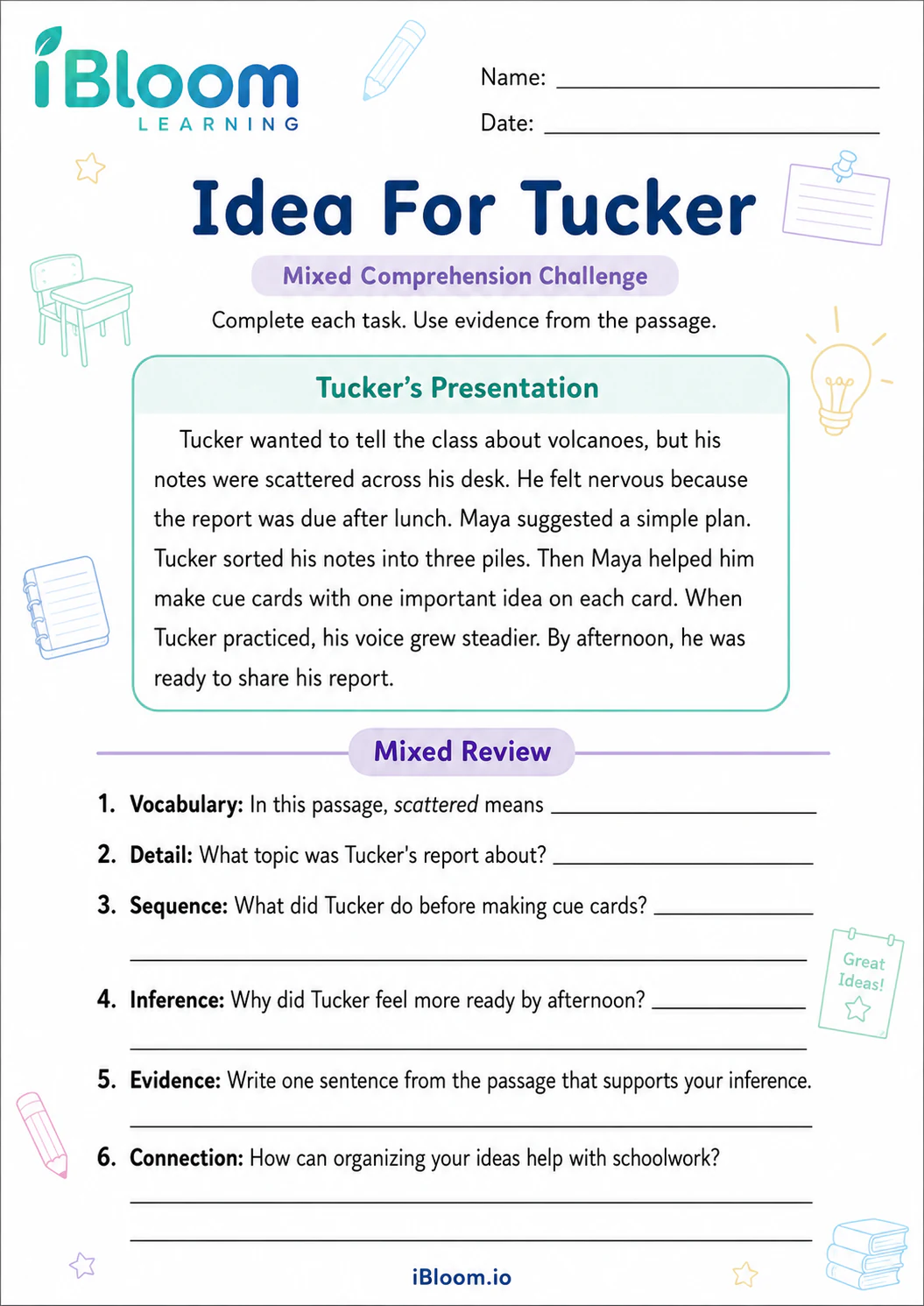
This free Grade 3 reading worksheet follows Tucker as he prepares a volcano report with help from Maya. Students track the order of events, use time clues, and explain how Tucker’s actions help solve his problem. It practices CCSS RL.3.3, with a 162-word story, 14 questions, and a separate answer key.
Aligned to RL.3.3
What happens in Tucker’s story?
Tucker wants to present a report about volcanoes, but his notes are scattered and he feels nervous. Maya suggests a plan: sort the notes, make cue cards, and practice. Questions 1–6 check details and what happens next.
- 1After Maya suggests a simple plan, Tucker sorts his notes into three piles. The event follows the suggestion in the passage.
How do time words help put events in order?
Words such as “First” and “Then” show how one action follows another. Readers can also use the events themselves: Tucker sorts his notes before Maya helps make cue cards, and he practices with the cards before presenting. Questions 7–10 connect these clues to the sequence.
How does Tucker solve his problem?
Tucker’s problem is not knowing how to organize his report. Maya’s plan gives him steps to follow. His practice helps him speak more steadily, so the ending grows out of the actions earlier in the story. Questions 11–14 ask students to identify that structure and support an answer with a detail.
- 1Tucker’s scattered notes are the problem; sorting them, making cue cards, and practicing are steps in his solution.
How to use this worksheet
- 1Read the passage once to understand Tucker’s problem.
- 2On Part B, look for the event that directly follows the action in the question.
- 3Underline time words such as “First” and “Then” when answering Part C.
- 4For Part D, connect Tucker’s problem to the steps Maya suggests.
- 5Use a passage detail in each written response, then check the key.
Common mistakes and quick fixes
The mistake
Choosing an event because it appears nearby, without checking its order.
The fix
Find the time word or action in the passage, then read the next event.
The mistake
Calling the volcano report itself Tucker’s problem.
The fix
Look for what makes him nervous: the scattered notes and the report due after lunch.
The mistake
Saying Maya solves everything without describing Tucker’s actions.
The fix
Name a step Tucker takes, such as sorting notes or practicing with cue cards.
Curriculum alignment
This worksheet practices the following Common Core skill.
Describe characters and explain how their actions contribute to events.
On this sheet: Questions use Tucker’s and Maya’s actions to follow and explain the sequence.
Show the official wordingHide the official wording
Describe characters in a story (e.g., their traits, motivations, or feelings) and explain how their actions contribute to the sequence of events.
What to practice next
Make more practice
Further reading
Questions parents and teachers ask
What is the story about?
Tucker is nervous about presenting a volcano report because his notes are scattered. His friend Maya suggests sorting the notes, making cue cards, and practicing. Students use those events to answer questions about sequence, character actions, and how the problem is solved.
How many questions are on the worksheet?
There are 14 questions in four parts after the passage. They include multiple-choice questions about details and structure, followed by two written responses. The passage itself is 162 words, and the separate answer key gives answers for every question in order.
What should a student do when answering a sequence question?
Find the event named in the question in the passage, then check the time word or action that comes before and after it. For example, Tucker sorts his notes after Maya suggests a plan and before she helps him make cue cards.
Can written answers use different words from the key?
Yes. The key gives sample answers for the two written questions. Another response works if it names an accurate time-order word or explains how Tucker gets ready using events stated in the passage, and it should be easy to locate the supporting detail.
How does the story show problem and solution?
Tucker’s scattered notes make him nervous about his report. Maya suggests a plan, and Tucker sorts the notes, makes cue cards, and practices. The ending shows the result of those steps: he presents clearly and feels ready to share his report.