

About this worksheet
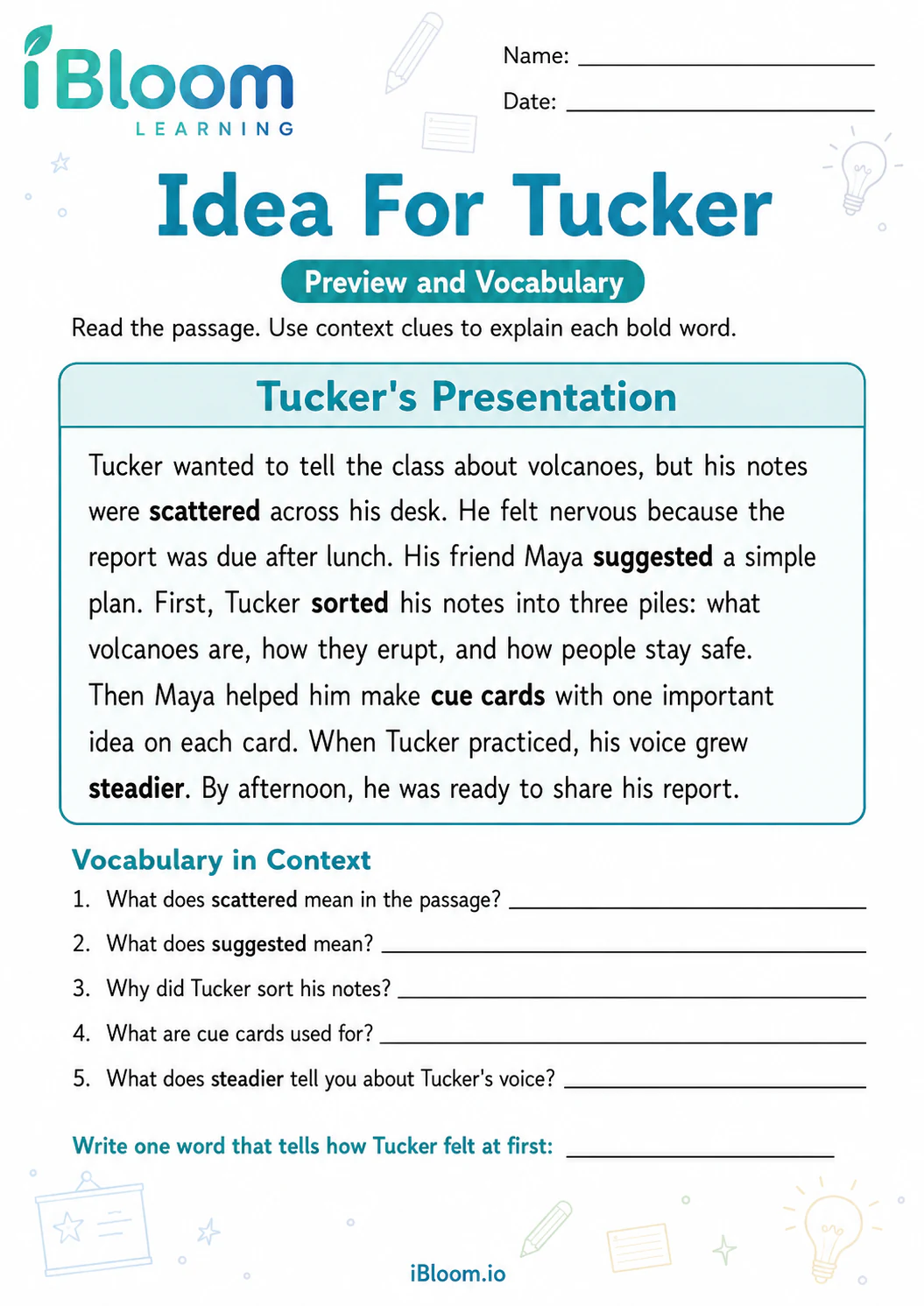
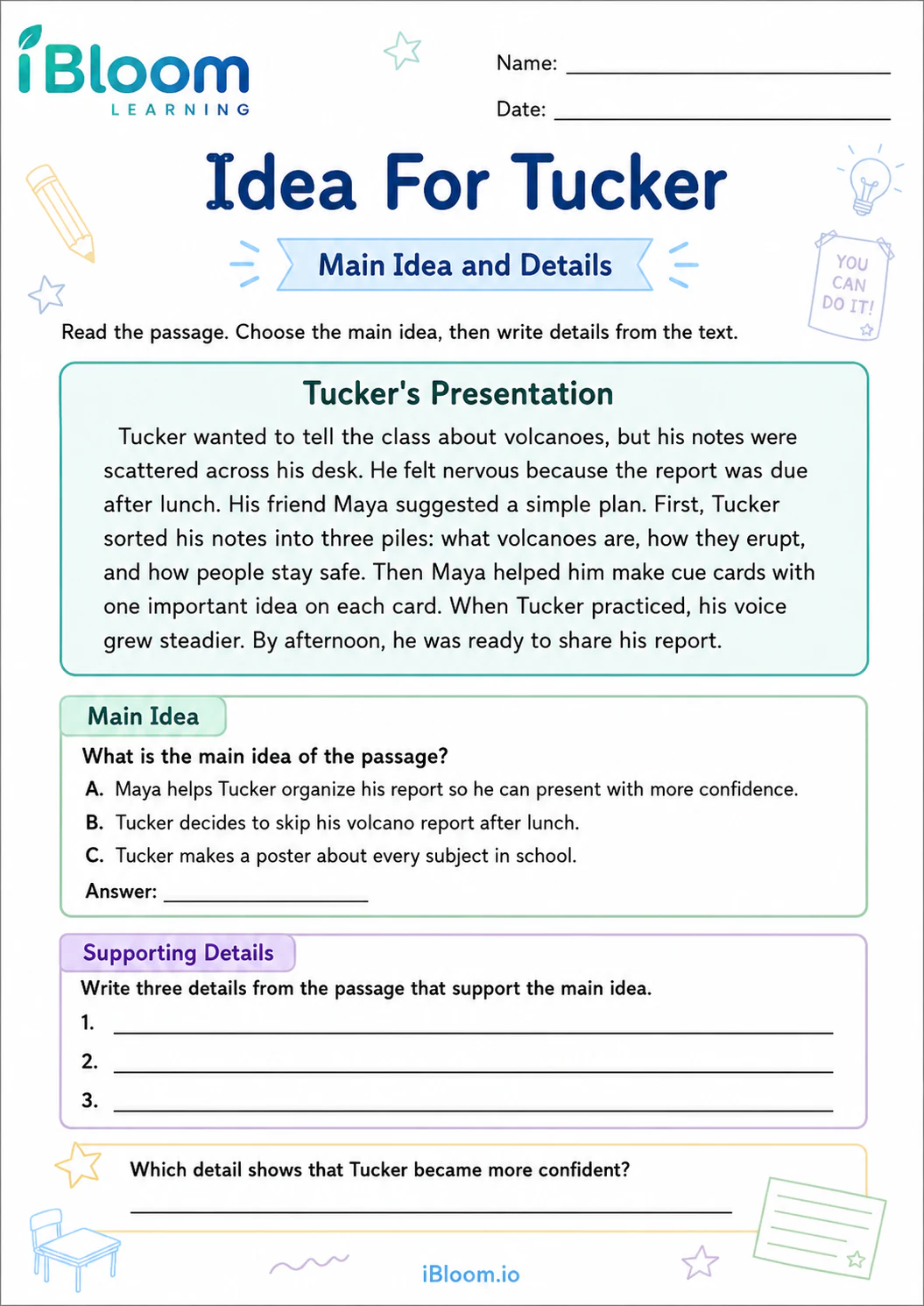
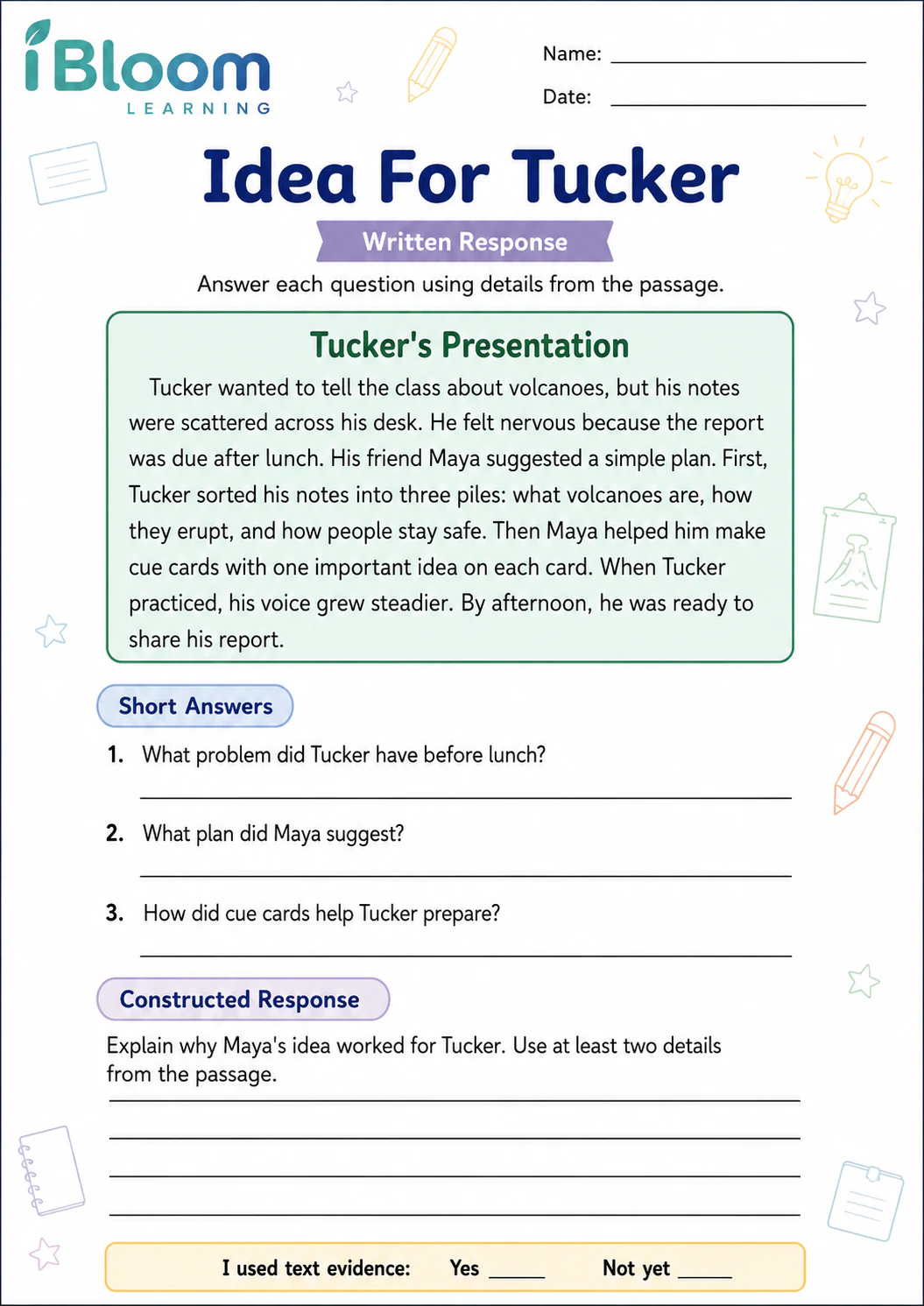
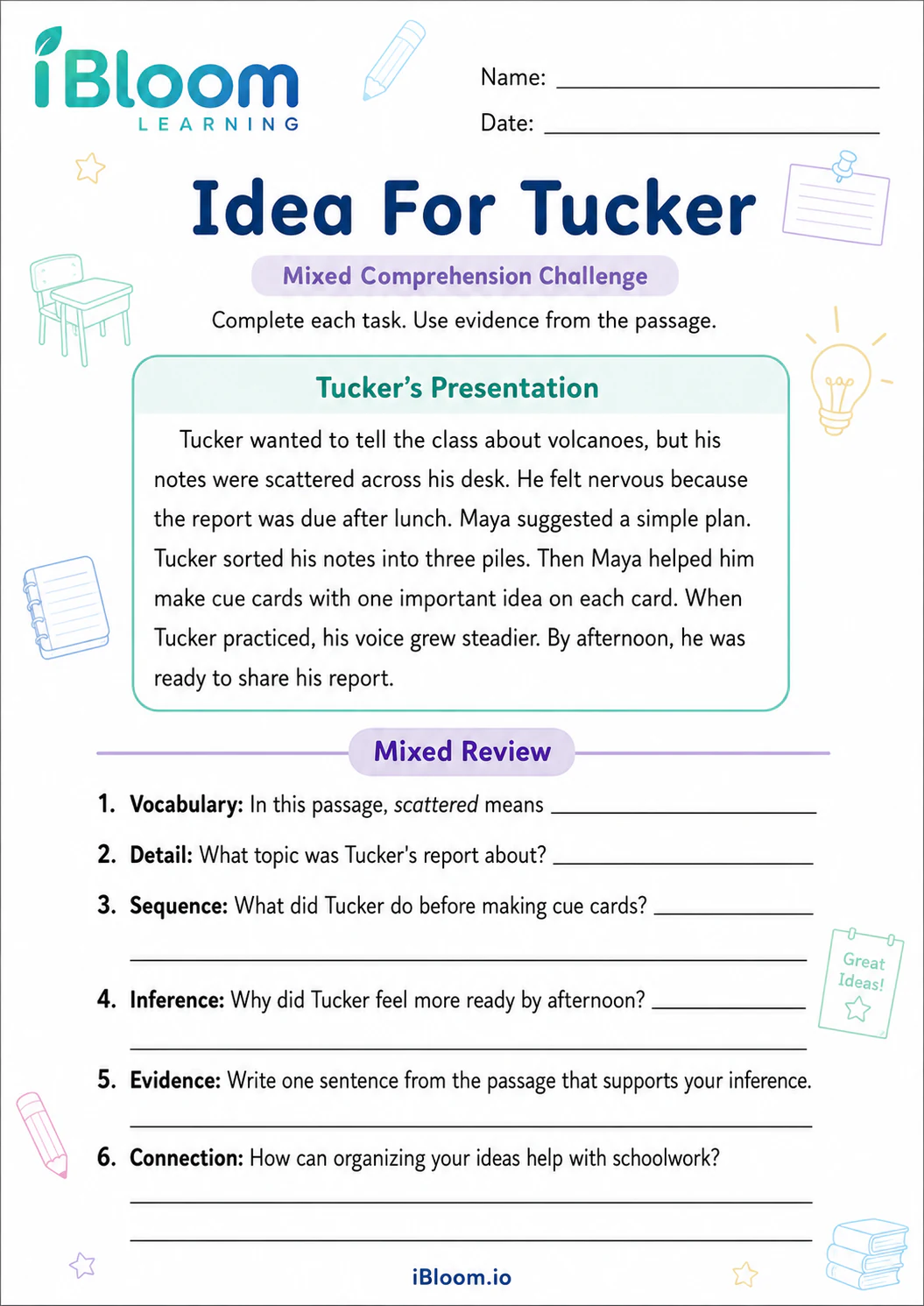
This free printable Grade 3 reading worksheet follows Tucker as he prepares a report about volcanoes. His friend Maya helps him sort scattered notes into three folders, make cue cards and practice speaking. Part A presents the story. Part B has eight choice blanks about what students can infer and which details support their ideas. Part C asks for two short explanations using story evidence. The work practices Common Core RL.3.1, answering questions with explicit reference to the text. A separate answer key marks the choices and gives sample written responses that connect an idea to a specific detail.
Aligned to RL.3.1
What can readers infer from Tucker’s actions?
Tucker picks up a page, puts it down and rubs his forehead. His question about where to start suggests that ordering his ideas is difficult. Readers use these actions and words together to understand his problem.
Part B has four inference-and-evidence pairs. Students choose an idea about Tucker or Maya, then choose the detail that supports it. The last pair considers how Tucker can be prepared and still feel nervous.
How do readers choose evidence that actually fits?
A true detail is useful evidence only when it supports the particular answer. Hot lava tells us the report topic. Tucker’s question about where to start tells us why he needs help. Ask students to finish the thought, “This detail supports my answer because…”
- 1Question 1: Tucker needs help with ___ (organizing / researching).
- 2Inference: He needs an order for his ideas.
- 3Question 2 clue: “where do I start?”
- 4The clue shows he has facts but has trouble choosing a beginning.
What makes a strong written answer in Part C?
A strong answer states an idea and names a matching detail. For question 9, students might explain that the folders organize the report because each folder holds notes for one part. They may paraphrase the detail.
For question 10, students infer a lesson about solving problems. Planning, accepting help and practicing are all reasonable ideas when supported by Tucker’s actions. Accept wording that differs from the key when both the lesson and its evidence fit the story.
How to use this worksheet
- 1Read the story once to follow Tucker’s problem and Maya’s plan.
- 2Reread the opening and ask what Tucker knows and what he needs help doing.
- 3Complete the eight choice blanks, returning to the story for each clue.
- 4Write each Part C answer as an idea supported by one specific detail.
- 5Compare with the key and discuss why a chosen detail supports the answer.
Mistakes to notice and how to fix them
The mistake
Inferring that Tucker knows nothing about volcanoes.
The fix
Reread “I know these facts”; his difficulty is deciding where to start.
The mistake
Using “hot lava” as evidence that Tucker needs an order.
The fix
Choose a clue about organizing, such as his question about where to start.
The mistake
Saying Tucker feels no nervousness at the end.
The fix
His deep breath suggests he may still feel nervous; knowing his first idea shows that he is prepared.
Common Core alignment
Support answers about Tucker and Maya with specific details from the story.
On this sheet: Students select evidence for inferences and include story details in two written explanations.
Show the official wordingHide the official wording
Ask and answer questions to demonstrate understanding of a text, referring explicitly to the text as the basis for the answers.
What to practice next
Make more practice
Further reading
Questions parents and teachers ask
What happens in Idea for Tucker?
Tucker needs to prepare a volcano report, but his notes are scattered and he cannot decide where to start. Maya helps him organize three folders and make cue cards. After practicing, he is easier to hear and knows which idea will begin his presentation.
What is an inference on this worksheet?
An inference is an idea a reader works out from clues rather than simply copies from the story. For example, Maya’s actions suggest she is helpful. Students support that idea by noticing how she offers folders and helps Tucker organize his notes and cards.
Must students copy exact sentences as evidence?
No, students may put a story detail into their own words. For question 9, saying that each folder holds one part of the report is enough to support the idea that the folders organize Tucker’s work. The detail must stay accurate and match the explanation.
Does Tucker stop feeling nervous completely?
The ending suggests he still feels a little nervous because he takes a deep breath before starting. He is also more prepared: his cards are lined up, and he knows his first idea. Discuss how those two feelings can exist together before a presentation.
How should I check the two written answers?
Look for a reasonable idea and a matching story detail in each answer. The key provides sample wording, but students can express the same reasoning differently. Ask them to point to the part of the story that supports their explanation before making a correction.