


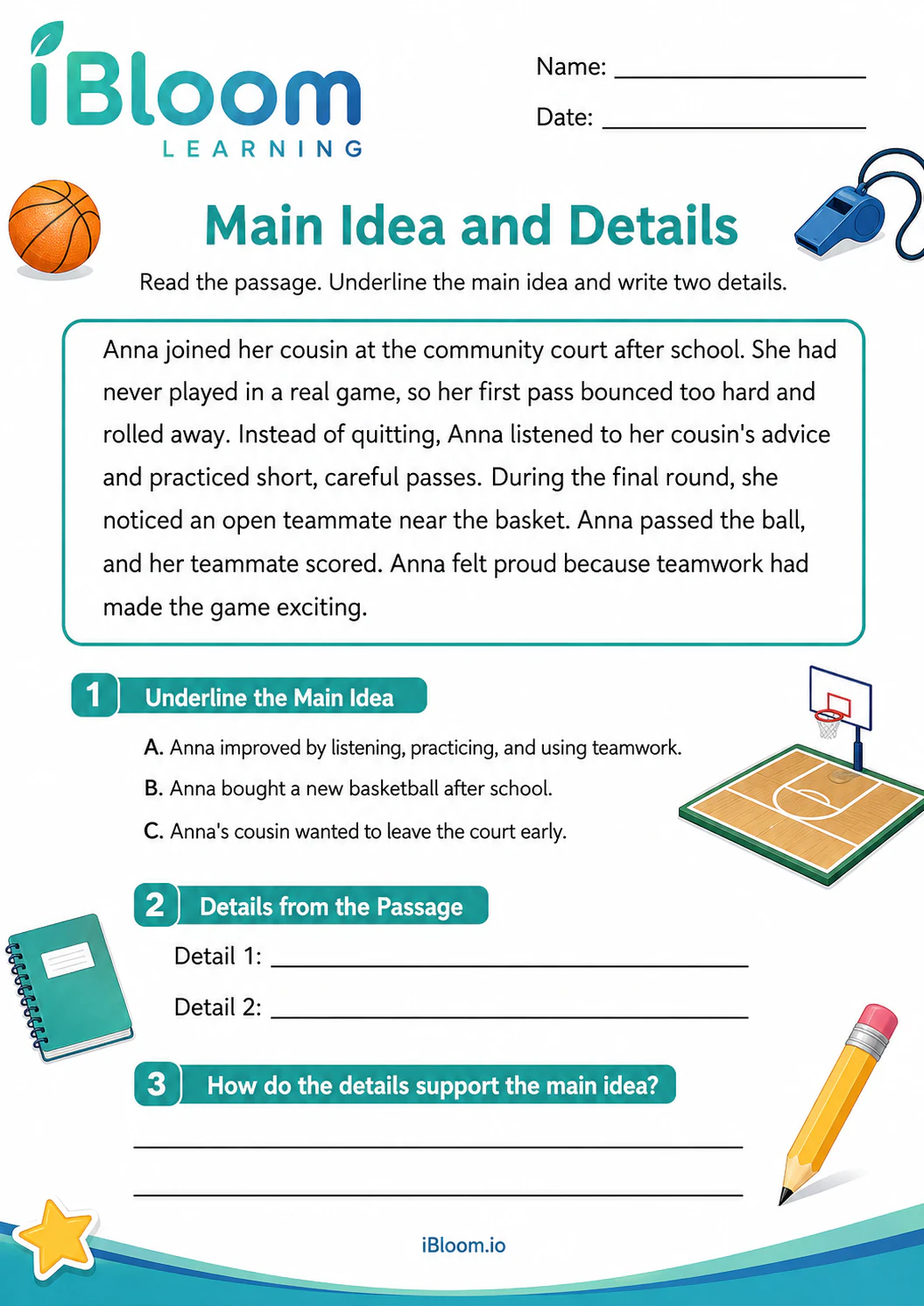
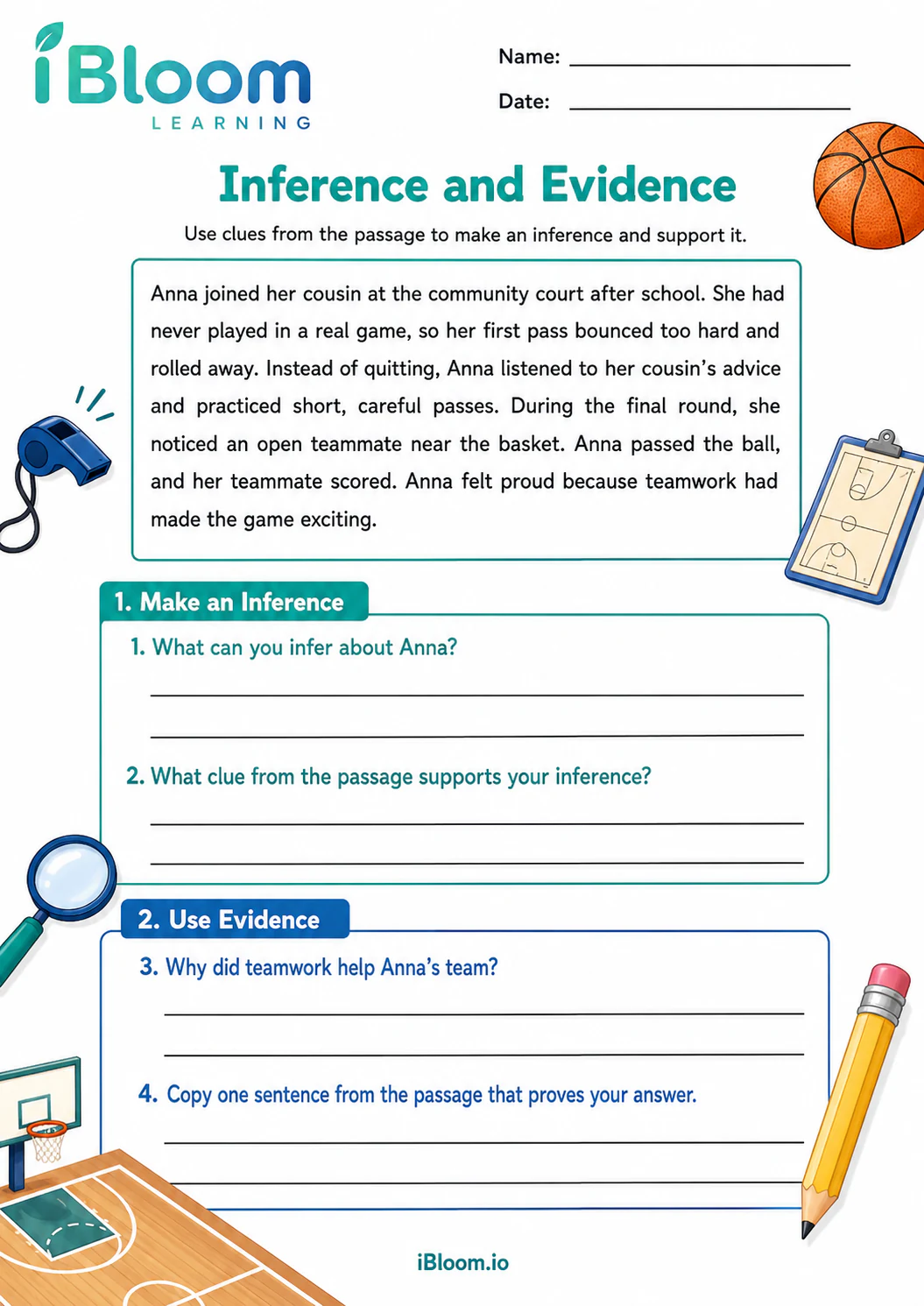
About this worksheet
This Grade 3 reading worksheet follows Maya as she searches for a missing library book and learns to keep track of where she has looked. Students choose a main idea, find details stated in the story, and explain how those details support a summary of Maya’s careful problem solving. The questions move from selecting an idea to writing text-based explanations. This story practice aligns with CCSS.ELA-Literacy.RL.3.2: recount a story, determine its central message, and explain how key details convey it. A separate answer key gives concise sample responses.
Aligned to CCSS.ELA-Literacy.RL.3.2
What will students practice in this worksheet?
The questions build the skill in stages. Students select the story’s main idea, retrieve details about Maya’s search and plan, and explain how events connect. Every response can be checked against The Missing Book.
The passage keeps the original plot: Maya loses a planets book, searches several places, remembers reading near the window, and finds it behind a basket under a chair. The added ending follows the same characters and extends the search strategy into a practical plan.
- Select the main idea and supporting details
- Find explicit details about Maya’s search and plan
- Connect story details to the main idea and summarize
How do details point to a main idea?
A main idea describes what the whole story is mostly about. A useful detail tells about an important action or event that supports that idea. Maya reads a book about planets, but that fact alone does not explain most of the story; her search and solution do.
- 1Question 1: What is the story mostly about?
- 2Answer: Maya searches carefully for her book.
- 3Check: She checks several places and remembers where she last read.
Which details are worth using in an answer?
Choose details that explain Maya’s problem, the steps she takes, or how the problem is solved. “She checks her desk, her backpack, and the shelf” shows her search. “She returns the book before the due date” shows responsibility, but it does not explain how she finds it.
For the written questions, name the event and connect it to the idea. A complete response makes the link clear instead of listing unrelated facts.
How can families review the story together?
After the worksheet, ask the reader to retell Maya’s search in order: the places she checked, the memory that changed her search, and where she found the book. Then ask which event best supports the main idea and why. Point back to the passage whenever an answer needs evidence.
How to use this worksheet
- 1Read the full passage once to understand Maya’s problem.
- 2Underline the sentences that tell where she searches and what she remembers.
- 3Choose the main idea that covers the whole story, not one small event.
- 4Answer detail questions with information stated in the passage.
- 5For written responses, name a detail and explain how it supports your idea.
Common mistakes and quick fixes
The mistake
Choosing “Maya learns about planets” because the book is about planets.
The fix
Check how much of the story describes planets; most of it follows Maya’s search.
The mistake
Using the place Maya finds the book as the whole main idea.
The fix
Ask what her search and discovery show across the entire story.
The mistake
Listing a detail without linking it to the answer.
The fix
Add a phrase explaining how that detail helps Maya solve the problem.
This story work practices a Grade 3 literature standard.
Students recount Maya’s story and connect key events to its central idea.
On this sheet:
Show the official wordingHide the official wording
Recount stories, including fables, folktales, and myths from diverse cultures; determine the central message, lesson, or moral and explain how it is conveyed through key details in the text.
What to practice next
Make more practice
Further reading
Questions parents and teachers ask
What is the main idea of The Missing Book?
Maya searches carefully for her book. She checks several places, remembers where she read, and finds the book behind a basket under the chair. These events matter more than the book’s topic because they make up the central problem and solution.
How many questions are on the worksheet?
There are 17 questions across three parts. Students answer six multiple-choice questions, seven short-answer questions, and four written-response questions. The separate answer key includes direct answers and sample wording for responses that can vary. Read the passage again whenever an answer needs a precise detail.
Can students use the passage while answering?
Yes. The questions ask students to use story details, so they should look back at the passage as they work. Finding the exact event helps them give a clear answer and explain how an important detail supports the story’s main idea.
What does “supporting detail” mean here?
A supporting detail is an event or fact from the story that helps explain its main idea. Maya’s search through several places supports the idea that she solves her problem carefully. Her reading about planets is true, but it does not explain the central action as well.
How should a child answer the written questions?
A complete answer names one or more events and explains their connection. For example, Maya remembers reading beside the window, then checks there and finds the book. That detail supports the idea that remembering where she last used something can help solve a problem.
What can we do after finishing the page?
Invite the reader to retell Maya’s search without looking, then check the order against the passage. Ask which detail best shows her plan and how the ending changes what she might do next time. The Solver sequence and inference pages offer related story practice.