
About this worksheet
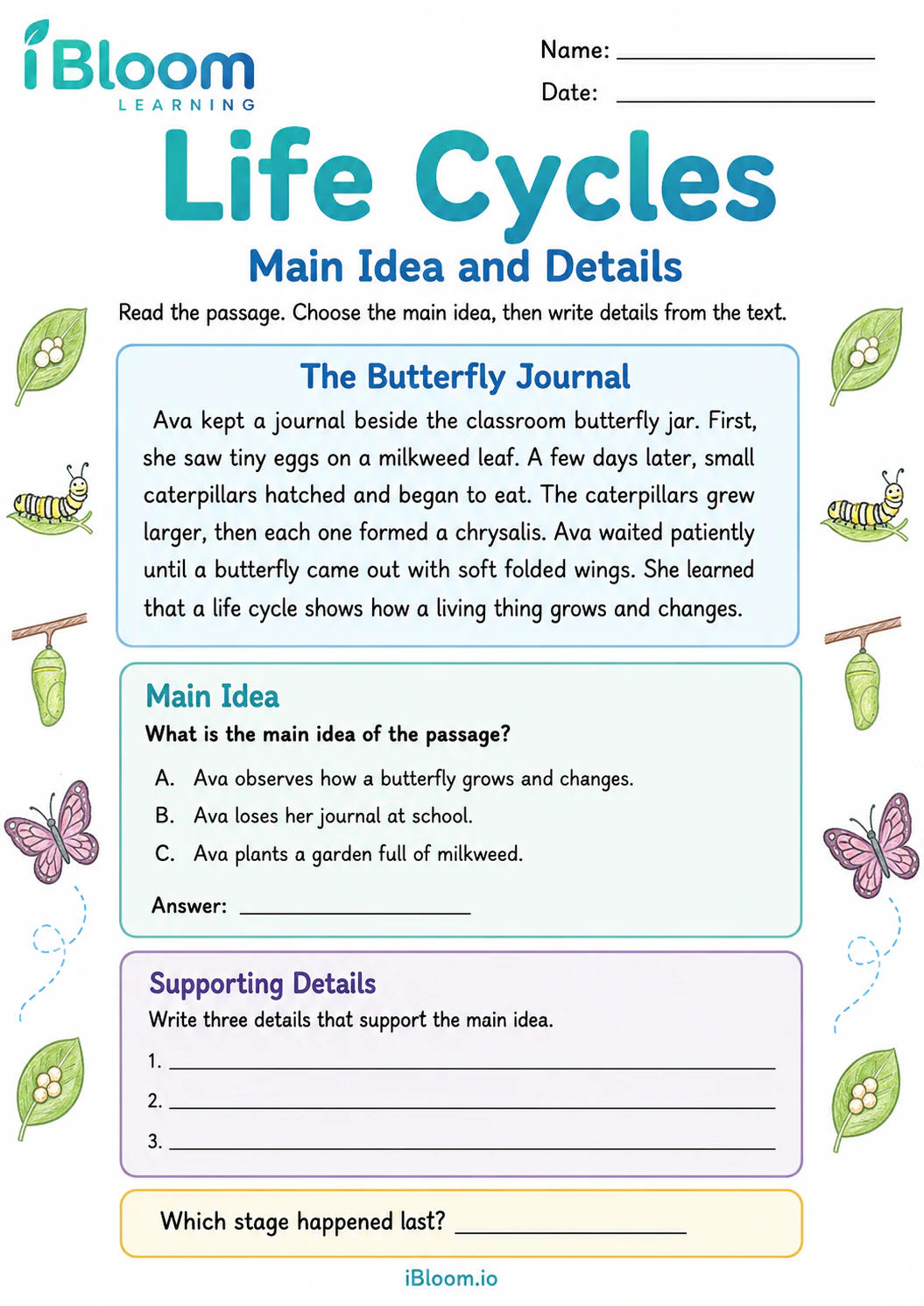
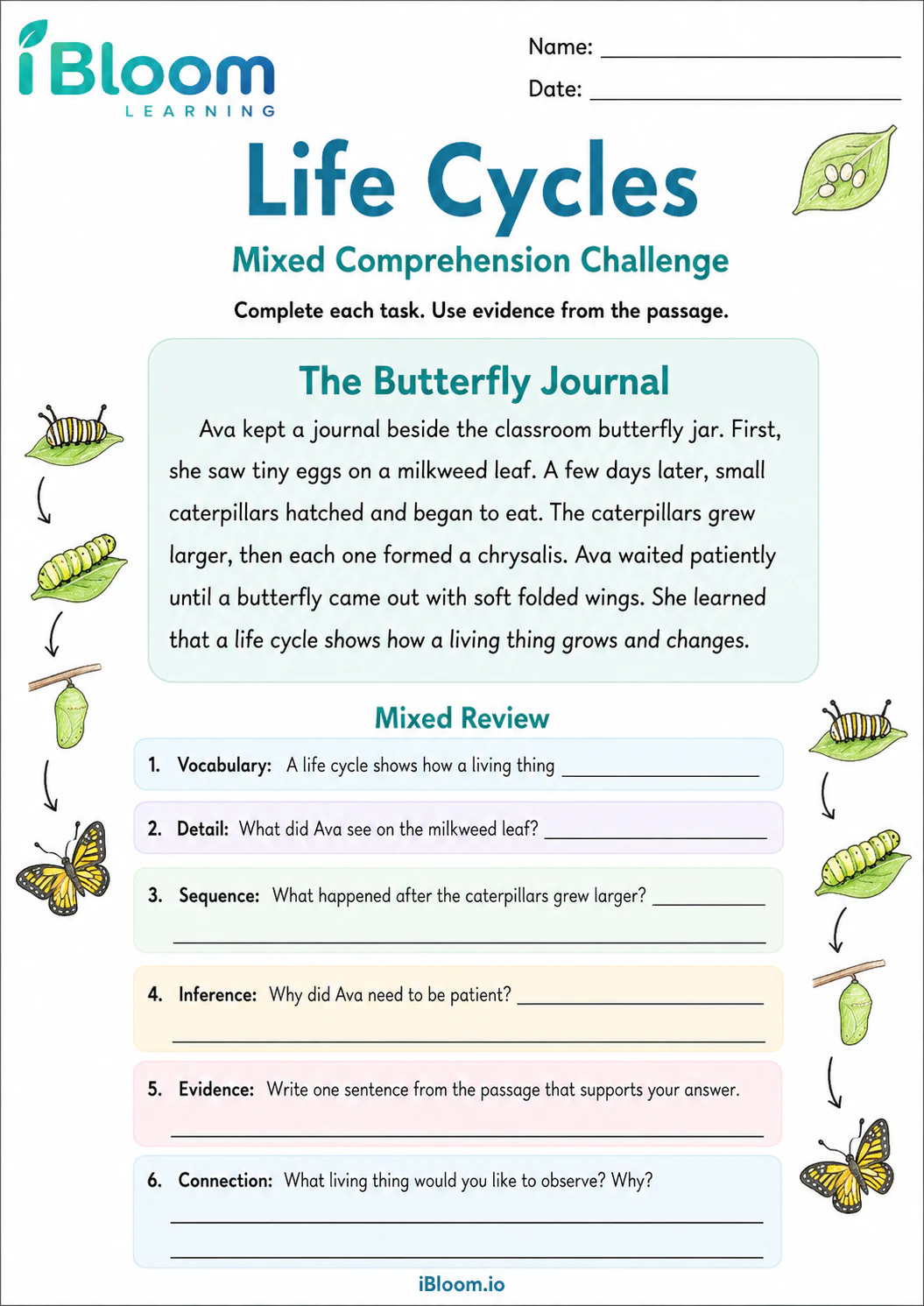
This Grade 3 worksheet pairs an original passage about a class observing a caterpillar with 15 multiple-choice questions on sequence, cause and effect, vocabulary, and text structure. Students recall what happened, order stages, and choose passage details that support their answers. A separate answer key identifies each correct choice. The work practices CCSS RI.3.3.
Aligned to RI.3.3
What happens in the passage, and in what order?
This Grade 3 worksheet pairs an original passage about a class observing a caterpillar with questions on sequence, cause and effect, vocabulary, and text structure. Students recall what happened, put the life-cycle stages in order, and support an answer with details from the passage. It includes 15 questions and a separate answer key, and practices CCSS RI.3.3.
How do details explain the children’s choices?
The worksheet has 15 multiple-choice questions in three parts: event details, sequence and structure, and passage details. Students choose answers supported by the passage, then check each response with the key.
How does a detail explain what happened next?
A reason in the passage can explain a character’s next choice. Match the stated condition with the action that follows.
- 1Detail: the butterfly’s wings were folded and damp.
- 2Action: the children waited before releasing it.
How to use this worksheet
- 1Read the passage once to follow the class’s observations.
- 2Reread the event named in each question before answering.
- 3For sequence, compare the order words and details in the passage.
- 4For a why question, use the sentence that gives the reason.
- 5Check the stage order and details with the answer key.
Common mistakes and quick fixes
The mistake
Putting chrysalis before caterpillar.
The fix
Follow the passage: egg, caterpillar, chrysalis, butterfly.
The mistake
Giving an event that happened later when asked what came first.
The fix
Locate both events in the text and compare their order.
The mistake
Guessing why the children waited.
The fix
Use the passage’s detail that the wings were folded and damp.
Curriculum alignment
This worksheet practices the following Common Core skill.
Describe how event order and cause-and-effect details connect in a text.
On this sheet: Students order life-cycle events and connect the butterfly’s damp wings with the class’s decision to wait.
Show the official wordingHide the official wording
Describe the relationship between a series of historical events, scientific ideas or concepts, or steps in technical procedures in a text, using language that pertains to time, sequence, and cause/effect.
What to practice next
Make more practice
Further reading
Questions parents and teachers ask
What life cycle appears in the passage?
The passage follows a caterpillar as it changes inside a covering and emerges as a butterfly. It names the stages egg, caterpillar, chrysalis, and butterfly. Students can number the stages in the order named near the end of the passage, then check the story details that show how the class observed the change.
What comes after the caterpillar hangs from the twig?
A hard covering forms around its body. The passage says the class leaves it alone while the caterpillar changes inside. The text gives a sequence from Monday through Friday and explains why the children waited. Use the passage wording when answering both kinds of questions.
Why do the children wait before release?
The butterfly’s wings look folded and damp. The children wait until the wings dry before Ms. Lee carries the habitat outside. Ask the student to point to a sentence showing the reason. The butterfly’s wings are described as folded and damp, which explains the wait.
How should students answer the evidence question?
Use two actions the passage gives: the children check the habitat each morning and do not touch the covering. Both details show care. This question asks for the order of stages, not the order the class first saw them. The passage names egg, caterpillar, chrysalis, then butterfly.
What does the answer key include?
The separate answer key marks the correct choice for all 15 questions. Students can return to the passage after checking and underline the sentence that supports each answer. They can also point to the passage sentence that supports a choice, which helps connect the answer to the text.