
About this worksheet
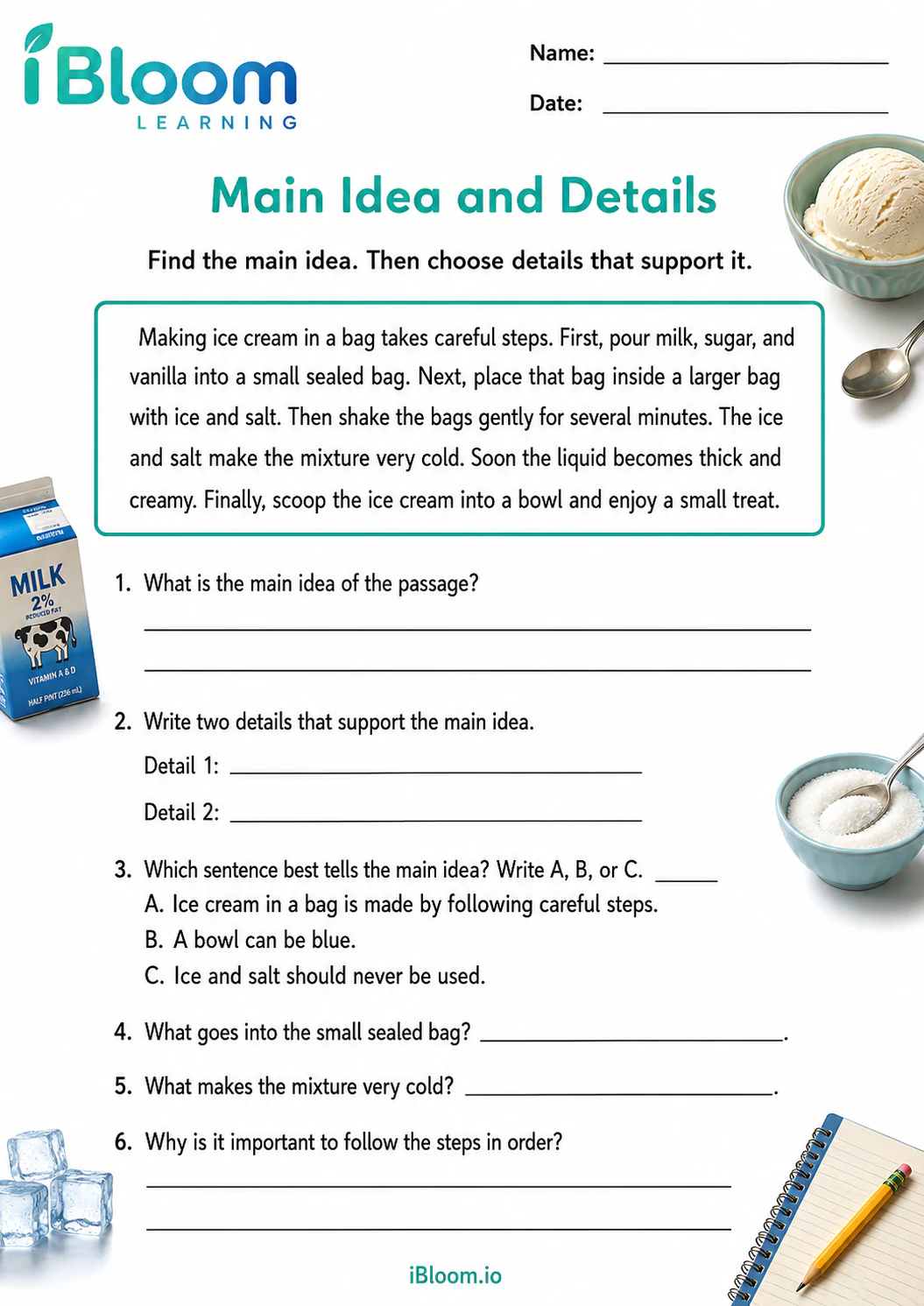
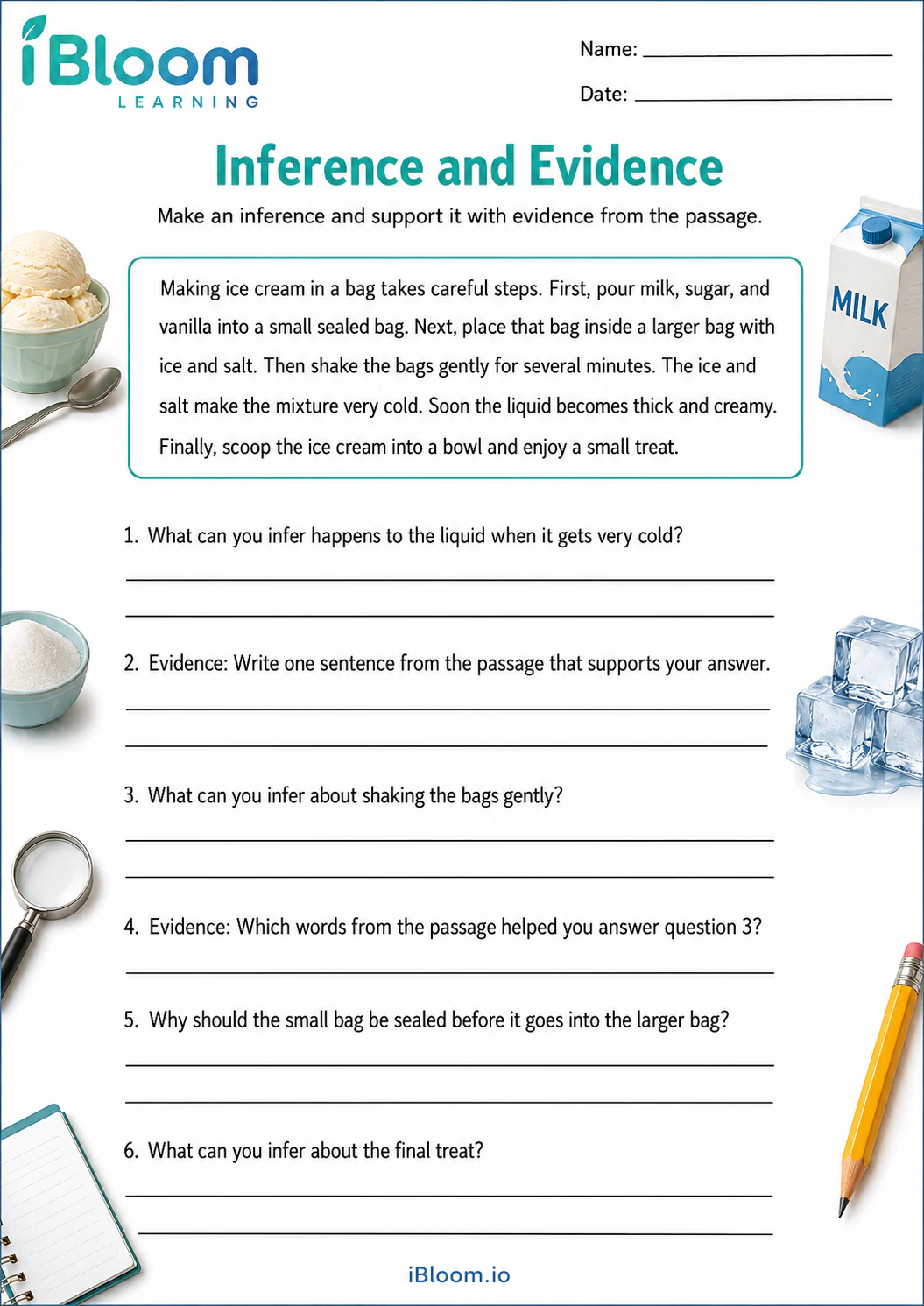
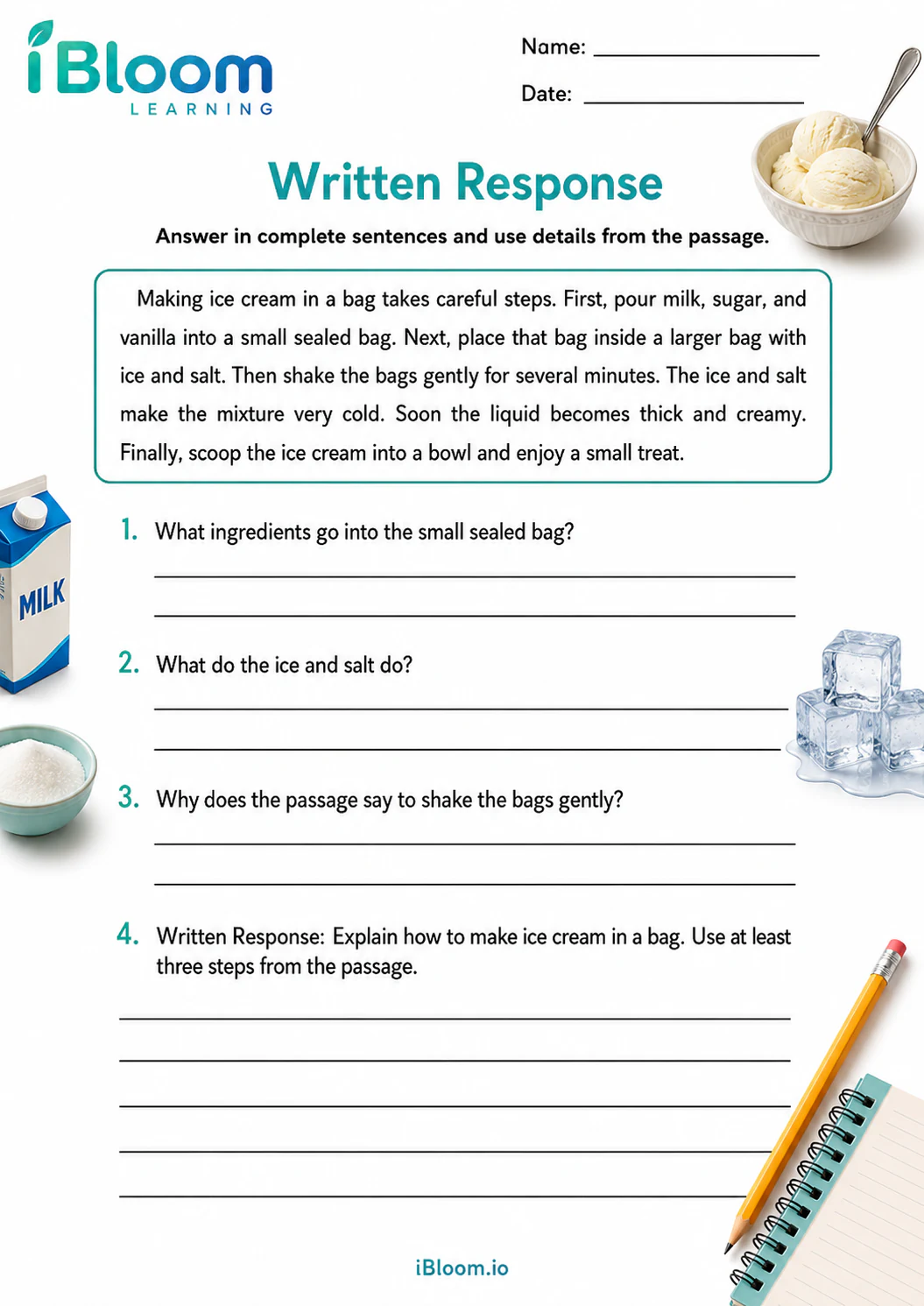
This Grade 3 printable pairs an original passage about making ice cream in a bag with 15 questions. Children follow the steps, find details, use context to think about words such as “sloshed,” and identify the main idea. The questions practice CCSS RI.3.1 and RI.3.2, and a separate answer key includes sample responses for open-ended items.
Aligned to RI.3.1 and RI.3.2
How can readers find details in a process?
Look for the sentence that names the ingredient, action, or result. Question 2 asks what Ben put in the larger bag; the passage states that it held ice and salt.
For sequence questions, watch signal words such as first, then, and later. These help readers put the recipe steps in order.
- 1Question: What did Ben put in the larger bag?
- 2Find: “a larger bag filled with ice and salt.”
- 3Answer: ice and salt
How does context help with a new word?
The passage says the mixture “sloshed like liquid,” then explains that it was still sloshing after five minutes. Those clues show it moved around and had not thickened yet.
How do the questions build understanding?
Detail questions check what happened; vocabulary questions ask what a word means in context; and the main idea question asks what the steps and explanation add up to. The answer key gives sample wording when children can answer in their own words.
How to use this worksheet
- 1Read the passage once to understand what Mia and Ben are making.
- 2Reread the paragraph named by a detail or sequence question.
- 3Underline a clue before answering a vocabulary question.
- 4Use a complete sentence for questions that ask why or how.
- 5Check open responses against the key’s sample ideas, not exact wording.
Common mistakes and quick fixes
The mistake
Guessing from general knowledge instead of the passage.
The fix
Find the sentence that directly supports the answer.
The mistake
Mixing up the order of steps.
The fix
Use first, then, and later to build a quick sequence.
The mistake
Treating “sloshed” as a taste or ingredient.
The fix
Read the comparison “like liquid” and the next sentence for context.
Common Core alignment
This passage and its questions practice reading informational text and using details as evidence.
Answer questions using details from the passage.
On this sheet: Questions ask children to locate details and support responses with the passage.
Show the official wordingHide the official wording
Ask and answer questions to demonstrate understanding of a text, referring explicitly to the text as the basis for the answers.
Determine the main idea and explain how details support it.
On this sheet: The main idea item asks readers to connect the steps and explanation.
Show the official wordingHide the official wording
Determine the main idea of a text; recount the key details and explain how they support the main idea.
What to practice next
Make more practice
Further reading
Questions parents and teachers ask
How long is the passage?
The original passage has three short paragraphs about Mia and Ben making ice cream in a bag. It explains the ingredients, the steps, and why the mixture becomes cold, giving readers details to use throughout the questions. The passage is short enough to reread while finding evidence.
What kinds of questions are included?
The 15 questions ask readers to find details, put a step in order, use context to understand vocabulary, identify the main idea, and make a simple inference. Several answers can be phrased in a child’s own words. The key gives sample responses for those questions.
Does the worksheet include an answer key?
Yes. A separate answer key gives direct answers and sample responses for questions that invite explanation. A child’s wording can differ while still matching the evidence in the passage. Check that the response reflects a clue from the text.
What does “sloshed” mean in this passage?
Here, “sloshed” means the mixture moved around like a liquid. The clue is that it still sloshed after five minutes, before it became thick and soft. Readers can use both nearby details to infer that it had not frozen yet.
How can I help my child with the main idea question?
Ask your child to connect the recipe steps with the explanation of how the mixture gets cold. The main idea should describe the whole process rather than one detail, such as the strawberries or the towel. Ask which details support that bigger idea.