
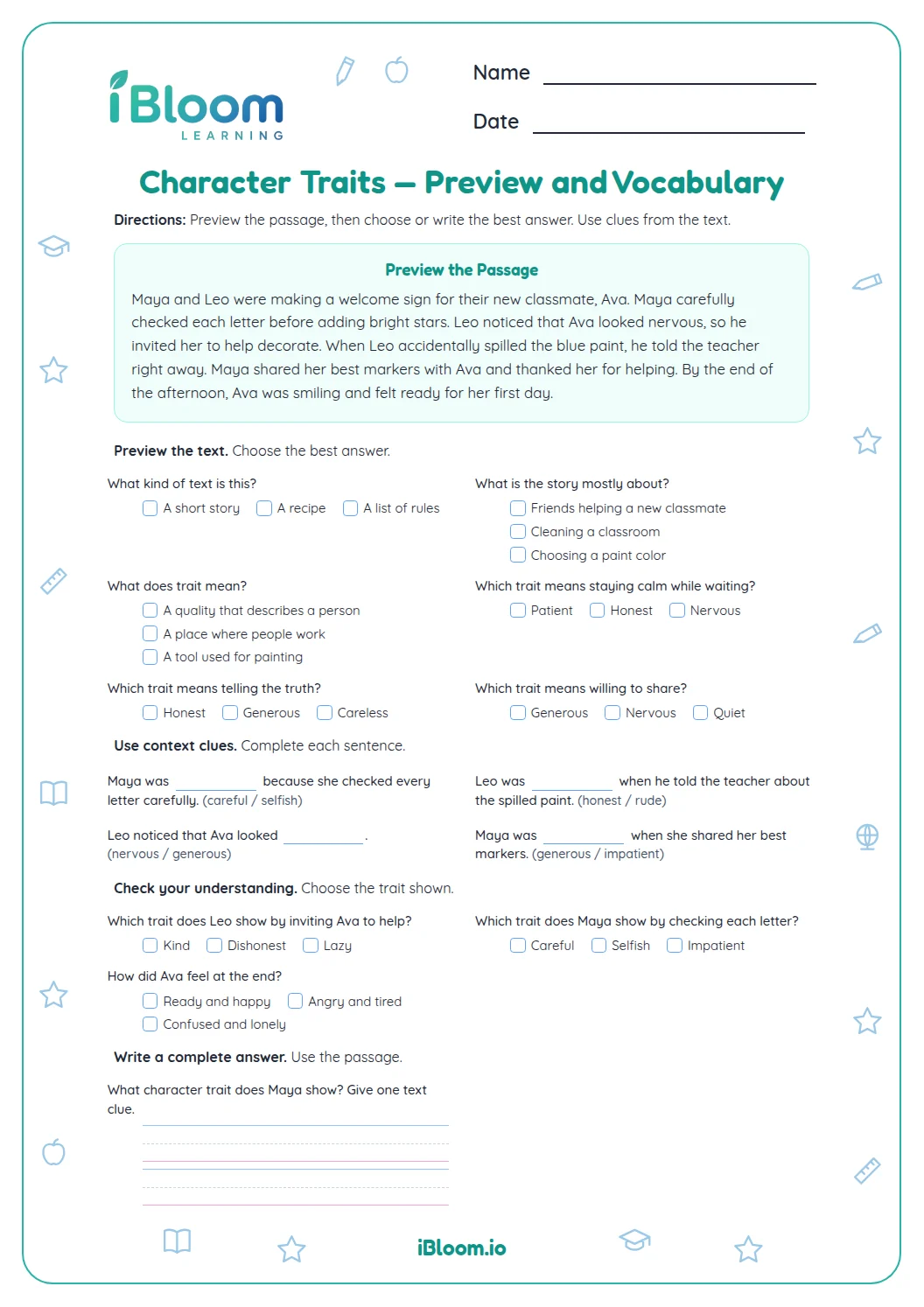
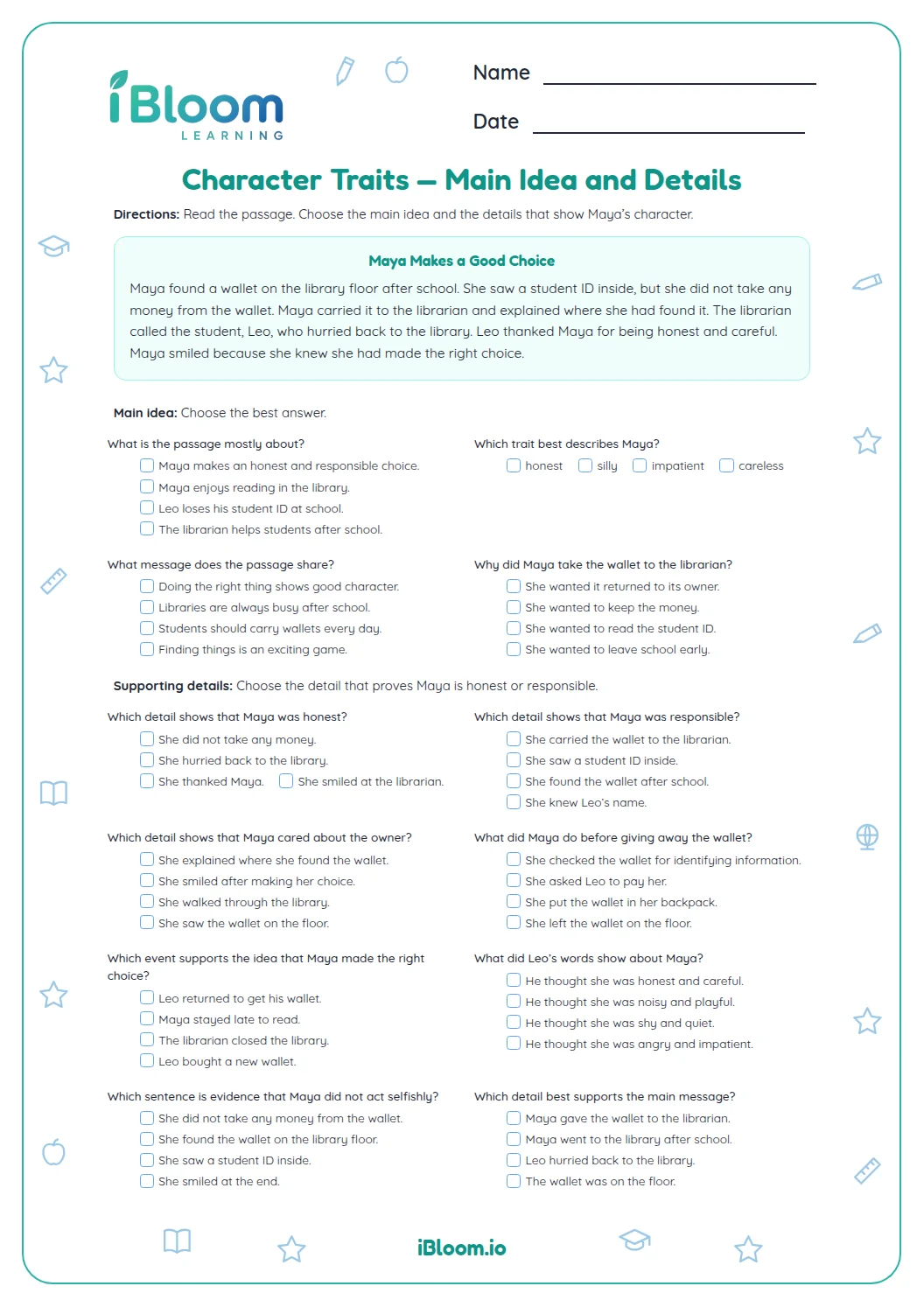
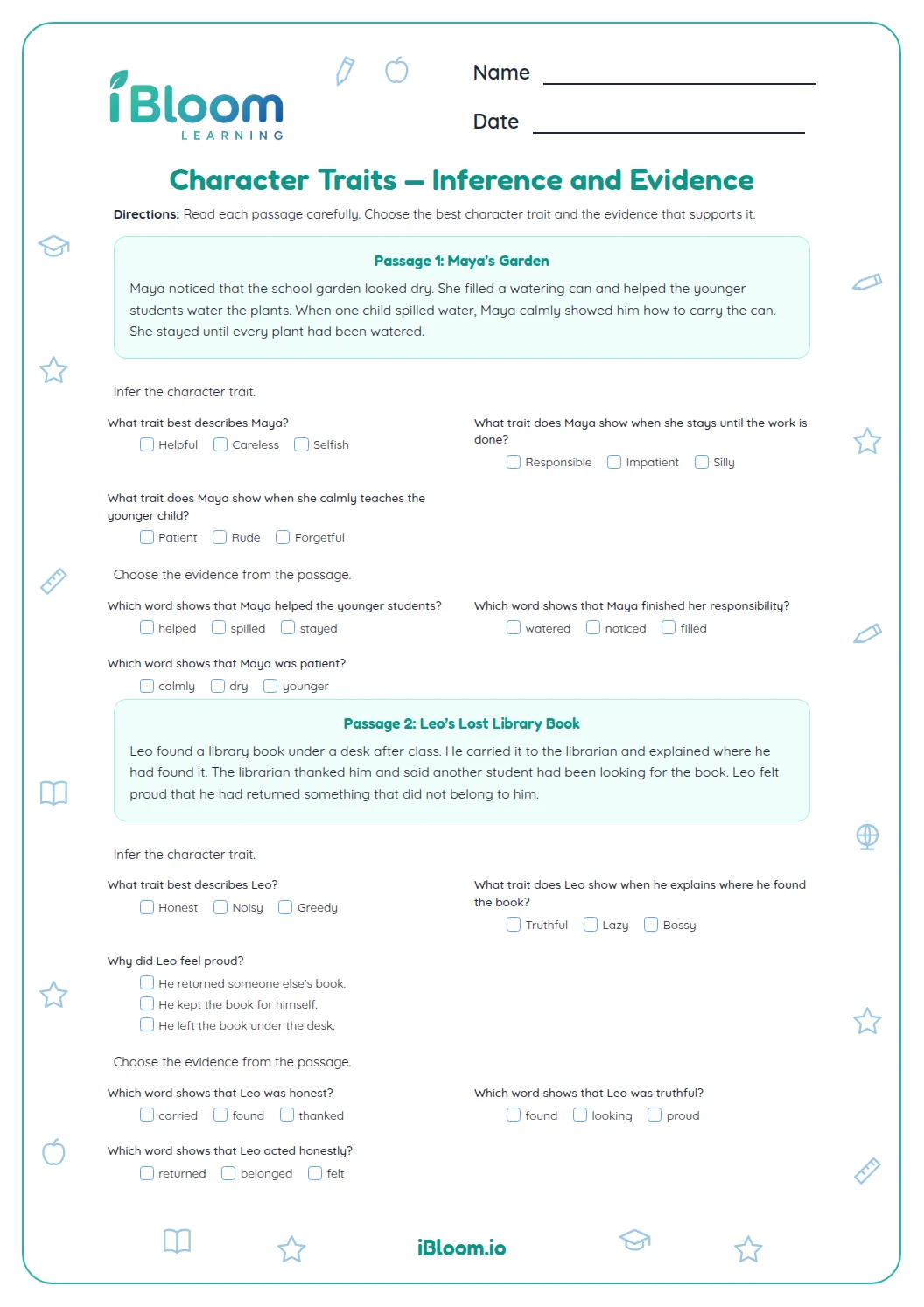


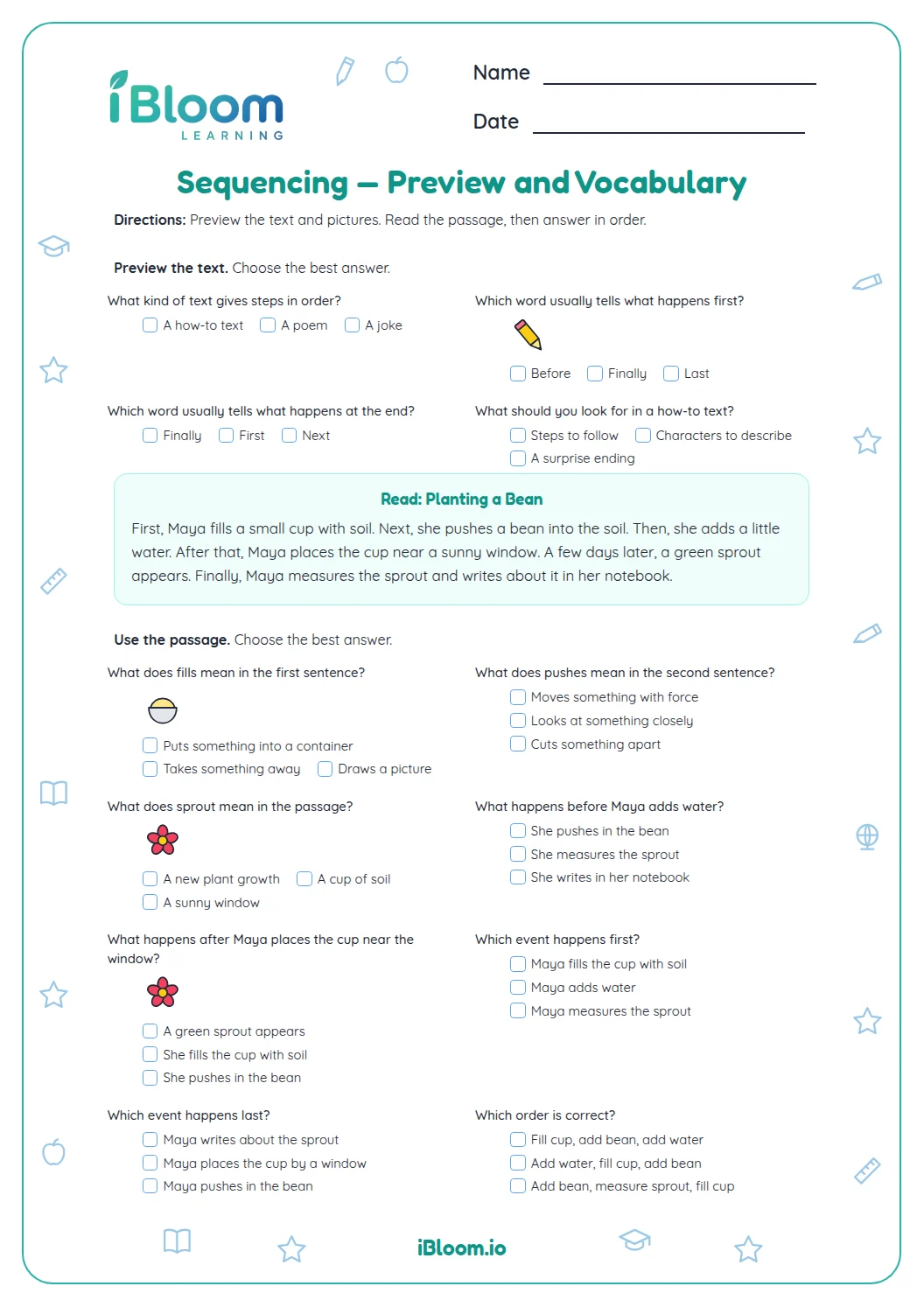

About this worksheet
In this free Grade 3 reading worksheet, Lena and Omar build a cardboard bridge that needs repair. Children read an original story in three short chapters, then answer ten questions about character traits, the order of events and how one chapter leads to the next. The activity practices CCSS RL.3.3 and RL.3.5 by connecting Lena’s actions to the bridge’s success and to the ending. Part A is the passage; Parts B through D move from choosing details to explaining connections. The separate answer key includes sample sentences for the two written explanations.
Aligned to RL.3.3 and RL.3.5
How is a trait different from an action?
An action is something a character does. A trait describes a way the character behaves. Lena tests the bridge before painting it; that action supports the trait careful. Her repeated efforts also give evidence of persistence. Children should name the action that supports their chosen trait.
How do the chapters fit together?
Chapter 1 introduces a weak bridge. Chapter 2 follows Lena and Omar as they repair and test it. Chapter 3 uses that success: the team can decorate the bridge and welcome Ben. The ending depends on solving the earlier problem.
- 1Chapter 1: The bridge sags during the first test.
- 2Chapter 2: Lena supports the weak side with folded cardboard.
- 3Connection: The failed test reveals the problem that the support solves.
- 4Answer: The bridge sags under the car.
What should a written explanation include?
Part B has six choices about actions, traits and order. Part C asks for a chapter number and the earlier problem. Part D asks for six written explanations and evidence-based responses. A useful sentence names an action and links it to a result, rather than simply saying that Lena is nice.
Accept different wording when it fits the passage. For example, “she checks the repair with the toy car” and “she tests the bridge several times” both describe Lena’s careful follow-through.
How to use this worksheet
- 1Read all three chapters once for the main events.
- 2Reread Lena’s words and actions, looking for evidence of a trait.
- 3Answer the six choice questions by checking the passage.
- 4For Part C, find the repair and look back to what made it necessary.
- 5Write the two final explanations with an action and its result.
- 6Compare written answers with the samples, accepting accurate paraphrases.
Mistakes to discuss
The mistake
Naming a feeling instead of a supported trait.
The fix
Ask what Lena repeatedly does; careful or persistent fits her testing actions.
The mistake
Putting painting before the successful tests.
The fix
Trace the shift from the repair in Chapter 2 to painting in Chapter 3.
The mistake
Retelling an event without connecting the chapters.
The fix
Use because or so to explain why the earlier event makes the later one possible.
Common Core alignment
Use actions as evidence of traits and explain how those actions move the story forward.
On this sheet: Children connect Lena’s patience and helpfulness to the repair of a classroom bridge.
Show the official wordingHide the official wording
Describe characters in a story (e.g., their traits, motivations, or feelings) and explain how their actions contribute to the sequence of events
Explain how the bridge story’s three chapters build on one another.
On this sheet: Children identify the repair chapter and explain how its successful tests lead to decorating in Chapter 3.
Show the official wordingHide the official wording
Refer to parts of stories, dramas, and poems when writing or speaking about a text, using terms such as chapter, scene, and stanza; describe how each successive part builds on earlier sections.
What to practice next
Make more practice
Further reading
Questions parents and teachers ask
Does the sheet include a story?
Yes, it includes the original story “The Bridge Team” in three short chapters. Lena and Omar repair a cardboard bridge, then invite Ben to help decorate it. All ten questions can be answered from the printed passage, so children can return to specific details as they work.
Which character traits do children study?
Children study Lena’s care, persistence and welcoming behavior. Testing before painting supports careful; repairing the bridge and testing it again supports persistent; inviting Ben supports welcoming. The questions tie these words to particular actions, so a child must use story evidence instead of choosing a pleasant word at random.
How does this worksheet practice sequence?
It asks children to locate events before and after other events and connect the repair to the original problem. The three chapter headings make the order easy to revisit. The final question goes further by asking how the successful tests allow the decorating and display work to happen.
Must written answers match the key exactly?
No, the two final answers may use different words if they accurately connect actions and results. The key provides sample explanations. Look for a link between Lena’s repeated testing and the sturdy bridge, or between the successful repair and the team’s work preparing the bridge for display.
Can I read the passage aloud first?
Yes, you can read it aloud once and then let the child revisit the printed chapters. Pause after each chapter to ask what changed. During the questions, encourage the child to find the evidence independently and point to the action that supports a trait or event connection.