


About this worksheet
This free Grade 3 reading worksheet pairs an informational passage about collecting rainwater for a school garden with 14 multiple-choice questions. Students trace how rain moves from a roof into a barrel, connect reasons with results, put setup steps in order, and identify how the explanation is organized. The three-page worksheet has a separate three-page answer key. It supports CCSS RI.3.3 by asking readers to describe how events and ideas connect through time and cause and effect.
Aligned to RI.3.3
What is the passage about?
“Collecting Rain for a Garden” explains how roof water can be collected and used safely. It follows the water from roof to gutter to downspout, then describes how an adult places a stable, clean container and what students do after rain.
- 1What causes water to flow into the container?
- 2Rain flows from the roof through the gutter and downspout.
- 3This follows the water’s path in the passage.
How do the questions connect causes and effects?
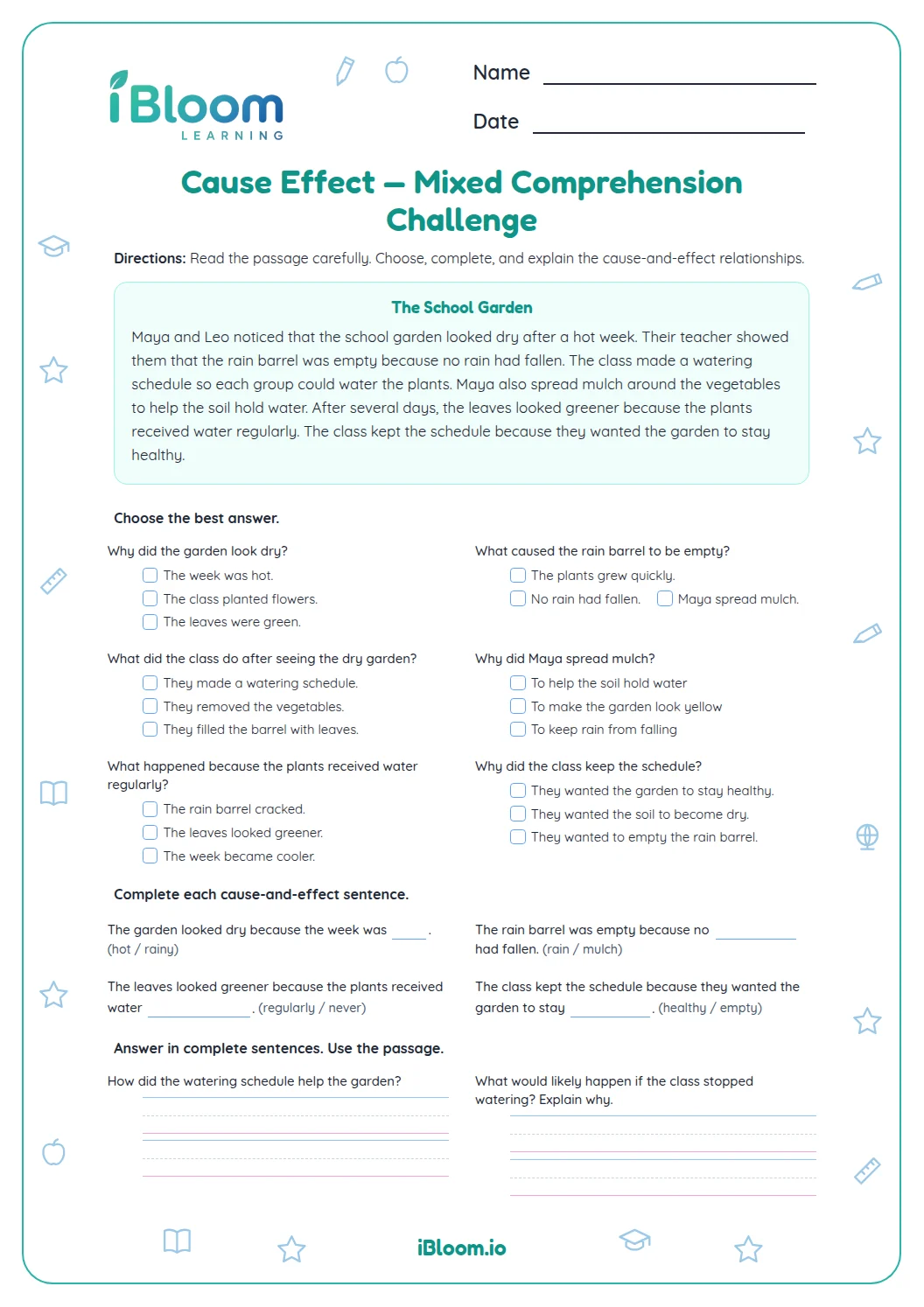
Part B asks readers to connect a reason with its result. For example, the container needs a secure cover so children and animals cannot fall in. Another question asks why students should not drink roof water: it can carry dirt. Return to the sentence that states each connection.
How can readers follow the steps?
Use signal words such as first, next, after, and before to rebuild the order. In the passage, an adult checks the container, places it before a storm, and students use collected water after rain. Part C also asks how the passage is structured: it explains a process in time order.
How to answer passage questions
- 1Read the whole passage once to understand its topic.
- 2For a detail question, find the sentence that names the fact.
- 3For a cause-and-effect question, look for why, so, or a sentence that explains a result.
- 4For order questions, mark time words such as first, next, and after.
- 5Choose the option supported by the passage, then check all 16 answers with the key.
Common reading slips and fixes
The mistake
Choosing an answer that sounds sensible but is not stated in the passage.
The fix
Point to the sentence that supports the choice.
The mistake
Reversing cause and effect, such as saying the barrel makes the rain fall.
The fix
Ask what happened first and what happened because of it.
The mistake
Mixing up the order of setup steps.
The fix
Reread the time words and place the events in that order.
Curriculum alignment
This worksheet practices the skill described in the listed standard.
Describe how the passage connects steps and ideas through time and cause and effect.
On this sheet: Questions ask students to sequence rain-collection steps and connect causes, effects, and details in the passage.
Show the official wordingHide the official wording
Describe the relationship between a series of historical events, scientific ideas or concepts, or steps in technical procedures in a text, using language that pertains to time, sequence, and cause/effect.
What to practice next
Further reading
Questions parents and teachers ask
How many questions accompany the passage?
The informational passage is followed by 14 multiple-choice questions in two question parts. They ask about details, cause and effect, sequence, and the organization of the explanation. The separate three-page answer key includes the correct choice for every question. All items stay with the rainwater topic.
What is the passage about?
It explains how a school can collect roof rainwater in a clean, stable, covered container and use some of that water in a garden. The text follows rain through a gutter and downspout, then describes setup and safe use after a storm.
How does the worksheet practice cause and effect?
Students connect reasons with results described in the passage. A secure cover helps prevent children or animals from falling into a container, and students should not drink roof water because it can carry dirt. The choices ask them to identify these relationships.
What does text structure mean in this passage?
Text structure is the way information is arranged. This passage explains a process in time order, using words such as first, next, and after to show how to set up the container and use collected water. One question asks students to identify that organization.
Which standard does this reading worksheet support?
It supports CCSS RI.3.3. Students describe connections among events and ideas by tracking the sequence of rain-collection steps and the causes and effects described in the informational passage. The questions ask them to return to details as evidence. Students support their choices with details from this text.
How many pages should I print?
The passage and questions use three worksheet pages, and the answer key uses three separate pages. Students can read and answer the questions first, then use the key to check all 14 choices. Keep the key aside until the work is finished.