


About this worksheet
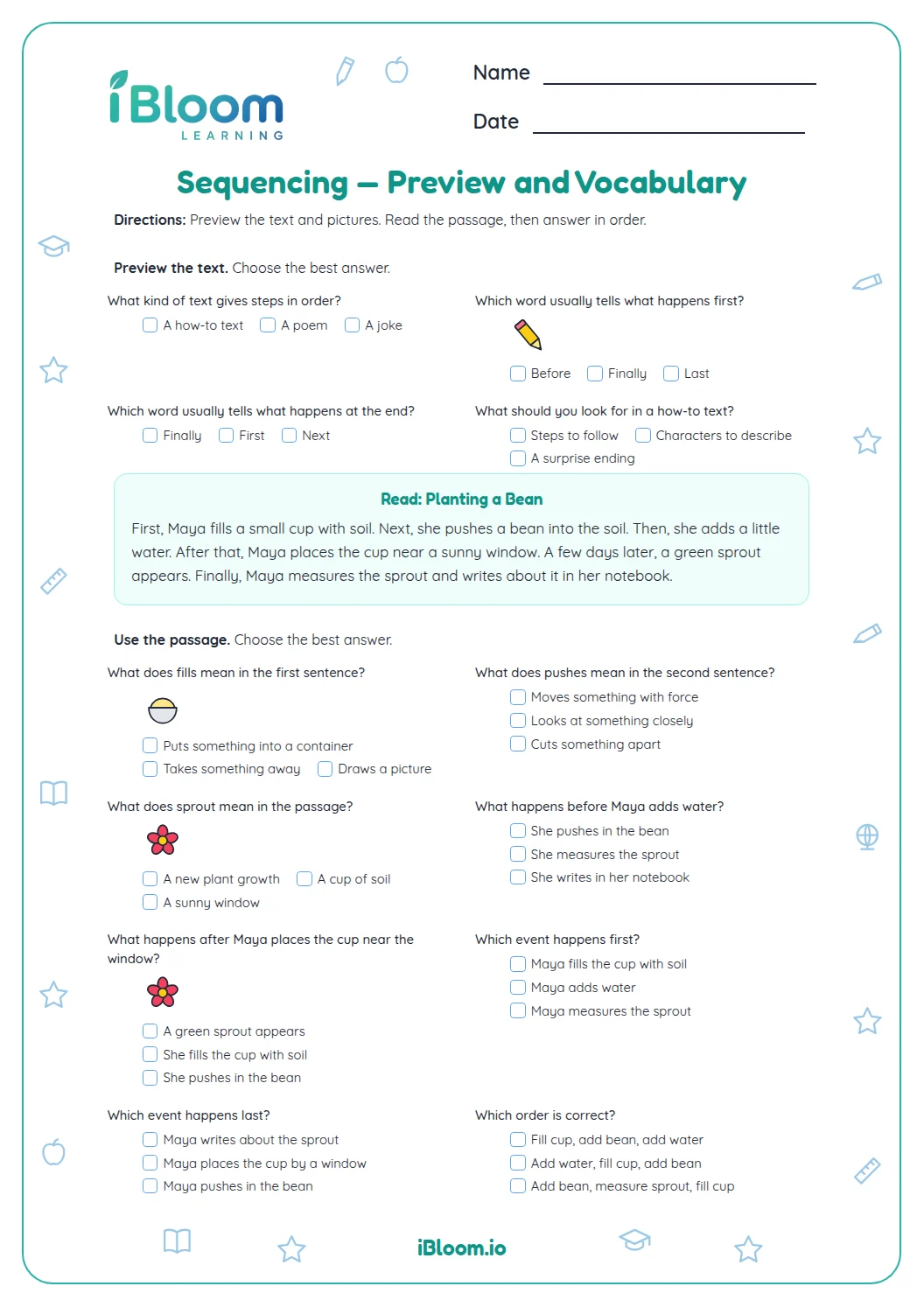
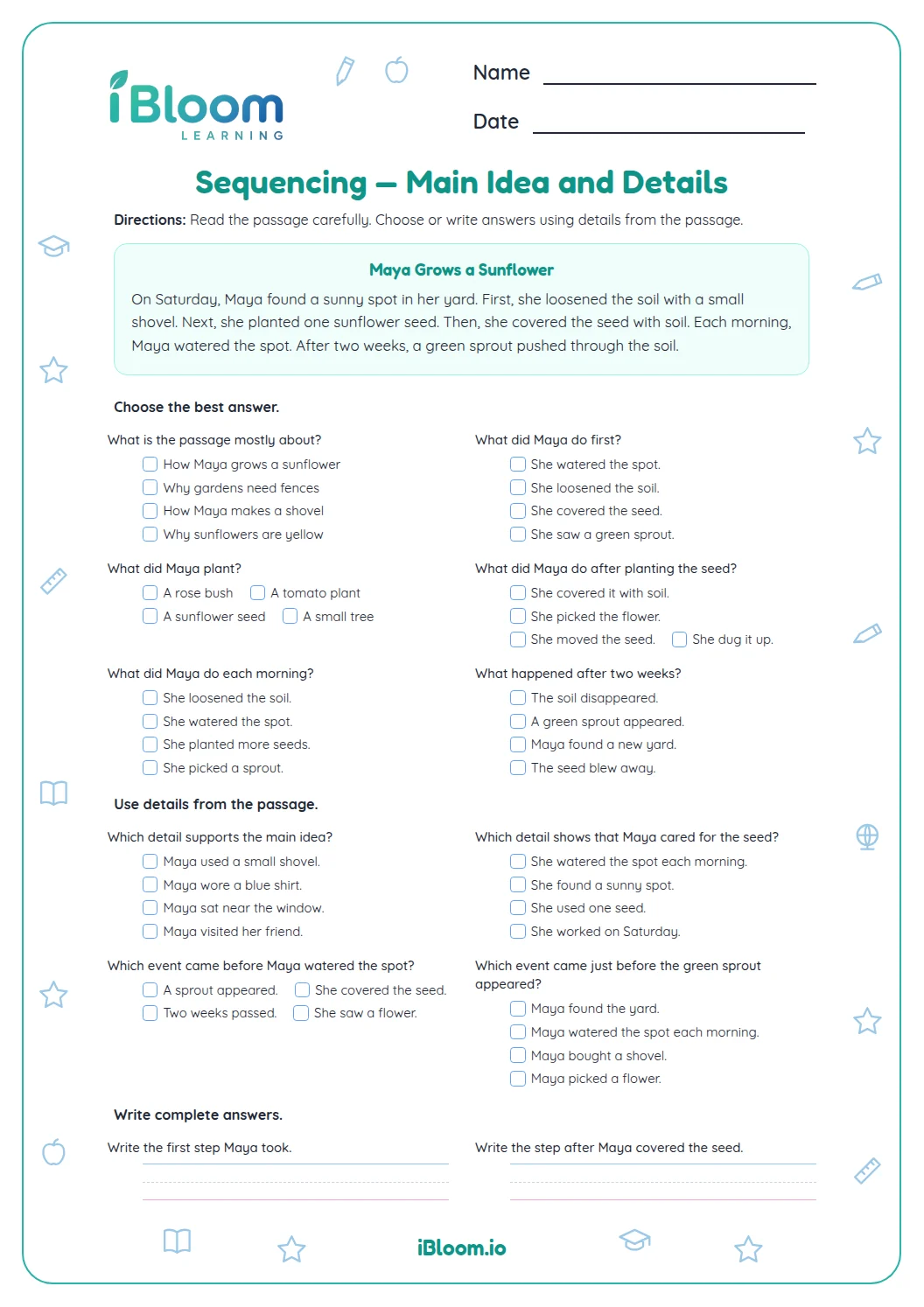
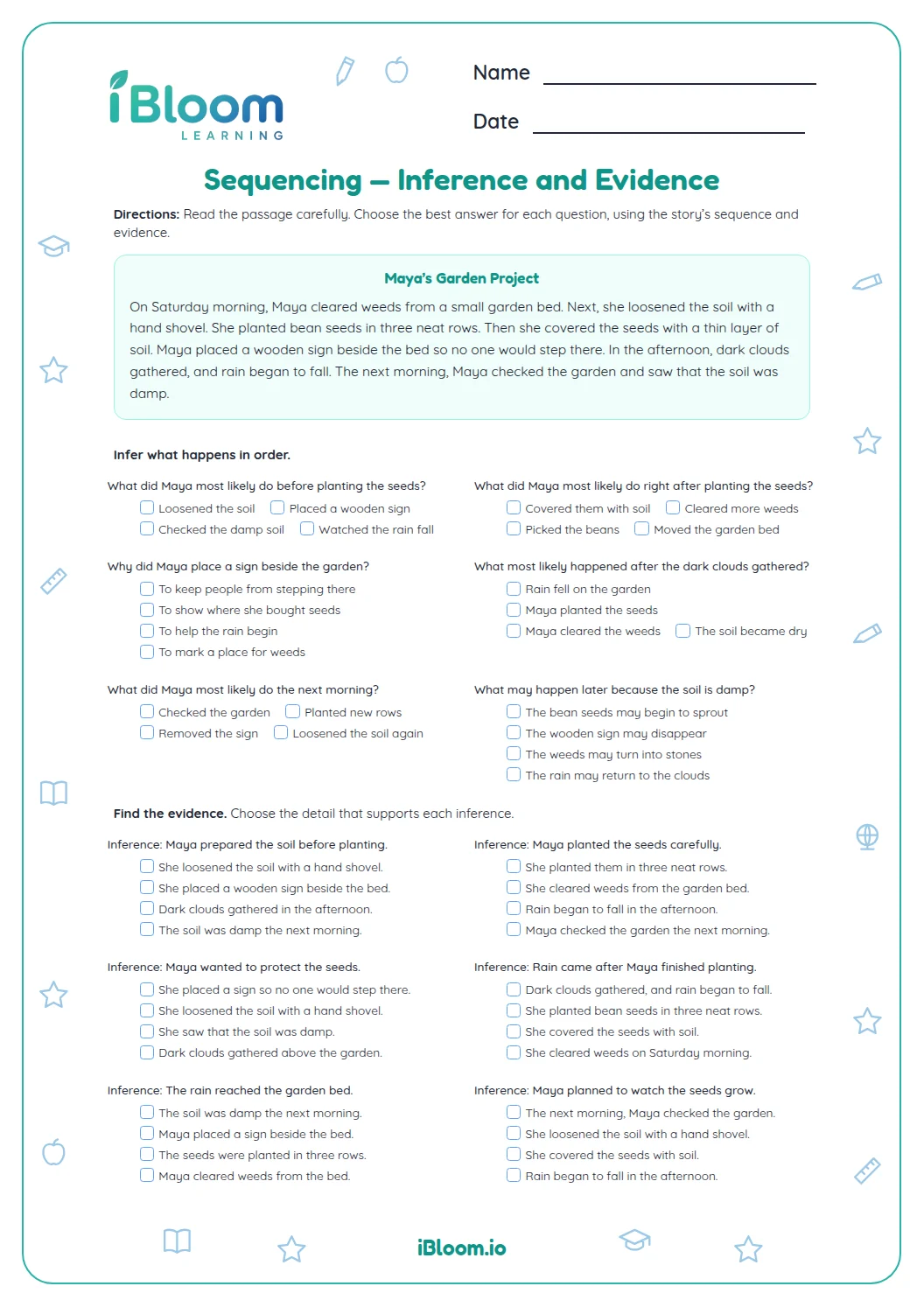
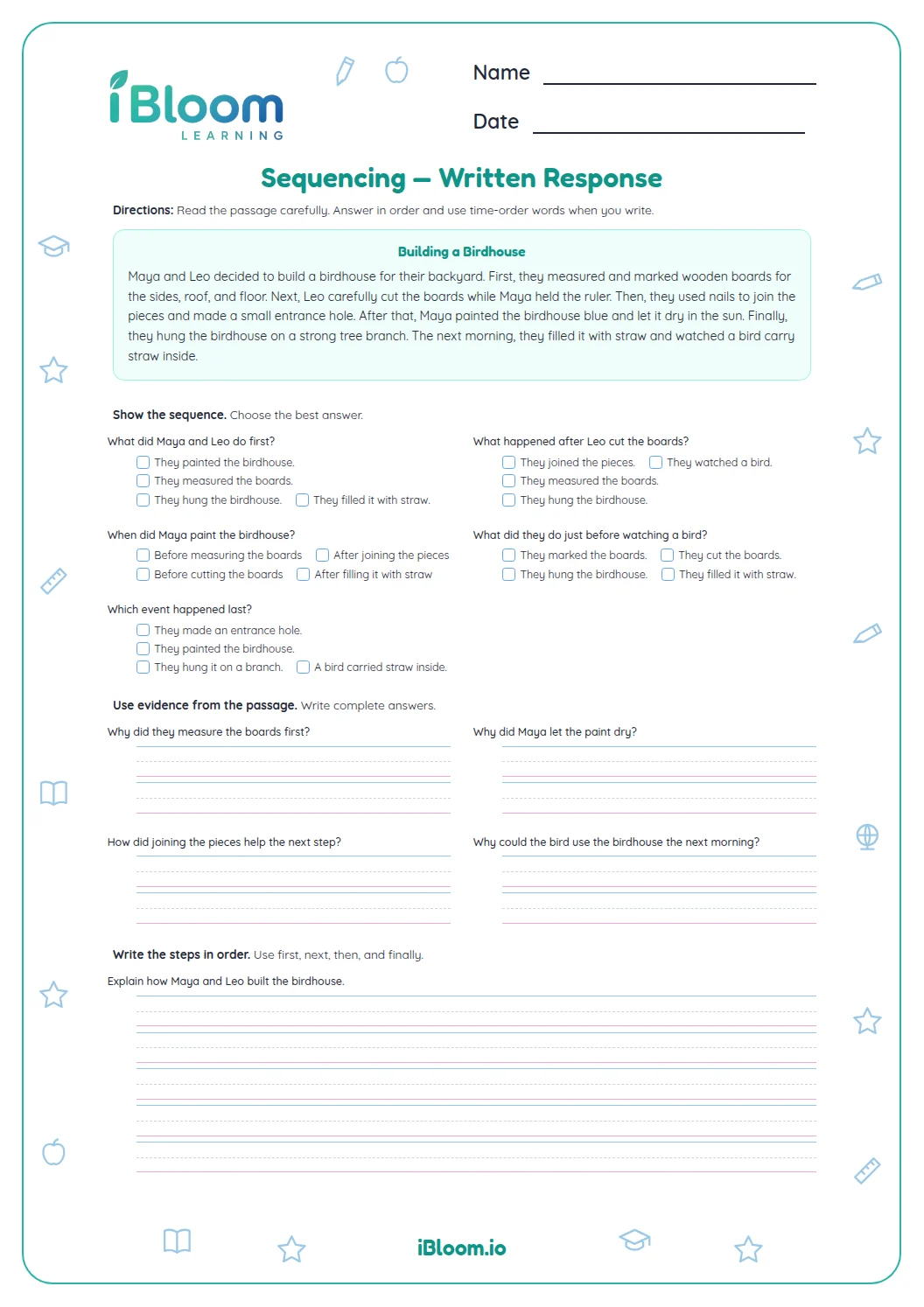
This free printable Grade 3 worksheet practices put story events in order and use time words to explain how they connect. It has 16 questions across 3 worksheet pages, with a separate answer key. Follow Nora from planting sunflower seeds to protecting the shoots, using time clues to track each step.
Aligned to RL.3.3
How can time clues put events in order?
Words such as “first,” “next,” and “finally” mark when each event happens. The passage follows Nora from preparing soil to protecting the shoots.
- 1Grandpa covered the seeds after Nora dropped one in each hole.
- 2So the event just before covering was dropping in the seeds.
What does a transition word tell the reader?
A transition can mark a new step or show that time has passed. “At last” signals that the shoots appeared after the soil looked unchanged for several days.
How do events connect across the story?
Nora waters the seeds, checks the patch, and later sees shoots. Her later actions depend on what happened earlier, so the passage is organized in time order.
How to work through this sheet
- 1Read the passage once to learn what Nora is doing.
- 2Notice words that show order, such as first, next, then, and finally.
- 3For each question, find the event just before or after the named event.
- 4Use the whole passage to check what caused a later action.
- 5Review each choice with the separate answer key.
Common mistakes and quick fixes
The mistake
Putting the sign up before the shoots appear.
The fix
Find the sentence that says Nora tied the sign after the shoots grew taller.
The mistake
Treating “at last” as the first event.
The fix
Use the nearby clue: the soil looked the same for several days first.
The mistake
Choosing an event that happened in the story but at the wrong time.
The fix
Check which event comes immediately before or after the one named.
Common Core alignment
This worksheet gives practice with the listed Common Core skill.
Explain how Nora’s actions lead from planting seeds to protecting the growing shoots.
On this sheet: Learners track how each event follows from earlier actions.
Show the official wordingHide the official wording
Describe characters in a story (e.g., their traits, motivations, or feelings) and explain how their actions contribute to the sequence of events.
What to practice next
Make more practice
Further reading
Questions parents and teachers ask
What does this worksheet ask children to do?
It asks children to follow Nora’s sunflower story in time order. The 16 questions ask what happened first, next, and last, and how transition words connect the events. Learners must use the passage details, not just guess from what usually happens in a garden. The answer key lets an adult point back to the sentence that gives the clue.
Which time words appear in the practice?
The passage and questions use first, next, then, at last, and finally. Children use these clues to put Nora’s actions in order and notice when time passes. The answer choices ask children to match a transition to the event order. They can reread the sentences around the blank to decide whether the action is next, later, or last.
How does question 3 work?
Question 3 asks what happened just before Grandpa covered the seeds. The passage says Nora dropped a seed into each hole, then Grandpa helped cover them. The passage states that she dropped a seed into each hole before Grandpa helped cover the seeds. Children can find both actions in the planting paragraph.
What does “At last” mean in the passage?
It tells the reader that the shoots appeared after Nora had waited and checked the patch for several days. It marks a later event, not the start of planting. The words “for several days” explain why “At last” fits: the shoots appear after a wait. The other choices would place the event at the wrong time.
How many pages are included?
The printable has three worksheet pages and a separate three-page answer key. The key lists the correct event choices and transition words for all 16 questions. These questions also ask children to notice how Nora’s early choices lead to later events. This gives a little practice linking the sequence, not only memorizing transition words.