




About this worksheet
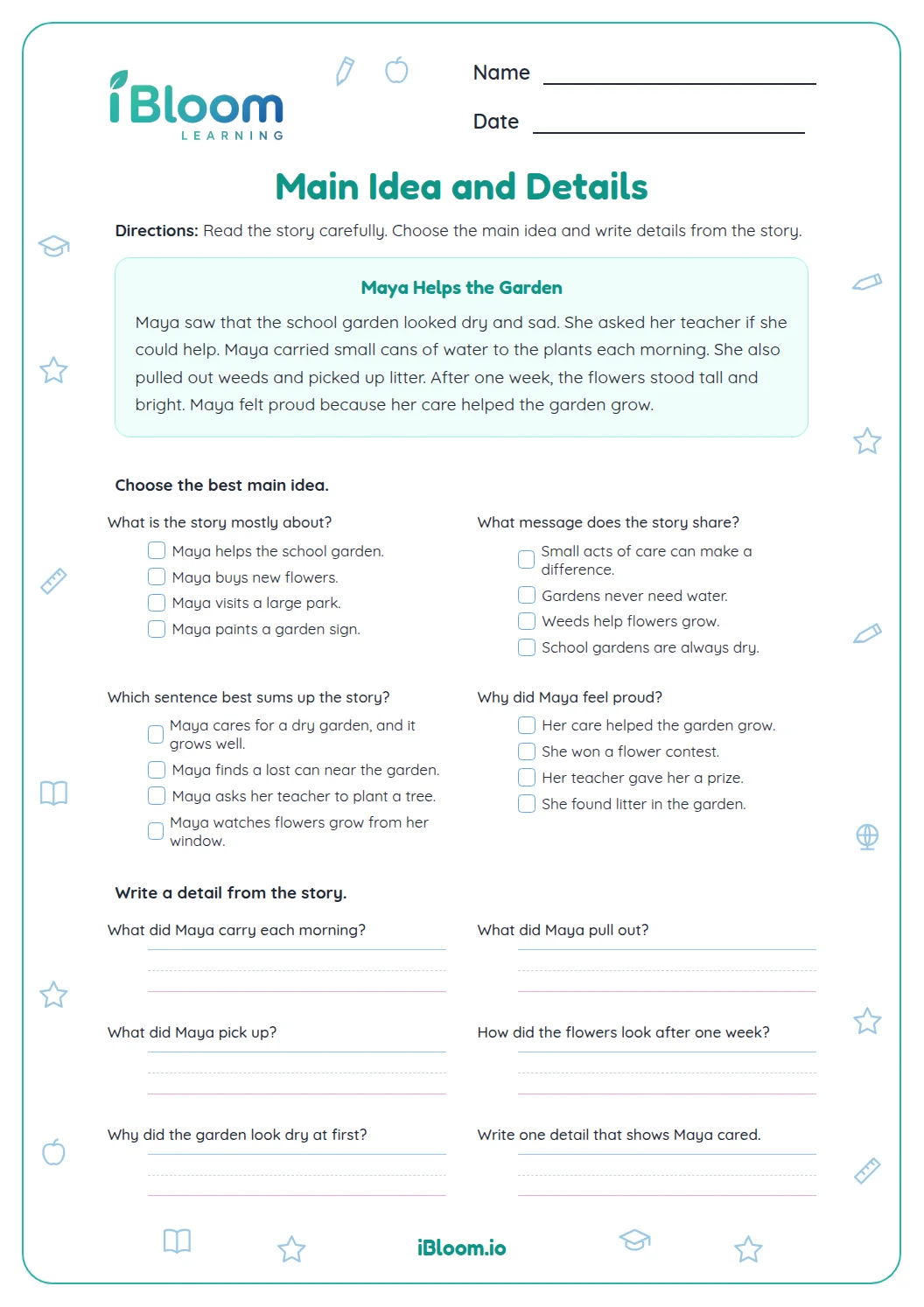
This Grade 3 printable story worksheet helps students identify a main idea and select details that support it. The original 155-word passage, “A Little Shade,” follows Nora and her classmates as they build a screen to help garden seedlings. Fourteen questions ask about the story’s central idea, key details, sequence, and lesson. It practices CCSS RL.3.2 and includes a separate answer key.
Aligned to RL.3.2
How do you find a story’s main idea?
Ask what the character wants, what problem comes up, and what the character does. Then choose an idea that covers the whole story rather than one small event. In this story, Nora wants to help drooping seedlings, so she and her class make a shade screen.
- 1Nora notices the seedlings drooping in the sun.
- 2She asks about a shade screen.
- 3The class builds one and checks the garden.
- 4Main idea: Nora and her class make a shade screen to help the garden.
Which details support the main idea?
A supporting detail explains what the class did or what happened afterward. Tying cloth between two poles directly supports the idea that the children made shade. Nora writing a sign is a real detail, but it does not explain the main action as well.
What will students answer after reading?
Questions 1–12 offer choices about the main idea, problem, key details, sequence, and lesson. Questions 13–14 ask for short written answers using story information.
- Part B: ten multiple-choice questions
- Part C: two text-based written answers
- Part D: two more multiple-choice checks
- The answer key includes sample responses for open-ended items
How to use this worksheet
- 1Read the story once to understand what happens.
- 2Name the character’s goal and the problem.
- 3Notice the action that helps solve the problem.
- 4Choose a main idea that fits the beginning, middle, and ending.
- 5Use one accurate story detail to support a written answer.
Common mistakes and quick fixes
The mistake
Choosing one event as the main idea.
The fix
Ask whether the choice explains the whole story, not just one moment.
The mistake
Picking an answer that adds something the story never says.
The fix
Point back to a sentence in the passage before choosing.
The mistake
Giving a detail without answering the question.
The fix
Start with a direct answer, then add the supporting story detail.
Common Core alignment
This story worksheet practices key ideas and details in a literary text.
Determine a story’s central message and explain it with key details.
On this sheet: Students choose the story’s main idea and lesson and connect answers to story details.
Show the official wordingHide the official wording
Recount stories, including fables, folktales, and myths from diverse cultures; determine the central message, lesson, or moral and explain how it is conveyed through key details in the text.
What to practice next
Make more practice
Further reading
Questions parents and teachers ask
Is the garden story original to this worksheet?
Yes. “A Little Shade” is an original story written for this practice page. It follows Nora and her classmates as they respond to drooping seedlings by building and checking a small shade screen. The passage is written specifically for this worksheet and centers on a garden problem and solution.
How many questions are included?
There are 14 questions: twelve multiple-choice items and two short written answers. The questions cover the main idea, supporting details, a problem and solution, sequence, and a lesson. The questions ask about the main idea, supporting details, sequence, and the lesson of the story.
What is the answer to the main-idea question?
The best answer is that Nora and her class make a shade screen to help the garden. Several details support it: Nora notices the seedlings drooping, the class sets up the cloth, and the plants stand upright by Friday. The best choice covers Nora’s goal, the class’s action, and the garden result across the passage.
Should students use exact words from the passage?
They may quote or restate a detail accurately. For the written questions, a complete sentence that answers the question and refers to an event in the story is a strong response. A response may use the passage’s exact words or restate a detail accurately in the student’s own words.
Does this worksheet include an answer key?
Yes. A separate answer key lists the ten correct choices and gives sample answers for both written questions. Other responses may be correct when they answer the prompt using the passage. Students can check each choice against the story and use the key’s sample responses for the open-ended items.