


About this worksheet
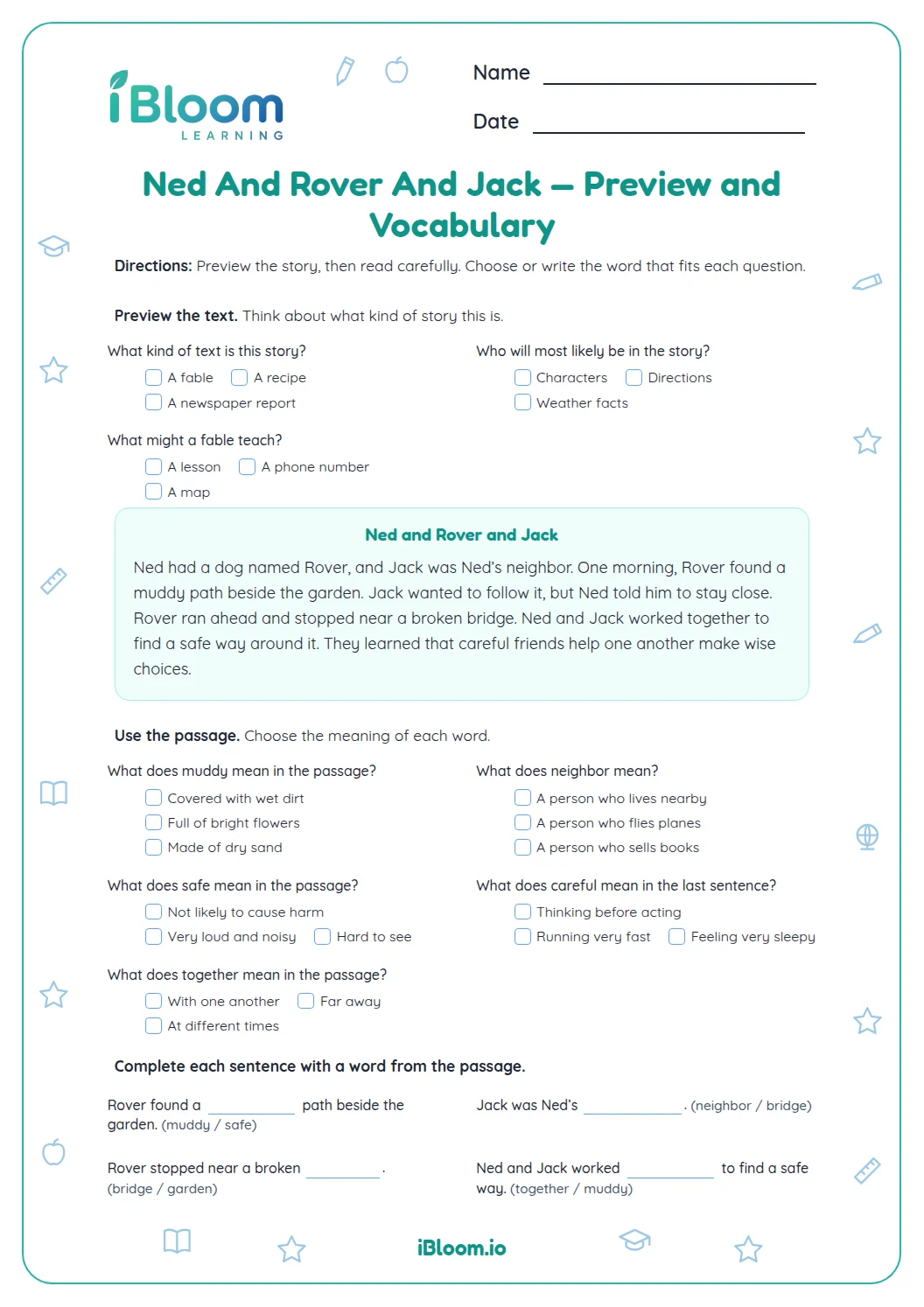
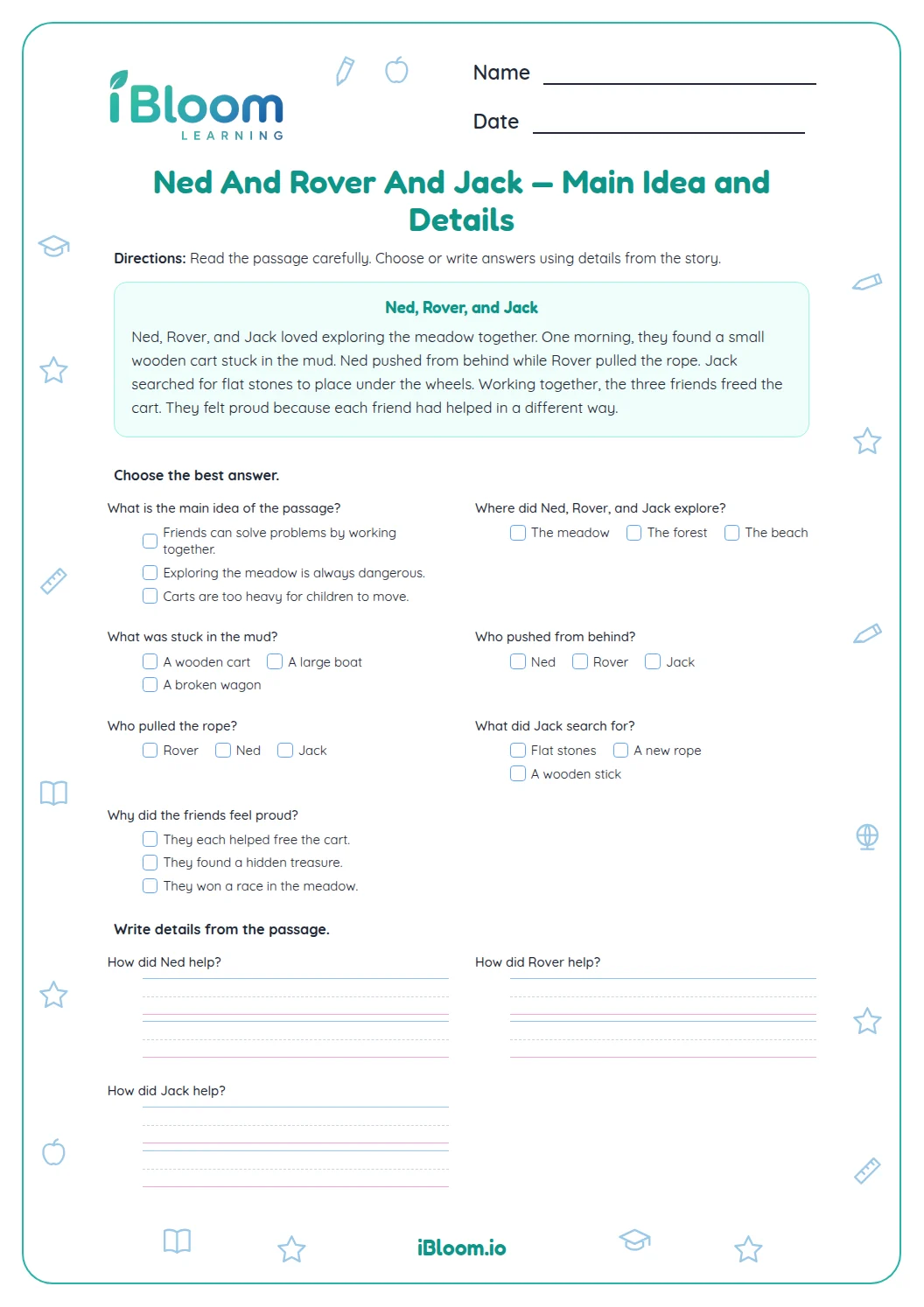
This free printable is for Grade 3 readers practicing comprehension through an original fable about Ned, Rover, and Jack. Learners follow a rescue, recall important details, sequence events, infer what Rover’s behavior shows, and explain the story’s lesson. Fourteen questions include two longer written responses, and a separate key gives concise answers and sample responses. The questions practice using the text as evidence, as described in Common Core RL.3.1.
Aligned to CCSS.ELA-Literacy.RL.3.1
What happens in the fable?
Rover’s barking brings Ned to Jack, who has hurt an ankle near the bridge. Ned helps Jack get comfortable, then runs to find Jack’s parents. The second paragraph shows the friends reflecting on how noticing trouble and acting helped.
- 1Question 10 compares two events.
- 2Find both events in the passage, then identify which one happened first.
How do story details support an answer?
A direct answer names a detail from the fable. An inference goes one step further: the reader uses an action, such as Rover staying beside Jack, to explain what that action suggests.
How can a reader support the lesson?
The final question asks for two details that support the friends’ idea about helping. Learners can choose different details, as long as each one comes from the story and fits the lesson.
How to use this worksheet
- 1Read both paragraphs once to follow the rescue and the later visit.
- 2Reread the sentence that contains a detail named in the question.
- 3For sequence questions, compare when each event happened.
- 4For an inference, connect a character’s action to what it suggests.
- 5Use two accurate passage details to support the final response.
Common mistakes and quick fixes
The mistake
Retelling the whole story instead of answering the question.
The fix
Start with a direct answer, then add only the detail that supports it.
The mistake
Mixing up the bridge rescue and the next-afternoon visit.
The fix
Use time words and reread the paragraph where each event appears.
The mistake
Giving a lesson without evidence.
The fix
Name two actions from the fable that show the lesson in practice.
Curriculum alignment
The prompts ask learners to use story details to answer and explain.
Learners answer direct and inferential questions using details from the fable.
On this sheet: Learners answer from the passage and support written responses with explicit story details.
Show the official wordingHide the official wording
Ask and answer questions to demonstrate understanding of a text, referring explicitly to the text as the basis for the answers.
What to practice next
Make more practice
Further reading
Questions parents and teachers ask
What reading skills does this fable practice?
The 14 questions ask learners to recall details, put events in order, infer what Rover’s behavior shows, and explain a lesson. The final two prompts connect both characters’ actions and support the fable’s idea with details from the passage.
How long is the passage?
The original fable is 165 words in two short paragraphs. It follows Ned, Rover, and Jack from the rescue near the bridge through a visit the next afternoon, with details for recall and inference questions. Learners can reread either paragraph to locate supporting evidence.
What is the lesson in Ned, Rover, and Jack?
The friends agree that paying attention and helping someone in trouble can make a hard moment safer. Learners can support that idea with details such as Rover staying close to Jack and Ned going to get Jack’s parents.
Are written responses required?
Most prompts can be answered in a short sentence, and each has an answer line. The final two questions ask learners to compare Rover’s and Ned’s actions or choose details that support the fable’s lesson, so a complete sentence is useful.
How can an adult check the answer key?
Use the key as a model, then accept another response when the learner supports it with a correct passage detail. For the open responses, the key begins with “Sample” because learners may explain the story in their own words.