


About this worksheet
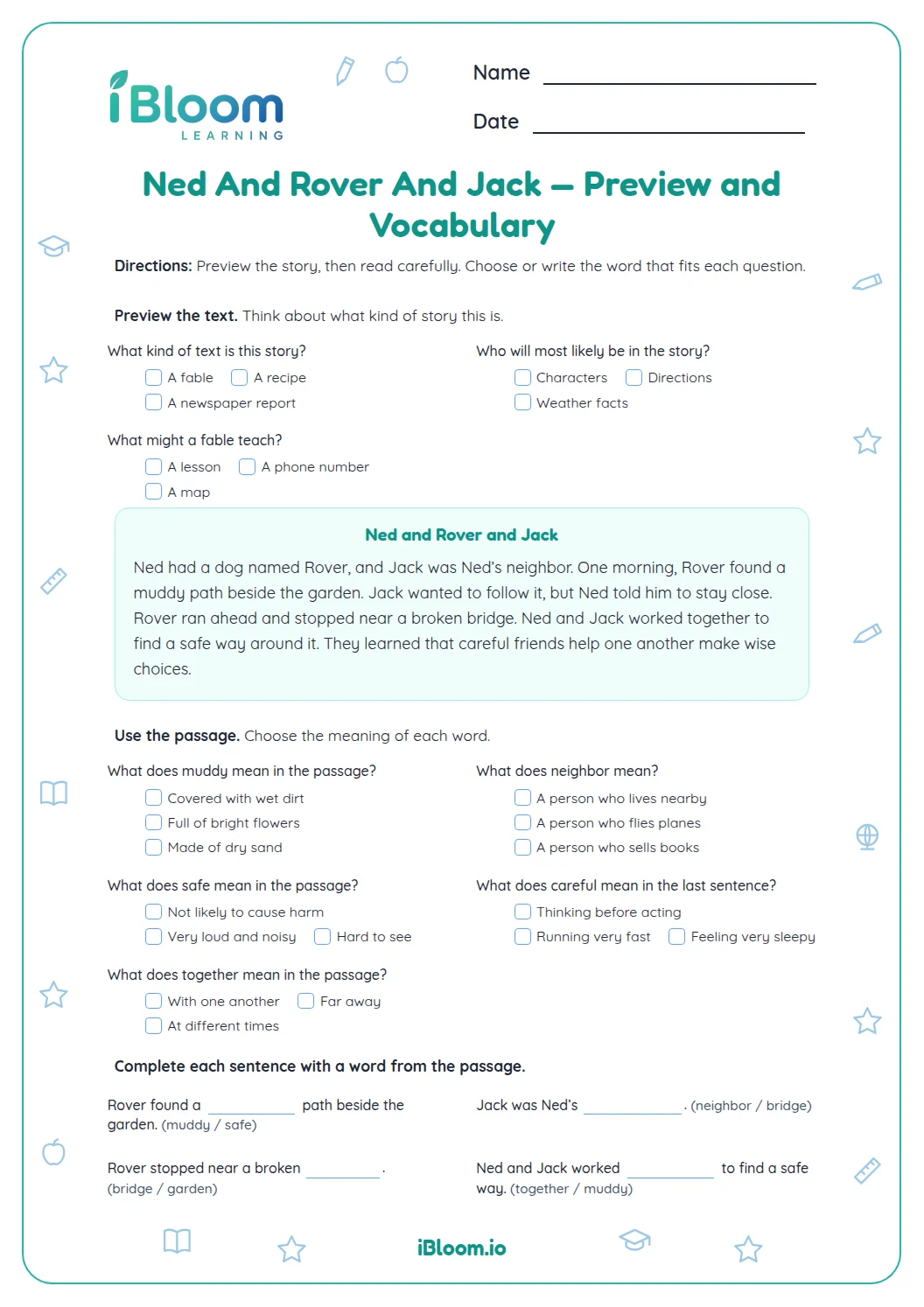
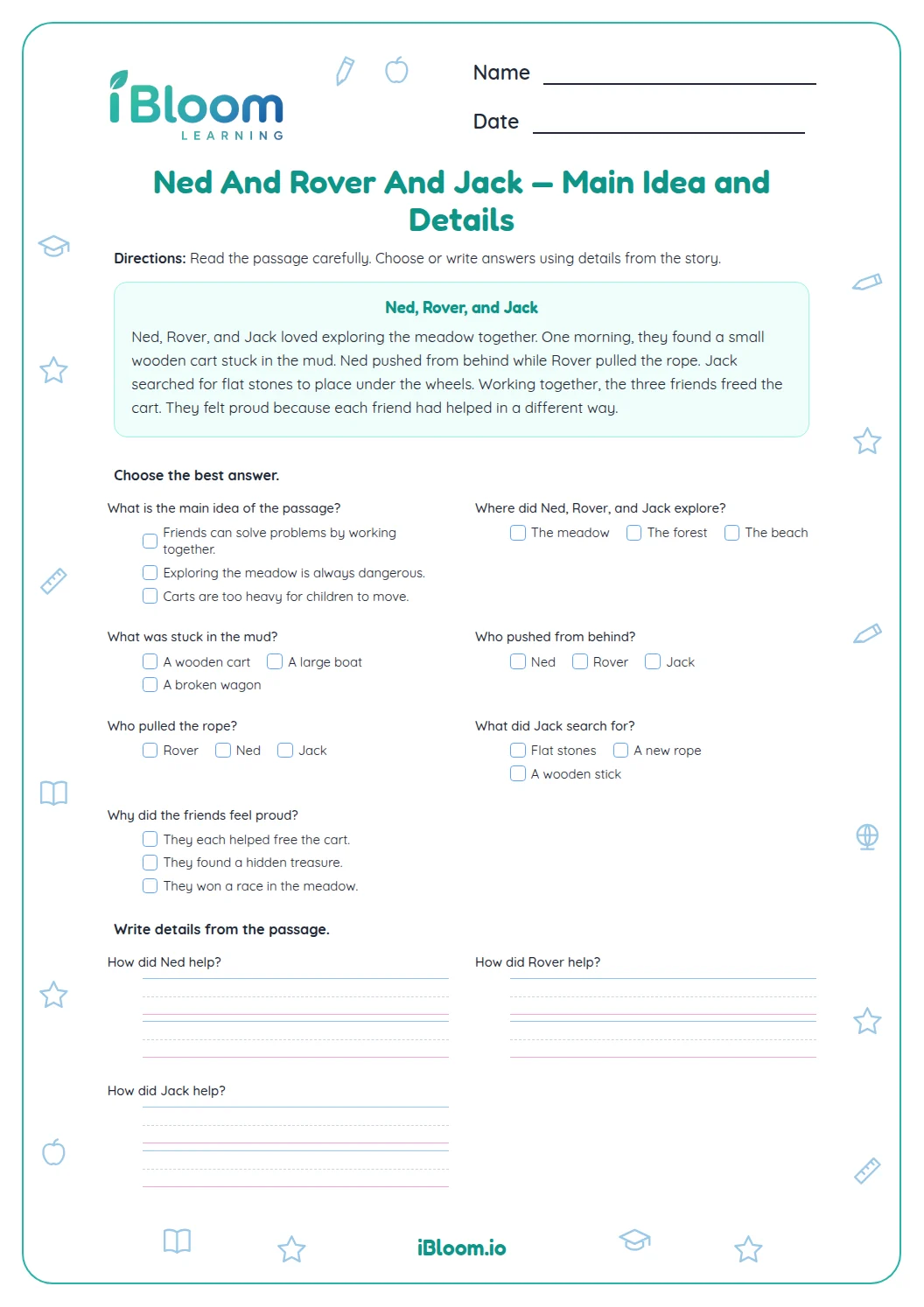
This Grade 3 reading worksheet pairs the Ned, Rover and Jack pond story with 14 mixed comprehension questions. Students identify details, follow the events, explain how the characters solve a problem and support inferences with evidence from the story. It aligns with RL.3.1: answering questions and referring explicitly to the text. The answer key provides direct answers and sample responses for questions that allow more than one phrasing.
Aligned to RL.3.1
Which details explain what happened?
Part B begins with four multiple-choice questions about the picnic, the story’s idea, the drifting boat, and where Jack stood. Students can return to the passage to check each choice against what Ned, Rover, and Jack did.
What happened as the boat drifted away?
Part C asks six short questions about the people, objects, and events. The passage says Ned tied a rope to a tree, Jack held its loose loop from the dry shore, and Rover barked when the boat turned sideways.
How can a story detail support an answer?
Part D has four written responses. For example, Ned reminded Jack to stay close because the muddy bank was slippery. Students can answer in their own words while naming a detail from the passage.
How to use this worksheet
- 1Read the passage once to understand the problem.
- 2Reread the part named in a question.
- 3For event questions, keep the story in time order.
- 4For an inference, connect a detail with what it suggests.
- 5Write a complete sentence and include evidence when asked.
Common mistakes and quick fixes
The mistake
Choosing an answer that sounds reasonable but is not in the story.
The fix
Return to the passage and find a detail that supports it.
The mistake
Mixing up what Rover and the people carried.
The fix
Track each character’s action as you reread.
The mistake
Giving an inference without a clue.
The fix
Name the words or action that led you to the idea.
Curriculum alignment
This standard describes the skill practiced on this worksheet.
Answer questions and support inferences with details from the story.
On this sheet: Students answer detail questions and use story evidence to explain inferences.
Show the official wordingHide the official wording
Ask and answer questions to demonstrate understanding of a text, referring explicitly to the text as the basis for the answers.
What to practice next
Make more practice
Further reading
Questions parents and teachers ask
How long is the reading passage?
The passage is about 150 words and follows Ned, Rover, and Jack at a pond. Rover spots an empty boat drifting away, and Ned and Jack guide it back with a rope while staying on the shore. Students can look back at these details as they answer.
How many questions follow the story?
There are 14 questions in three question parts: four multiple-choice items, six short-answer details, and four written responses. The questions ask about the picnic, the drifting boat, the characters’ actions, and what readers can conclude from the passage.
What idea does the story show?
The story shows the friends paying attention, staying safe, and working together. Ned secures a rope, Jack guides the boat from the dry shore, and Rover signals when it turns sideways. Students can use those actions when explaining why the friends feel proud.
Do students need to use evidence?
The final four questions ask students to explain an answer in a sentence with a story detail. For instance, Ned tells Jack to stay close because the muddy bank is slippery. A response can use different wording as long as it matches the passage.
Does the answer key allow different wording?
Yes. The key gives direct answers for the multiple-choice and short-answer items, then sample sentences for the written responses. Other wording is acceptable when it accurately describes the passage and includes a detail that supports the answer. The key follows the same question order as the worksheet.