


About this worksheet
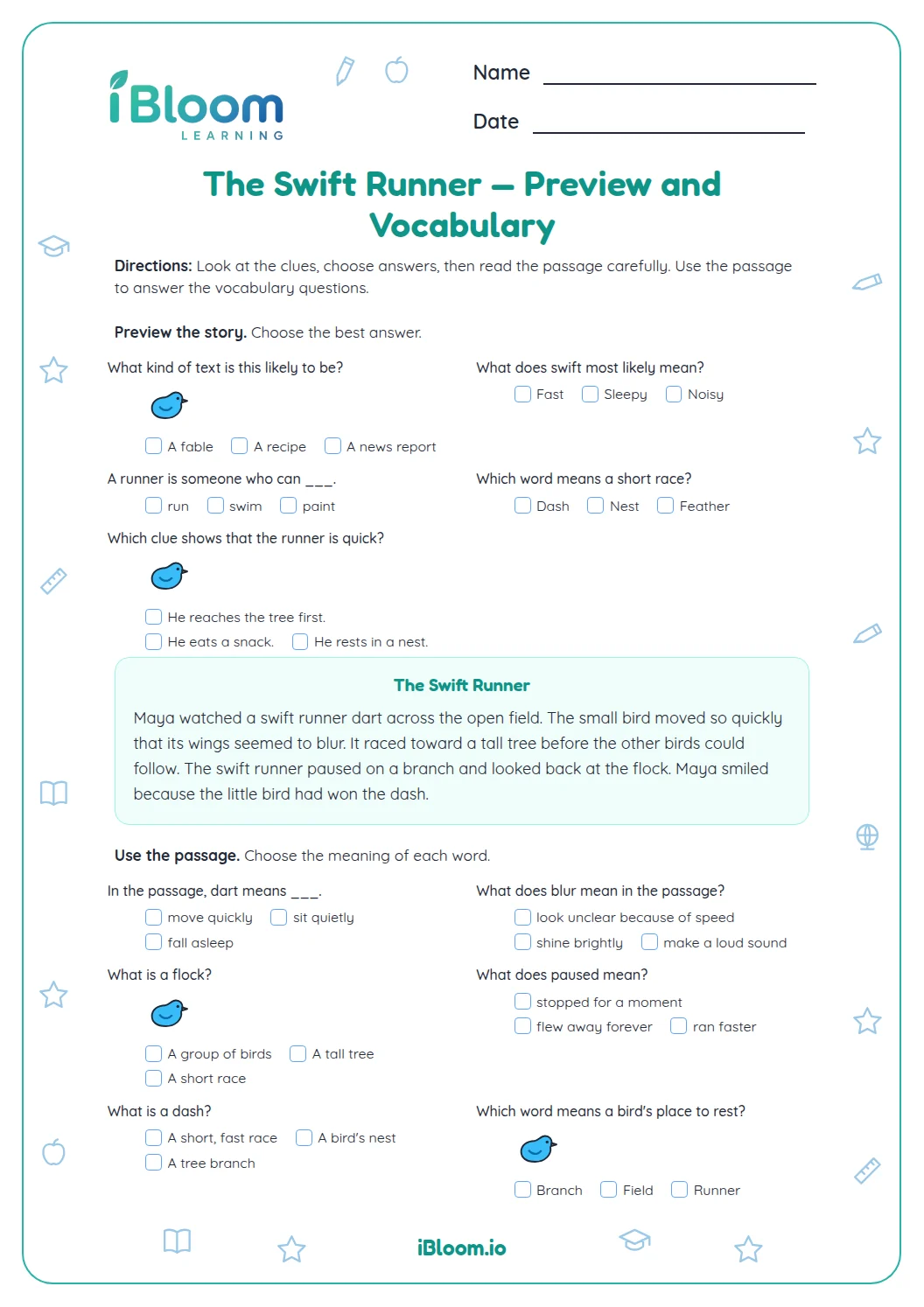
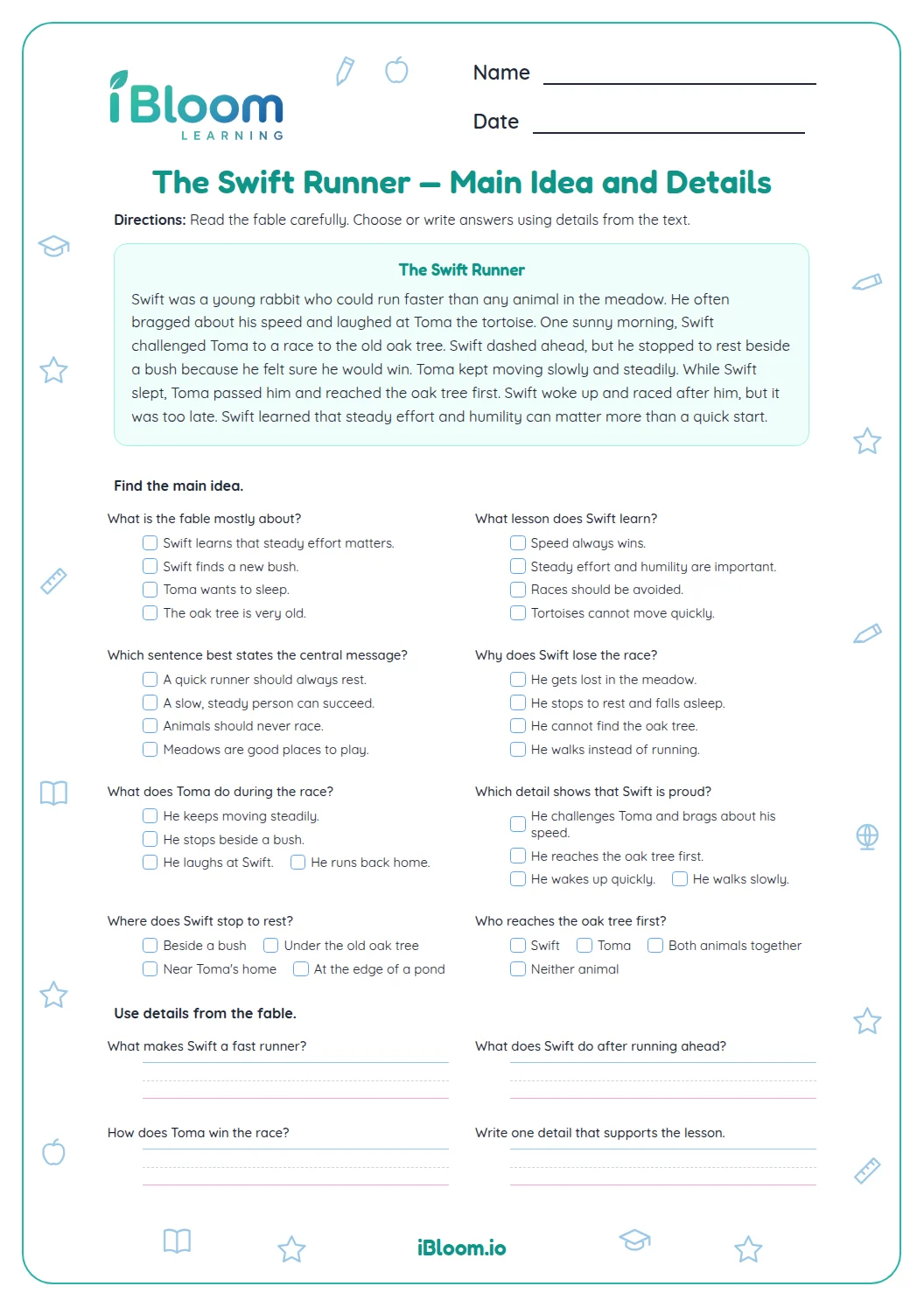
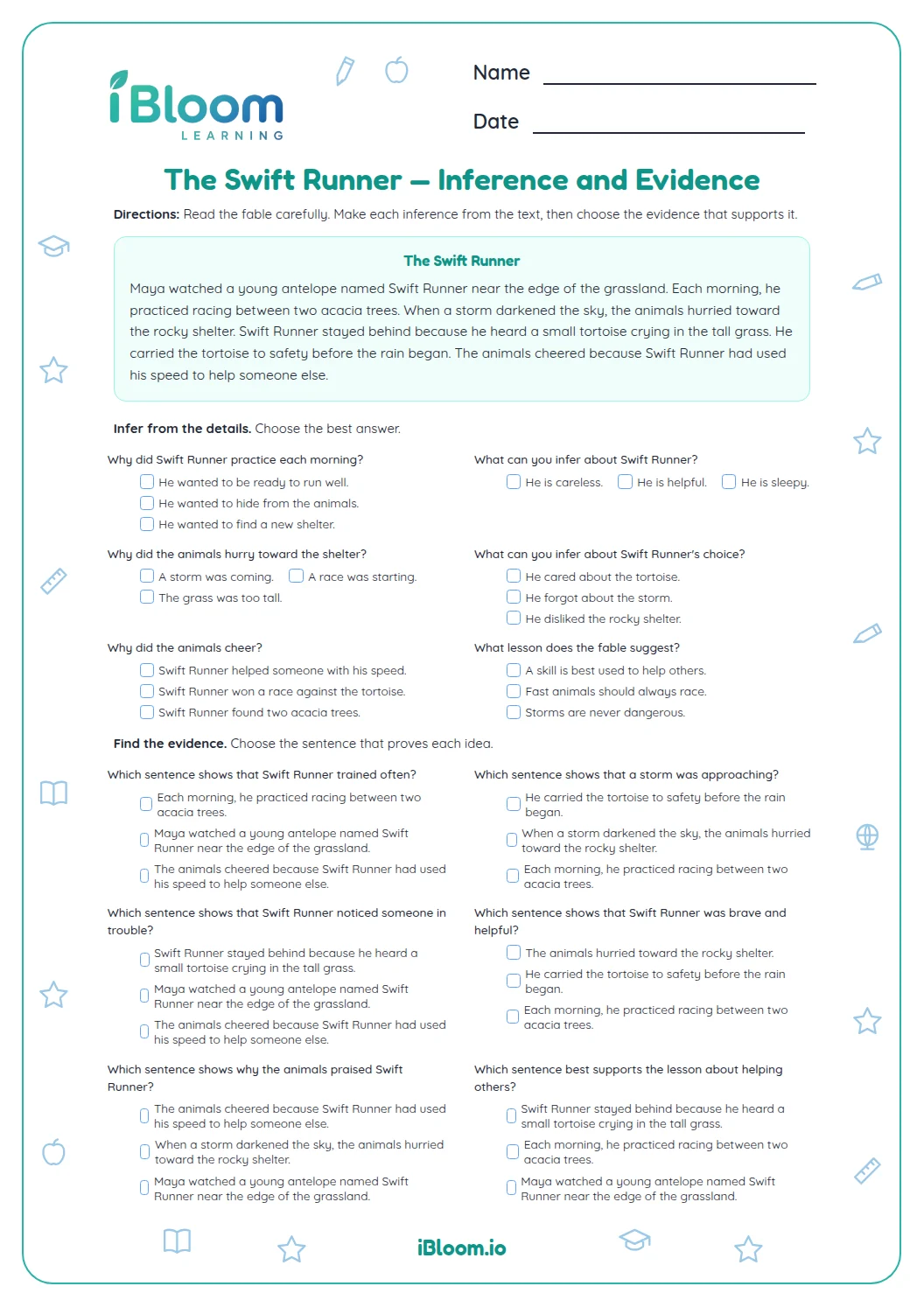
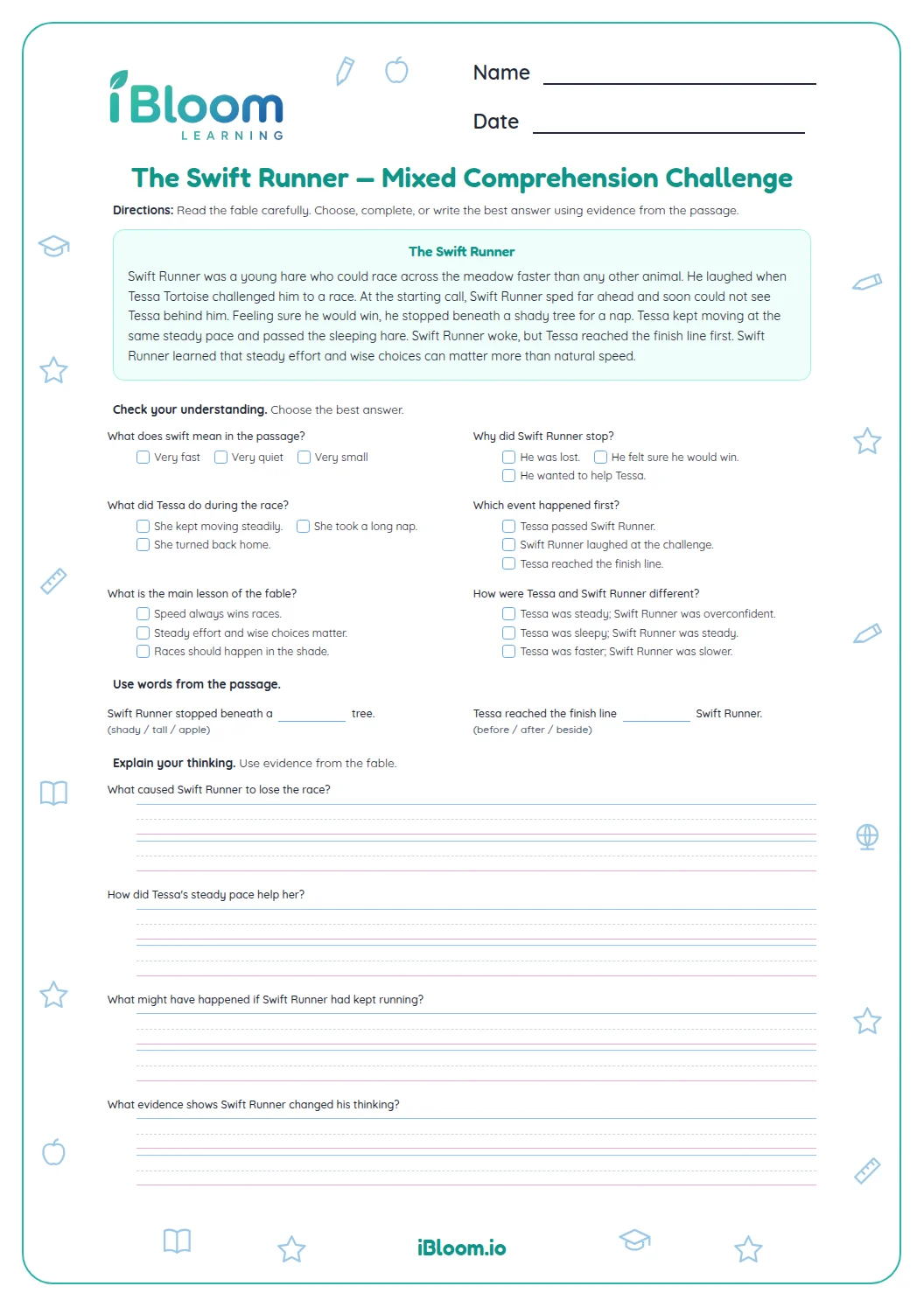
This free Grade 3 reading worksheet uses the Swift Runner fable shown in the earlier sheet: a hare rushes to deliver berries to an old oak, slips on a muddy path, and learns to value careful effort. Sixteen questions ask students to recall details, order events, infer character traits, and explain the lesson with evidence. The practice supports CCSS RL.3.1 and RL.3.2. A separate answer key includes direct answers and sample explanations.
Aligned to RL.3.1 and RL.3.2
What happens in “The Swift Runner”?
Swift Runner agrees to take berries to the old oak, but he stops to boast and rushes along a path made muddy by rain. He slips and spills most of the berries. By the end, he sees that care and steady effort matter more than speed.
How can a student support an inference?
Question 12 asks what Swift Runner is like at the beginning. A strong answer points to his boast that speed is all anyone needs, then infers that he is overconfident.
Which event supports the fable’s lesson?
Swift Runner hurries, slips, and loses berries. That result shows why careful effort matters in this story; the lesson comes from the consequences of his choice.
How to use this worksheet
- 1Read the fable once to follow the berry delivery.
- 2Reread the part named in a question before answering.
- 3Use the correct character and event in each detail response.
- 4For an inference, state the idea and the story clue that supports it.
- 5Connect the lesson to what happened after Swift Runner rushed.
Common mistakes and quick fixes
The mistake
Mixing up the fox’s request and Swift Runner’s actions.
The fix
Check who asks for the delivery and who carries the basket.
The mistake
Saying the rain spills the berries by itself.
The fix
Include Swift Runner’s slip on the muddy path.
The mistake
Giving a lesson without pointing to an event.
The fix
Use the spill and Swift Runner’s changed promise as evidence.
Common Core alignment
The listed standard describes the reading, writing, or math work students practice on this page.
Answer questions with explicit details from a literary text.
On this sheet: Recall and evidence questions require students to refer to events and details in the fable.
Show the official wordingHide the official wording
Ask and answer questions to demonstrate understanding of a text, referring explicitly to the text as the basis for the answers.
Determine a fable’s lesson and explain it with key details.
On this sheet: Students recount the fable and connect its lesson to Tavi’s and Nera’s choices.
Show the official wordingHide the official wording
Recount stories, including fables, folktales, and myths from diverse cultures; determine the central message, lesson, or moral and explain how it is conveyed through key details in the text.
What to practice next
Make more practice
Further reading
Questions parents and teachers ask
Who is Swift Runner?
Swift Runner is a young hare who loves racing across the meadow. At first, he boasts that speed is all anyone needs; the berry delivery helps him see why care and steady effort matter. His choices and the lost berries lead to the fable’s lesson.
What happens to the basket of berries?
Swift Runner slips on a muddy path after rain begins and spills many berries. He gathers what he can, but reaches the old oak with only a few left in the basket. The fox thanks him, and Swift Runner realizes that rushing caused trouble.
What does Swift Runner learn?
He learns that careful work and steady effort matter more than showing off or being first. His rushed trip and lost berries show why he changes his mind. In the final paragraph, he promises to pay closer attention next time.
How many questions are included?
The worksheet has sixteen questions in three parts. Students find story details, put events and choices in context, then explain an inference or lesson with evidence from the fable. The answer key provides direct answers and sample responses for open questions.
Can answers to the last questions vary?
Yes. The last questions ask students to infer a character trait, explain a lesson, and connect events to that lesson. The answer key offers examples, and another response can work if it accurately refers to the passage and explains the connection.