

About this worksheet
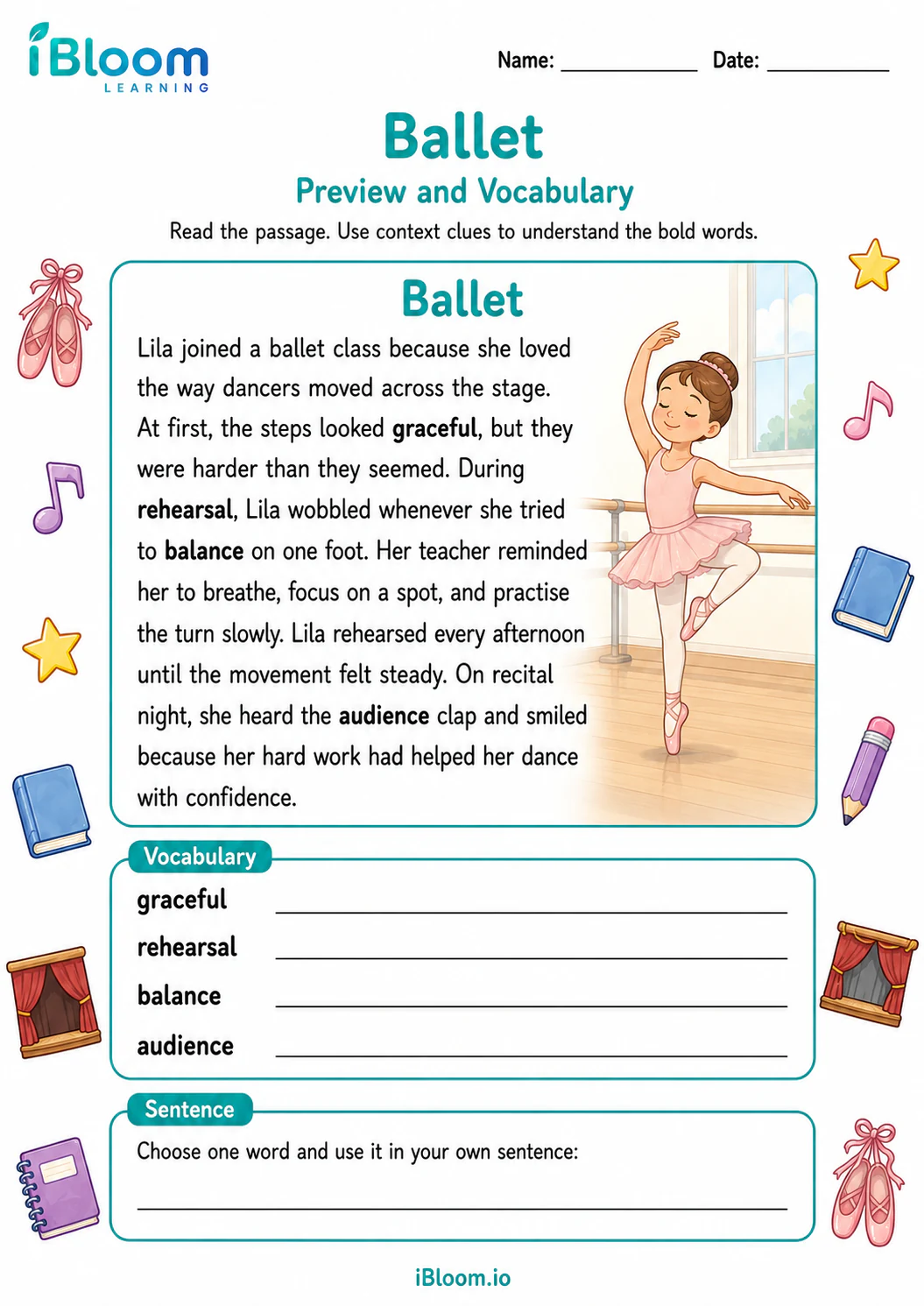
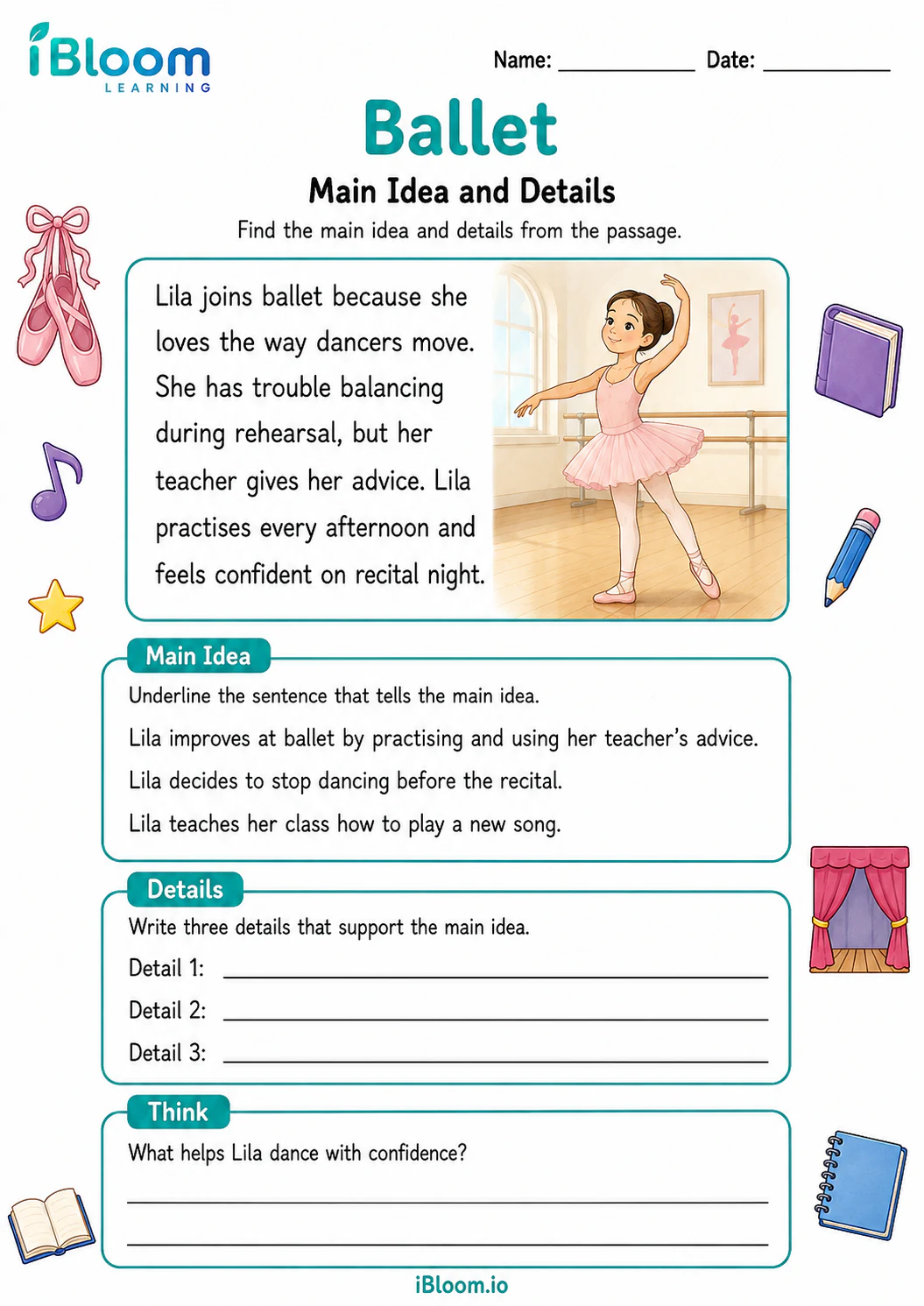
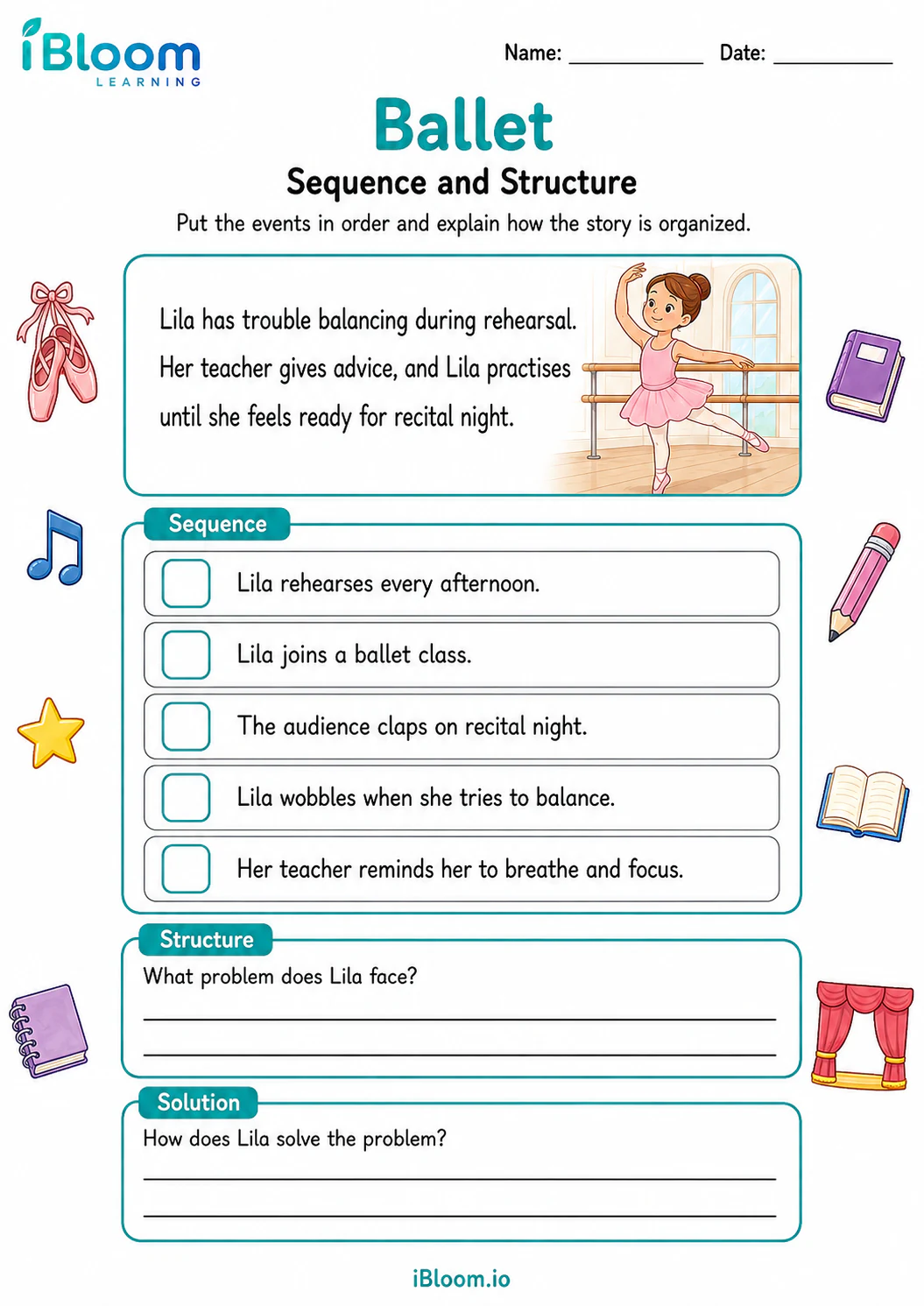
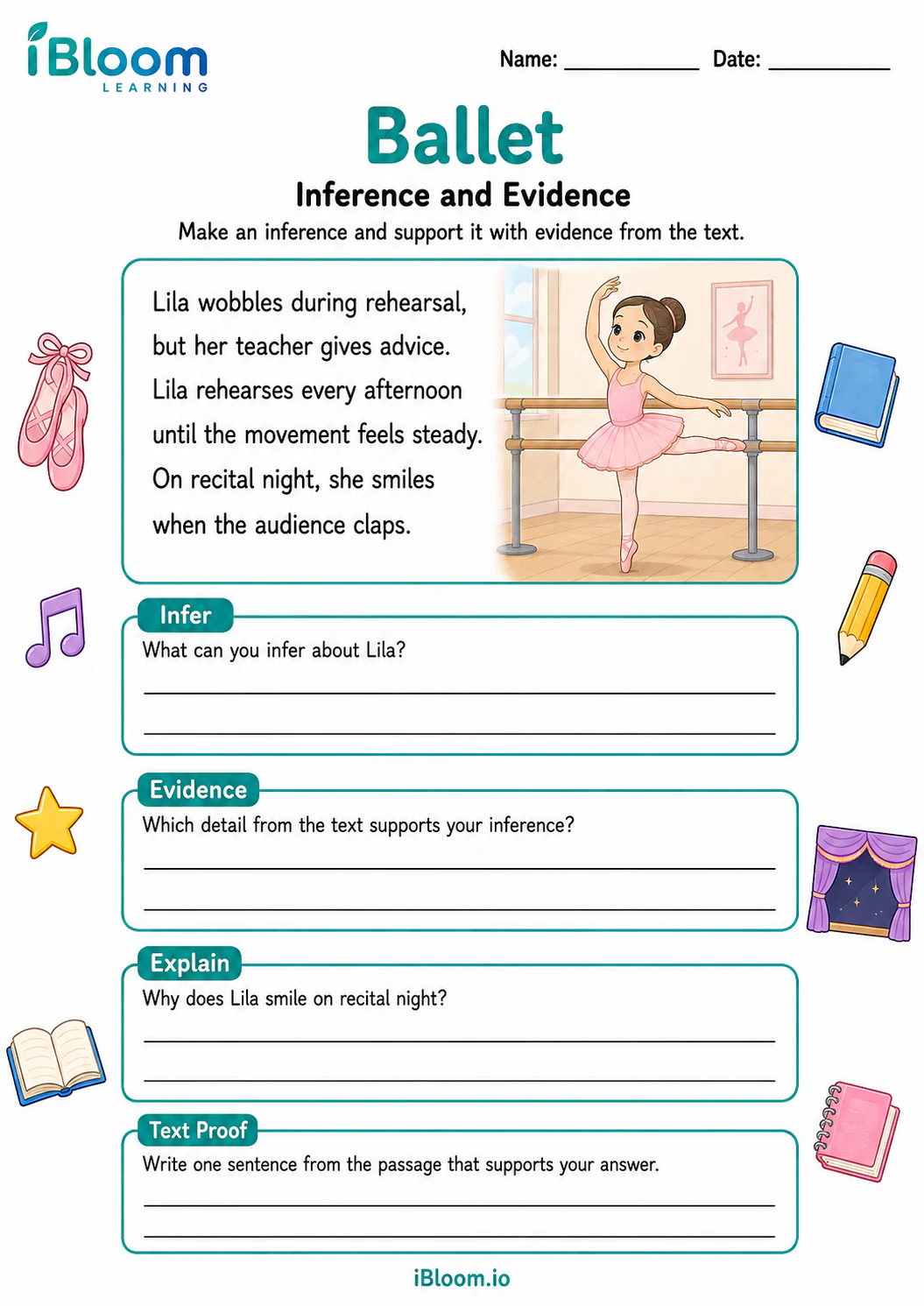
This Grade 4 reading worksheet uses an original ballet story about Lila learning to balance during rehearsal. Students answer detail and vocabulary questions, then write four responses using evidence from the story. The passage follows Lila from early wobbling to a successful recital pose. It practices CCSS RL.4.1 and RL.4.2, and includes a separate key with sample responses.
Aligned to CCSS.ELA-LITERACY.RL.4.1 and CCSS.ELA-LITERACY.RL.4.2
Which details explain Lila’s challenge?
Lila wobbles because she holds her breath and looks down at her feet. The story then shows her practicing with a steady point and controlled breathing.
How does Lila change by recital night?
At first she remains uncertain and loses balance. After practicing each afternoon, she uses her teacher’s advice and holds the pose on recital night.
What lesson can a reader infer?
The story connects repeated practice with confidence. A supported response can mention Lila’s practice and the strategy she uses when she feels nervous.
Build a text-based response
- 1Read the story to follow Lila’s challenge.
- 2Mark the advice Ms. Chen gives.
- 3Find the moment that shows Lila’s response to wobbling.
- 4Answer in a complete sentence.
- 5Add a detail that supports the answer or lesson.
Story response checks
The mistake
Saying Lila improved without naming evidence.
The fix
Mention that she focused on a spot, breathed, and held her pose.
The mistake
Treating “reset” as leaving the dance.
The fix
In this story, she lowers her foot and tries the pose again.
The mistake
Giving a lesson unrelated to the events.
The fix
Connect the lesson to Lila’s steady practice and strategy.
Common Core alignment
The detail questions and final responses connect to these story-reading skills.
Use story details to explain events and infer the story’s lesson.
On this sheet: The questions ask learners to practice this standard.
Show the official wordingHide the official wording
Refer to details and examples in a text when explaining what the text says explicitly and when drawing inferences from the text.
Infer a theme from Lila’s experience and summarize her change.
On this sheet: The questions ask learners to practice this standard.
Show the official wordingHide the official wording
Determine a theme of a story, drama, or poem from details in the text; summarize the text.
What to practice next
Make more practice
Further reading
Questions parents and teachers ask
What happens in “The Quiet Count”?
Lila struggles to balance during ballet rehearsal. Her teacher suggests breathing, focusing on one steady point, and practicing slowly. Lila notices she was holding her breath and looking down, then uses the strategy during practice and holds her pose on recital night.
What reading skills does the page practice?
Students answer questions about story details, vocabulary, character response, and theme. Four written responses ask them to explain events and support ideas with details from Lila’s experience. The separate key offers sample answers, while another clear response can work if it matches the story.
How should students support a written answer?
Answer the question in a complete thought, then include a detail from the passage. For example, explain that Lila’s balance improved because she focused on a spot, breathed, and practiced. The detail shows how she used her teacher’s advice rather than merely stating that she changed.
What does “reset” mean in the story?
When Lila begins to wobble, she lowers her foot, resets, and tries the pose again. Here, reset means to begin the movement again after regaining her balance. Students can use the actions around the word to infer its meaning.
Is an answer key included?
Yes. The answer key gives direct answers for detail and vocabulary questions and sample responses for open-ended items. Treat the samples as models rather than the only possible wording. Accept another answer when it accurately describes the story and supports the idea with evidence.