
About this worksheet
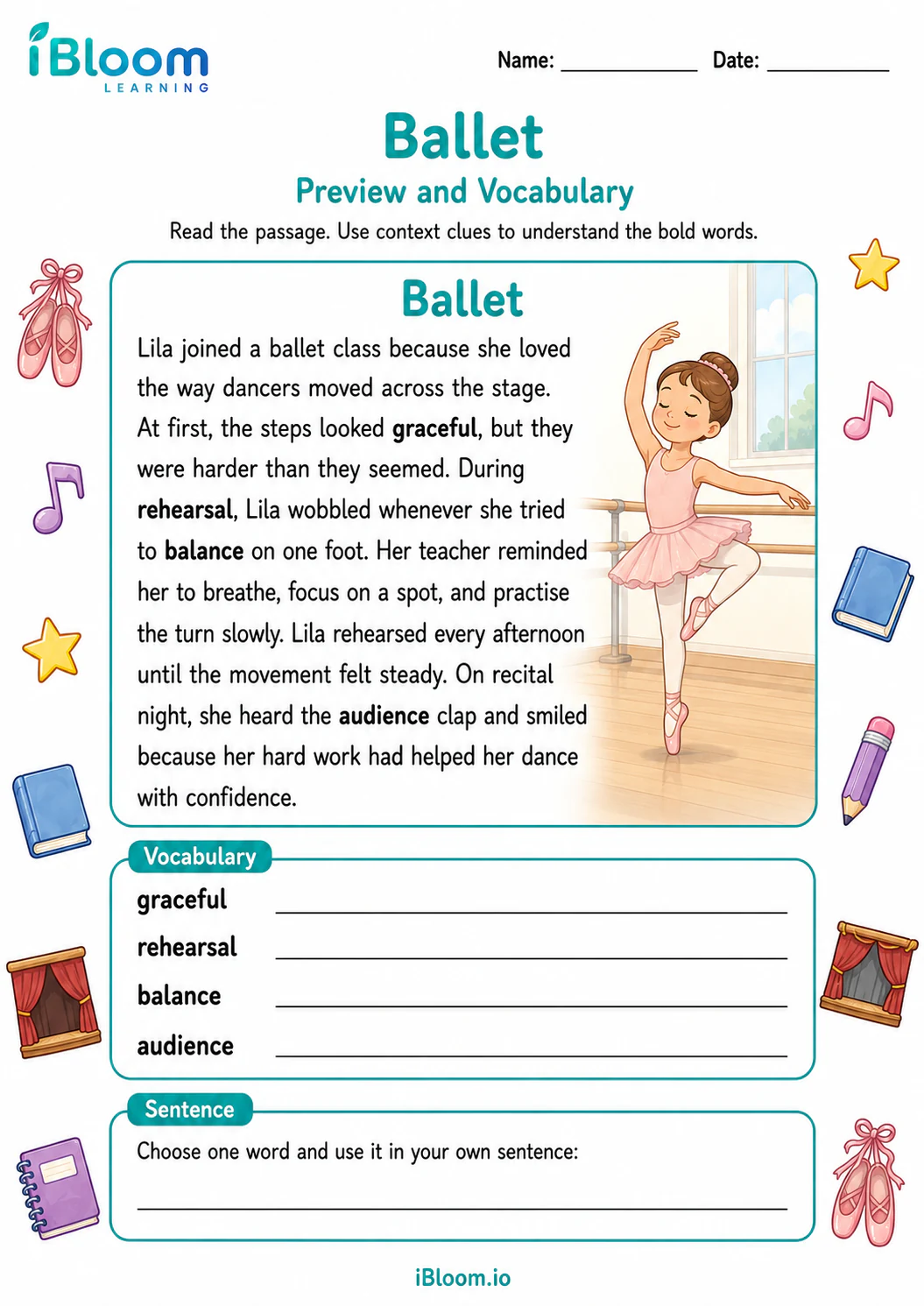
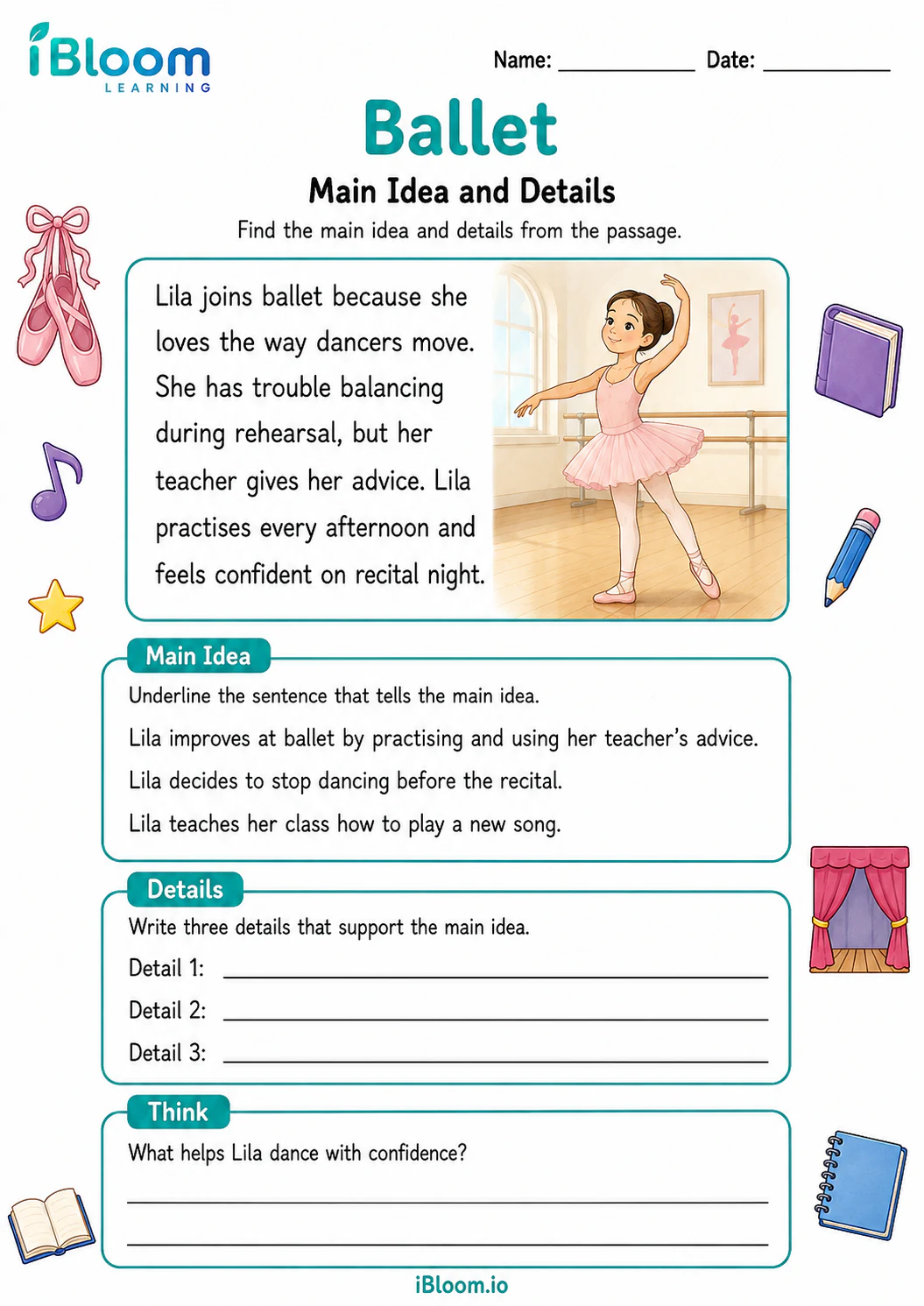
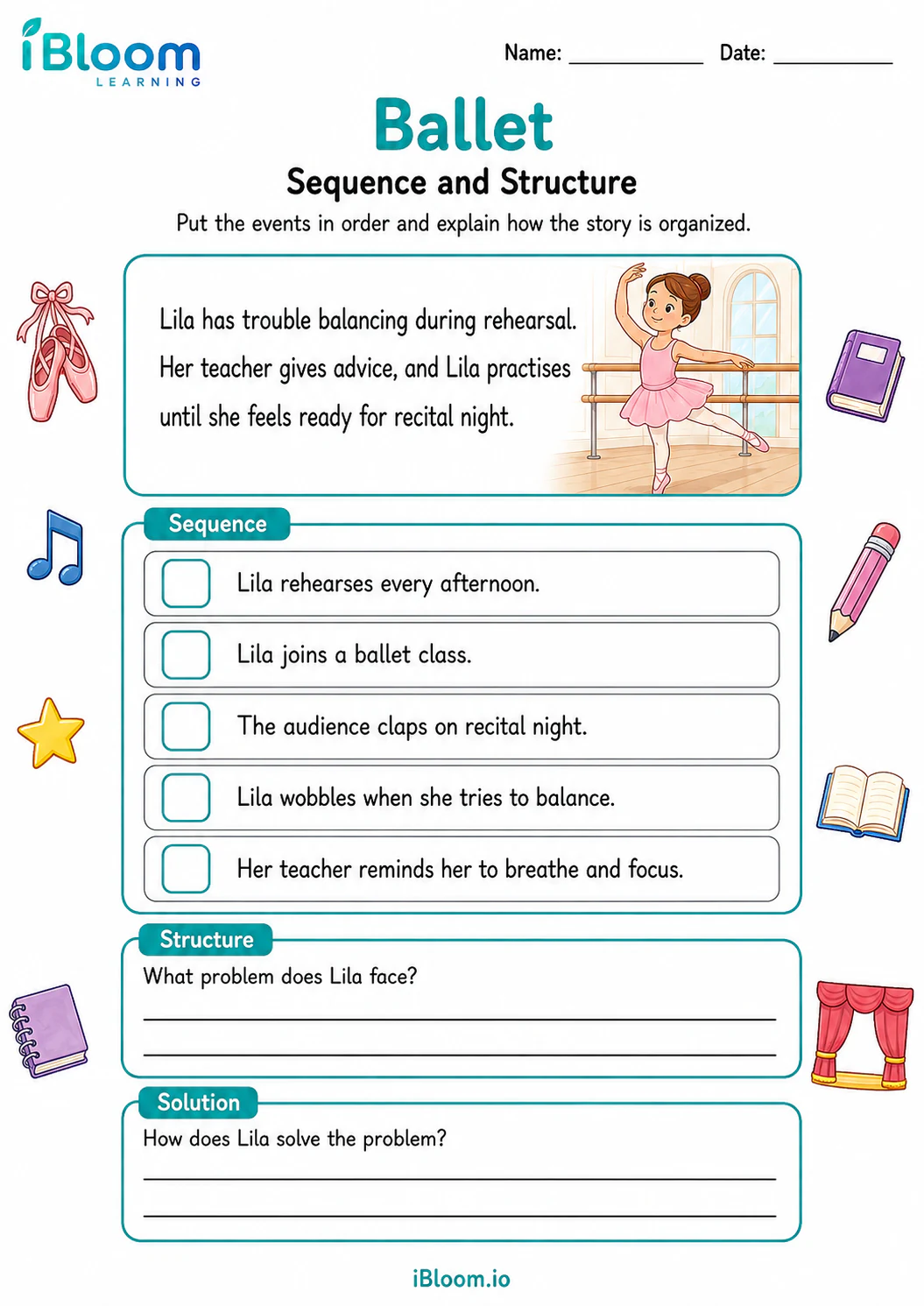
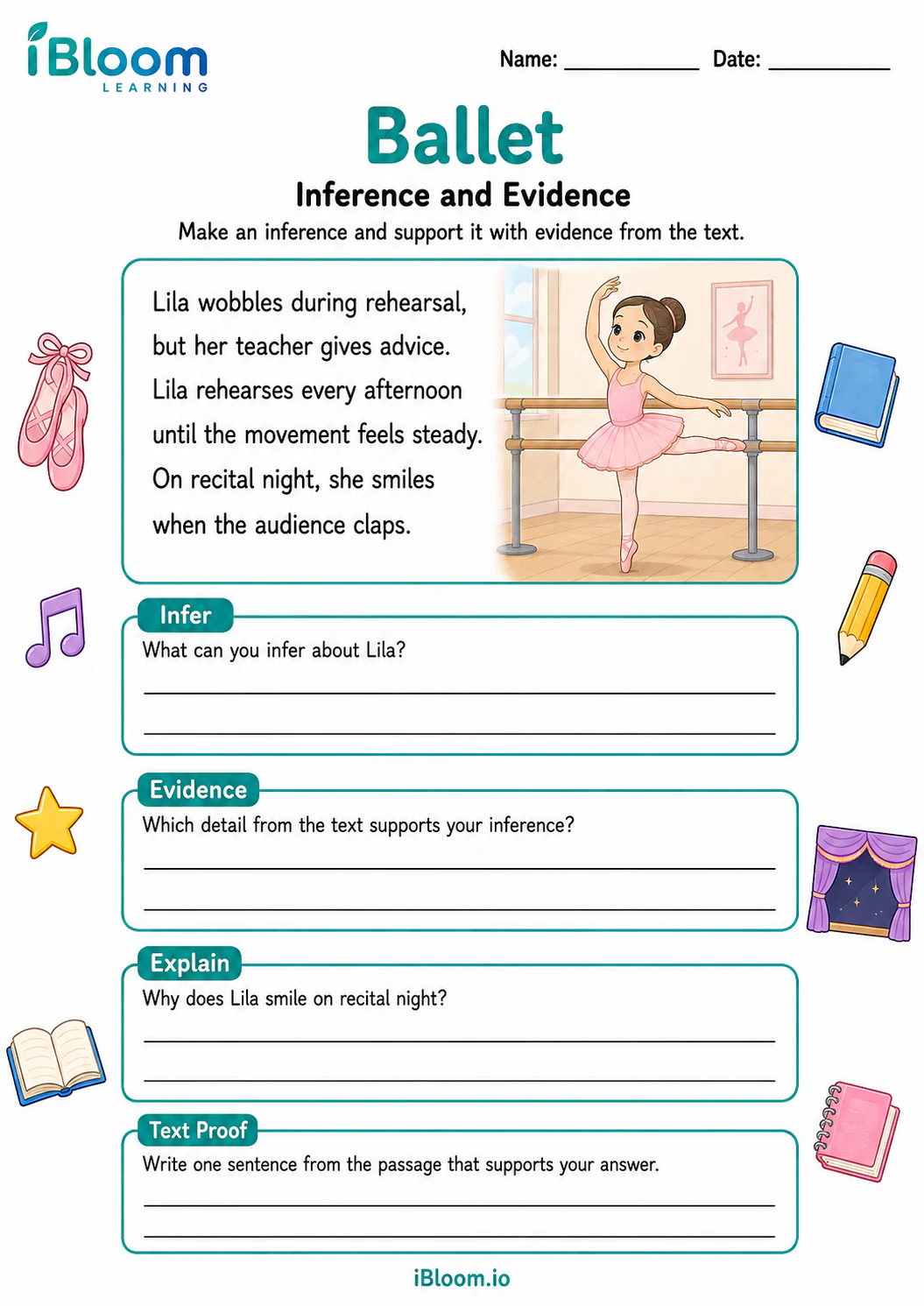
This free Grade 4 reading comprehension worksheet tells how Lila learns to balance in ballet class, practices her teacher’s advice, and uses it during a recital. The complete original passage appears in Part A. Part B has eight multiple-choice questions about details, sequence, word meaning, inference, character change, and a lesson. Part C asks children to support a theme and write a summary. The work practices Common Core RL.4.1 and RL.4.2. The separate answer key includes selected choices and sample responses, allowing children to explain the passage in their own words.
Aligned to RL.4.1 and RL.4.2
What happens in the Ballet passage?
Lila struggles to balance at her first class. Ms. Chen suggests choosing a fixed spot at eye level, and Lila practices with a blue tile as her focus. At the recital, she uses a painted star in the same way and finishes her balance.
This sequence gives children concrete events to track: a difficulty, useful advice, repeated practice, and a successful performance. The final sentence adds a more subtle idea: Lila can feel nervous and still trust what she has learned.
Which details support Lila’s improvement?
Question 7 asks for two details from the practice week. Children should find the two balance counts and connect them: she holds the position for three counts on Monday and eight by Friday. Those numbers provide specific evidence of progress.
The reversed choice, eight counts on Monday and three on Friday, would describe a decline. Ask the child to reread the third paragraph and check the order of the two numbers.
- 1Monday: Lila balances for three counts.
- 2Friday: Lila balances for eight counts.
- 3Holding the position longer shows that her balance improves.
How are a theme and a summary different here?
A theme expresses a lesson, such as “Practice builds skill.” Question 9 asks the reader to connect that lesson to an event. Lila’s daily practice and increasing balance counts provide a clear link between effort and improvement.
A summary recounts the central events. For question 10, include Lila’s balance problem, her use of advice and practice, and her successful recital balance. The color of the tile and the shape on the wall help the story feel specific, but the summary can focus on the larger sequence.
How to use this worksheet
- 1Read Part A once to follow Lila’s experience from class to recital.
- 2Reread the passage and locate the teacher’s advice, practice details, and final comment.
- 3Answer Part B, checking each choice against the passage.
- 4For Part C, find the details that support each answer before writing.
- 5Compare responses with the key, accepting accurate paraphrases and other supported examples.
Mistakes to discuss and fix
The mistake
Saying Lila stops feeling nervous at the end.
The fix
Reread her final words: she is still nervous, but she knows what to do.
The mistake
Giving “ballet” as the theme.
The fix
Turn the topic into a lesson supported by events, such as “Practice builds skill.”
The mistake
Listing tiny details without summarizing the problem and result.
The fix
Use three anchors: balancing difficulty, advice and practice, successful recital balance.
Common Core alignment
Use details from Lila’s practice and recital to explain events and infer how she feels.
On this sheet: Questions ask for explicit details, inferences about nervousness and confidence, and supporting examples.
Show the official wordingHide the official wording
Refer to details and examples in a text when explaining what the text says explicitly and when drawing inferences from the text.
Support a lesson about practice and summarize Lila’s problem, actions, and result.
On this sheet: Questions 6 and 9 address theme, and question 10 asks for a summary.
Show the official wordingHide the official wording
Determine a theme of a story, drama, or poem from details in the text; summarize the text.
What to practice next
Make more practice
Further reading
Questions parents and teachers ask
Is the complete story included?
Yes, Part A contains the complete original passage about Lila, her teacher Ms. Chen, and a ballet recital. Children can refer to it while answering all ten questions. The passage supplies the vocabulary clue for audience and the practice details needed for the written evidence questions.
What reading skills do the questions practice?
The questions combine details, sequence, vocabulary in context, inference, character change, theme, and summary. Eight multiple-choice items lead into two written responses. Children identify information, track Lila’s progress, and then explain a lesson using evidence and summarize the passage in their own words.
What does the story mean by audience?
Audience means the people watching a performance. The recital paragraph explains that the audience is waiting to watch, so children can infer the meaning from nearby words. Ask them to point to that clue before choosing an answer in question 2, then reread the sentence with the definition.
What evidence supports the theme in question 9?
Accept an event that supports the given lesson, “Practice builds skill.” Lila practices daily and increases her balance from three counts to eight. Her successful recital balance also works if the child connects it to practice. Different wording is fine, but the answer should explain how the event supports that lesson.
What should the final summary include?
The summary should include Lila’s difficulty balancing, her use of advice and daily practice, and her successful balance at the recital. Children can write those events in their own words. Check that they preserve the order and the connection between practice and the result, rather than copying every detail.