
About this worksheet
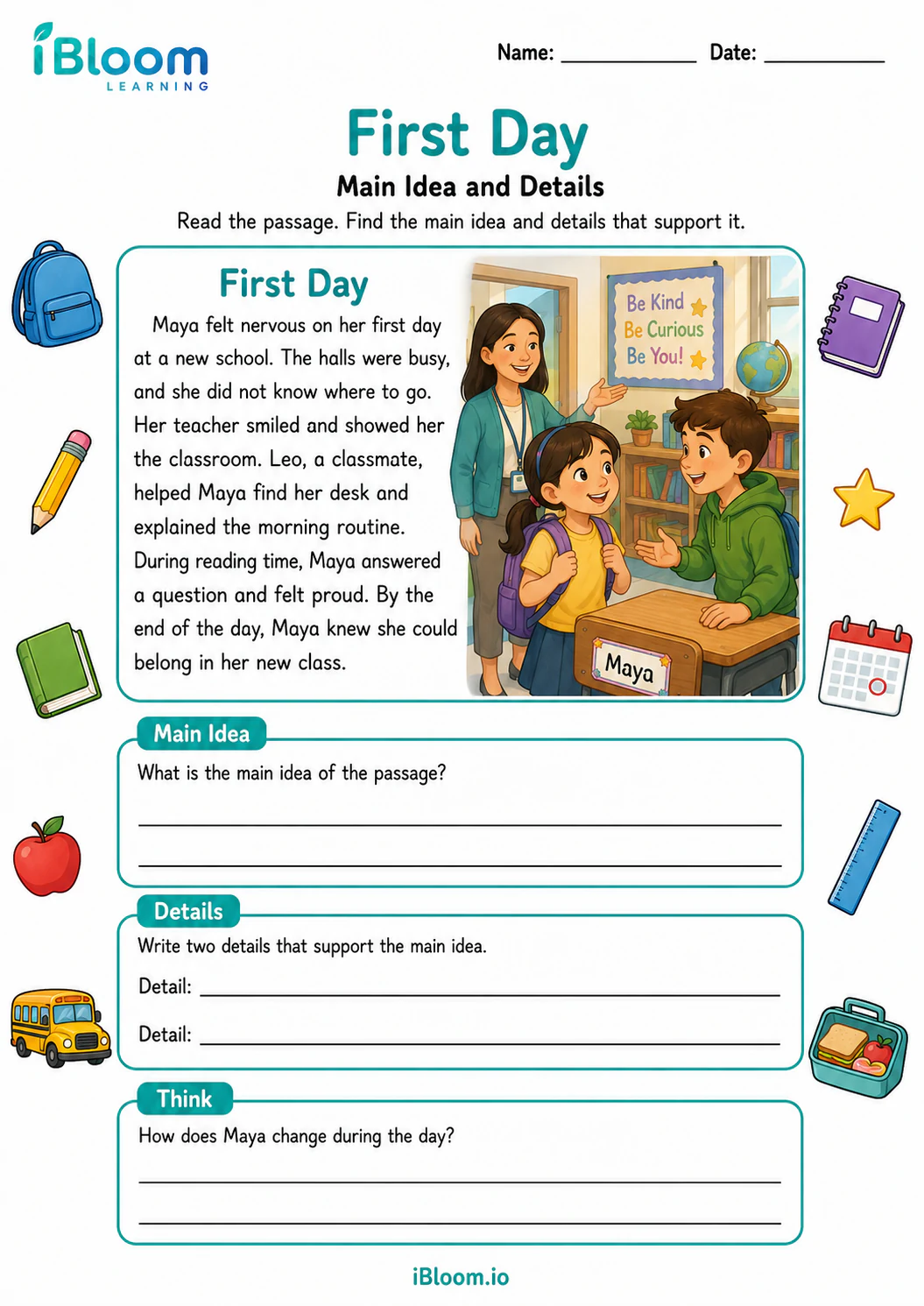
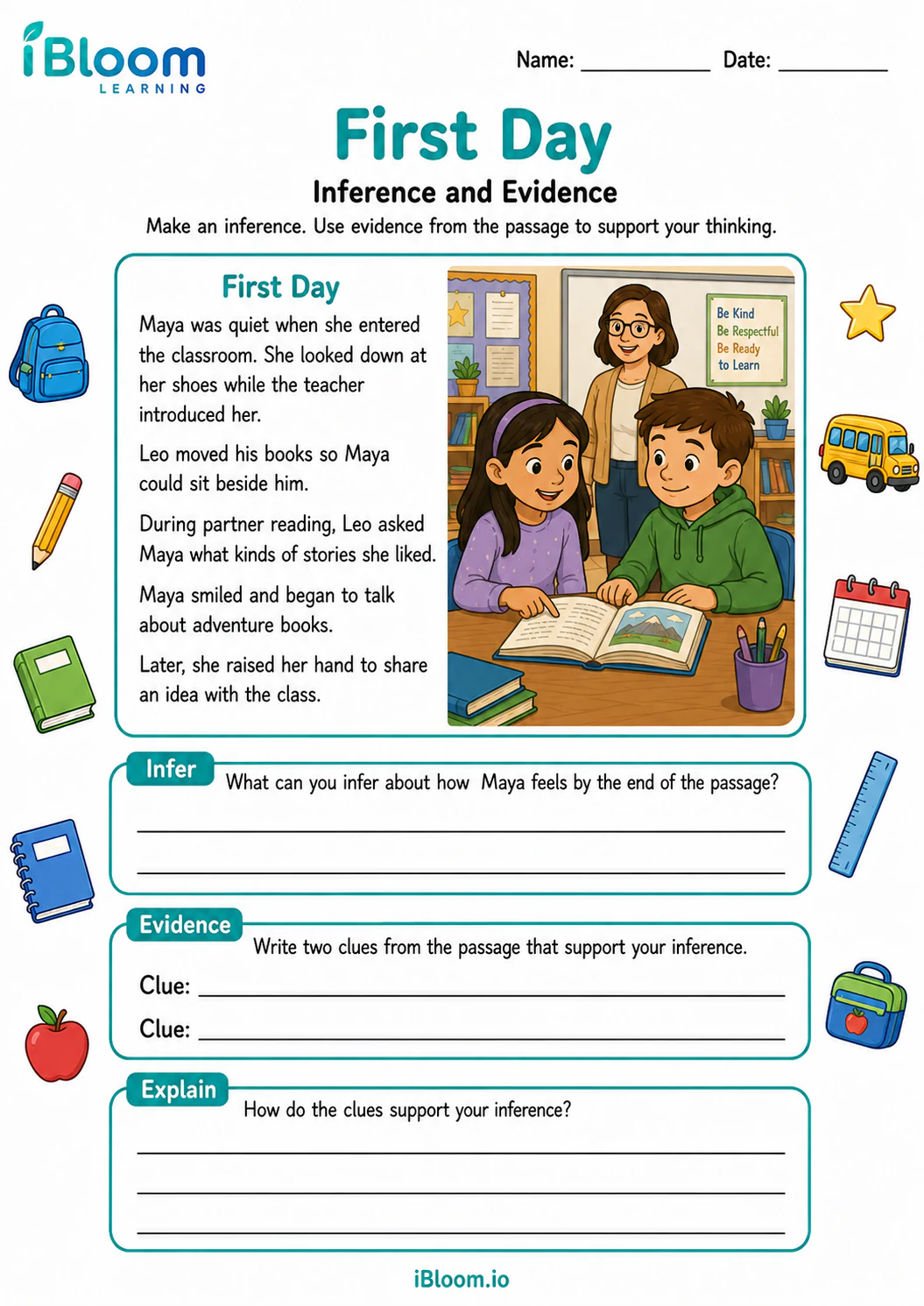
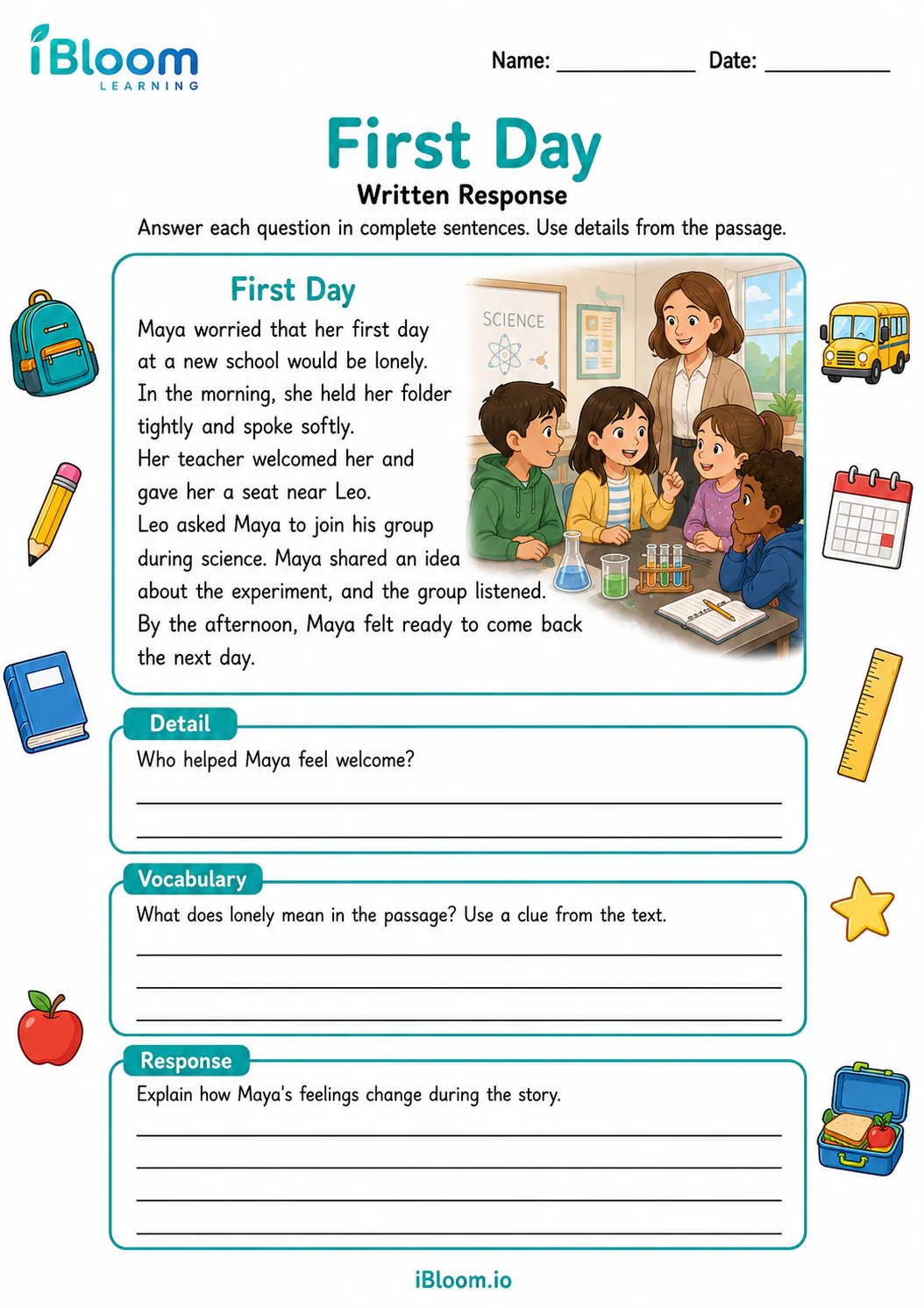
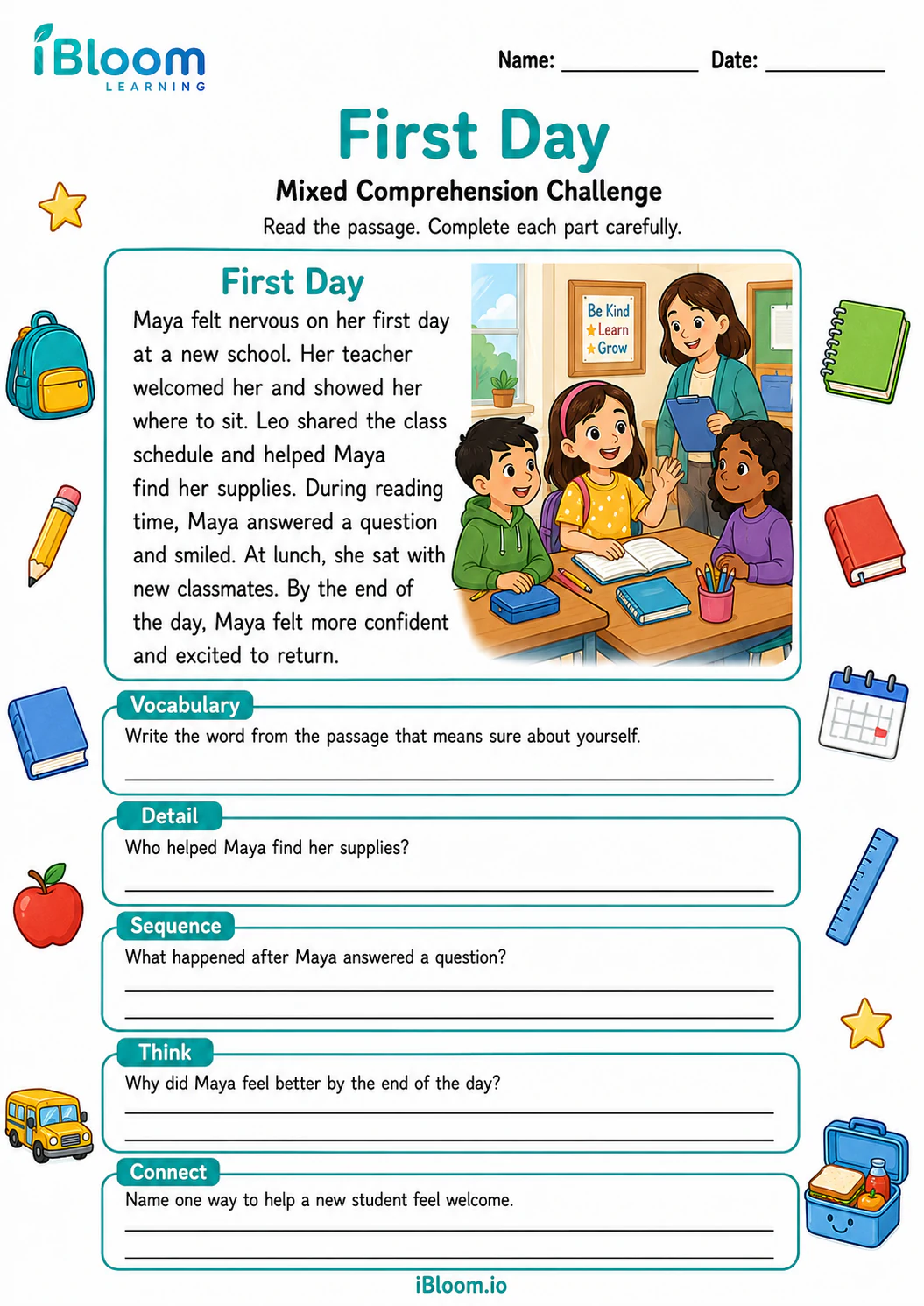
This free Grade 4 reading worksheet pairs First Day with eight questions about its opening and vocabulary. Maya arrives at a new school feeling unsure; a warm welcome from her teacher and help from Leo make the day easier. Part A presents the passage. Part B asks readers to examine the opening before reading on. Part C asks for four word meanings in context. Part D asks for a supporting detail and an original sentence using a vocabulary word. The context-clue work practices Common Core L.4.4a. A separate answer key includes sample written responses.
Aligned to L.4.4a
How should readers begin this worksheet?
Read the title and first two sentences of Part A, then answer the two opening questions in Part B. Identify Maya’s situation and choose a question to keep in mind. Read the rest of the story before beginning Part C.
The passage remains available while children answer. Ask them to connect a meaning to a specific detail instead of guessing from the word alone.
Which details help explain the vocabulary?
The passage explains unfamiliar through the hallway and classmates Maya does not know. Paper, pencils, and an eraser are examples of supplies. Maya’s growing belief that she can manage the day explains confident. The list of activity times explains schedule.
- 1Maya carries paper, pencils, and an eraser.
- 2These are things she needs for schoolwork.
- 3Supplies means things needed for a task.
How do children use a vocabulary word themselves?
Part D first asks for a story detail that explains Maya’s confidence. The teacher’s warm greeting is a clear example. Then children choose one of the four words and write a new sentence that shows its meaning.
For example, “Our schedule says art starts after lunch” uses schedule as a plan of activities and times. Accept other sentences when the chosen word fits the meaning used in First Day.
How to use this worksheet
- 1Read the title and first two sentences, then complete Part B.
- 2Read the whole story and look for examples or explanations near each vocabulary word.
- 3Write the four meanings in Part C in your own words.
- 4Use a story detail for question 7 and write a new sentence for question 8.
- 5Compare ideas with the sample key; accept accurate wording that differs from the examples.
Mistakes to notice and fix
The mistake
Calling unfamiliar a feeling such as scared.
The fix
Maya may feel nervous, but unfamiliar describes what she does not know or recognize.
The mistake
Saying a schedule is a list of school supplies.
The fix
Look for the activity times. Supplies are the materials; a schedule tells when things happen.
The mistake
Writing “I have supplies” without showing the word’s meaning.
The fix
Add an example: “I packed pencils and paper with my art supplies.”
Common Core alignment
Use details in First Day to work out unfamiliar words and phrases.
On this sheet: Students infer four word meanings from definitions and examples and explain a supporting story detail.
Show the official wordingHide the official wording
Use context (e.g., definitions, examples, or restatements in text) as a clue to the meaning of a word or phrase.
What to practice next
Make more practice
Further reading
Questions parents and teachers ask
When should my child answer the opening questions?
Answer Part B after reading the title and first two sentences, before continuing with the story. The first question identifies Maya’s situation, and the second identifies a useful question to keep in mind. Then read the entire passage and use it to answer Parts C and D.
Which four vocabulary words are included?
The words are unfamiliar, supplies, confident, and schedule. Each appears in Maya’s first-day story with examples or an explanation nearby. Children write a short meaning for each word, explain a detail about Maya’s confidence, and use one vocabulary word in a new sentence.
What helps Maya feel more confident?
Her teacher’s warm greeting helps Maya believe she can manage the day. Leo also welcomes her, shares the class schedule, and helps her find a page. In question 7, children should name a detail from the story that explains her growing confidence.
Must the written answers match the key exactly?
No, accurate wording can differ from the sample key. Accept meanings that fit the passage, such as “things needed for school” for supplies. For the final sentence, check that the chosen vocabulary word makes sense and that the sentence gives enough context to show its meaning.
Is an answer key included for all eight questions?
Yes, the key marks both opening choices and provides samples for the six written answers. The final sentence is one possible response, so children can write something different. Ask your child to explain which words in their sentence help a reader understand the vocabulary word.