

About this worksheet
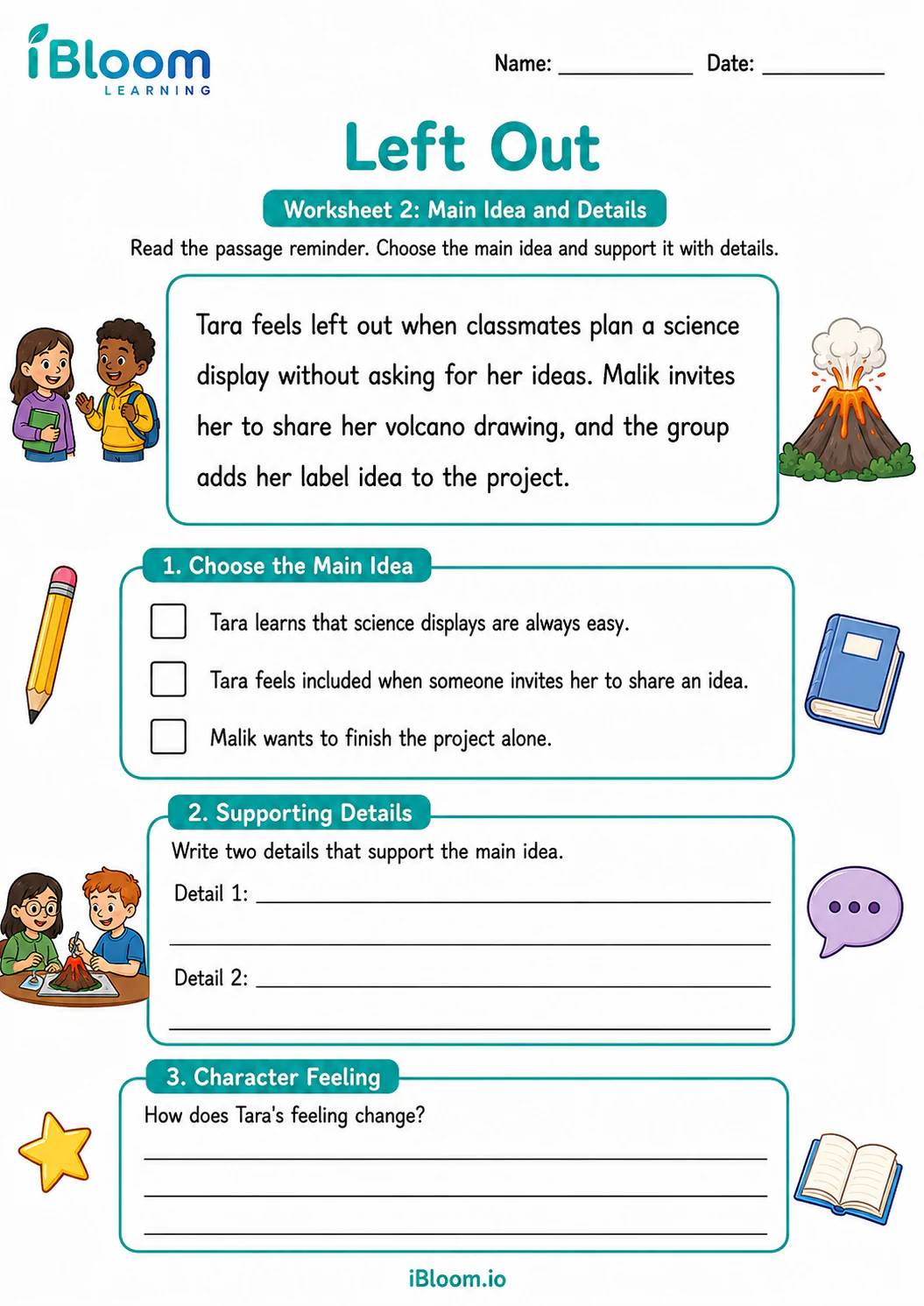
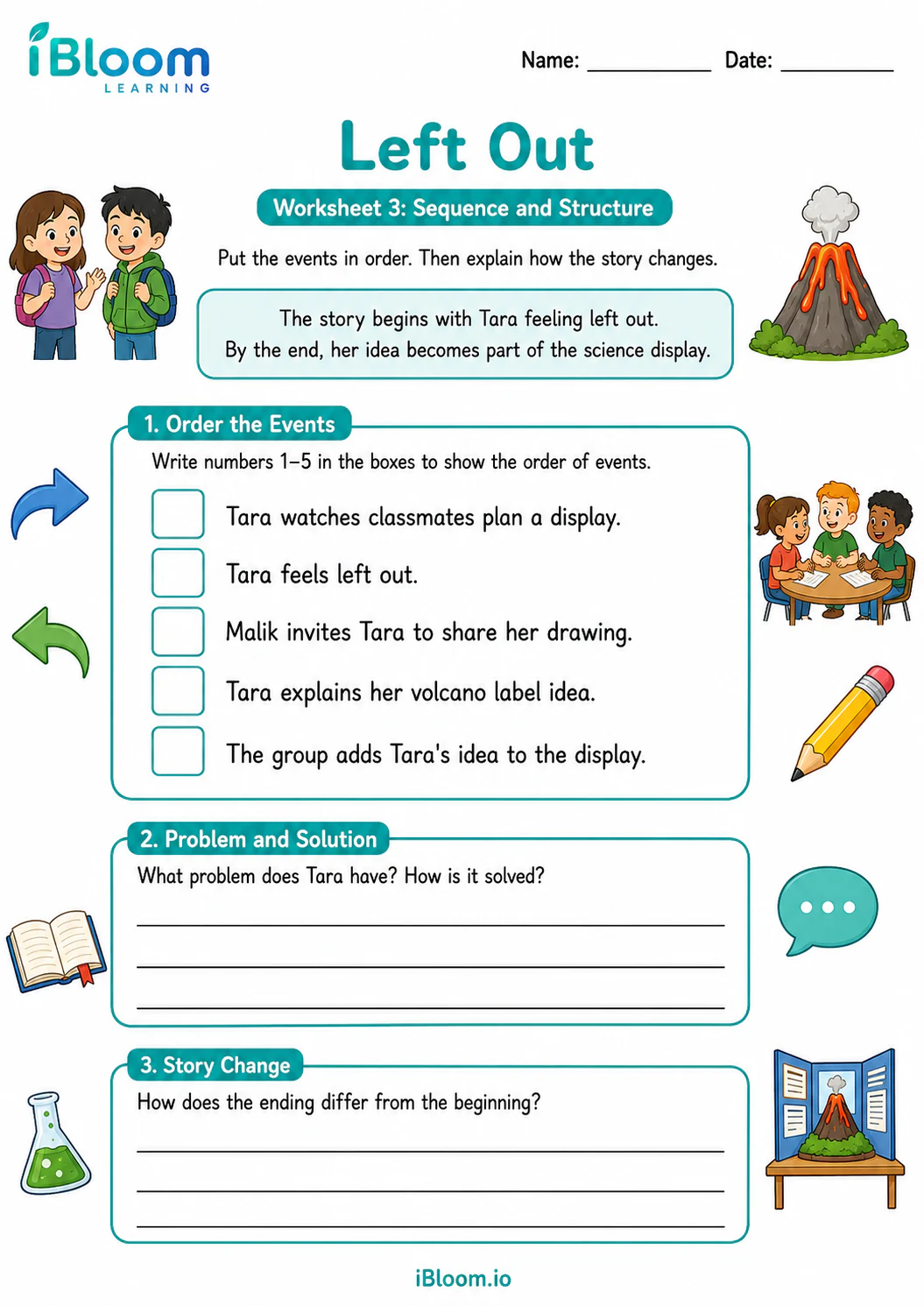
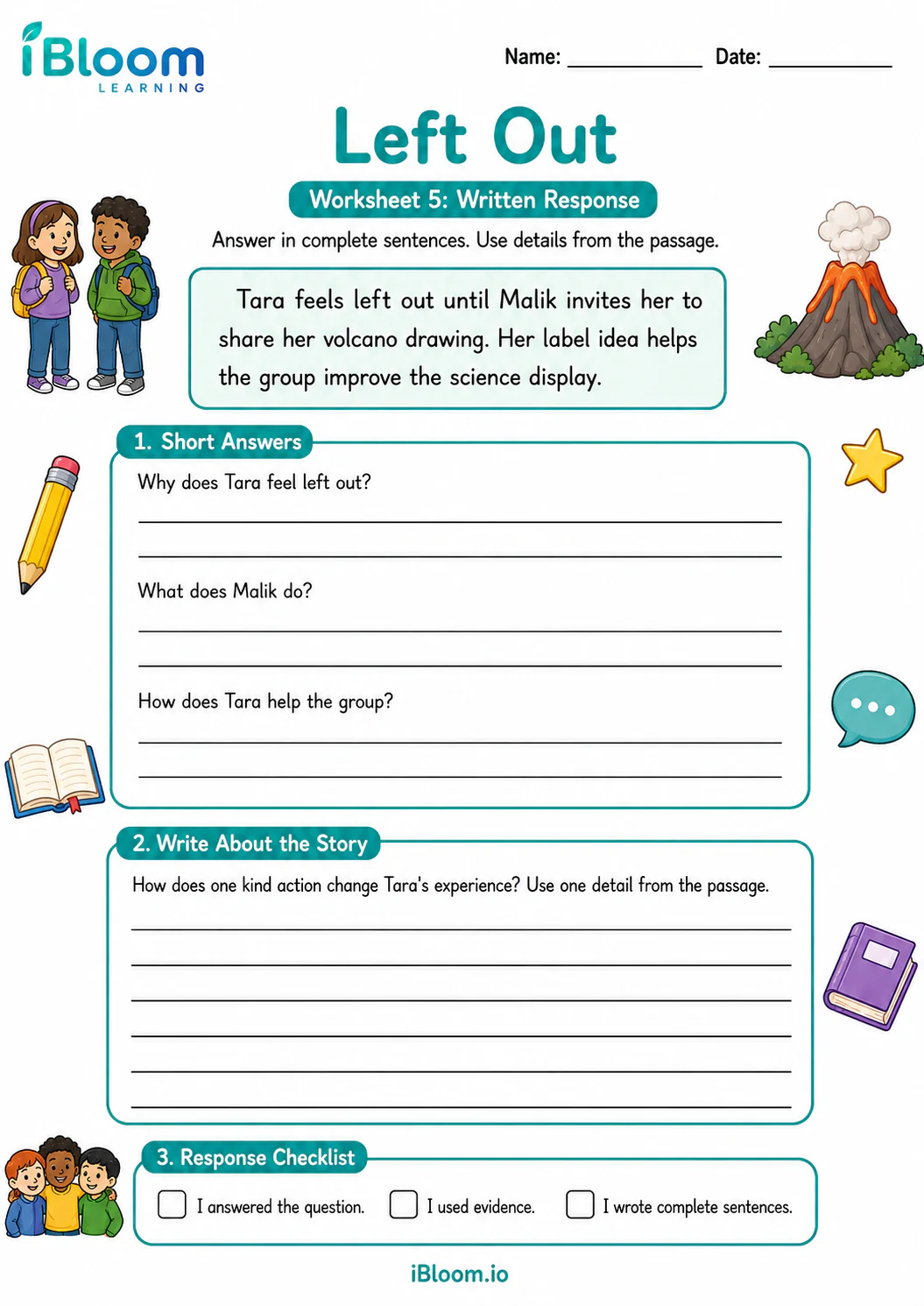
“Left Out” is an original Grade 4 story about Tara contributing to a volcano science display. This three-page worksheet pairs the passage with 14 questions on context-clue vocabulary, explicit details, and inferences. Children select answers using story evidence, and a separate key provides the correct choices. The work aligns with Common Core reading and vocabulary standards.
Aligned to RL.4.1 and L.4.4.a
How does context help with vocabulary?
A nearby sentence can give clues to an unfamiliar word. In the story, the classmates are planning a science display without asking Tara for her ideas. That helps explain why she feels left out: she feels not included.
For question 1, compare “not included” with the other choices. It matches what is happening to Tara at the back table.
- 1Tara sees that the group is planning without her.
- 2She feels left out.
- 3Left out means not included.
How do details answer reading questions?
Find the sentence that tells what happened, then answer in your own words. Malik notices Tara sitting alone and invites her to explain her volcano drawing. Tara suggests labels for the layers, and the group adds them to the display. Those details show how she joined in.
What can readers infer about Tara?
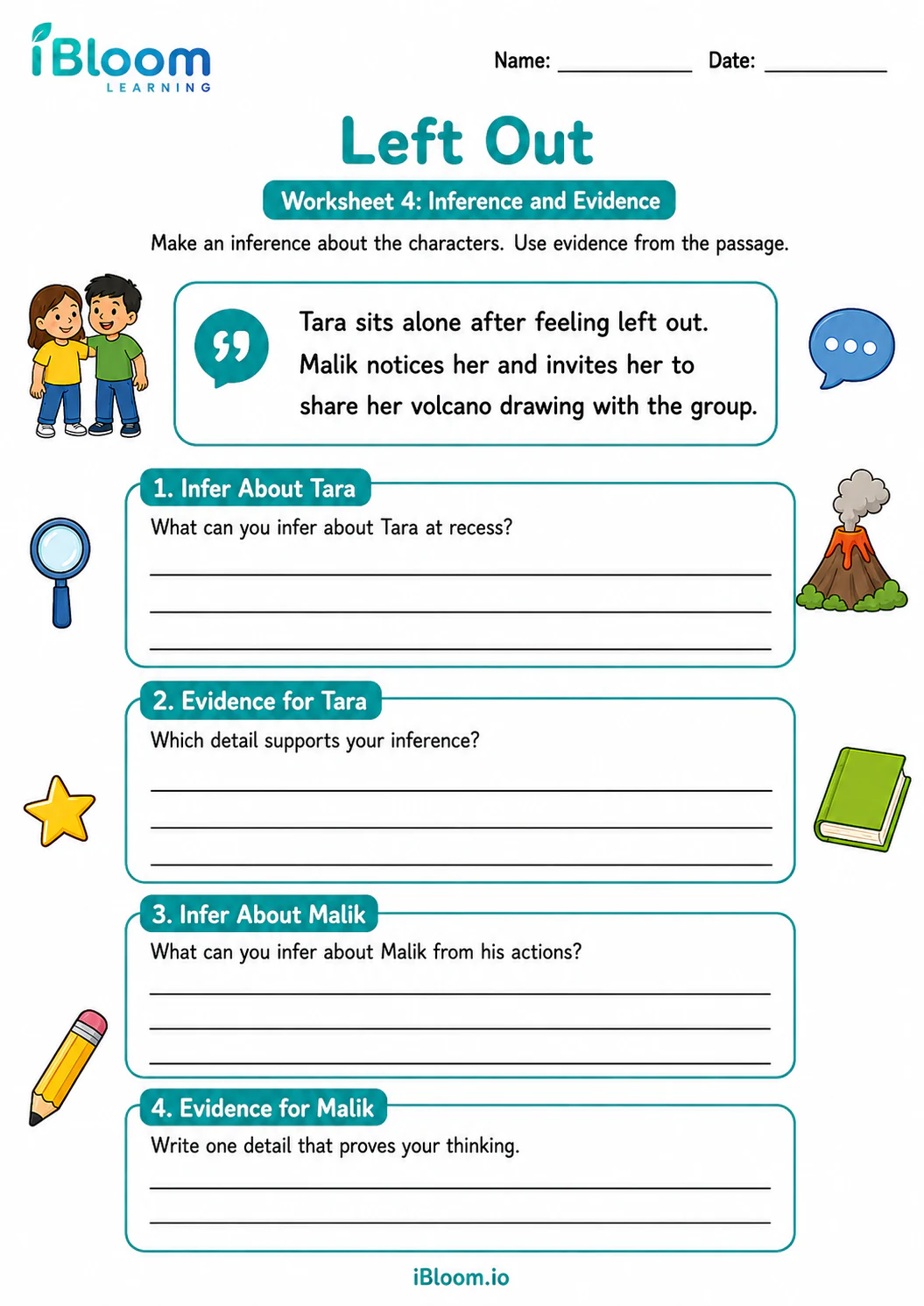
An inference combines a clue from the story with what the reader knows. Tara explains a way to label the volcano’s layers, and the classmates add her labels to the display. Those actions support an inference that she is thoughtful and helpful. The final questions ask children to cite such clues.
What is included in this worksheet?
The “Left Out” story about Tara and a volcano display is followed by 14 questions: context-clue vocabulary, explicit details, and inferences. The answer key lists the correct choice for each question.
How to use this worksheet at home or in class
- 1Read the story once to follow what happens to Tara.
- 2For vocabulary, reread the sentence and the lines around the word.
- 3Find a story detail before answering an explicit question.
- 4For an inference, connect an action or thought with what it suggests.
- 5Use the answer key to check that selected responses match details in the text.
Common mistakes and quick fixes
The mistake
Choosing a dictionary-like meaning that does not fit the scene.
The fix
Reread the nearby sentence and test each meaning against what is happening.
The mistake
Answering from a guess instead of a detail in the story.
The fix
Point to a sentence that supports the answer before writing it.
The mistake
Retelling the whole story for a question about one event.
The fix
Answer the question directly, then add one relevant detail.
Common Core alignment
This page connects the printed practice to the grade-level skills named below.
Answer explicit and inferential questions with story details.
On this sheet: Answer explicit and inferential questions with story details.
Show the official wordingHide the official wording
Refer to details and examples in a text when explaining what the text says explicitly and when drawing inferences from the text.
Use sentence context to infer the meaning of story vocabulary.
On this sheet: Use sentence context to infer the meaning of story vocabulary.
Show the official wordingHide the official wording
Use context (e.g., definitions, examples, or restatements in text) as a clue to the meaning of a word or phrase.
What to practice next
Make more practice
Further reading
Questions parents and teachers ask
What does “left out” mean in this story?
It means not included. Her classmates are planning a science display without asking for her idea. The story later shows how she joins by suggesting labels for the volcano’s layers. Question 1 asks children to use that context to choose the meaning. The answer key explains why the choice fits the scene.
How many questions are on the worksheet?
There are 14 questions following the story: four context-clue vocabulary choices and ten detail or inference choices. The story and questions span three worksheet pages, with an answer key on a separate page. Children can check the passage again while reviewing their choices.
How should my child answer an inference question?
An inference should connect a clue in the story to an idea that is not stated word for word. For example, Tara suggests labels for the volcano layers, which supports the idea that she is thoughtful. Encourage your child to name the clue as part of the answer.
Must an answer match the key word for word?
No. The key lists the correct choices and helps readers check each response against the passage. A strong response answers the question and uses a detail from the story. For question 11, a child might infer that Tara feels included and point to the classmates adding her idea.
What vocabulary does this sheet practice?
The four vocabulary questions ask children to infer meanings from context, including left out, invited, included, and clever. The answer choices are tied to what happens in the volcano science display so learners can test a meaning against the story. The key names the intended meaning for each word.