

About this worksheet
This Grade 4 reading worksheet introduces Ben’s first skateboard practice through an original story that keeps the established characters and sequence. Learners use context clues for five words, answer six detail questions, and explain four details or inferences in writing. The answer key gives clear choices and sample responses. The questions practice Common Core RL.4.1 and L.4.4.a.
Aligned to RL.4.1 and L.4.4.a
What happens in Ben’s skateboard story?
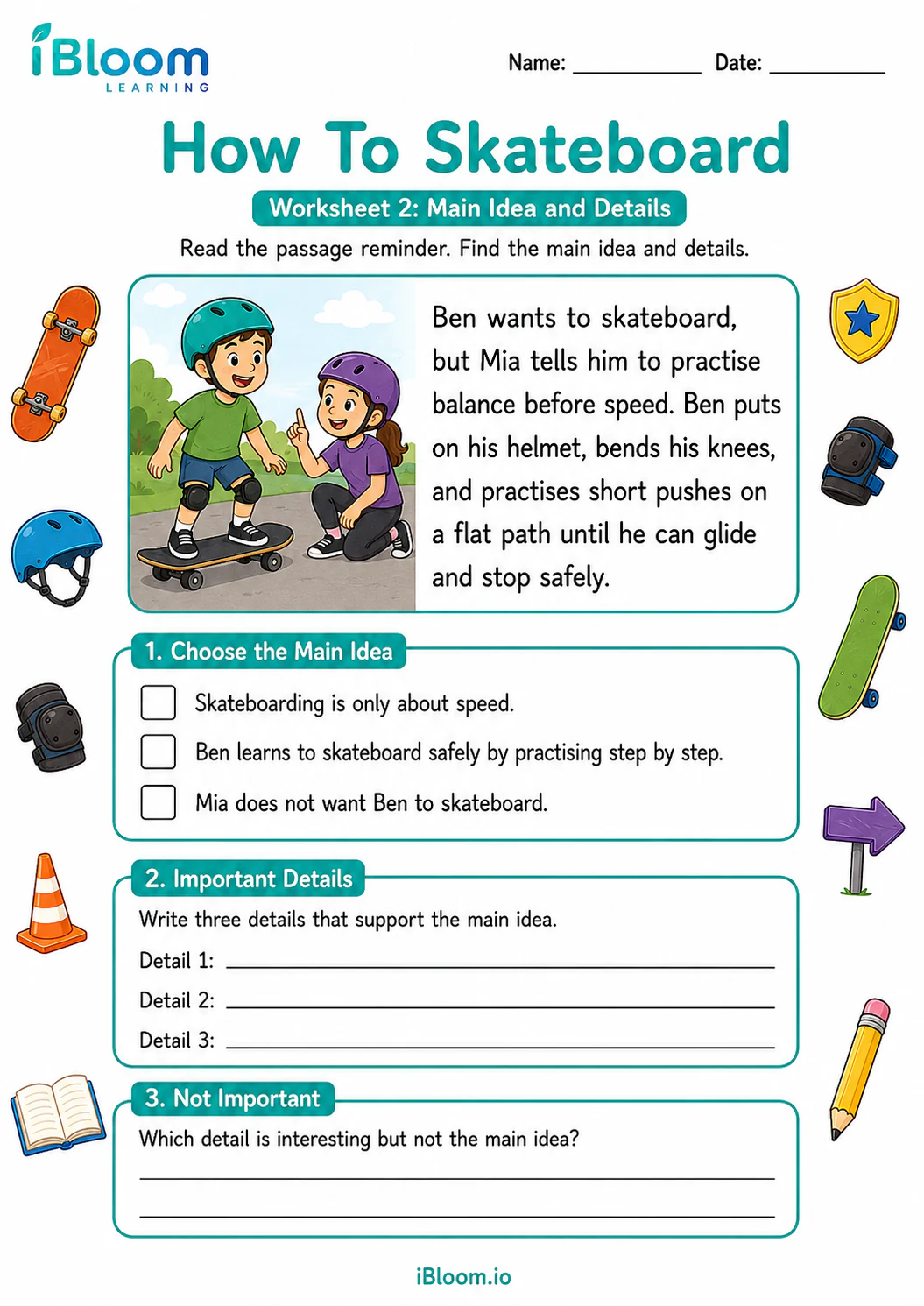
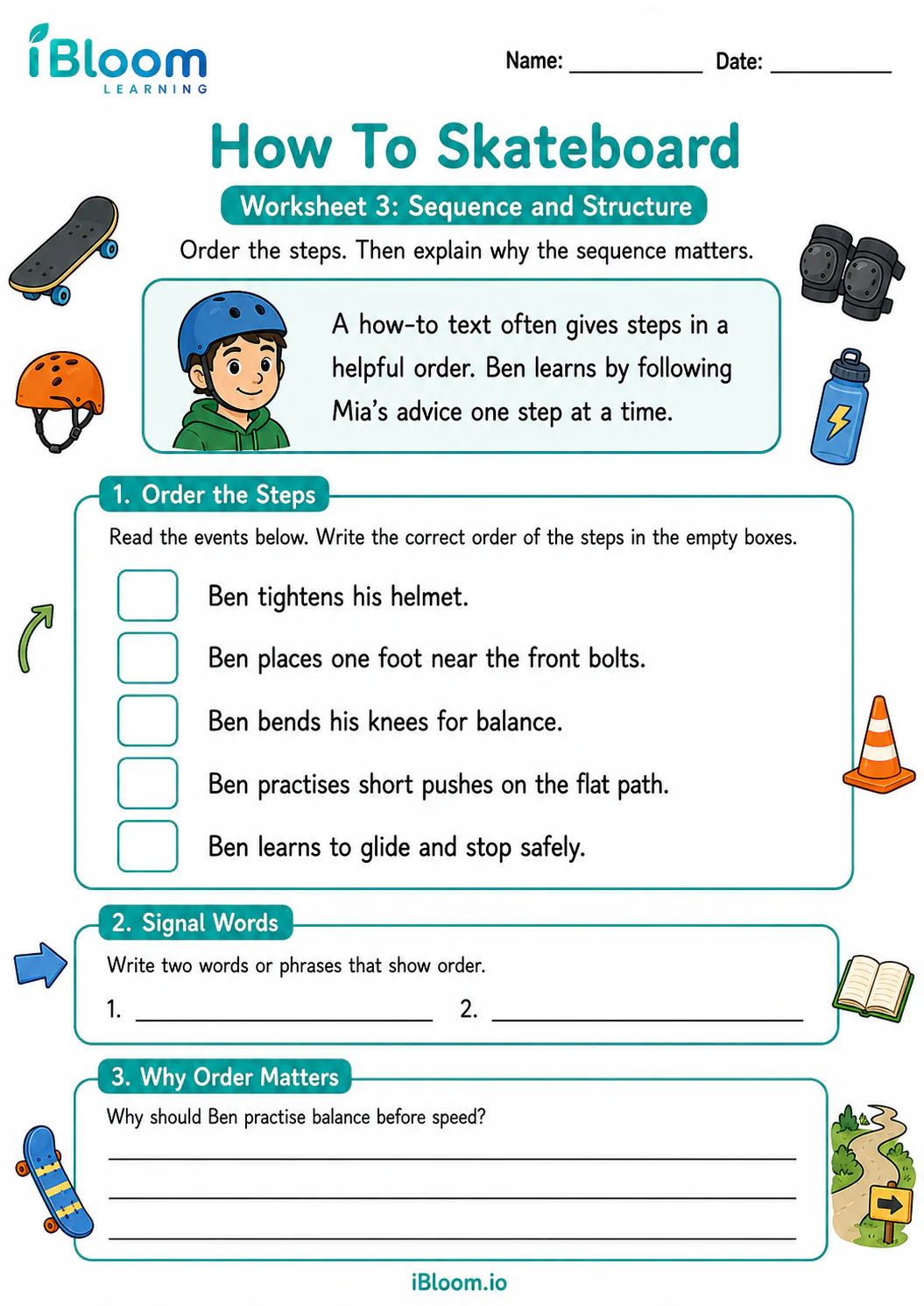
Ben starts on a flat path with his helmet secured and knees bent. His cousin Mia reminds him to practice balance before speed. He wobbles, makes short pushes, shifts his weight when the board veers, then learns to glide and stop safely. The questions follow those events.
How can context explain a new word?
Look at the sentence around the target word. The passage explains balance as staying steady and wobbled as rocking from side to side. Part B includes five words with nearby clues.
- 1“At first, Ben wobbled. The board rocked from side to side…”
- 2The second sentence explains that wobbled means “rocked from side to side.”
Which details support an answer?
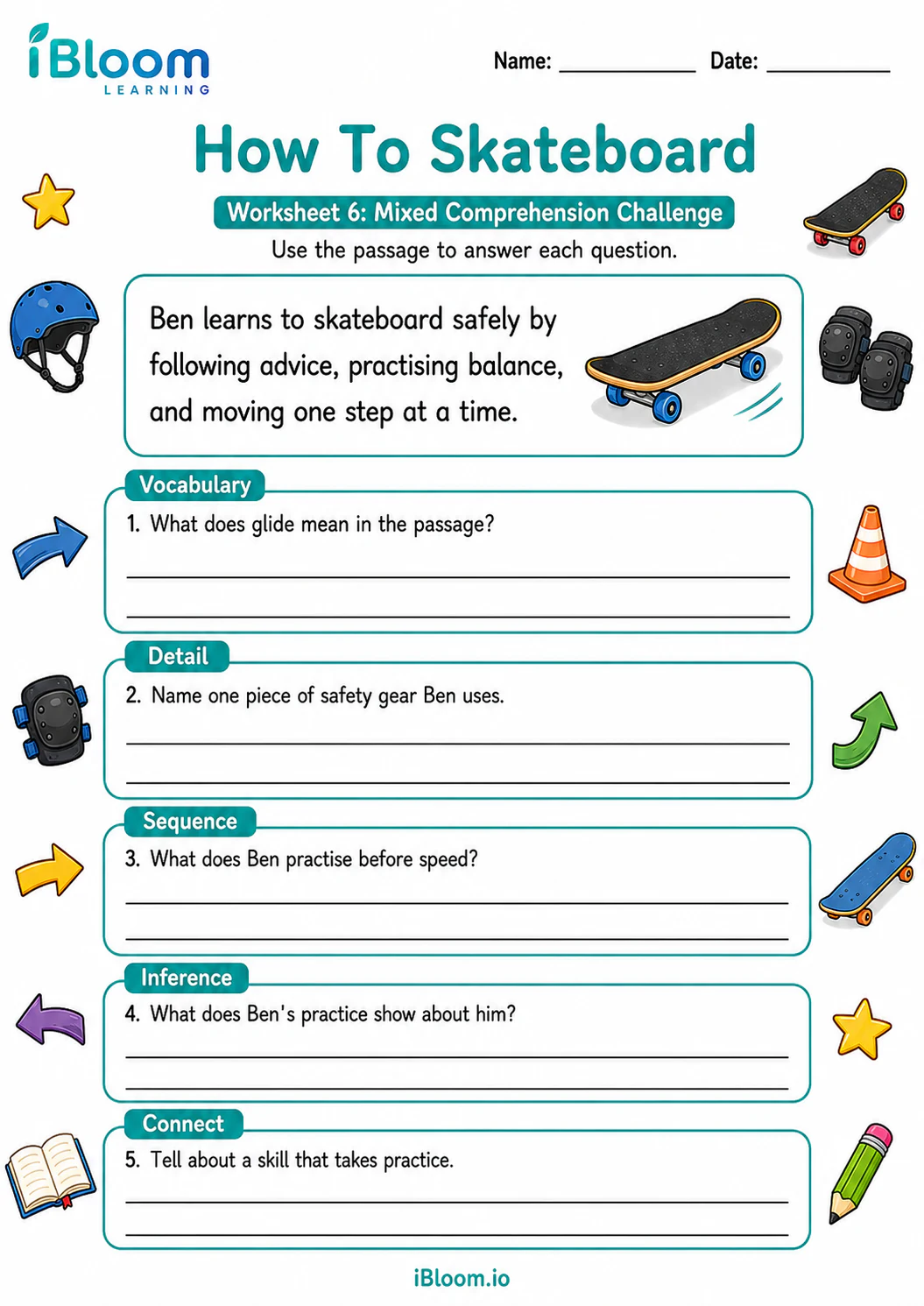
Questions 6–11 ask about Ben’s choices, safety steps, and practice. Questions 12–15 ask the learner to explain a choice or inference with a detail from the passage.
How to use this worksheet at home or in class
- 1Read the passage once to understand Ben’s practice and Mia’s advice.
- 2For Part B, reread the whole sentence around each target word.
- 3For Part C, find the line that gives the answer before choosing.
- 4For Part D, answer in a complete thought and include a story detail.
- 5Compare written answers with the sample key; similar wording is fine.
Common mistakes and quick fixes
The mistake
Choosing a ramp as Ben’s first practice place.
The fix
Reread the opening: Ben and Mia find a flat path away from walkers.
The mistake
Guessing a word meaning without using its sentence.
The fix
Use the nearby action or explanation as a clue.
The mistake
Making an inference without a passage detail.
The fix
Name an action that supports the idea, such as Ben’s plan to return.
Common Core alignment
This page practices the listed Common Core skill through the questions and responses on the sheet.
Answer with details from Ben’s actions and the passage.
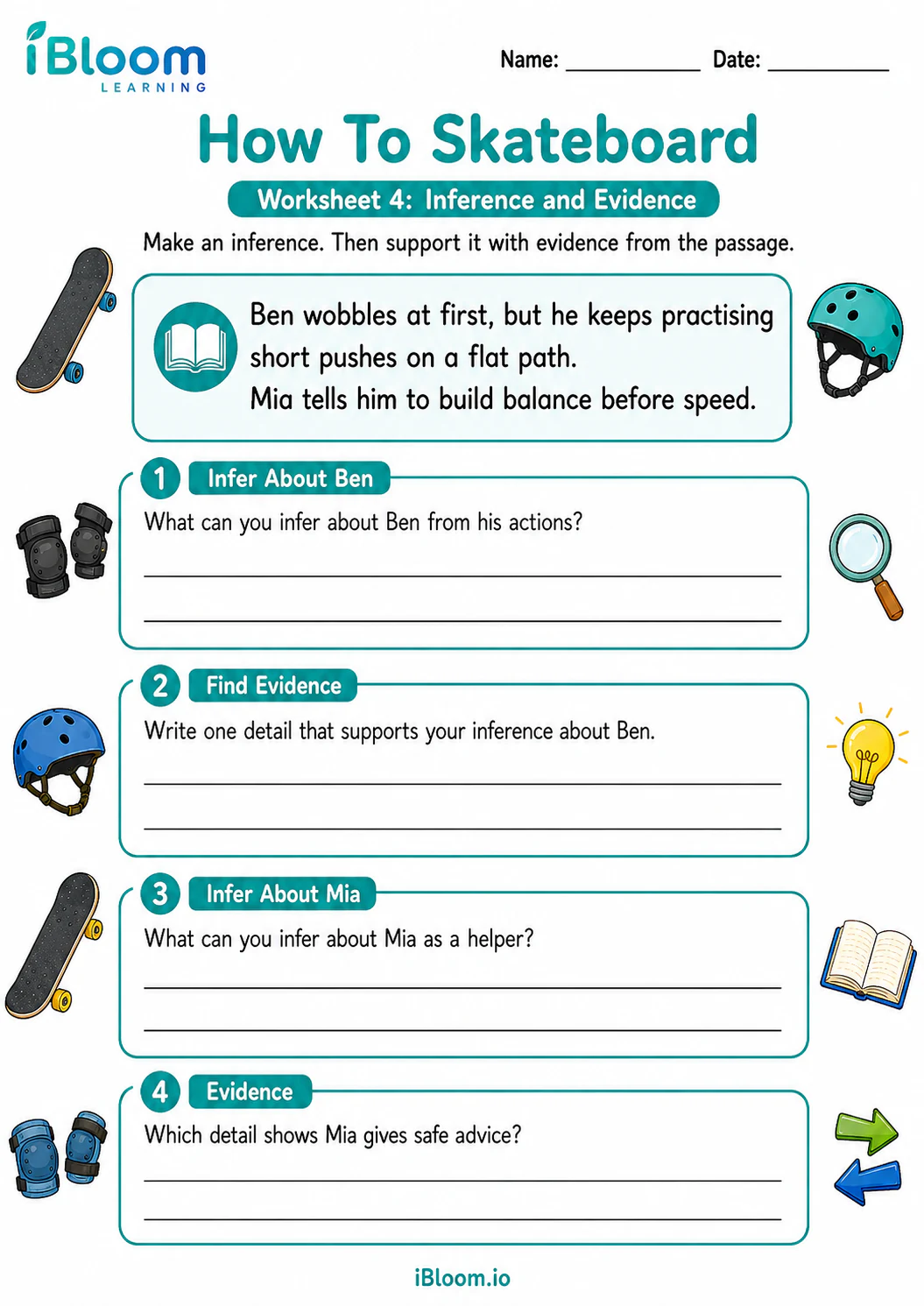
On this sheet: Parts C and D ask for explicit details and an inference supported by Ben’s actions.
Show the official wordingHide the official wording
Refer to details and examples in a text when explaining what the text says explicitly and when drawing inferences from the text.
Use nearby restatements and examples to infer a word’s meaning.
On this sheet: Part B asks learners to use context to interpret balance, wobbled, glide, and veer.
Show the official wordingHide the official wording
Use context (e.g., definitions, examples, or restatements in text) as a clue to the meaning of a word or phrase.
What to practice next
Make more practice
Further reading
Questions parents and teachers ask
What does this Grade 4 skateboard story worksheet practice?
The original passage follows Ben as he practices on a flat path with help from his cousin Mia. Five questions focus on word meaning, six ask about details, and four invite written explanations or inferences. The key gives correct choices and sample responses that learners can compare with their own.
What does “wobbled” mean in the passage?
It means rocked from side to side. The next sentence explains that the board rocked as Ben tried to ride, so that phrase gives a direct clue. Learners can reread the two sentences around the word before selecting an answer in Part B.
Where does Ben practice, and what does he do?
Ben practices on a flat path away from walkers. He tightens his helmet, bends his knees, makes short pushes, and shifts his weight when the board veers. The passage describes these details in order, so learners can return to it for support.
How many questions and pages are included?
There are 15 questions: eleven multiple-choice items and four written responses. The worksheet has three pages and the answer key has three pages. Part A is the passage, followed by vocabulary questions and then comprehension questions in Parts C and D.
Can written answers use different wording from the key?
Yes. The key provides sample responses for questions 12–15, not the only acceptable wording. A response should match the passage and include the requested detail or a sensible inference. For question 13, for example, learners may name any two careful actions Ben takes before or during practice.