

About this worksheet
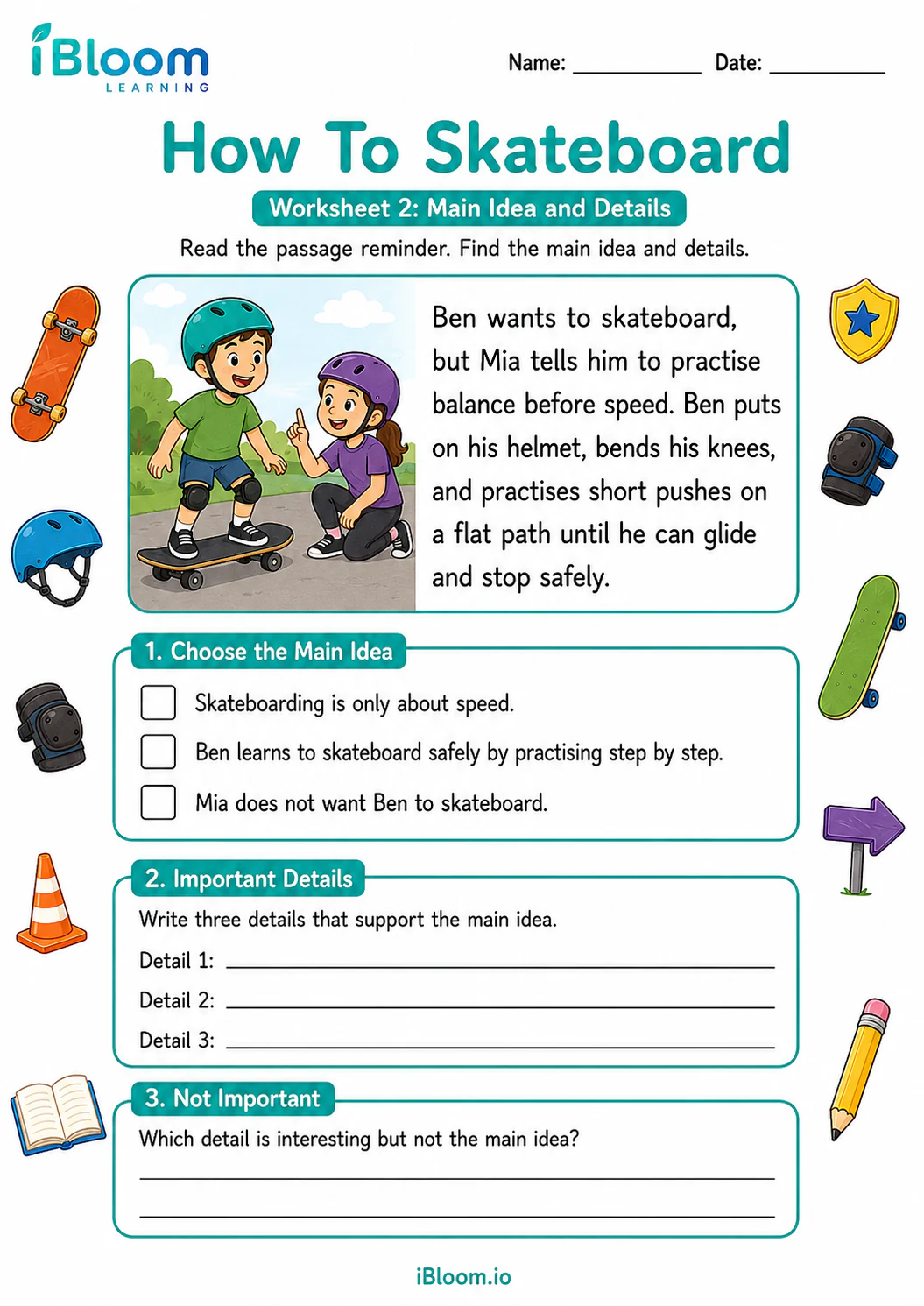
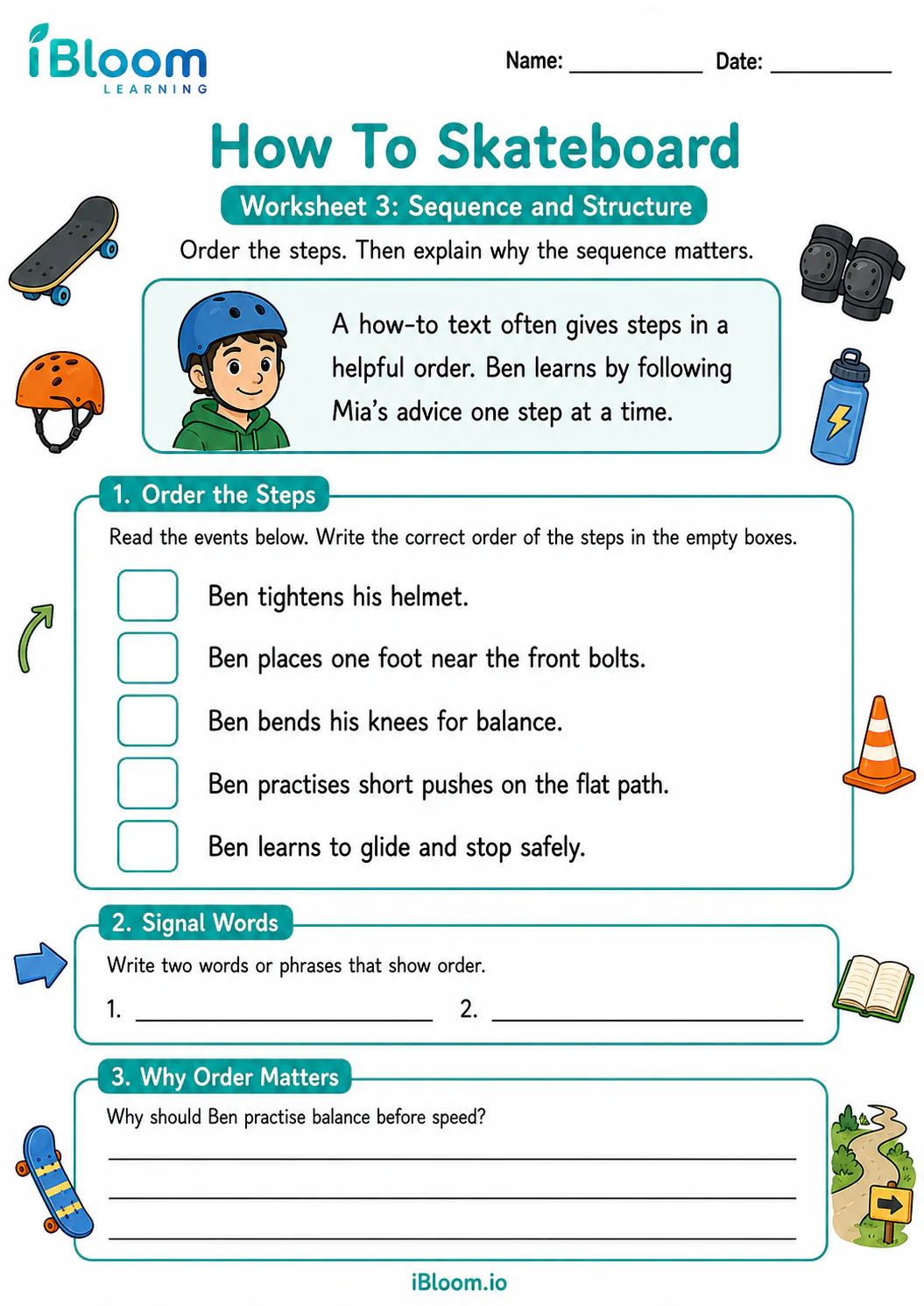
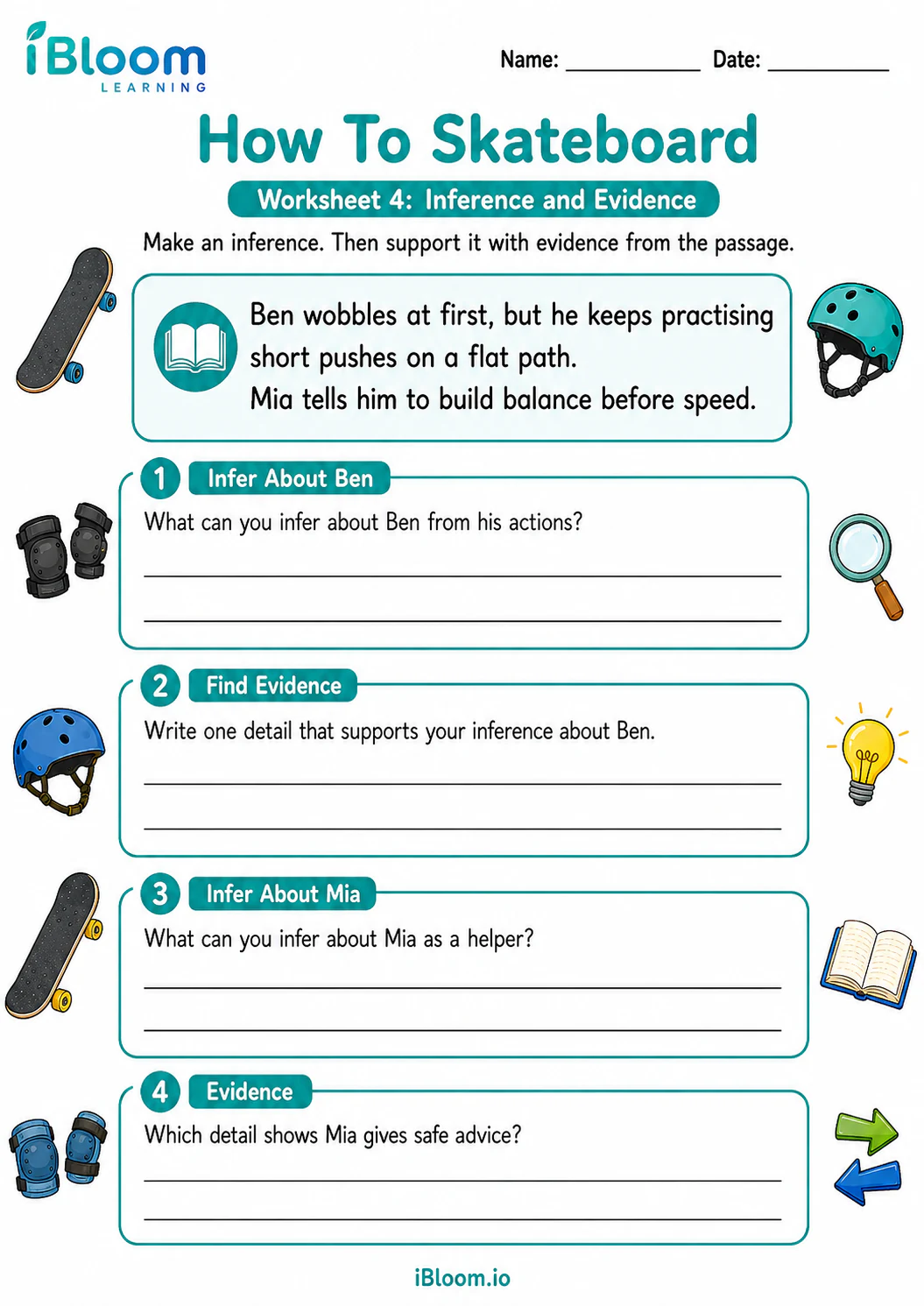
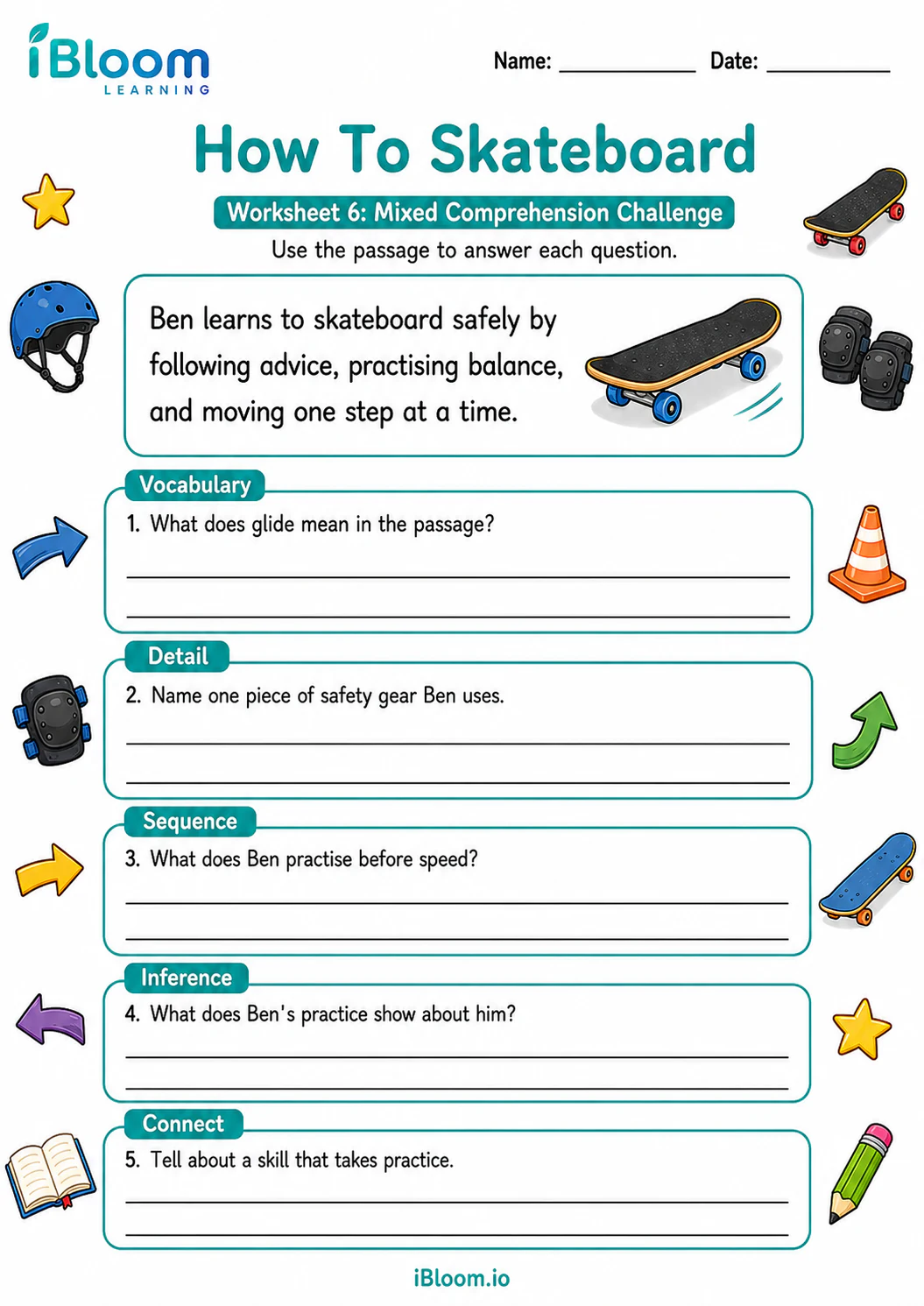
This free Grade 4 reading worksheet pairs an original story about Ben learning to skateboard with 14 comprehension questions. Learners recall safety steps, sequence events, explain a character’s choices, and support responses with details from the passage. A separate answer key includes sample responses for open-ended questions.
Aligned to RL.4.1
What happens in Ben’s story?
The story follows Ben as he learns to skateboard with Eli’s help. He wears safety gear, practices on an empty tennis court, and changes his stance after an early wobble. Several detail questions now use choices; later prompts ask readers to explain events and inferences.
- 1Question 8: How did Ben change his second try?
- 2He bent his knees and looked ahead, following Eli’s advice.
How do the questions ask readers to explain?
Part C asks readers to use an event or detail to explain an inference. For example, Eli’s reminders and demonstrations support the idea that he is patient. The answer key gives a model; wording may differ when the evidence and reasoning are sound.
How to use this worksheet
- 1Read the complete story once to follow the events.
- 2Return to the passage when a question asks for a detail.
- 3For an inference, state what you think and name the clue.
- 4Write complete thoughts for explain-your-thinking questions.
- 5Compare responses with the answer key after finishing.
Common mistakes and quick fixes
The mistake
Answering from memory when the story gives an exact detail.
The fix
Reread the relevant paragraph and use its wording.
The mistake
Giving an inference without a story clue.
The fix
Add a detail that led you to the idea.
The mistake
Treating a sample answer as the only acceptable wording.
The fix
Check that a different response answers the question and is supported by the passage.
Common Core alignment
Refer to story details when explaining answers and inferences.
On this sheet: Questions ask readers to answer from the story and support inferences with details.
Show the official wordingHide the official wording
Refer to details and examples in a text when explaining what the text says explicitly and when drawing inferences from the text.
What to practice next
Make more practice
Questions parents and teachers ask
How many questions are on this worksheet?
There are 14 questions on this printable. The tasks focus on story details, sequence, and written responses, and the separate answer key makes it easy to check each response after the learner finishes. The items are numbered in sequence, so learners can work from the first section to the last.
Do written answers need to match the key word for word?
No. The key gives sample wording for questions that allow more than one good response. Accept an answer that addresses the question and, when requested, uses a relevant detail from the story. Ask the learner to point to the exact story detail or clue that supports the response.
How should I use the answer key?
Let the learner finish a part before opening the key. Compare each response with the model, then reread the sentence or passage detail that supports it. For written answers, the key gives a sample response; another answer can work when it is accurate and supported.
How long does the worksheet take?
Allow about 20 minutes for 14 questions, with extra time for reading or discussing responses. A child can complete one part at a time and return to the rest later. The answer key is separate so it can stay out of view during practice.
What materials are needed?
Print the worksheet and its answer key, and have a pencil ready. The activities use the printed page, so no extra materials are needed. An adult may read directions aloud for a younger learner, then invite the child to choose or write each answer.