



About this worksheet
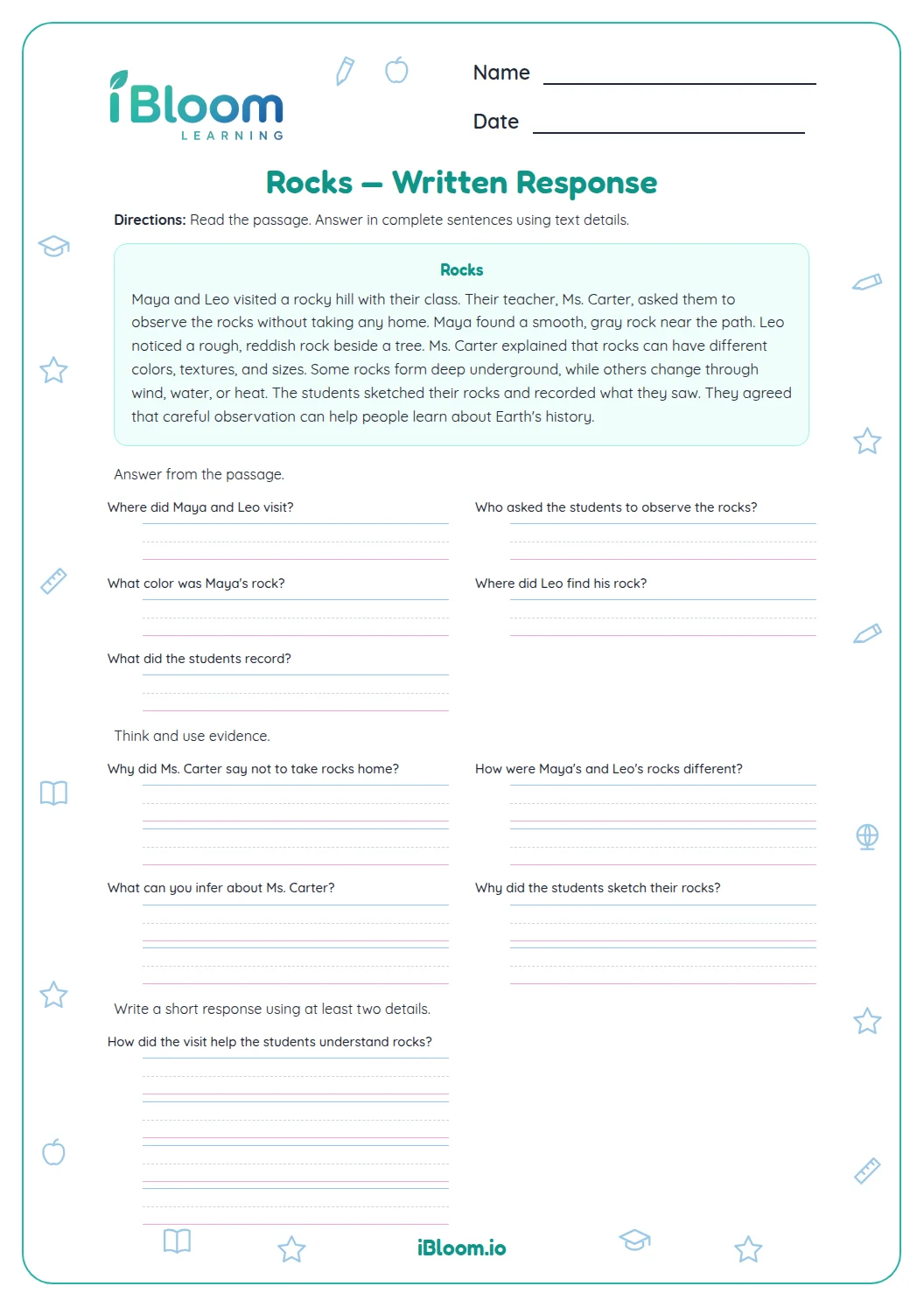
This free Grade 4 printable pairs an original story about Maya and Leo on a rocky trail with 14 mixed comprehension questions. Readers locate explicit details, infer from the students’ observations, identify a lesson, and follow the event sequence. The activity practices CCSS RL.4.1 and RL.4.2, and the answer key identifies the correct choices. The previous sheet’s generic seed question is replaced with a story-specific passage and a focused progression of comprehension practice.
Aligned to RL.4.1 and RL.4.2
What is in the mixed comprehension challenge?
The passage is Part A. Part B asks seven direct questions about trail observations. Part C moves to inferences, sequence, a lesson, and the story’s main idea.
- Part A: read the story passage
- Part B: answer seven detail questions
- Part C: infer, sequence events, and identify the lesson
How can a reader support an inference?
Pair a clue from the story with what it suggests. Leo records the holes and rough surface on his field card, which supports the idea that he observes carefully.
How do details point to the theme?
Notice what the class does. Maya and Leo compare features, record what they observe, and return the rocks to the trail. Their actions support a lesson about observing nature while leaving it undisturbed.
- 1Question: Which choice states a lesson?
- 2The class looks closely at rock features.
- 3Everyone returns the rocks before leaving.
- 4The actions support observing and protecting nature.
What belongs in a short story summary?
Choose the main idea and the key events that support it. The class observes different rock features and returns each one. A summary keeps those central details together without repeating every observation.
How to use this worksheet
- 1Read the passage once for the whole event, then reread when an answer asks for a detail.
- 2Complete Part A by pointing to the sentence that gives each fact.
- 3In Part B, separate what the story says from what a clue suggests.
- 4Use the class’s choices to select a lesson about careful observation and the trail.
- 5Write the Part C answers in your own words and include a supporting event.
- 6Compare with the key; check that the summary includes the problem, resolution, and lesson.
Common mistakes and quick fixes
The mistake
Using a detail that is true but does not answer the question.
The fix
Underline the words in the question and find the matching moment in the story.
The mistake
Treating an inference as a stated fact.
The fix
Name the story clue and then say what it suggests.
The mistake
Retelling every event in a summary.
The fix
Keep the problem, one or two key events, resolution, and theme.
Common Core alignment
This story page builds close reading through evidence and a theme-based summary.
Use story details and examples to explain and infer.
On this sheet: Parts B and C ask readers to answer from details and infer from story clues.
Show the official wordingHide the official wording
Refer to details and examples in a text when explaining what the text says explicitly and when drawing inferences from the text.
Determine a story theme from details and summarize it.
On this sheet: Part C asks readers to identify a lesson and select a concise summary.
Show the official wordingHide the official wording
Determine a theme of a story, drama, or poem from details in the text; summarize the text.
What to practice next
Make more practice
Further reading
Questions parents and teachers ask
What is the story about?
Maya and Leo study rocks on a trail with their class. They record different features, compare their observations, and return the rocks before leaving. Questions move from details to inferences and a lesson, all grounded in the passage and its rock observations.
How many questions are on the worksheet?
There are 14 multiple-choice questions after the passage: seven detail questions and seven questions about inference, sequence, lesson, and summary. The answer key marks the correct choice for each question. Children can reread the passage and point to a clue that supports a selected answer.
What does the answer key include?
The answer key marks the correct choice for every question. Children can check a detail, inference, theme, and summary choice against the story. After checking, ask them to point to one line that supports a selected answer and retell it in their own words.
How can a child find the theme?
Look at what the class does by the ending, then connect those actions to a broader lesson. Maya and Leo record what they see and return the rocks. Their choices support a lesson about observing nature with care at the trail.
How long should this worksheet take?
Plan about 20 minutes for reading and answering the 14 questions. A child may want to reread the passage when choosing an inference or summary. A short pause between parts can help keep the story details organized. The key can support a quick reread of the passage.