



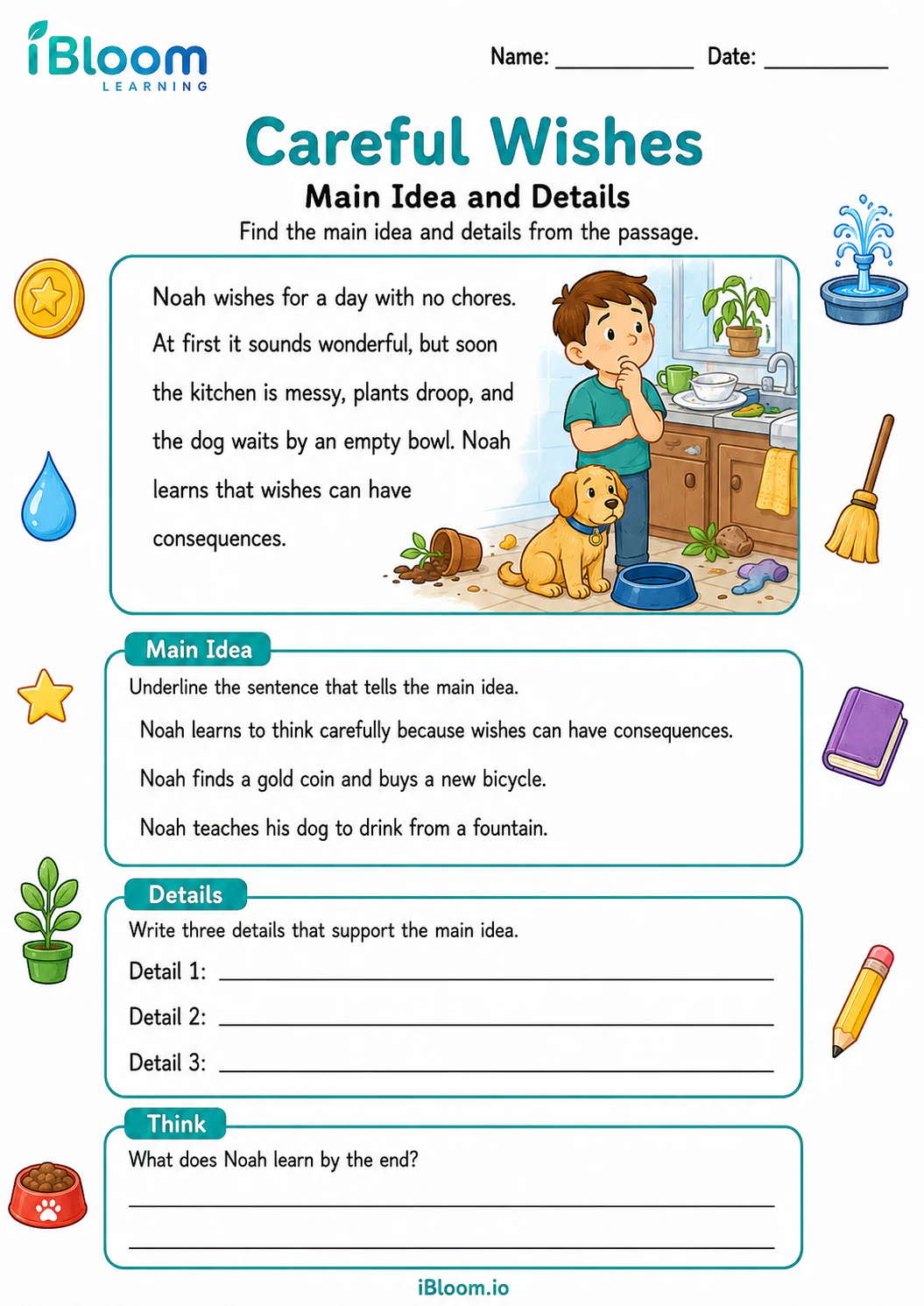
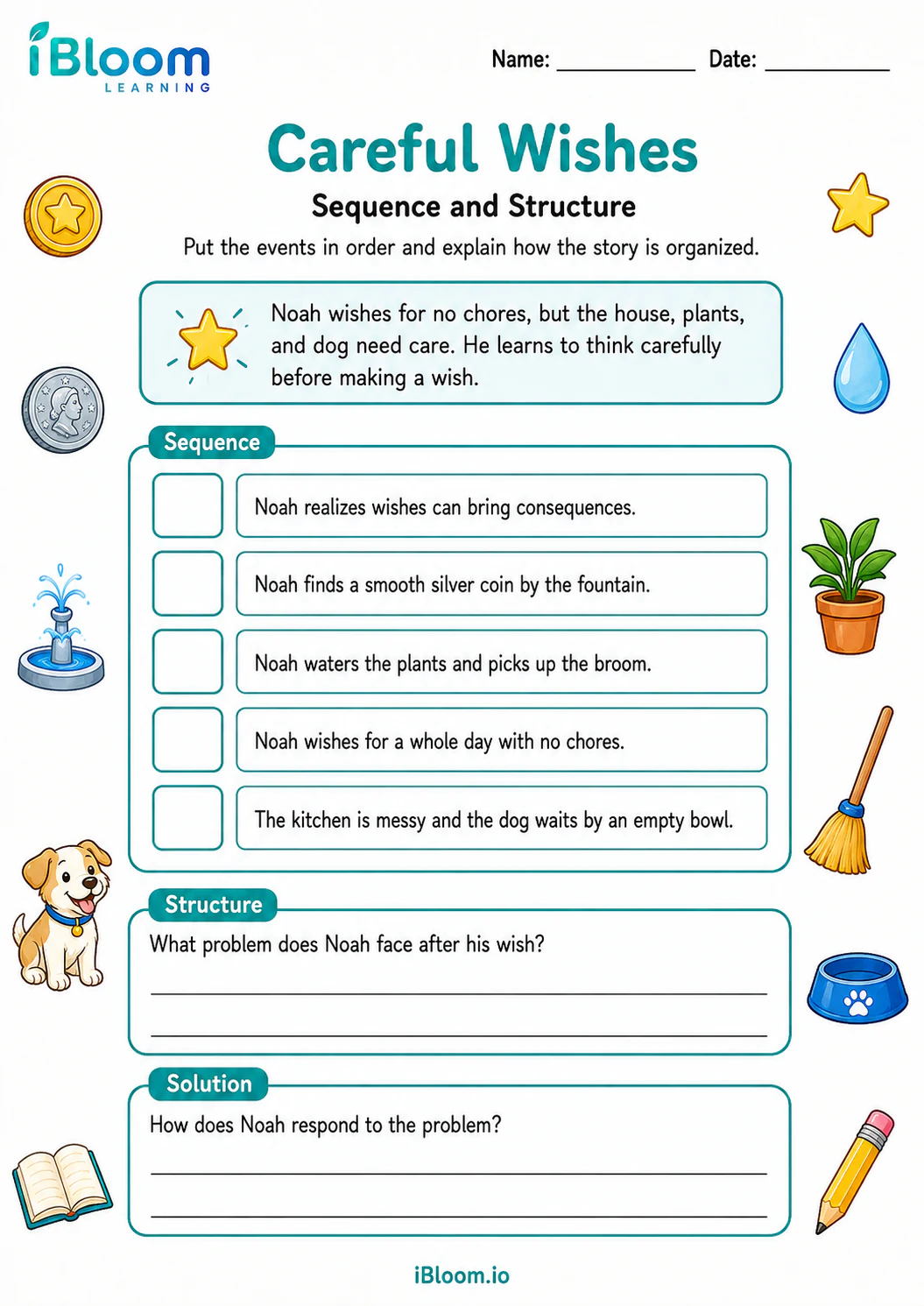
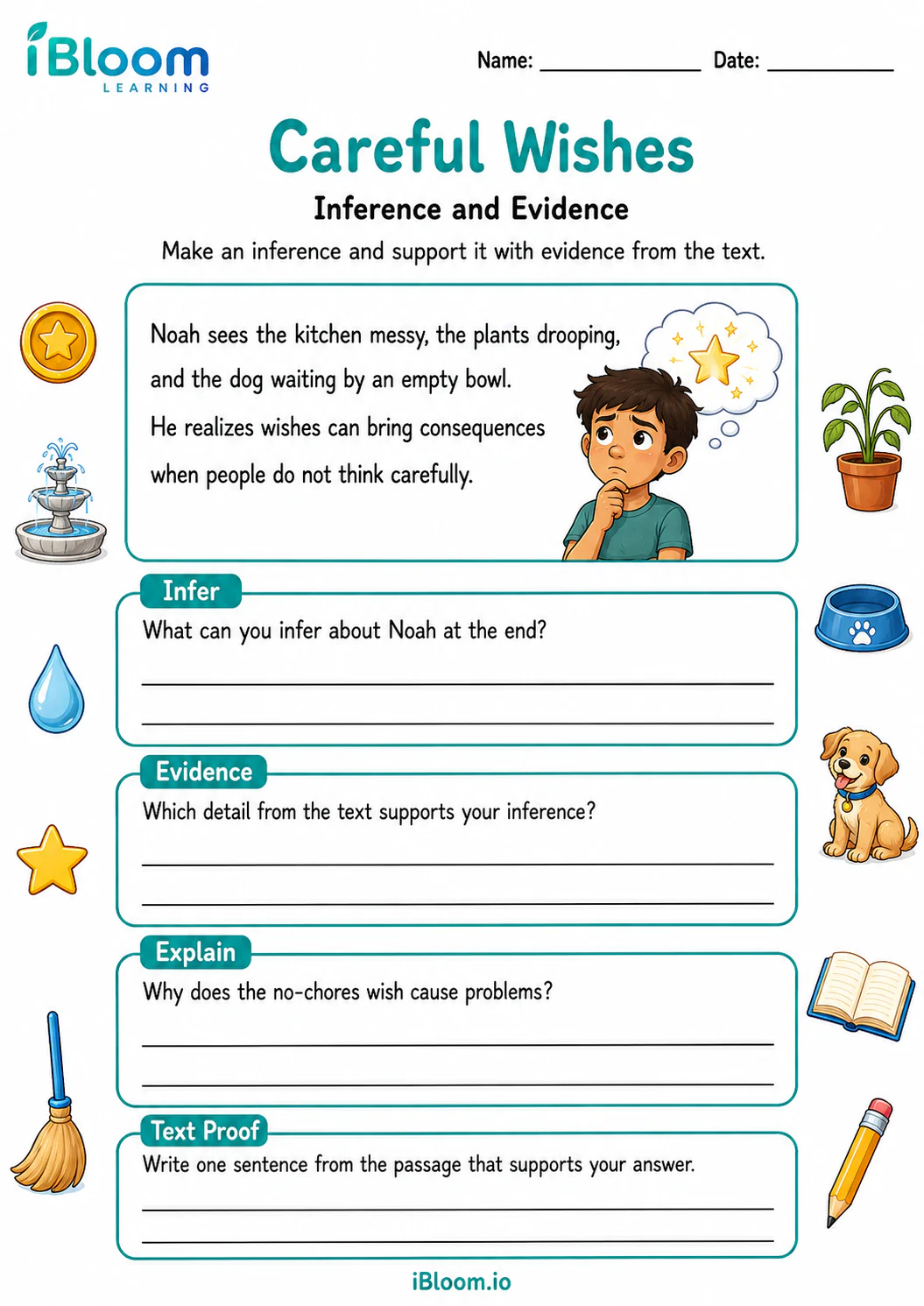
About this worksheet
This free Grade 4 reading worksheet uses an original story about Lena finding a rock by a creek and investigating it at a library. Readers follow what she notices, compares, and records, then explain how the events fit together. Fourteen questions move from details and event order to short explanations supported by the passage. The included answer key gives direct answers and sample wording for open responses. The work connects character actions and important events to specific story details through CCSS RL.4.3.
Aligned to RL.4.3
How can readers track the story events?
Follow Lena’s actions in order: she finds a rock, studies it, visits the library, and labels it. Notice how each action grows from a clue before it. The passage follows one investigation, so event order also reveals the story structure.
- 1Lena finds the rock.
- 2She visits the library and compares clues.
- 3Back home, she labels her find.
- 4The library visit connects discovery to the ending.
Which details explain Lena’s choices?
Sparkling grains and hardness explain why Lena compares her rock with quartzite. She is not certain from a picture alone. That careful language matters: the ending is a reasonable guess and a plan to ask a geologist, not a final identification.
What does the story structure show?
The beginning introduces a discovery, the middle shows Lena gathering information, and the ending shows what she concludes and plans next. Readers name events and explain their connections in Parts B and C.
How to use this worksheet
- 1Read the passage once to understand Lena’s investigation.
- 2On a second read, notice actions that mark the order.
- 3Complete Part B with a specific story detail for each choice.
- 4Use Part C to connect clues and events.
- 5Write complete explanations in Part C, then check the key.
Common mistakes and quick fixes
The mistake
Retelling events without explaining how they connect.
The fix
Use a linking phrase such as “because,” “after,” or “this helps Lena” to explain the relationship.
The mistake
Calling quartzite a certain identification.
The fix
Reread the last paragraph: Lena makes a likely guess and plans to ask a geologist.
The mistake
Mixing up the library visit and the label.
The fix
Use “visited the library” and “Back home” to anchor the middle and final events.
Common Core alignment
This Grade 4 reading work uses story details to describe events and their relationships.
Describe characters, settings, and events with details from the story.
On this sheet: Questions trace Lena’s actions and explain why key events lead to the ending.
Show the official wordingHide the official wording
Describe in depth a character, setting, or event in a story or drama, drawing on specific details in the text (e.g., a character’s thoughts, words, or actions).
What to practice next
Make more practice
Further reading
Questions parents and teachers ask
What does this worksheet help children practice?
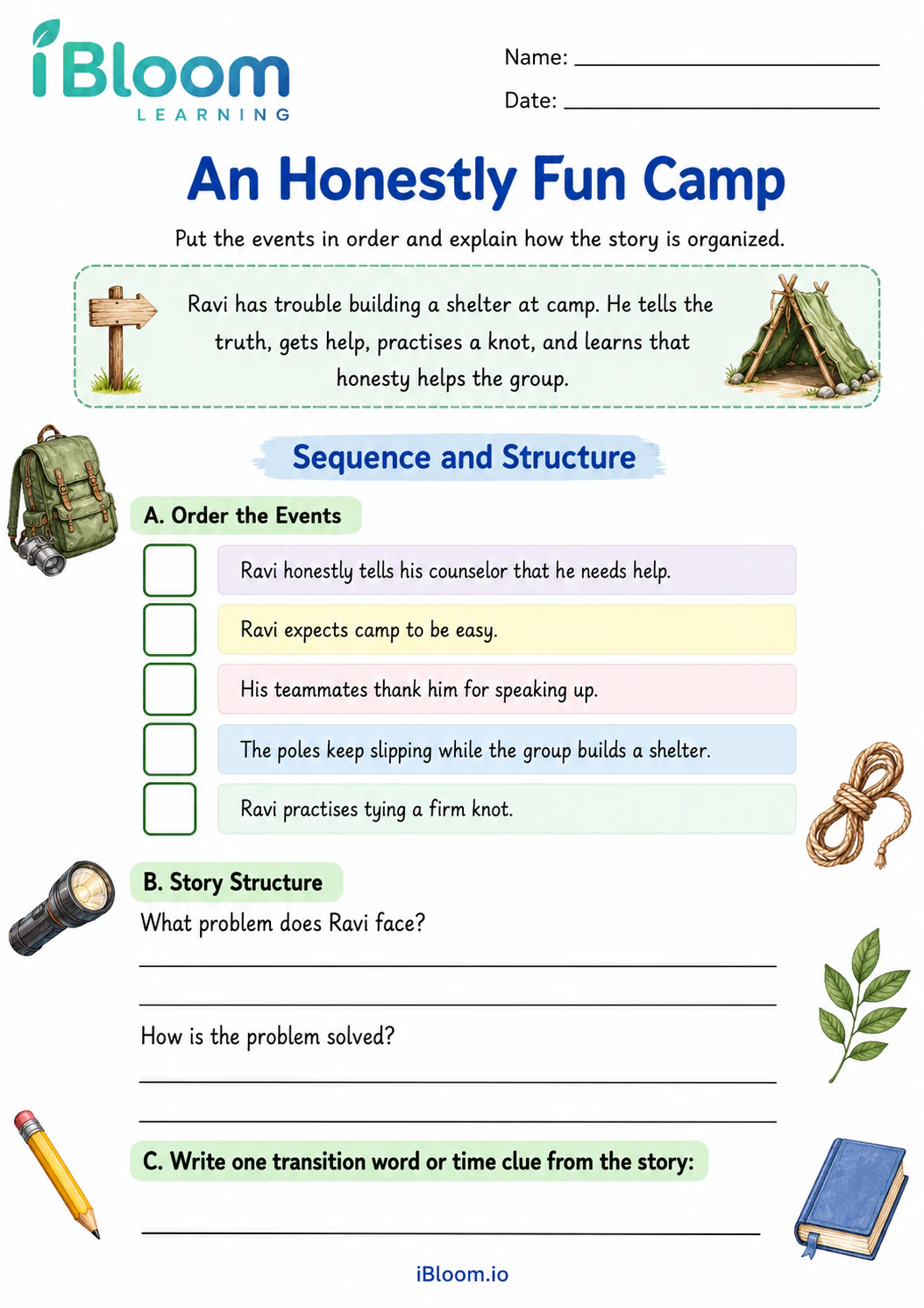
This printable focuses on sequence, story structure, and details from an original rock story. It includes event-order questions, short answers, and written explanations and a matching answer key. Children can work through the questions in order, pause to explain a choice or calculation, and then use the key to review each response. The examples are written for this particular sheet.
Is an answer key included?
Yes. The key includes an answer for all 14 questions, with sample wording where different clear responses can be correct. For an open response, compare the child’s idea with the passage or math relationship and accept an accurate explanation even when the wording differs from the model.
Can children complete this in one sitting?
Yes. The printable is designed for one practice session, and adults can also divide it by part. Begin with the directions, let the child try the first few items, and pause to discuss the strategy. The time estimate is a guide; careful reading or conversation may take longer.
How should I use the answer key?
Use the key after the child has attempted each part. For a missed item, ask which detail, clue, or calculation supports the answer, then revisit the question together. Open responses may have multiple correct versions, so check the idea and its support rather than requiring an exact match to the sample sentence.
What if a child needs help with a question?
Read the directions aloud and return to the specific clue the question asks about. For reading, point back to the sentence with the evidence. For math, name the known numbers and operation before solving. A small hint can help the child continue while still doing the thinking and recording the response.