


About this worksheet
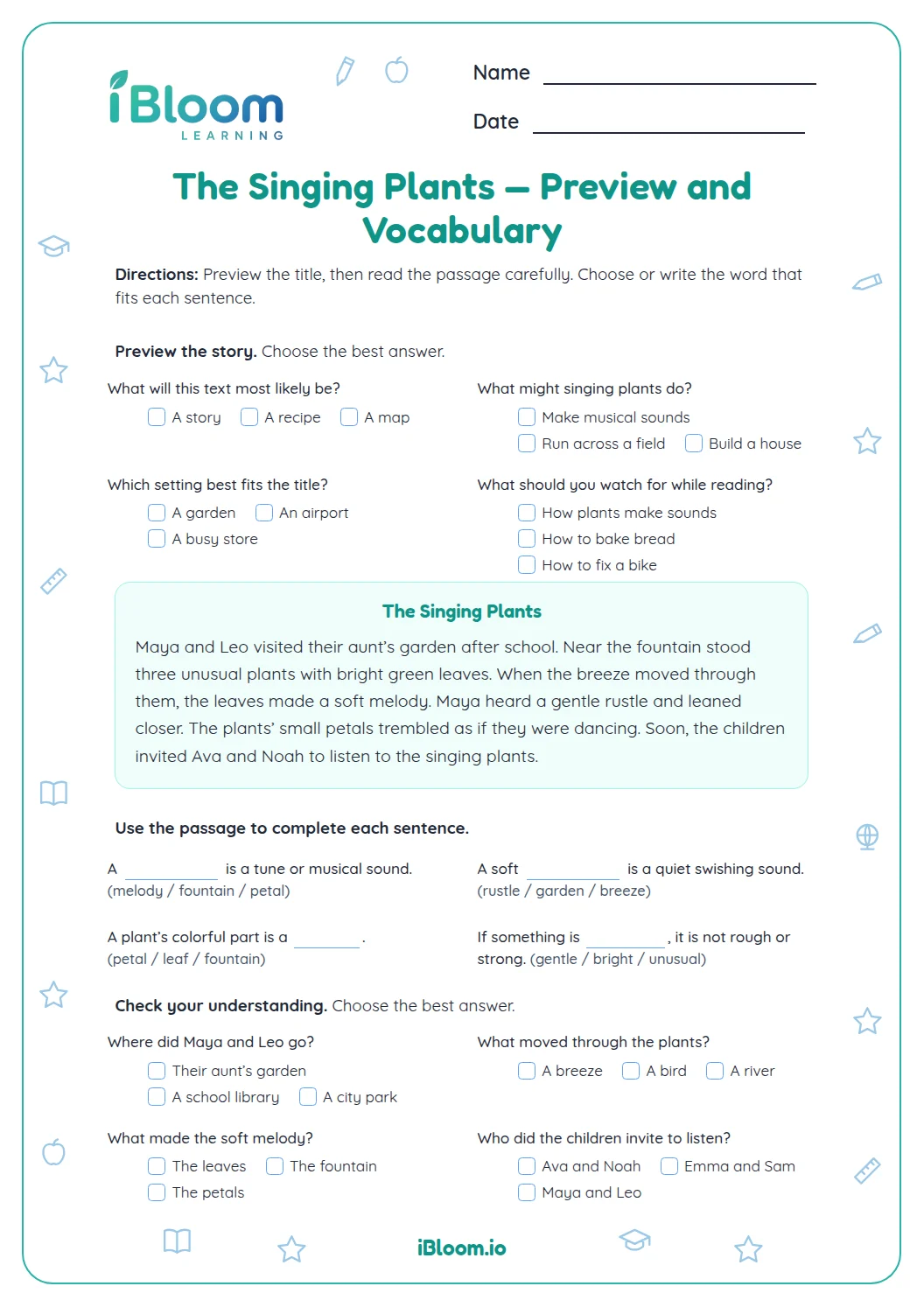
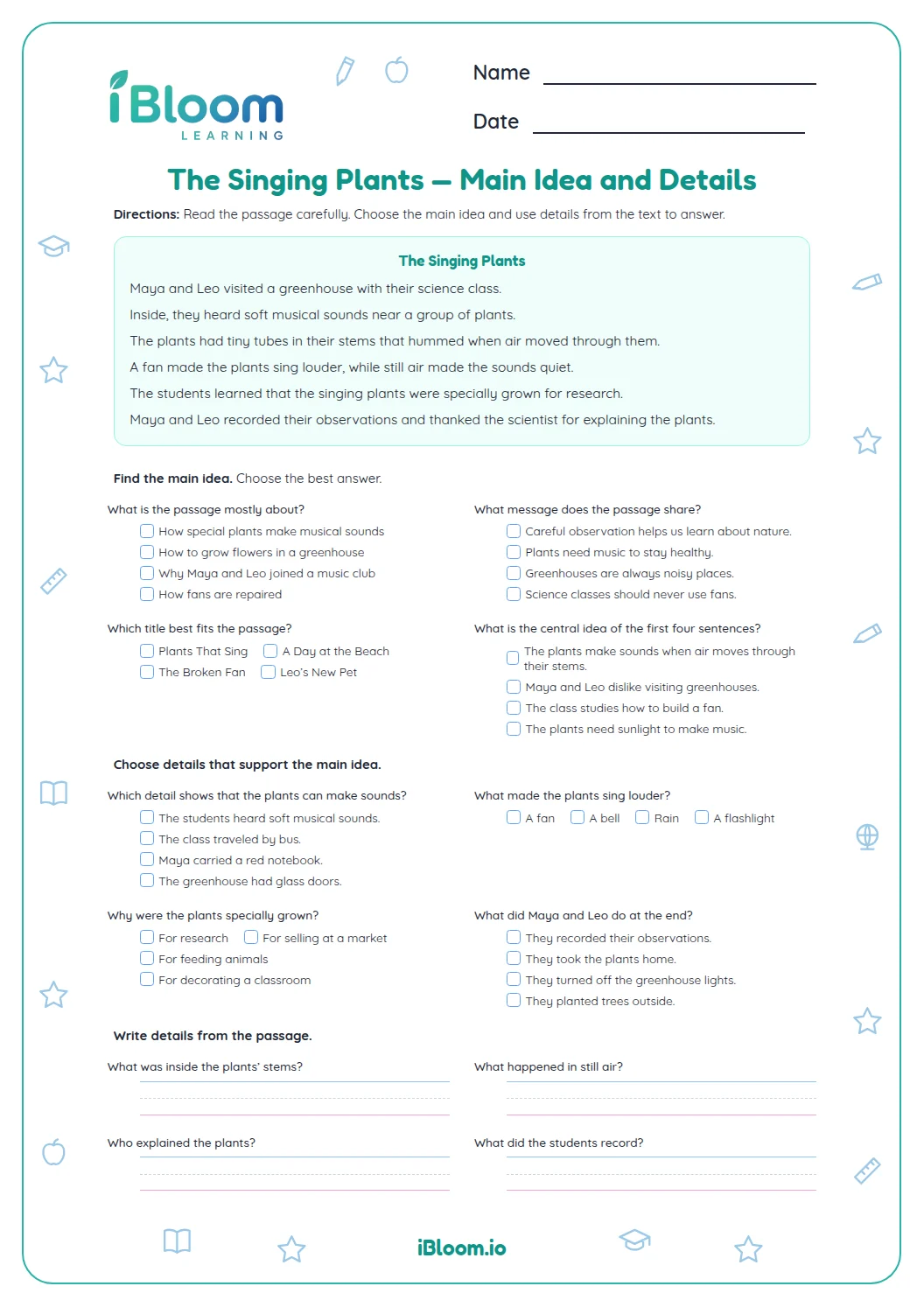
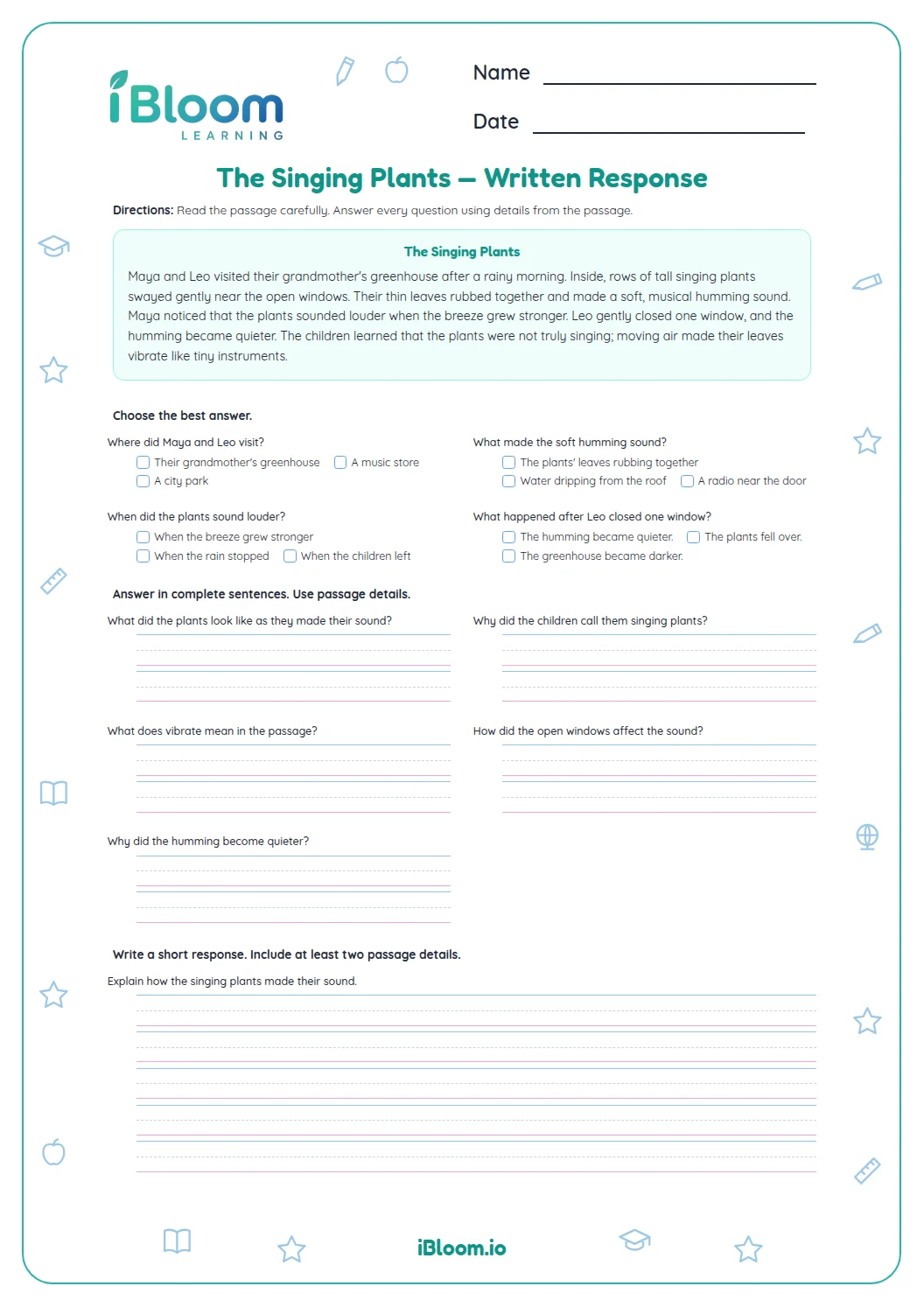
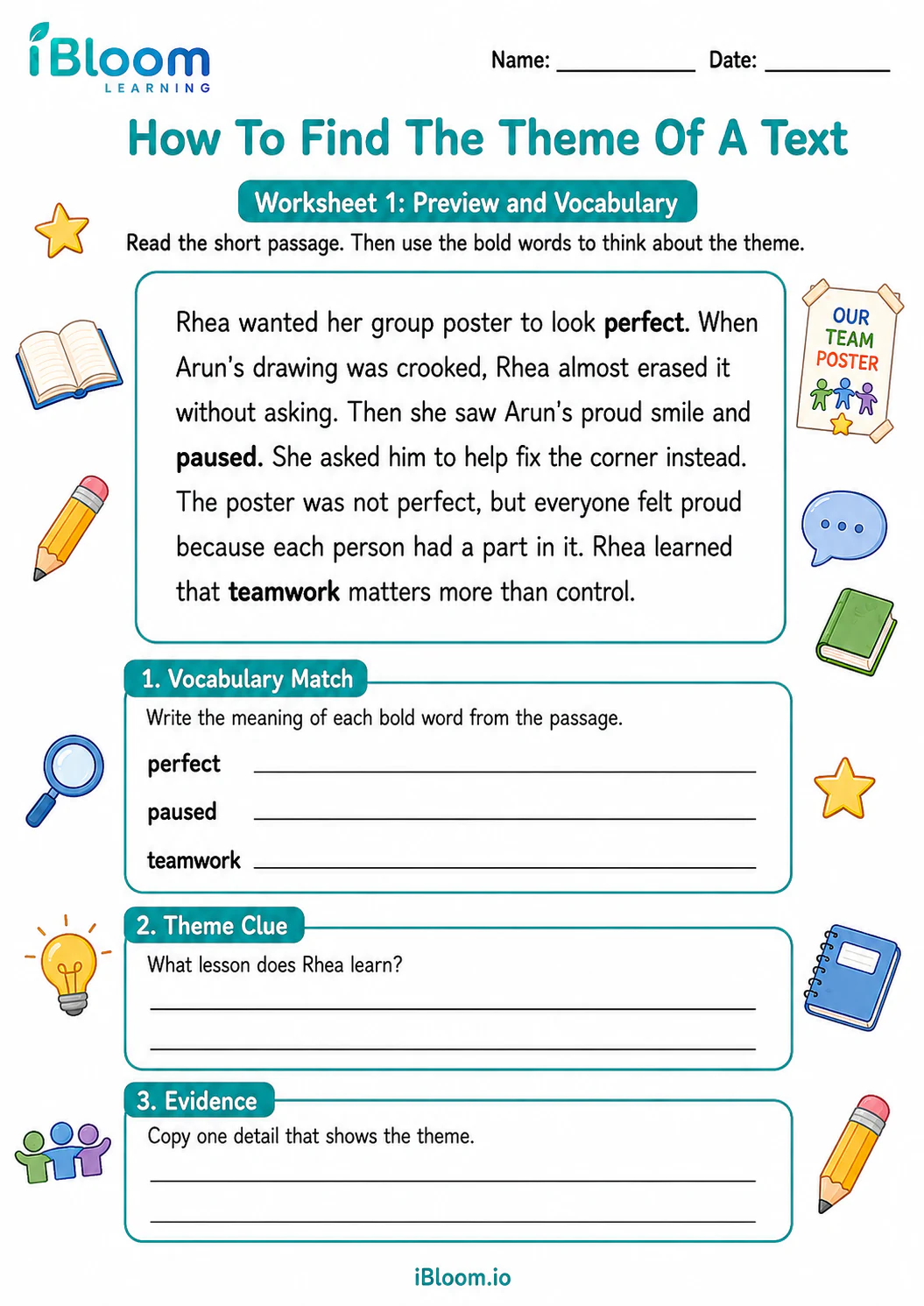
This free printable worksheet gives Grade 4 students a short original story, "The Singing Plants," and eleven questions to answer from it. Maya and Leo visit their grandmother's greenhouse and discover tiny plants that make music when warm air moves them, until Leo opens a window. Part B checks key details and a word in context. Part C asks about order, a character's feelings, the best title and the lesson. Part D asks for two written answers with details from the text. It supports Common Core RL.4.1 and RL.4.2. The answer key is on its own pages.
Aligned to RL.4.1 and RL.4.2
What is on this worksheet?
The story is about 200 words in six short paragraphs. It has two characters, Maya and Leo, a setting (Grandma's greenhouse on a rainy afternoon), and a clear problem and solution: the song fades when Leo opens a window, and returns when he closes it.
Part B has four multiple-choice questions on key details and one word in context, faded. Part C has five multiple-choice questions on what happened first, what happened next, how Leo feels, the best title and the lesson. Part D has two questions that need a written sentence.
- Part A: the story, printed on its own page
- Part B: 4 questions on key details and the word faded
- Part C: 5 questions on order, feelings, title and lesson
- Part D: 2 written answers that use evidence
- Story: 206 words, original to iBloom
How do students find evidence in the story?
Teach students to go back to the story every time, even when they think they remember it. They read the question, find the part of the story it asks about, and underline the words that answer it. For question 2, "What makes the stems produce notes?", the evidence is in two sentences: "The stems began to sway. As each one bent, it made a clear note."
In Part D, students use those same words in a complete sentence. A strong answer to question 10 names the cause and the result: warm air moved the stems, and the bending stems made bell-like notes.
- 1Question: Why does the tallest plant sound lower?
- 2Find the clue: "Longer stems bend more slowly," Grandma explained, "so they sing lower."
- 3The tallest plant has the longest stem, so it bends more slowly.
- 4Answer: Its stem bends slower
How do students find the lesson and the best title?
A title or lesson should fit the whole story, not just one part. "A Rainy Day Trip" is only the setting, and "Leo's Broken Window" is wrong because nothing is broken. "Warm Air Makes Music" covers the heart of the story: warm air moves the stems and the stems make notes.
For the lesson, ask what Leo learns. He opens the window without asking, the music stops, and at the end he says, "Next time, I will ask before I change anything." That is where the lesson, "Ask before you change it," comes from.
How can students work out what faded means?
Students use the words around faded: "Cool air rushed in, and the stems went still. Within seconds, the song faded." The stems stopped moving, so the song must have gotten quieter and stopped. Later the music "returned," which shows that it had gone away.
This is context clues, a Grade 4 language skill (L.4.4.a). Ask students to say what the sentence would mean if faded meant grew louder. It makes no sense when the stems have stopped moving.
How to use this worksheet at home or in class
- 1Read the story once through without stopping, then ask your child to say what happened in one or two sentences.
- 2Read the story again with a pencil. Have your child underline the sentence with the heater and the sentence about the window.
- 3Do Part B. For each question, find the answer in the story first, then choose from the options.
- 4Do Part C. For the title and lesson questions, try each option and ask whether it fits the whole story.
- 5In Part D, write one full sentence with a detail from the story for each question.
- 6Check with the answer key, and for each wrong answer go back to the story and find the sentence together.
Common mistakes and quick fixes
The mistake
Answering from memory or guesswork, such as choosing "They are older" for why the tallest plant sounds lower.
The fix
Ask your child to show you the sentence that proves the answer. If it is not in the story, it is not the answer.
The mistake
Choosing a title or lesson that matches one detail only, like "A Rainy Day Trip" or "Always stay indoors."
The fix
Ask whether the choice covers the whole story. A lesson should explain what happens at the end, not just the setting.
The mistake
Writing an answer without a detail, such as "Because of the window."
The fix
Ask for the because: what came in through the window, and what happened to the stems? Use words from the story.
Common Core alignment
Most US states use Common Core or a close version, so this sheet fits Grade 4 literature standards in most classrooms.
Answer questions with details from the story and infer how a character feels.
On this sheet: Main standard. Parts B and D ask students to answer using details, and question 7 asks for an inference about Leo's feelings.
Show the official wordingHide the official wording
Refer to details and examples in a text when explaining what the text says explicitly and when drawing inferences from the text.
Work out the lesson of a story from its details and choose a title that fits the whole story.
On this sheet: Questions 8 and 9 ask for the best title and the lesson, which draws on the theme.
Show the official wordingHide the official wording
Determine a theme of a story, drama, or poem from details in the text; summarize the text.
What to practice next
Make more practice
Further reading
Questions parents and teachers ask
What is the story on this Grade 4 worksheet about?
It is about Maya and Leo, who find tiny plants in their grandmother's greenhouse that sing when warm air moves their stems. When Leo opens a window, cool air makes the stems go still and the song fades. When he closes it, the music returns. The story is about 200 words.
What are the answers to Part B?
The four answers are In a greenhouse, Bending in warm air, Its stem bends slower, and got quieter and stopped. Each is stated or clearly shown in the story. For example, the story says the stems sway and each one bends to make a note. The answer key shows all eleven answers.
Is it okay if my child's written answer is different?
Yes, if it gives a correct detail from the story. The key shows a sample answer, but other wording works. For question 10, any answer that says warm air moves the stems and the stems make notes is correct. Ask for a full sentence and one detail.
What is the lesson of The Singing Plants?
The lesson is to ask before you change something. Leo opens a window without asking, the music stops, and at the end he says he will ask before he changes anything next time. The answer choice "Ask before you change it" matches that ending better than the other two choices.
Is The Singing Plants from a published book?
No. It is an original story written for this worksheet, so every question can be answered from the text on page 1. It has two characters, one setting, a problem (the song stops when Leo opens a window) and a fix, which makes it a good length for practicing evidence at Grade 4.
How long does the worksheet take, and can I split it up?
Most Grade 4 students need about 20 minutes. You can split it: read the story and finish Part B first, then do Parts C and D later in the day. If your child finds the written answers hard, do them together and talk about the evidence.