
About this worksheet
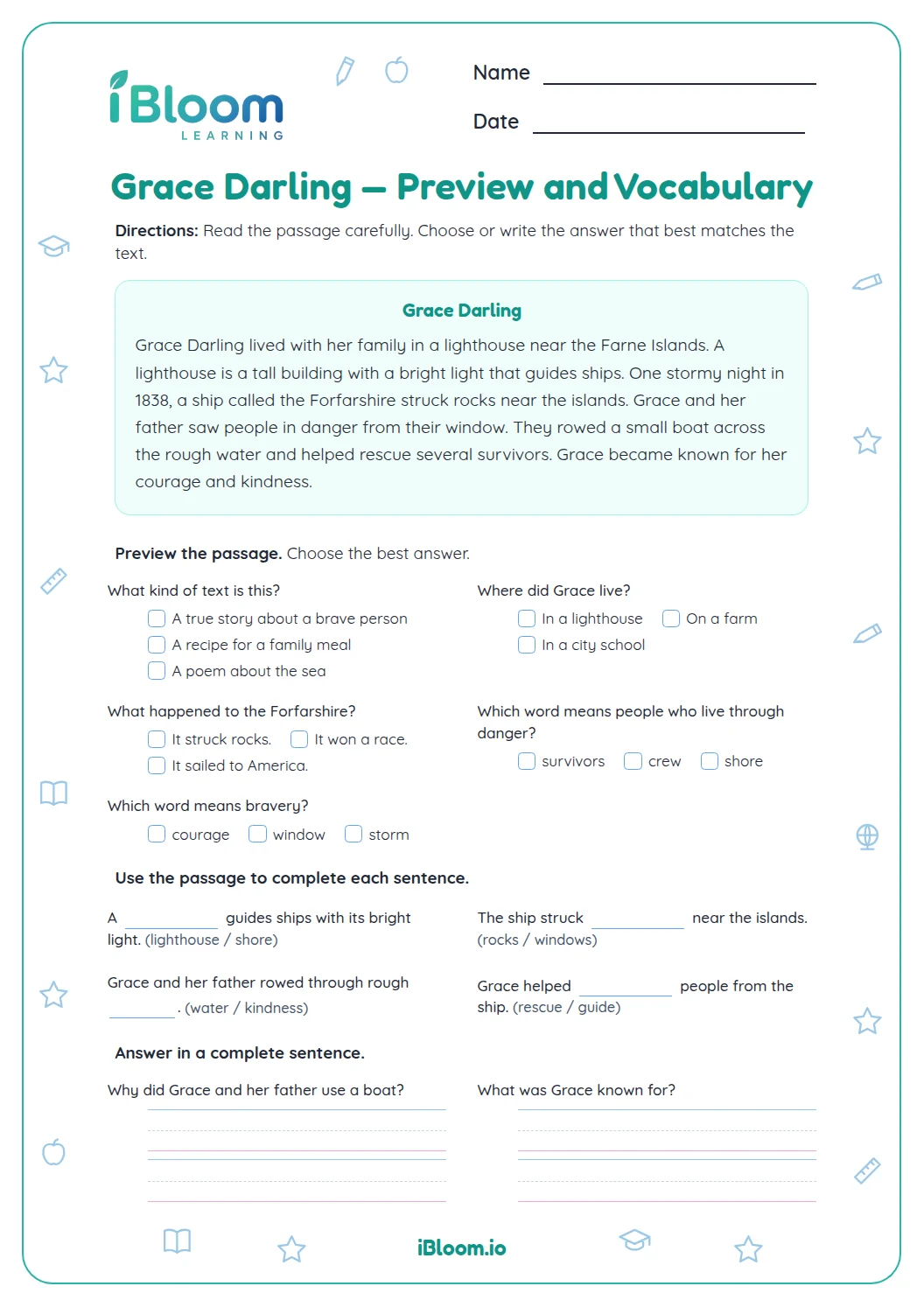
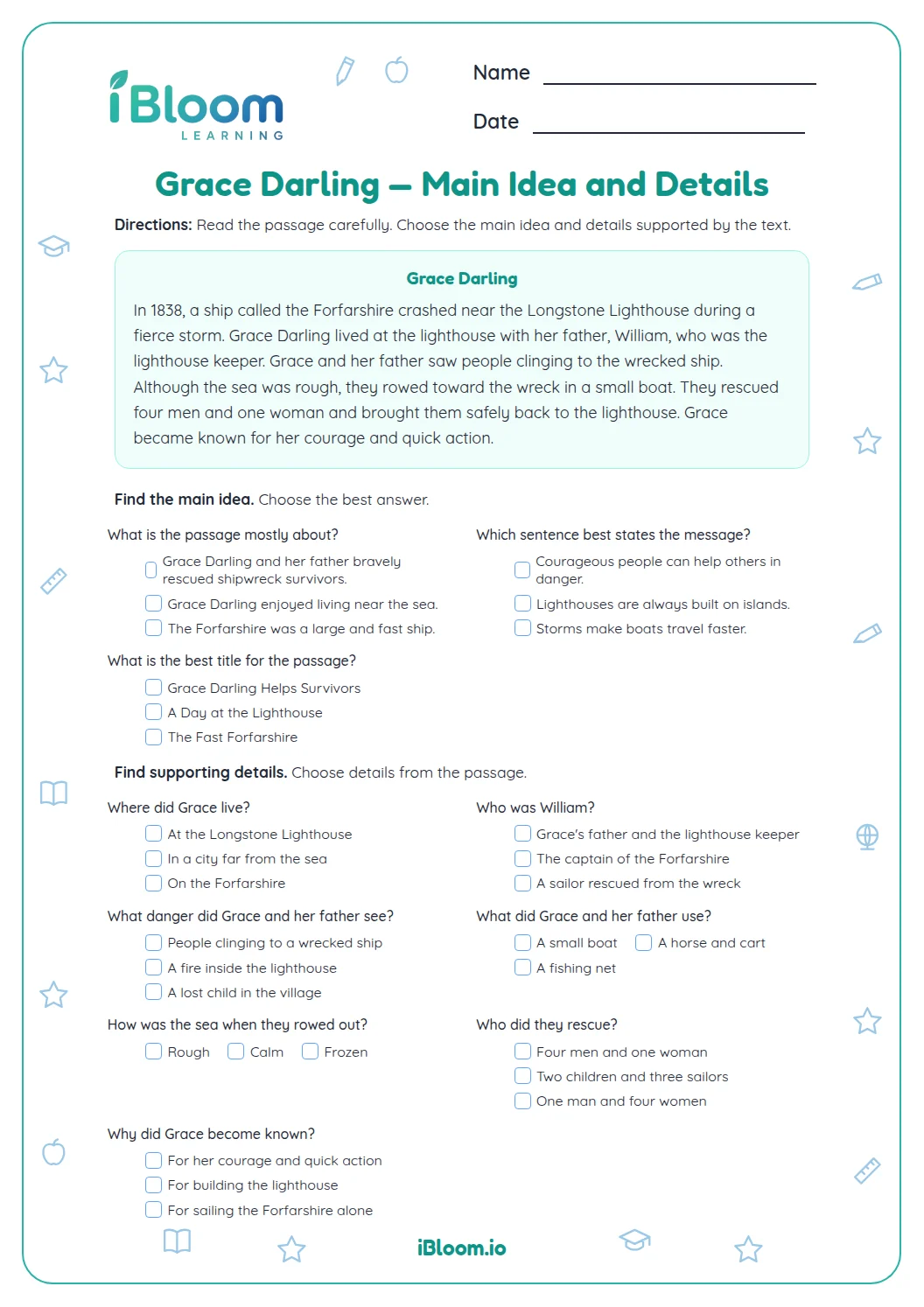
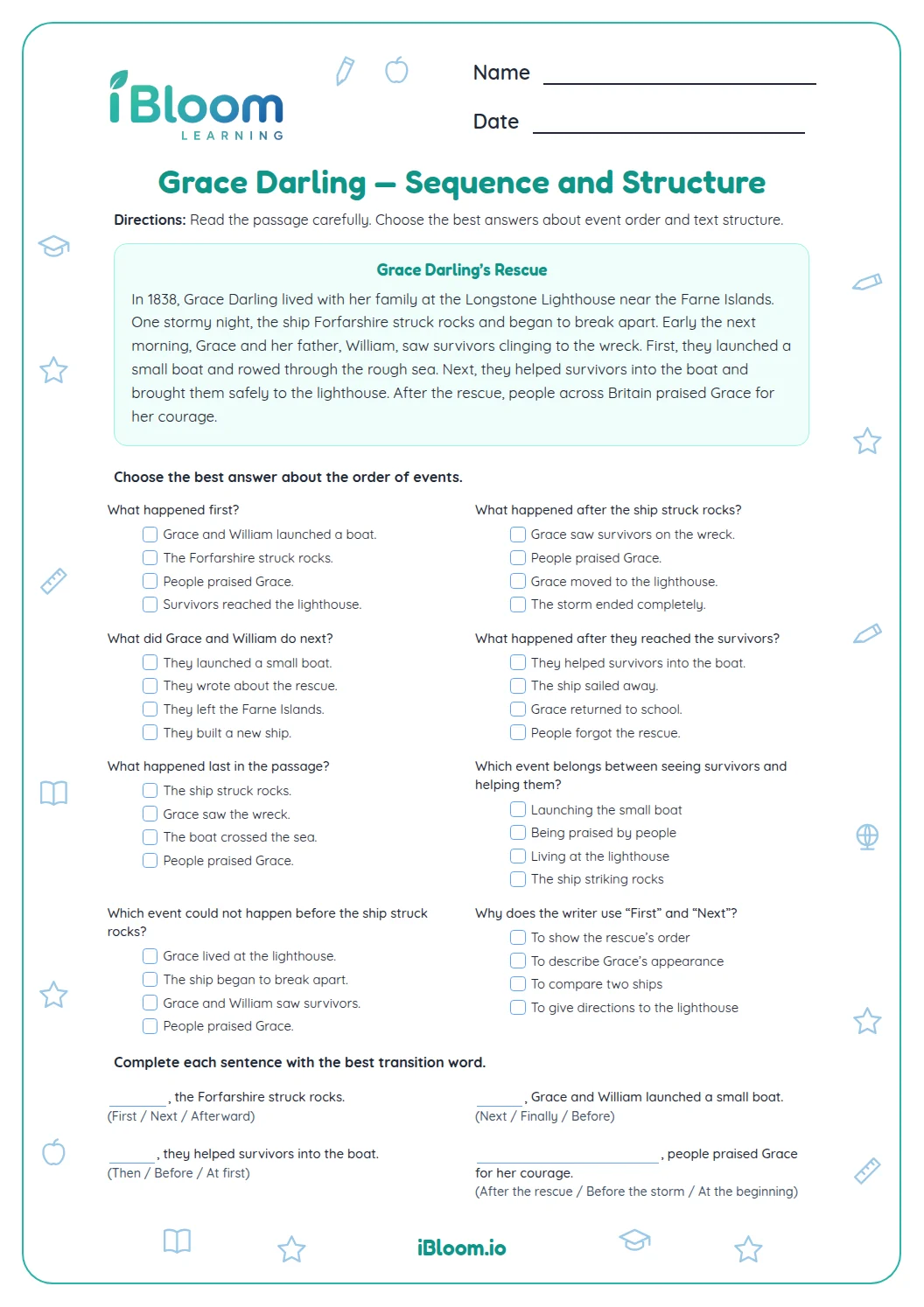
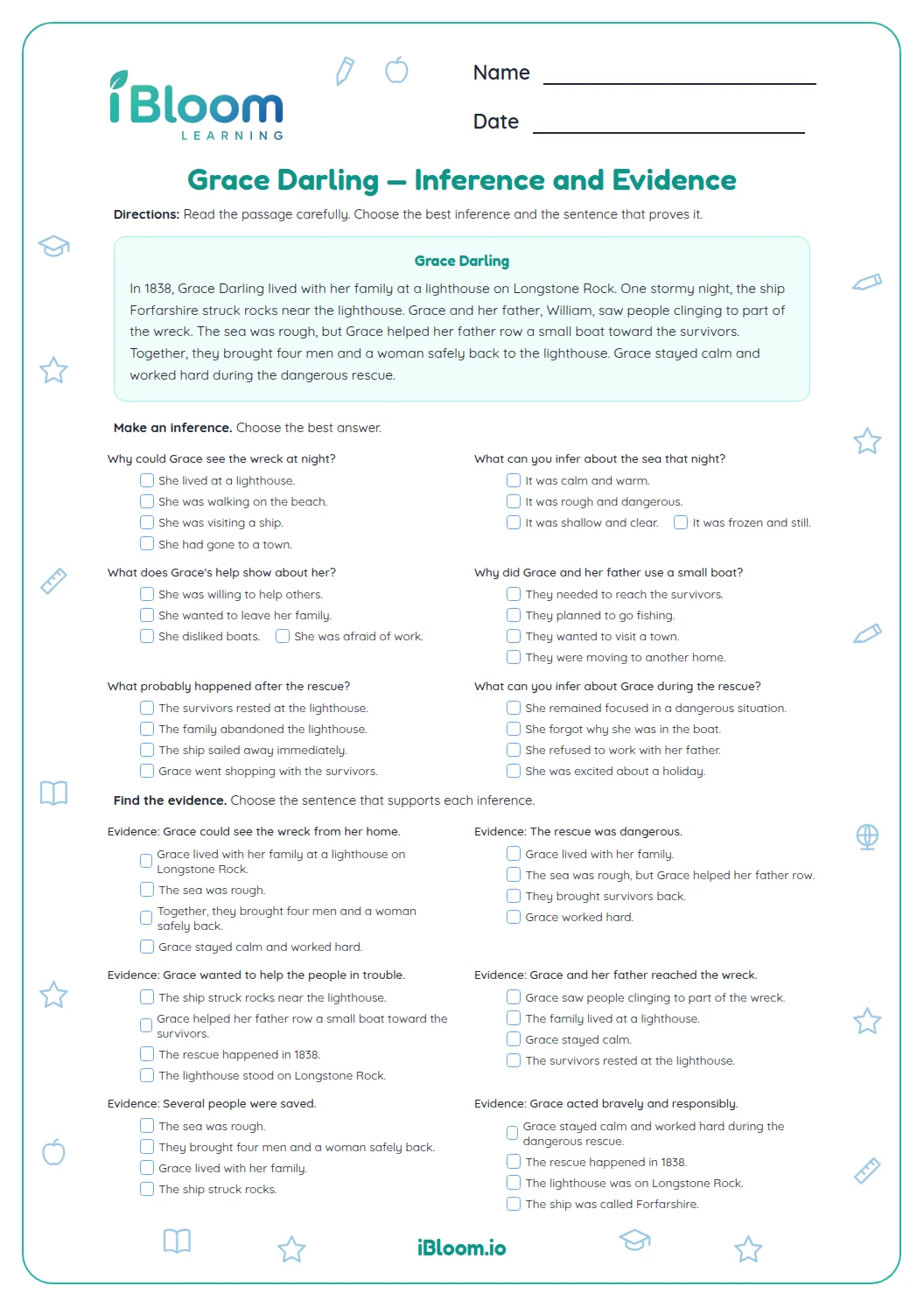
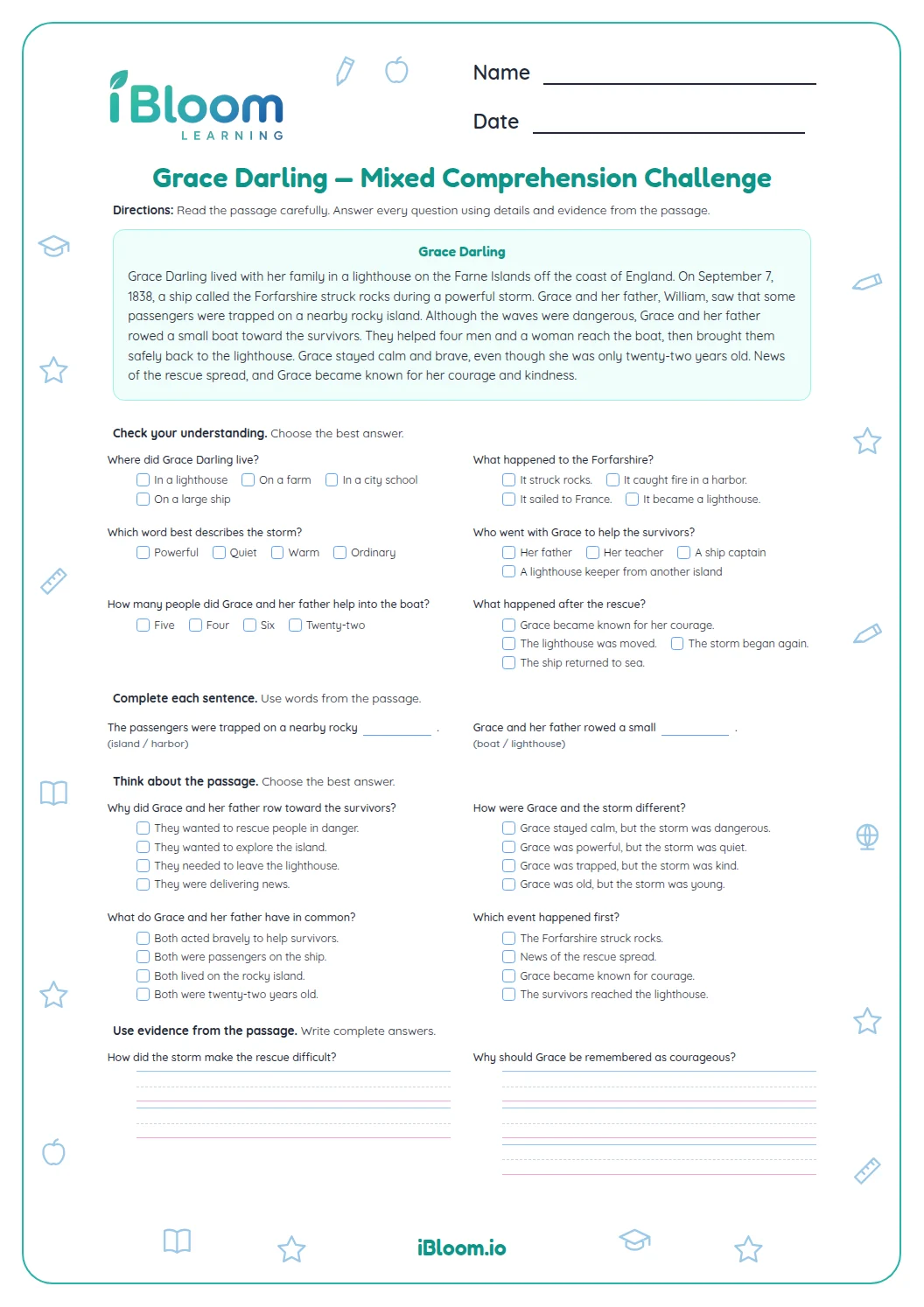
This free Grade 4 reading worksheet pairs an original passage about Grace Darling’s 1838 rescue with 14 questions. Students find explicit details, put events in order, and write responses supported by evidence from the passage. The questions move from locating information to explaining Grace’s actions and the event’s significance. An answer key gives concise responses and sample evidence-based answers. It aligns with Common Core RI.4.1.
Aligned to RI.4.1
What does the passage cover?
The account introduces Grace’s home at Longstone Lighthouse, the storm, and her decision to help her father reach the survivors. It gives details about the boat and the work needed to bring people safely to the island.
- 1Question 4 asks why they used a small boat.
- 2The passage says the waves were too rough for a large boat, so that detail supports the answer.
How do the questions build reading skills?
Part B checks names, place, and events stated directly. Part C asks students to sequence what happened and explain the rescue. Part D asks for a conclusion supported by a detail, such as Grace helping steer through breaking water.
How can a child support a written response?
A useful response answers the question first, then points to a passage detail. For example, a response about courage can mention that Grace helped steer a small boat through rough waves toward the wreck.
How to use this worksheet
- 1Read the passage once to follow the event from the lighthouse to the rescue.
- 2Return to Part B for passage details and use Part C to put events in sequence.
- 3For Part D, answer in your own words and include a relevant passage detail when asked.
- 4Check that the detail supports your idea instead of merely repeating a nearby sentence.
- 5Use the key to compare ideas; written answers may be worded differently.
Common mistakes and quick fixes
The mistake
Mixing up who rowed and who steered.
The fix
Reread the second paragraph: William rowed and Grace helped steer.
The mistake
Giving a detail without answering the question.
The fix
Start with a direct answer, then add the passage detail that supports it.
The mistake
Putting the rescue before the shipwreck.
The fix
Use the event order in the passage: the ship struck rocks, Grace saw survivors, then she woke her father.
Common Core alignment
Use text details to explain explicit meaning and make inferences.
On this sheet: Questions ask students to explain Grace’s actions and support a conclusion with details from the passage.
Show the official wordingHide the official wording
Refer to details and examples in a text when explaining what the text says explicitly and when drawing inferences from the text.
What to practice next
Make more practice
Further reading
Questions parents and teachers ask
Is the Grace Darling passage original?
Yes. This page uses an original historical account written for the worksheet. It describes Grace’s home at Longstone Lighthouse, the storm, and the rescue with her father, William. Students return to those details to answer questions about the event and explain what Grace did.
How many questions are on the worksheet?
There are 14 questions: six multiple-choice items and eight short or written responses. The later questions ask students to explain events and use passage details; the final three provide space for fuller answers. The key gives sample responses for questions with more than one reasonable wording.
What does the passage say Grace did?
Grace saw people clinging to a wreck near Longstone Island and woke her father, William. They took a small rowing boat because the waves were too rough for a large boat. William rowed while Grace helped steer, and they brought survivors back to the island.
Do written responses need to match the answer key exactly?
No. The key gives sample ideas for the final responses, but students can use different wording. A good answer addresses the question and points to an accurate detail, such as Grace helping steer through breaking water or the pair bringing survivors safely to the island.
Which reading skills does the page practice?
The page asks students to find explicit details, sequence events, and draw conclusions supported by the account. Questions about Grace’s actions require students to connect an idea with evidence from the text. Those reading tasks align with RI.4.1. Students can cite details from each paragraph.
How should I help if a child is unsure?
Ask the child to find the sentence that gives a useful detail, then explain how it answers the question. For a response about courage, the detail about Grace steering through breaking water can support an idea about her actions during the rescue.