

About this worksheet
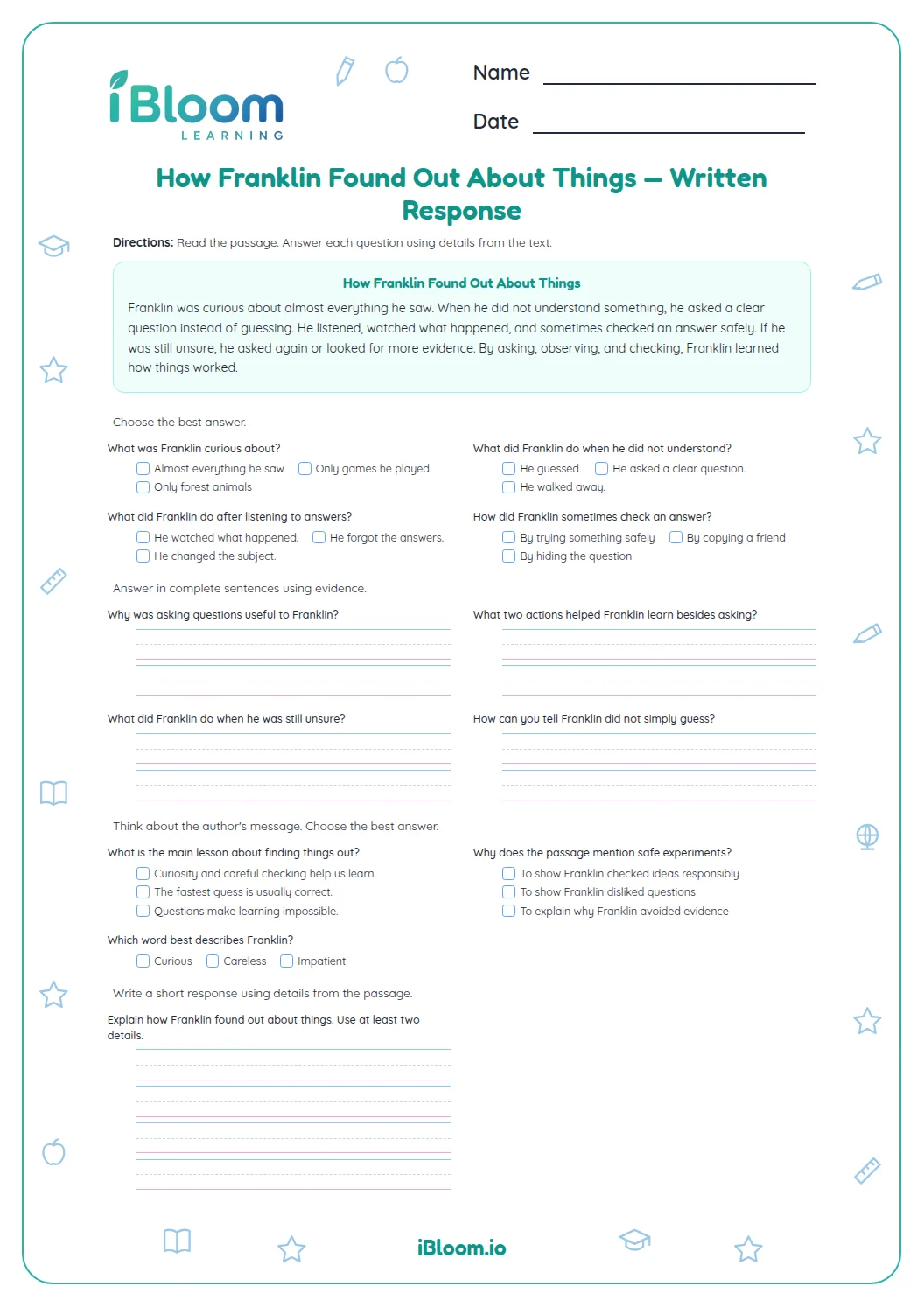
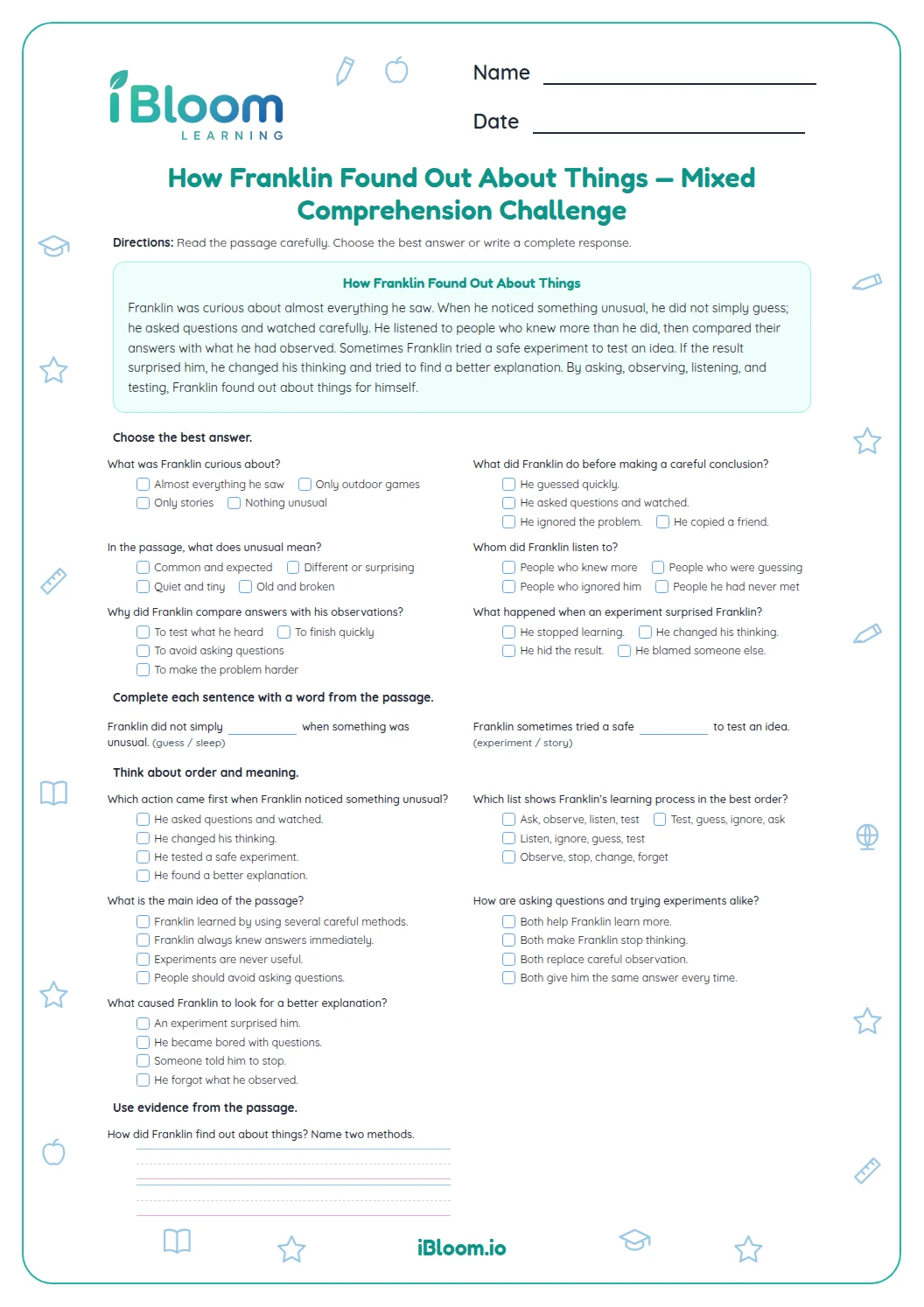
This free Grade 4 worksheet pairs a passage about Benjamin Franklin investigating a candle flame with fourteen inference and evidence questions. Franklin wonders why a flame leans, compares candles in different spots, records what he sees and repeats his test. Part A is the passage. Part B asks students to choose supported conclusions, Part C asks them to identify evidence, and Part D includes two short written explanations. The worksheet practices Common Core RI.4.1 by drawing inferences from details and examples in a text. A separate answer key includes sample responses.
Aligned to RI.4.1
What is an inference in this Franklin passage?
An inference is a conclusion the reader reaches by connecting clues. Franklin watches a flame lean more near an open window, and he repeats the test. Those details support the idea that moving air may affect a flame.
A useful inference stays close to the text. The passage supports an idea about the draft, but it does not tell readers every cause of a flame’s movement.
Which detail supports the idea that Franklin is curious?
Question 1 asks students to infer Franklin’s trait. Question 5 asks for an action that supports that inference. Pairing the questions helps students connect a conclusion with its evidence.
- 1Inference: Franklin is curious.
- 2Evidence: He wonders why the flame leans.
- 3Connection: His question leads him to compare candle locations.
How should students write the explanations?
For question 13, students describe what Franklin did before deciding what caused the flame to lean. A strong answer names his observations in different locations.
Question 14 asks how Franklin investigated the flame. Students can mention comparing candle spots, recording what happened or repeating the test. The sample answers are concise; other text-supported wording is welcome.
How to use this worksheet
- 1Read Part A once for the events, then reread for Franklin’s question and actions.
- 2Complete Part B by choosing the conclusion best supported by the passage.
- 3In Part C, find the observation or action that supports each idea.
- 4Write the Part D explanations: question 13 asks what Franklin did before deciding; question 14 asks how he investigated the flame.
- 5Check the key and ask whether each detail supports the conclusion.
Mistakes to check and ways to help
The mistake
Treating the draft as proof that every flame leans only because of a window.
The fix
Use the passage’s cautious conclusion: moving air may affect a flame.
The mistake
Choosing a detail that does not support the conclusion.
The fix
Connect the evidence directly: the flame leaned more near the open window.
The mistake
Writing “Franklin learned” without describing how.
The fix
Add a detail, such as comparing candle locations, recording observations or repeating the test.
Common Core alignment
Support conclusions about Franklin’s actions with details from the retelling.
On this sheet: Students connect character inferences and conclusions to specific actions and observations in the passage.
Show the official wordingHide the official wording
Refer to details and examples in a text when explaining what the text says explicitly and when drawing inferences from the text.
What to practice next
Make more practice
Further reading
Questions parents and teachers ask
What does this How Franklin Found Out About Things: Inference and Evidence worksheet practice?
It pairs focused reading comprehension practice with a short story written for this page. Children can reread the passage, point to a detail, and use that detail to support each answer in their own words. The questions move from direct details to explaining ideas.
Can a student use the passage while answering?
Yes. The passage stays available on the worksheet, so students can return to it as they work. Rereading a sentence or paragraph can help them check a detail before choosing an answer or explaining an idea. They can underline a clue before responding.
What is included in the answer key?
The key gives an answer for every question. For responses that can be phrased in different ways, it provides a sample; students may use other wording when it is accurate and supported by the passage. An adult can accept another clear answer with evidence.
How can an adult use the written responses?
Ask the student to point to the sentence or event that supports the response. A short oral explanation can help them connect the evidence to the idea before they write or select their final answer. This makes the reasoning visible without requiring a long response.
How long should the worksheet take?
Plan for about 20 minutes, with extra time if the student rereads the story or discusses an answer. The pace depends on reading fluency and how much explanation each response needs. Students can complete the questions independently or talk through selected items with an adult.